If you own a Tesla Cybertruck, or you’re eyeing a used one, you’ve probably heard about the string of recalls since it finally hit the road in late 2023. This Tesla Cybertruck recalls list pulls together the major issues so far, explains what each recall actually means in real-world driving, and shows you how to check any truck’s VIN for open safety campaigns before you sign on the dotted line.
Why the Cybertruck’s recall record matters
Overview: Cybertruck recalls so far
Tesla began delivering Cybertrucks to U.S. customers in late November 2023. In the roughly two years since, regulators and Tesla have issued multiple recalls specific to Cybertruck, plus several broader Tesla campaigns that include it alongside Model 3, Y, S, and X. These range from relatively mild issues, like small-font warning lights, to more serious problems, including an accelerator pedal pad that can get trapped and exterior trim that can detach on the highway.
Tesla Cybertruck recalls at a glance
Software vs. hardware recalls
Quick Tesla Cybertruck recalls list by date
Major Tesla Cybertruck recalls, roughly in order
This is a high‑level summary of key Cybertruck recalls as of February 25, 2026. Always confirm details for your exact VIN on Tesla’s site or NHTSA.gov, because dates, counts, and coverage can change as investigations evolve.
| Approx. date announced | Issue (plain language) | Main risk | Typical fix type | Notes |
|---|---|---|---|---|
| February 2024 | Warning light label font too small | Drivers may miss critical dashboard warnings | Over‑the‑air software update | Multi‑model recall; Cybertruck included with other Teslas |
| April 2024 | Accelerator pedal pad can slip and get trapped in trim | Unintended acceleration, harder to modulate pedal | Replace/rework accelerator pedal assembly | Covers ~3,900 early Cybertrucks built Nov 2023–Apr 2024 |
| Mid‑2024 | Rearview camera image delay on low‑voltage hardware | Reduced rear visibility when backing up | Software update to camera/display logic | Affects certain 2024 Cybertrucks with specific hardware set |
| Mid‑2024 | Windshield wiper motor failure | Poor visibility in rain, increased crash risk | Replace wiper motor/related components | Hardware repair; typically quick service visit |
| Mid‑2024 | Loose exterior trim pieces (early campaign) | Trim can detach, possible road debris hazard | Re‑secure or replace affected trim | Early, smaller campaign before the larger 2025 cant rail recall |
| December 2024 | Tire pressure monitoring system not warning correctly | Driving on under‑inflated tires, handling/braking risk | Over‑the‑air software update | Multi‑model recall including Cybertruck, Model 3 and Y |
| March 2025 | Stainless cant rail trim near windshield can detach | Metal panel may fly off, road hazard and collision risk | Replace/secure panel with improved fasteners/adhesive | ~46,000 trucks built Nov 2023–Feb 2025; nearly all on the road |
Campaign names are simplified for shoppers. Official NHTSA campaigns use 24V‑/25V‑ style numbers.
Don’t ignore “cosmetic” recalls
2024 accelerator pedal trim recall: unintended acceleration risk
The recall that put the Cybertruck under a harsh spotlight in April 2024 started with a viral video: an owner’s pedal pad slipped forward, jammed under the interior trim, and held the accelerator open. Tesla and NHTSA confirmed that an assembly‑line change introduced lubricant during pedal pad installation, which could let the pad slide off under heavy pressure.
- Covers: roughly 3,878 model‑year 2024 Cybertrucks built from November 13, 2023 through April 4, 2024.
- Symptom: with high force on the pedal, the decorative pad can walk its way up and out of position, then wedge against the trim above.
- Risk: the pedal can stick partially open, making it harder to modulate speed until you hit the brake pedal.
- Mitigation: Tesla’s brake‑throttle override will still cut torque when you press the brake, but the situation is distracting and dangerous in traffic.
How Tesla fixes the pedal issue
If you’re test‑driving a used Cybertruck, pay close attention to the feel of the accelerator. It should offer smooth, consistent resistance with no crunch, binding, or sudden step as you get near the floor. But don’t rely on feel alone, always verify the recall status by VIN and make sure the seller can show documentation that the pedal recall was completed.
Software and display-related Cybertruck recalls
The Cybertruck runs on the same software‑heavy platform as other Teslas, so it inherited some of the brand’s software‑centric recalls. These usually sound scarier in a headline than they feel day‑to‑day, but they still matter for safety and resale value.
Key software‑driven Cybertruck recalls
Most of these are fixed with a simple over‑the‑air update, but verify that previous owners didn’t ignore them.
Warning light label size
In early 2024, Tesla recalled about 2.2 million vehicles, including Cybertruck, because some warning light labels used a font that was too small to meet U.S. regulations.
The fix was a software update to the instrument cluster graphics. If your truck has been online and updating regularly, this one is likely already handled.
Rearview camera image delay
Certain 2024 Cybertrucks with a specific low‑voltage hardware setup experienced a delay in the rearview camera feed when shifting into Reverse.
A delayed image may not sound dramatic until you’re backing toward a child or a tight parking pole. Tesla addressed this with updated camera and display logic.
Tire pressure monitoring logic
In December 2024, a multi‑model recall flagged that tire pressure warning lights might not trigger correctly on some Teslas, including Cybertruck.
Again, the cure was a software change. After the update, confirm that your Cybertruck’s TPMS gives a warning when you intentionally lower tire pressure in one corner.
Why OTA recalls still matter for used buyers
Windshield wiper and visibility recalls
Another cluster of Cybertruck recalls involves seeing where you’re going. Owners reported premature failure of the giant single windshield wiper’s motor, along with the rear camera‑image delay mentioned earlier. For a heavy, powerful pickup with thick A‑pillars and unusual sight lines, losing visibility in a storm is not a small problem.
Windshield wiper motor issues
Some 2024 Cybertrucks were recalled because the wiper motor could fail prematurely, leaving the truck without front‑window clearing in rain or snow.
- Risk: Poor forward visibility, especially at highway speeds.
- Fix: Replace the motor and, if needed, related hardware with a revised part.
- Owner sign: Slowing or intermittent sweep, or total failure, even on high speed.
Rearview camera delay
The rear camera issue shows up as a lag before the image appears when you select Reverse, or a frozen image that doesn’t reflect current surroundings.
- Risk: Backing up with an outdated or blank view of what’s behind you.
- Fix: Software update, sometimes paired with hardware diagnostics.
- Owner sign: Count how long it takes for the image to appear when you shift to R.
Test this on every used Cybertruck drive
2025 exterior cant rail trim recall: panels that can fly off
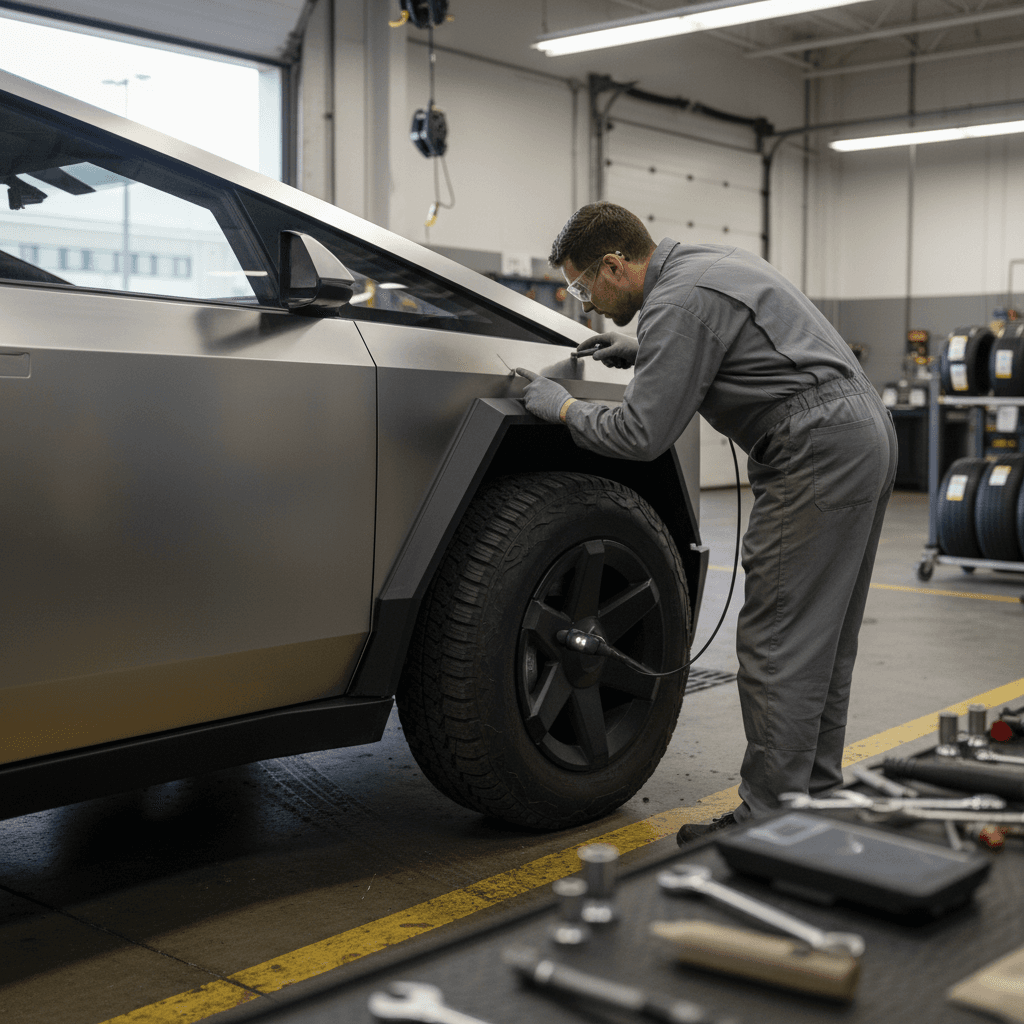
By March 2025, the Cybertruck’s most dramatic recall was about the part everyone notices first: that bold stainless‑steel body. Regulators found that a long exterior panel, called the cant rail, running along the left and right sides of the windshield could loosen and detach while driving. Viral videos of owners pulling the piece off with bare hands didn’t help Tesla’s case.
- Covers: about 46,000 Cybertrucks built between November 13, 2023 and February 27, 2025, essentially most trucks delivered in the first production wave.
- Defect: the adhesive and fastening approach for the cant rail trim wasn’t robust against real‑world vibration and environmental exposure, so panels could come loose over time.
- Risk: a metal panel separating at highway speed becomes a projectile, endangering following traffic and raising the risk of a crash.
- Remedy: Tesla replaces or re‑secures the panel using stronger adhesive and mechanical fasteners (such as nuts or clips), and inspects both sides for looseness.
The good news on the trim recall
Other multi-model recalls that include Cybertruck
Beyond Cybertruck‑only campaigns, Tesla has also issued multi‑model recalls where Cybertruck is one player in a much larger cast. For shoppers, these broad campaigns are worth noting because they show how Tesla treats safety issues across the lineup, and they can still affect the truck you’re looking at.
Big Tesla recalls that Cybertruck shares
These may not be Cybertruck‑specific problems, but they affect how safe and livable your truck is day‑to‑day.
Dashboard warning fonts (2024)
A massive, multi‑million‑vehicle recall over warning‑light label sizes might sound nitpicky, but it reflects how tightly regulated driver information has become.
Cybertruck’s screens were updated along with the rest of the lineup so critical alerts are easier to read at a glance.
Tire‑pressure alerts (2024)
When the tire pressure monitoring system doesn’t reliably warn you of low pressure, you’re more likely to drive on under‑inflated tires.
For a heavy EV pickup like the Cybertruck, already working its tires hard, correct pressures are key for braking, stability, and tire life.
How Cybertruck compares to other new trucks
How to check your Cybertruck for open recalls
Whether you already own a Cybertruck or you’re shopping used, never guess about recalls. You can check any truck’s status in a few minutes with just the VIN, a 17‑character code on the lower edge of the windshield or on the door jamb label.
Step‑by‑step: Check a Cybertruck for open recalls
1. Locate the VIN
Stand outside on the driver’s side and look through the lower corner of the windshield, or open the driver’s door and read the label on the door jamb. Snap a clear photo so you don’t transpose characters.
2. Use Tesla’s recall lookup
Go to Tesla’s official recall search page, enter the VIN, and confirm that the “Vehicle Status” section shows each relevant Cybertruck campaign as completed, or flagged as open if it still needs attention.
3. Cross‑check on NHTSA.gov
Visit the U.S. government site for vehicle recalls and enter the same VIN. This gives you a second source, plus background documents on each campaign if you want more detail.
4. Verify with the Tesla app (owners)
If the Cybertruck is already in your Tesla account, open the app and check for any safety‑related notifications or overdue service bulletins. Software‑only fixes usually show up here first.
5. Ask for paperwork from the seller
When buying used, ask for service invoices or repair confirmations showing that <strong>accelerator pedal</strong>, <strong>wiper</strong>, and <strong>cant rail trim</strong> recalls have been performed. A reputable seller should have no problem providing them.
6. Plan repair timing before purchase
If an otherwise great Cybertruck still has an open recall, talk to a Tesla service center about parts availability and scheduling. Decide whether you’re comfortable taking delivery before the fix, or negotiate to have it handled first.
Make recall proof part of the deal
Used Cybertruck buyers: how to protect yourself
Cybertruck buyers today fall into two camps: early adopters who took the arrows, and second‑wave shoppers hoping to scoop up a wild‑looking EV pickup at a more reasonable price. If you’re in that second group, recall history isn’t a reason to walk away, but it is a reason to be methodical.
Questions to ask about recalls
- “Which recalls has this truck had?” Ask specifically about the accelerator pedal, windshield wiper, and exterior trim campaigns.
- “Do you have repair records?” You’re looking for Tesla service invoices or at least a documented visit date and mileage.
- “Has the truck been regularly connected for updates?” Sporadic connectivity can leave software recalls undone.
How Recharged approaches Cybertruck recalls
When a Cybertruck passes through Recharged, safety recalls are part of the standard intake and Recharged Score process:
- We run the VIN through official recall databases and confirm repair status.
- Our EV specialists road‑test for telltale symptoms, from pedal feel to wiper performance.
- Any open safety recalls are addressed or clearly disclosed with a plan, never brushed off as "minor."
That transparency makes it easier for you to weigh risks and costs before you buy.
Leaning toward a used Cybertruck?
FAQ: Tesla Cybertruck recalls
Common questions about Cybertruck recalls
Bottom line: What Cybertruck recalls mean for you
The Cybertruck’s recall list tells a familiar story in the car world: an ambitious, first‑of‑its‑kind model goes on sale, real‑world use exposes weak spots, and the fixes arrive in waves. Early trucks have faced a handful of meaningful issues, from a pedal pad that could trap the accelerator, to wipers and exterior trim that didn’t stand up to the elements as they should. None of that means the Cybertruck is doomed; it does mean you should treat recall history as non‑negotiable homework, not fine print.
If you already own a Cybertruck, stay on top of software updates, check your VIN for new campaigns a few times a year, and don’t let hardware recalls sit. If you’re shopping used, lean on tools like official recall lookups, professional inspections, and trusted marketplaces. At Recharged, every used EV, including the Cybertruck, goes through a structured review that surfaces safety campaigns alongside battery health, pricing, and overall condition. That way, you get the sharp‑edged styling without the nasty surprises hiding in its history.