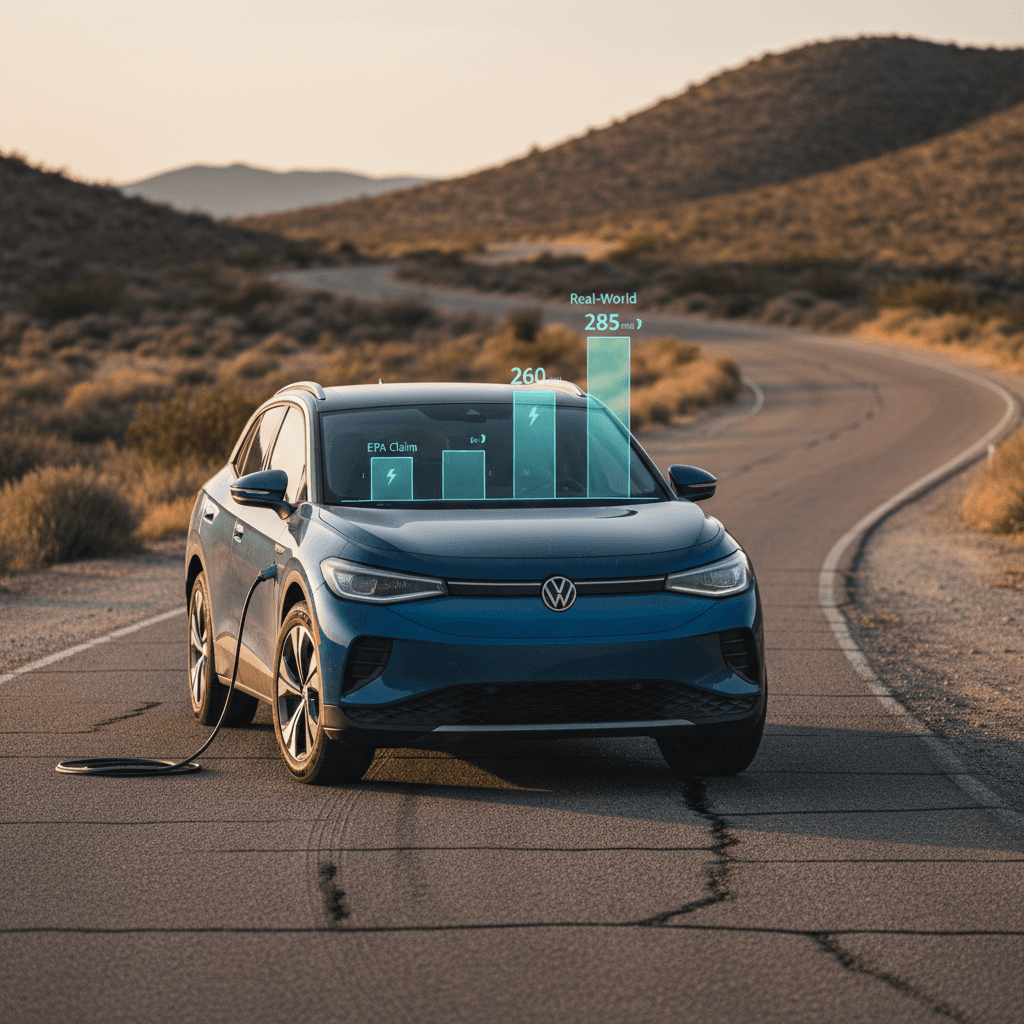
You don’t buy an electric family crossover like the 2024 VW ID.4 to lay rubber. You buy it to make life simpler: school runs, Ikea trips, road‑trip duty on I‑95. The big question is, how far will a **2024 VW ID.4 range test** actually take you before you’re hunting for a charger, and does it live up to the glossy EPA window sticker?
Why the 2024 ID.4 is different
2024 VW ID.4 range overview
The 2024 Volkswagen ID.4 is built around two battery sizes: a smaller pack often called **62 kWh** (about 58 kWh usable) and a larger **82 kWh** pack (about 77 kWh usable). In U.S. trims, most serious range numbers come from the bigger battery, particularly the Pro and Pro S models. For 2024, the updated rear‑drive motor is more powerful and more efficient, nudging EPA range and real‑world results upward compared with earlier years.
Headline 2024 ID.4 range & efficiency numbers
Know your battery before you believe the badge
EPA range ratings for the 2024 ID.4
The EPA numbers for the **2024 VW ID.4** cover a useful spread, depending on battery size, drive wheels, and wheel diameter. Here’s how the main U.S. configurations stack up:
2024 VW ID.4 EPA range by configuration
Approximate EPA combined range figures for core 2024 ID.4 trims sold in North America. Exact values can vary slightly by wheel choice and options.
| Model year 2024 trim | Battery | Drivetrain | Wheels | EPA range (mi) |
|---|---|---|---|---|
| ID.4 Standard / S | 62 kWh | RWD | 19"–20" | ~206–209 |
| ID.4 Pro | 82 kWh | RWD | 19" | ~275–291 |
| ID.4 Pro S | 82 kWh | RWD | 20" | ~275 |
| ID.4 AWD Pro | 82 kWh | AWD | 19" | ~255–263 |
| ID.4 AWD Pro S | 82 kWh | AWD | 20" | ~255 |
Use this as a reality‑check starting point, not a promise, your conditions will move the needle up or down.
On paper, the sweet spot is the **ID.4 Pro RWD with the 82 kWh battery**, which carries the highest EPA number, up to roughly 291 miles in U.S. testing. Add all‑wheel drive and larger wheels and you pay the aero and rolling‑resistance tax: 20–30 miles drop right off the top.
Don’t obsess over the single biggest number
Real‑world 2024 VW ID.4 range tests
Enough with the lab coats. What people want to know is whether the 2024 ID.4 can do a long day’s drive without turning into a rolling anxiety attack. Independent tests have started to answer that, and the picture for the updated 82 kWh models is better than early ID.4 coverage suggested.
Key independent 2024 ID.4 range test results
Two tests, two philosophies, both useful if you read the fine print.
Edmunds EV Range Test – 2024 ID.4 Pro S (RWD)
Result: 299 miles on a full charge, about 8 miles above EPA estimate for that configuration.
- Single‑motor 82 kWh Pro S on 20-inch wheels
- Mixed driving loop; not just steady‑state highway
- Shows how efficient the new rear motor can be in varied conditions
Car and Driver 75‑mph highway test – ID.4 AWD Pro S
Result: 240 miles at a constant 75 mph, versus a 263‑mile EPA rating for similar dual‑motor models.
- Focuses on sustained high‑speed highway driving
- More punishing than the EPA cycle
- Good proxy for long‑distance interstate trips
In other words: driven briskly on the highway, a dual‑motor 2024 ID.4 with the big battery behaves like a **240‑mile** EV. Driven in normal mixed conditions in a single‑motor Pro S, it can brush **300 miles** without heroic hypermiling. That split is the whole story of this car.
How the 62 kWh models compare
Highway vs city: where the ID.4 shines (and sags)
City & suburban driving
The ID.4’s heft and soft responses are far more flattering in stop‑and‑go than on an empty interstate. Regenerative braking harvests energy every time you come off the pedal, and average speeds are lower. In this environment, Pro and Pro S 82 kWh cars can track very close to their EPA numbers.
- Expect 3.0–3.5 mi/kWh in mild weather
- Real‑world ranges of 240–280 miles are common
- Heat pump (if equipped) helps in winter
Highway driving
At 70–80 mph, aero drag is the boss. The ID.4 isn’t a London phone box, but it’s no Prius either. That’s why the Car and Driver 75‑mph test came in about 9–10% under the AWD EPA rating, and why owners routinely report 2.5–2.8 mi/kWh on long highway stints.
- Plan on 200–250 miles of usable highway range
- 20-inch wheels and roof boxes nibble away at efficiency
- A steady 65 mph looks dramatically better than 80 mph
Highway + cold = the worst case
How weather and driving style change your ID.4 range
Every EV has an alter ego: the car you drove on a perfect 68‑degree Sunday and the one you suffer with on a sleeting February Tuesday. The 2024 ID.4 is no exception, and understanding its mood swings is half the game.
Biggest factors that move your 2024 ID.4 range
None of this is unique to Volkswagen, but the ID.4 is sensitive to all of it.
Temperature
Below freezing, the battery’s chemistry slows and cabin heating becomes a huge energy draw.
- Expect 15–30% less range in deep cold
- Short trips look especially bad because the car reheats from cold each time
Speed & wind
Doubling your speed nearly quadruples aero drag. Add a headwind and the math gets ugly fast.
- Each 5 mph above 65 can shave a few percent
- Roof racks and boxes magnify the penalty
Load & terrain
Climbing a long grade with four passengers and luggage is where weight really hurts.
- Mountain driving burns range going up, then pays some back on the way down
- Towing near the 2,700‑lb limit will effectively halve your range
Precondition like it’s your job
- Drive in the right lane at 70 instead of 78 mph and you’ll barely arrive later, but your state of charge will look dramatically healthier.
- Use Eco or Eco+ modes on longer drives; they dull throttle response a bit but do help rein in gratuitous energy spikes.
- Avoid yo‑yo driving. The ID.4’s mass means every hard acceleration followed by hard regen wastes just a bit more energy as heat.
Charging speeds and trip planning with the 2024 ID.4
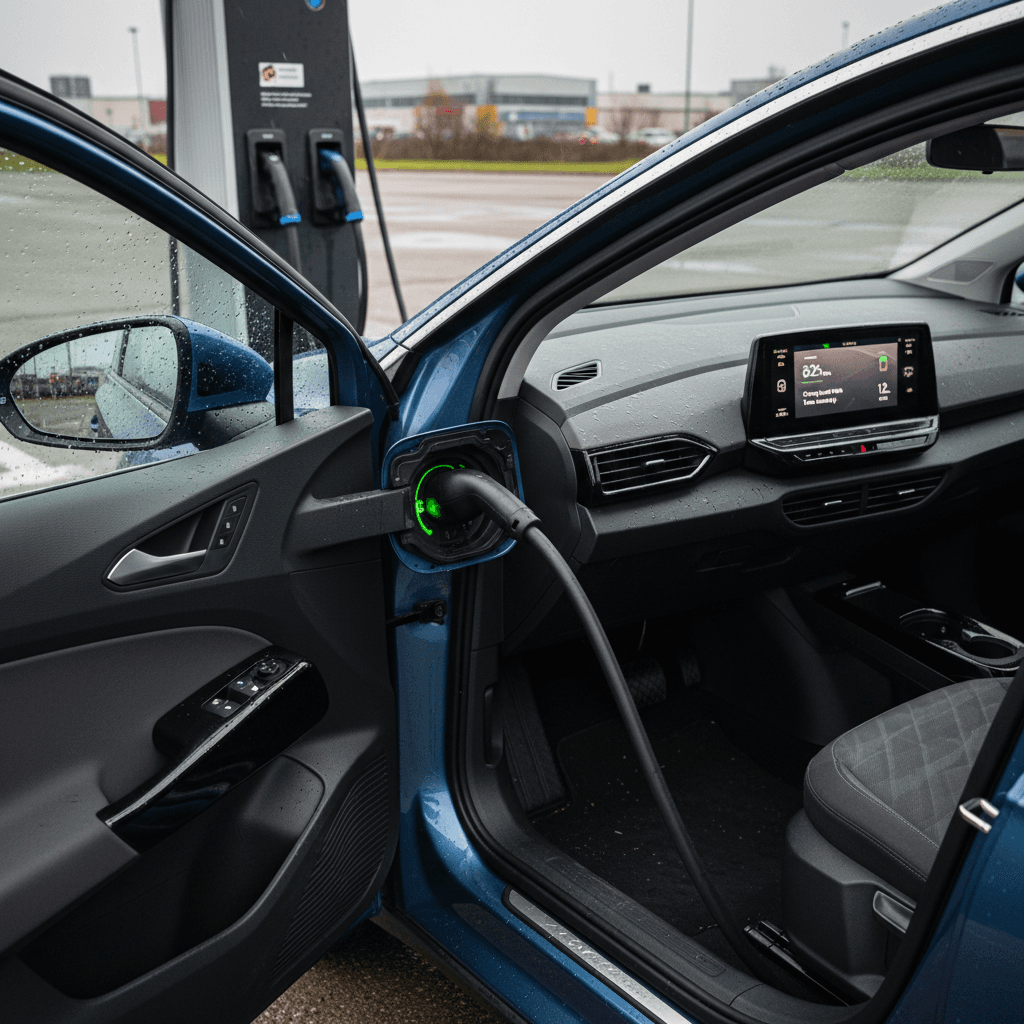
Range is half the story; the other half is how fast you can put miles back in. For 2024, ID.4 models with the 82 kWh pack can peak around the mid‑100‑kW range on a capable DC fast charger, with roughly a **28–30 minute** 10–80% session under ideal conditions. That’s not class‑leading like an 800‑volt Hyundai Ioniq 5, but it’s perfectly workable for family‑car duty.
Charging behavior you can expect from a healthy 2024 ID.4
Ballpark numbers for planning. Your actual speeds will depend on charger capability, state of charge, and temperature.
| Charging type | Typical power | Time 10–80% (82 kWh) | Miles added (realistic) |
|---|---|---|---|
| Level 1 (120V home outlet) | 1–1.4 kW | Not recommended for full recharge | 3–5 mi/hr |
| Level 2 (240V home / public) | 7–11 kW | 6–9 hours | 25–35 mi/hr |
| DC fast – good 150 kW station | 120–150 kW peak | ~28–30 minutes | 150–190 miles |
| DC fast – older 50 kW unit | 35–50 kW sustained | ~55–70 minutes | 90–120 miles |
Think in 10–80% chunks on road trips; the last 20% is painfully slow on almost every EV, ID.4 included.
Trip‑planning rule of thumb
Planning a realistic ID.4 road trip
1. Start at 90–100% only for leg one
Top up at home or overnight DC charging before you leave, but don’t feel compelled to sit from 80% to 100% in the middle of your trip, it’s slow and doesn’t add much usable distance.
2. Target 10–20% arrival state of charge
Most trip‑planning apps let you set a minimum arrival state of charge. For comfort, use 10–20% instead of 0%. Running an EV to 0% regularly isn’t good for your nerves or the pack.
3. Favor reliable networks
Look for clusters of fast chargers from established networks rather than a lonely single unit in a strip‑mall corner. Redundancy is its own kind of range extender.
4. Use the car’s estimate, not just the map distance
Watch the ID.4’s predicted arrival percentage and adjust speed or route if it starts falling faster than expected, especially in bad weather.
What these range tests mean if you’re shopping used
If you’re looking at a **used 2024 VW ID.4**, or a 2021–2023 model whose window sticker has long since walked into the ocean, range testing becomes a proxy for battery health. A well‑cared‑for pack in a late‑model ID.4 should land roughly in the same real‑world window as the numbers above, give or take weather and tires. What you don’t want is an ID.4 that behaves like it’s down a whole battery size.
Red flags in a test drive
- At 100% charge in mild weather, an 82 kWh ID.4 showing well under 230–240 miles of indicated range in Normal/Eco modes.
- Rapid drops in state of charge on modest highway runs (for example, losing 30% in 40–45 miles at 65–70 mph).
- Charging curves that fall on their face, needing 45+ minutes to go from 20% to 60% on a genuinely capable DC fast charger.
Good signs from a used 2024 ID.4
- Healthy 10–80% DC‑fast sessions in that ~30 minute window on an 82 kWh car.
- Owner records showing regular software updates and cooling‑system maintenance.
- Indicated ranges at 100% broadly consistent with EPA numbers for that trim, after adjusting a bit for wheel size and weather.
How Recharged de‑mystifies used ID.4 range
Ready to find your next EV?
Browse VehiclesBecause Recharged focuses on used EVs, including crossovers like the ID.4, our specialists can also help you decide whether the smaller 62 kWh pack fits your life or whether you’ll resent it every Thanksgiving on I‑80. That guidance matters more than a spec sheet number.
Checklist: how to maximize range in a VW ID.4
Practical steps to squeeze more miles from your ID.4
Keep tires properly inflated
Low tire pressure is sneaky range theft. Check at least once a month and set pressures to spec when cold; small under‑inflations add drag and heat.
Use Eco modes for longer drives
Normal is fine around town, but Eco/Eco+ trims climate power and aggressive throttle mapping, which helps on longer highway legs without making the car feel neutered.
Precondition while plugged in
Set departure times in the app or in‑car so the cabin and, where supported, the battery are warmed or cooled on grid power rather than from the pack.
Travel lighter and smarter
If you must use a roof box, take it off when you’re not road‑tripping. Remove heavy, unused cargo from the trunk, mass always shows up in your energy usage.
Stay in the aero sweet spot
The ID.4 returns disproportionately better efficiency at 65–70 mph than at 80 mph. On single‑motor cars especially, that difference can be 30–40 miles per charge.
Charge more often, less deeply
On trips, think in 10–80% hops: it keeps you in the faster part of the charge curve and reduces the temptation to arrive at chargers running on fumes.
2024 VW ID.4 range test FAQ
Frequently asked questions about 2024 VW ID.4 range tests
Bottom line: is the 2024 ID.4’s range good enough?
Strip away the marketing varnish and the 2024 Volkswagen ID.4 with the 82 kWh battery is a roughly **240‑mile highway EV** that can flirt with **300 miles** in mixed driving when conditions are kind. It won’t win any charging‑speed drag races with the newest Korean wonder twins, but it will quietly shoulder family duty without making every long drive feel like a science experiment.
If you mostly commute, school‑run, and grocery‑store within a metro area, even the small‑battery ID.4 can work, just be honest about your occasional road‑trip ambitions. If you’re scoping the used market, look hard at battery size, highway range behavior, and fast‑charge times rather than just the odometer. And if you’d rather not play backyard engineer, buying through Recharged means every ID.4 comes with a transparent battery health report, fair‑market pricing, and EV‑savvy support from first click to final delivery.