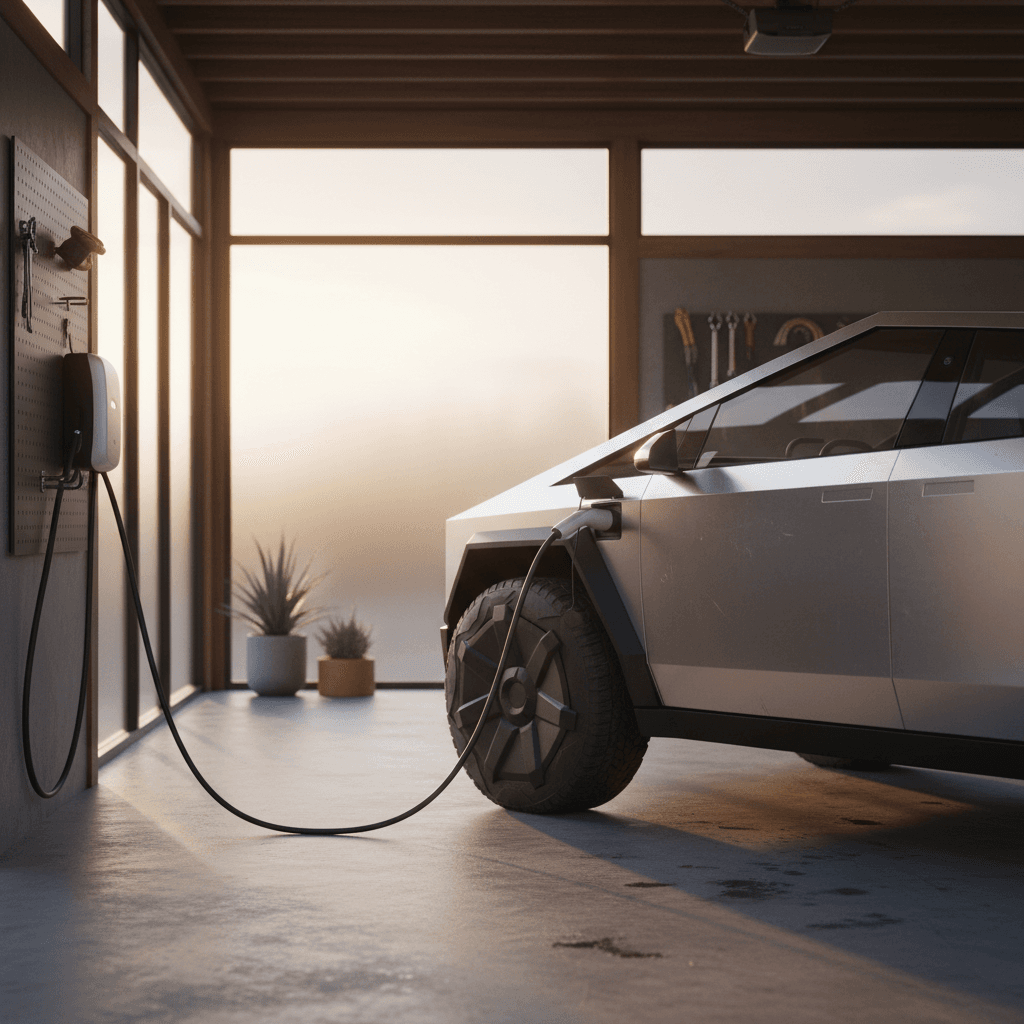
If you’re shopping for the best home charger for a Tesla Cybertruck, you already know the obvious: this is not a dainty little battery. Cybertruck is big, heavy, aerodynamically about as subtle as a bank vault, and when it’s empty, it’s really empty. The right Level 2 home charger turns this stainless‑steel science project into a painless daily driver; the wrong setup leaves you trickle‑charging a six‑figure truck like it’s a lawn mower.
Key takeaway in one sentence
Why home charging matters so much with the Cybertruck
Cybertruck’s battery is enormous, well over 120 kWh depending on trim, and its slab‑sided charisma does it no favors on the interstate. That means energy use per mile is high, and you’ll be leaning on home charging harder than a Model 3 or Y owner would. Public DC fast charging is great for road trips; for day‑to‑day life, it’s noisy, inconvenient, and expensive compared with overnight home power.
- You’ll likely add 30–60+ miles of range every night at home instead of “filling” from empty.
- You avoid peak public charging prices and idle fees.
- You wake up with the truck ready, instead of budgeting 30–60 minutes at a Supercharger every few days.
- You protect the battery by doing more gentle Level 2 charging and less DC fast charging.
The trap many Cybertruck owners fall into
Tesla Cybertruck home charging basics
Cybertruck home charging, in plain English
Three numbers matter: voltage, amps, and your daily miles.
Level 1 – 120V
Standard household outlet using the Tesla Mobile Connector.
- Roughly 1–3 miles of range per hour.
- Okay for emergencies or very light use.
- Too slow for a heavy‑use Cybertruck.
Level 2 – 240V
Dedicated 240V circuit: NEMA 14‑50 or hard‑wired wall charger.
- Typically 25–45 miles of range per hour for Cybertruck.
- This is what you want at home.
- Requires an electrician but pays you back in convenience.
DC Fast – Supercharging
Public fast charging, 250–325+ kW at Tesla V3/V4 sites.
- Great for road trips.
- Higher costs and more battery stress.
- Not a replacement for home Level 2.
Cybertruck’s onboard AC charger can pull up to about 11.5 kW at home on 240V, which translates to a maximum of 48 amps on a 60‑amp breaker. That’s the number you’re shopping around: any home charger that can reliably deliver ~11.5 kW on a properly wired circuit will fully exploit the truck’s AC charging capability.
So what is the “best” home charger for a Cybertruck?
For most owners, the best home charger for a Tesla Cybertruck is the Tesla Wall Connector, installed on a 60‑amp 240V circuit, mounted wherever the truck naturally lives. But there are strong arguments for some third‑party Level 2 chargers, especially if you want load‑sharing, non‑Tesla smart‑home integrations, or you’re future‑proofing for multiple brands in the driveway.
Cybertruck home charging cheat sheet
Option 1: Tesla Wall Connector – the default best home charger
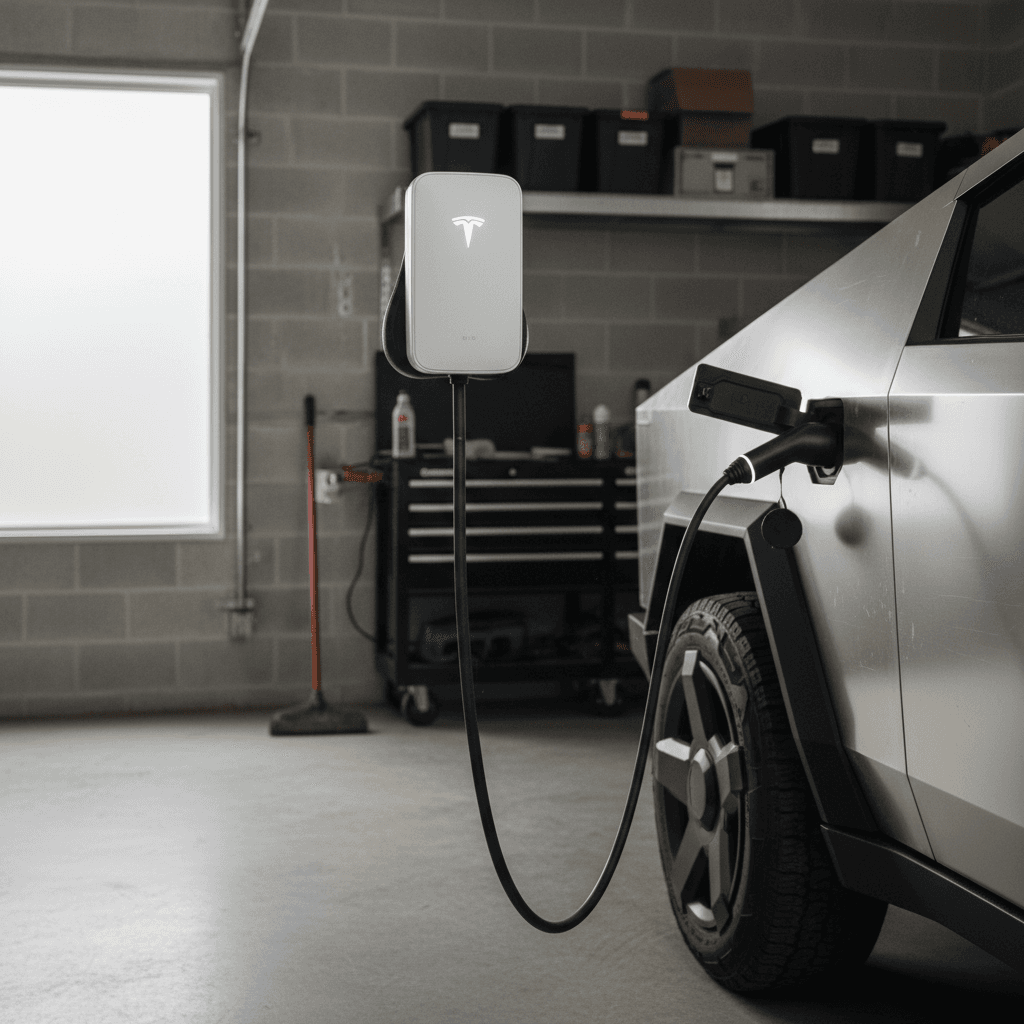
Tesla’s own Wall Connector is the obvious first choice, and in Cybertruck’s case, it’s actually the correct obvious choice. It uses the native NACS plug, talks to the truck in its own language, and is designed around Tesla’s 11.5 kW AC ceiling.
Tesla Wall Connector for Cybertruck: pros and cons
Why it’s usually the right answer, and when it isn’t.
Big advantages
- NACS plug, no adapter: One cable, one standard, no extra hardware dangling off the truck.
- Up to 48A/11.5 kW: Lets Cybertruck charge at its full AC rate.
- Smart features through Tesla app: Scheduled charging, charge limits, energy stats.
- Load sharing: Multiple Wall Connectors can share a circuit, handy if you add a second EV.
- Powershare compatibility: Required piece of the puzzle if you plan to use Cybertruck for home backup via Tesla’s ecosystem.
Potential drawbacks
- Best inside the Tesla world: It will charge non‑Tesla EVs, but you’ll get less cross‑brand app integration.
- Professional install recommended: It’s a hard‑wired unit; DIY only if you’re very comfortable with 240V work (most people shouldn’t be).
- Limited third‑party smart‑home hooks: If you’re married to a particular energy‑monitoring platform, a non‑Tesla charger might play nicer out of the box.
When the Wall Connector is a no‑brainer
Option 2: Third‑party NACS and J1772 chargers
Tesla opening up the NACS standard has kicked off a wave of third‑party home chargers with native NACS plugs. There are also plenty of excellent J1772 chargers that work perfectly with Cybertruck using Tesla’s compact J1772 adapter.
Why consider a non‑Tesla charger?
- Brand‑agnostic household: Maybe your partner drives a Kia EV6 or Ford F‑150 Lightning today.
- Advanced smart‑home integration: Some chargers tie deeply into home energy monitors, solar inverters, or utility demand‑response programs.
- Longer cables or outdoor ratings: A few units offer extra‑long cables, pedestal mounts, or specific NEMA ratings that fit tricky driveways.
What to look for with Cybertruck
- At least 48A output on a 60‑amp circuit to match the truck’s capability.
- Robust cable and strain relief: Cybertruck sits higher than a sedan; cheap cables sag and stress connectors.
- Weatherproofing (NEMA 3R or better) if the unit will live outdoors next to a very expensive stainless‑steel lawn ornament.
- Reputable brand, UL listed: You’re pushing real current for long stretches; this is not where you gamble on an off‑brand box.
Good news on compatibility
48A vs 80A: Which do you actually need for Cybertruck?
The internet, being the internet, is full of Cybertruck fantasy builds with 100‑amp breakers, 80‑amp chargers, and enough copper to re‑wire a small ship. Here’s the sober truth: Cybertruck’s onboard AC charger tops out at about 11.5 kW, or 48 amps at 240V. Feeding it more than that at home does not make it charge faster; the truck simply ignores the extra capability.
48A vs 80A home chargers for Cybertruck
Why oversizing the charger rarely buys you anything with today’s Cybertruck.
| Spec | 48A Charger (60A circuit) | 80A Charger (100A circuit) | What it means for Cybertruck |
|---|---|---|---|
| Max AC output | 11.5 kW | 19.2 kW+ | Cybertruck uses ~11.5 kW either way |
| Breaker size | 60 A | 90–100 A | Higher hardware cost and panel load |
| Copper wire size | Smaller gauge | Larger gauge | More expensive run, harder to pull |
| Typical use case | Modern EVs up to 11.5 kW | Future ultra‑high AC chargers | Today’s Cybertruck doesn’t benefit |
Unless you’re planning for a future EV with a bigger onboard charger, 48A is the rational ceiling.
Don’t overspend on invisible speed
Real‑world Cybertruck home charging times
Exact numbers depend on weather, driving style, and which Cybertruck variant you own, but we can talk in useful ballparks. Think in terms of miles of range added per hour, not charging from 0–100%, which you’ll rarely do at home.
Approximate Cybertruck home charging speeds
Based on owner reports and Tesla’s own Wall Connector guidance for 11.5 kW AC charging.
| Setup | Voltage / Amps | Power (kW) | Approx mi/hr added | Typical use |
|---|---|---|---|---|
| Level 1 wall outlet | 120V / 12A | ~1.4 kW | 1–3 mi/hr | Emergency backup, overnight topping at a cabin |
| NEMA 14‑50 on Mobile Connector | 240V / 32A | ~7.7 kW | 15–25 mi/hr | Acceptable if you can’t hard‑wire yet |
| 48A Wall Connector or 48A Level 2 | 240V / 48A | ~11.5 kW | 25–45 mi/hr | Ideal home setup for most owners |
Use these numbers as planning tools, not promises, your actual consumption will drift with speed, load, and temperature.
In practice, a 48A wall charger will usually take a low‑battery Cybertruck to 80–90% in roughly 8–12 hours. More importantly, if you drive, say, 60–80 miles in a day, you can claw that back in two to three hours of charging every night. The truck becomes an appliance, not an errand.
Think in “hours back,” not “full charges”
Installation, wiring, and panel capacity
The best charger on paper is useless if your panel can’t feed it. A 48A Level 2 charger typically calls for a dedicated 60‑amp, 240V circuit on copper wire sized per code and run distance. In older homes with 100‑amp main panels, that can be tight; in newer 200‑amp panels, you usually have more breathing room.
Home‑charging installation checklist
1. Map your daily usage
Look at your typical daily miles. If you’re consistently under 60–80 miles/day, a 48A Level 2 charger is more than enough headroom.
2. Check your main panel rating
Find your main breaker: 100A, 150A, 200A, or higher. This determines how generous you can be with a new 60‑amp EV circuit.
3. Plan charger location
Park the truck where you naturally will, then measure cable reach. Cybertruck is long, err on the side of a longer cable and smart mounting height.
4. Get quotes from licensed electricians
Ask specifically for a 240V / 60‑amp circuit for an EV charger, surface‑run if possible to save cost, and confirm permit requirements in your city.
5. Consider future EVs
If a second EV is likely, discuss load sharing or a slightly larger service upgrade now. It’s cheaper to think five years ahead than to redo everything later.
6. Don’t DIY 240V if you’re not qualified
Tesla’s documentation is good, but 240V mistakes are unforgiving. Let a professional handle breaker sizing, wire gauge, and grounding.
Panel upgrades and load management
Powershare & backup power: when your charger is part of a system
Cybertruck is Tesla’s first mainstream U.S. vehicle to truly lean into bidirectional charging. With the right hardware, the truck can power tools, another EV, or even your house in an outage. If that idea appeals to you, your choice of home charger is no longer just about amps and cable length.
Tesla’s Powershare Home Backup setup typically requires a Wall Connector plus additional Tesla hardware (Gateway or Powerwall ecosystem) to safely island your home during an outage and meet code. If you want Cybertruck to behave like a mobile Powerwall, staying inside Tesla’s hardware family today makes life much simpler than trying to stitch together third‑party solutions.
Powershare: cool, but not mandatory
How to choose the right Cybertruck home charging setup
Pick the path that matches your life, not the spec sheet
Urban / suburban commuter
Daily driving under ~70 miles.
Garage or driveway parking near the panel.
Recommendation: 48A Tesla Wall Connector on a 60A circuit.
If panel space is tight, consider a 32–40A charger as a temporary step up from 120V.
Towing & road‑trip warrior
Frequent highway use, trailers, or heavy loads.
You’ll use Superchargers for long legs, home for recovery.
Recommendation: Still a 48A Wall Connector or equivalent, the limiting factor is time parked, not the AC ceiling.
Consider adding a second outlet or charger at a dedicated trailer parking spot if you store it separately.
Multi‑brand EV household
Cybertruck plus a non‑Tesla EV in the driveway.
Preference for brand‑agnostic apps and energy monitoring.
Recommendation: Either a Tesla Wall Connector plus a second J1772 charger, or a high‑quality third‑party NACS/J1772 unit with load‑sharing.
Make sure at least one charger can deliver 48A to Cybertruck when it’s your turn.
Older home / limited electrical capacity
100A main panel, lots of existing large loads.
Full panel upgrade is painful or expensive.
Recommendation: 32–40A Level 2 charger on a 40–50A circuit, potentially with smart load management.
It’s still a night‑and‑day upgrade over Level 1, and you can revisit a 48A setup later if you upgrade the service.
Where Recharged fits in
Ready to find your next EV?
Browse VehiclesFAQ: Tesla Cybertruck home charging & best chargers
Frequently asked questions
Bottom line: a great home charger makes a huge truck feel easy
Cybertruck is a spectacle: stainless steel, bullet lines, the whole Mars‑colony fantasy baked into a pickup. But living with it day to day shouldn’t feel like a science experiment. A 48‑amp Level 2 home charger, ideally a Tesla Wall Connector on a 60‑amp circuit, is the simple, boring, correct answer for almost everyone. It lets this very large, very capable truck silently refill while you sleep, instead of turning charging into another errand on the calendar.
If you’re in the market for a Cybertruck, or cross‑shopping other big EVs, pairing the vehicle with the right home charging plan is as important as picking the right trim or wheel package. When you shop through Recharged, every used EV comes with a Recharged Score Report that translates battery health and real‑world efficiency into plain‑English ownership expectations. That way, the charger you bolt to your wall actually matches the truck in your driveway and the life you live, not just the spec sheet.