If you’re shopping for a Tesla, or already own one, Tesla battery longevity is probably your biggest long-term question. The good news: real‑world data from hundreds of thousands of cars shows Tesla packs generally hold up far better than most people expect, especially compared to early EVs.
Quick take
Why Tesla battery longevity matters, especially if you’re buying used
Your Tesla’s high‑voltage battery pack is its single most expensive component. It dictates your real‑world range, fast‑charging speed, and ultimately your resale value. If you’re looking at a used Tesla, understanding how long these batteries last, and how to spot an unusually tired pack, can save you thousands of dollars.
Why longevity is a plus
- Good packs routinely go well past 150,000–200,000 miles with modest range loss.
- Slow, predictable degradation makes high‑mileage Teslas more viable as used buys.
- Long battery life supports strong resale values compared with other EVs.
Where the risk comes in
- A neglected battery (constant 100% charges, heat, hard fast‑charging) can age faster.
- Out‑of‑warranty pack replacement is one of the few truly big‑ticket EV repairs.
- High mileage plus short remaining warranty can meaningfully change fair pricing.
How Recharged helps
How long do Tesla batteries really last?
Typical Tesla battery longevity at a glance
In practice, most owners will sell or trade their Tesla long before the pack is truly worn out. Under normal use, you can reasonably expect the battery to last 10–15 years and well over 150,000–200,000 miles before degradation becomes a real limitation rather than just a minor range reduction.
Tesla battery warranty basics by model
Tesla’s battery and drive unit warranty is the clearest baseline for how long the company expects its packs to remain usable. Regardless of model, Tesla guarantees at least 70% battery capacity over the warranty period.
Current Tesla battery & drive unit warranties (U.S.)
Warranty terms for new vehicles sold in the U.S. as of late 2025. Always verify against the specific warranty booklet for the model year you’re considering.
| Model | Configuration | Warranty term | Capacity guarantee |
|---|---|---|---|
| Model 3 / Model Y | Rear‑Wheel Drive / Standard Range | 8 years or 100,000 miles | At least 70% battery capacity |
| Model 3 / Model Y | Long Range / Performance / AWD | 8 years or 120,000 miles | At least 70% battery capacity |
| Model S / Model X / Cybertruck | All current variants | 8 years or 150,000 miles | At least 70% battery capacity |
All warranties are 8 years plus a mileage cap, with 70% minimum capacity retention over that time.
Watch the fine print on used cars
Real-world Tesla battery degradation: What the data shows
Tesla and independent analysts have published large datasets based on real‑world vehicles. The pattern is remarkably consistent: faster degradation in the first 1–2 years, then a much slower, flatter curve over high mileage.
- First 10,000–15,000 miles: often 3–5% capacity loss as the pack “settles.”
- Around 50,000 miles: roughly 5–8% loss is common in Model 3/Y data.
- Around 100,000 miles: many cars show about 8–12% loss, still very close to new range.
- Around 200,000 miles: Tesla’s own data suggests about 12% average loss, roughly 88% of original capacity remaining.
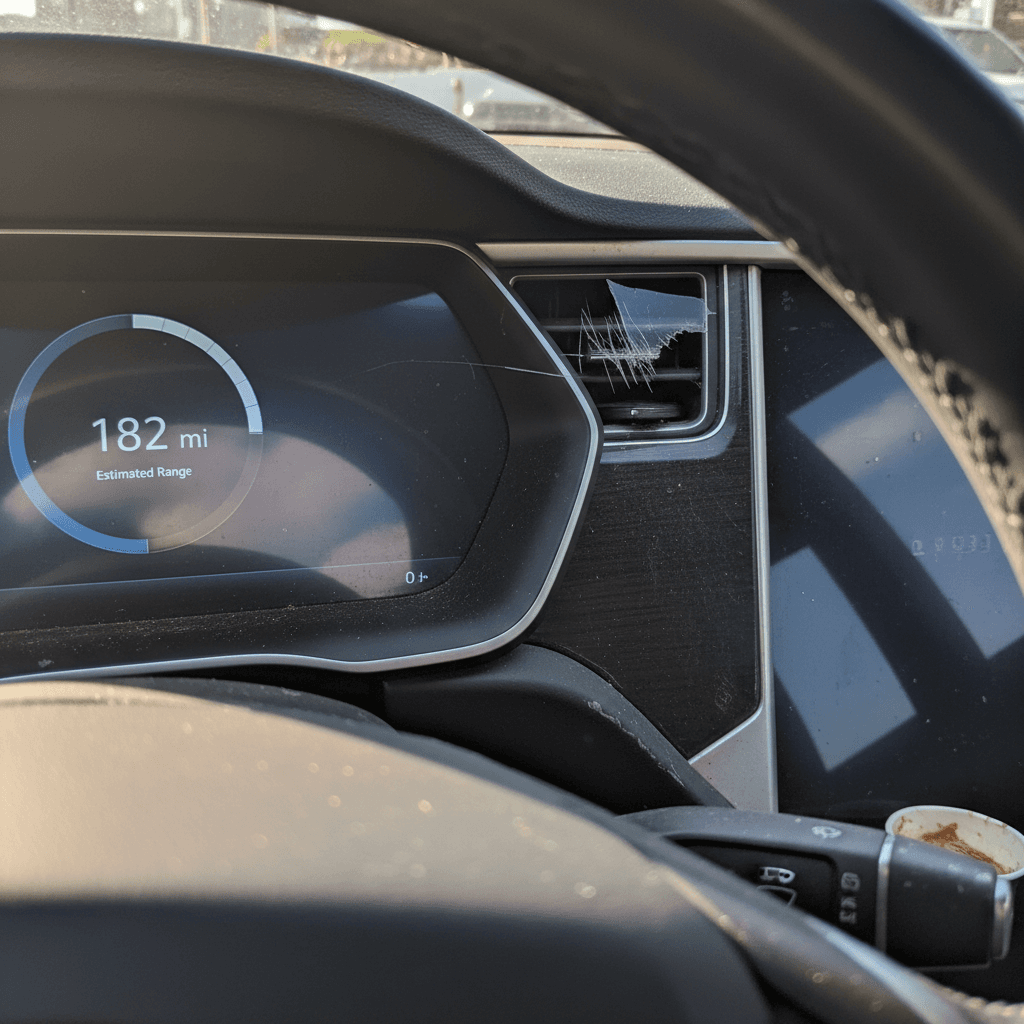
What that looks like in range terms
5 big factors that impact Tesla battery longevity
Not all miles are equal. Two Teslas with identical odometer readings can have very different battery health depending on climate, charging habits, and how the car was used. These are the main variables that move the needle.
What helps or hurts a Tesla battery over time
You can’t change cell chemistry, but you can control how the pack is treated day to day.
1. Temperature exposure
Heat is the enemy of lithium‑ion cells. Long periods parked in direct summer sun, especially at high state of charge, speed up chemical aging.
Cold hurts range temporarily but is less damaging long‑term. Tesla’s thermal management does a lot of heavy lifting, but shaded parking and garages still help.
2. Charging to 100% vs. 70–80%
Keeping the pack near full charge for long stretches stresses the cells. Tesla’s own guidance is to charge to around 70–80% for daily driving and reserve 100% for road trips.
Set your charge limit in the app and avoid leaving the car parked at 100% overnight if you can help it.
3. DC fast charging frequency
Supercharging is fine in moderation, but daily DC fast charging generates more heat and can accelerate wear compared with slower Level 2 charging.
Think of DC fast charging as a convenience tool, not your primary fueling strategy if you care about longevity.
4. Mileage and driving style
More miles mean more charge cycles, and aggressive driving can slightly increase pack temperature and cycling stress.
You don’t need to baby the car, but constant full‑throttle launches and very high freeway speeds won’t help battery life.
5. Deep discharges
Regularly running the battery down close to 0% then charging back to 100% is harder on the cells than keeping it in the middle of the state‑of‑charge window.
Try to stay mostly between about 20% and 80% for daily use.
Battery chemistry: NMC vs LFP Teslas
Most Teslas on U.S. roads use nickel‑based NMC/NCA chemistry, but some newer Rear‑Wheel Drive Model 3 and Model Y variants use LFP (lithium iron phosphate) packs. Chemistry matters because it changes how you should charge the car and how the pack ages.
NMC / NCA (most Teslas)
- Found in most Model S, X, and long‑range Model 3/Y variants.
- Higher energy density and strong performance at highway speeds.
- Prefer not to sit at 100% for long periods—keep daily charge limits around 70–80%.
- Show a bit more degradation in the first years, then flatten out.
LFP (some RWD Model 3/Y)
- Better tolerance for frequent 100% charges; Tesla even recommends charging to full regularly to help the BMS calibrate.
- Very robust to daily cycling; some owner data suggests excellent long‑term capacity retention.
- Lower energy density, so packs are heavier for the same range.
- Can lose more range in very cold weather until warmed up.
How to tell which you have
Signs a Tesla battery may be aging poorly
Normal degradation is slow and predictable. What you want to watch for, especially on a used purchase, are red flags that suggest something outside the norm.
- The displayed full‑charge range is dramatically lower than what other owners with similar mileage report.
- The car rapidly drops from, say, 20% to very low state of charge, or shuts down earlier than expected.
- Supercharging speeds are far slower than in comparable cars, even in warm weather with preconditioning.
- Frequent battery‑related warnings in the instrument cluster or app (reduced power, contact Tesla Service, etc.).
- A history of very heavy DC fast‑charging (for example, a car that lived almost exclusively at Superchargers).
Don’t ignore warning lights
Used Tesla? Checklist to judge battery health
If you’re evaluating a used Tesla from a dealer, private seller, or fleet like a rental company, you don’t need lab equipment to get a rough feel for battery health. A structured approach goes a long way.
7‑step battery health check for used Teslas
1. Verify odometer and model year
Confirm mileage against service records or digital history. High mileage isn’t necessarily bad, but it should be reflected in the price and remaining battery warranty.
2. Check remaining battery warranty
Look up the in‑service date and apply Tesla’s battery warranty rules for that model. This tells you how many years and miles of battery coverage you still have.
3. Look at the projected range at 100%
Ask the seller to show you the car near full charge or estimate from an 80–90% charge. Compare the displayed range to what the car was rated for new. A modest drop is normal; a dramatic one deserves questions.
4. Review charging history if possible
Fleet cars and heavily used Supercharger commuters may have done a lot of DC fast‑charging. Occasional Supercharging is fine; daily fast‑charging for years is harder on the pack.
5. Test a real‑world drive
On a test drive, watch how quickly the state of charge percentage falls versus miles driven. You’re looking for smooth, predictable behavior, not sudden drops.
6. Scan for warnings or reduced performance
Any persistent battery or drive‑unit alerts, or noticeable loss of power under acceleration, should be investigated before you buy.
7. Get a third‑party or Recharged battery health report
When available, use a professional health diagnostic (like a <strong>Recharged Score</strong> report) to see state‑of‑health estimates and degradation trends instead of guessing from range alone.
Where Recharged fits in
Ready to find your next EV?
Browse VehiclesDaily habits to extend your Tesla battery life
You don’t have to obsess over every kilowatt‑hour, but a few simple habits can meaningfully boost Tesla battery longevity without making the car inconvenient to live with.
Simple ways to treat your Tesla battery kindly
Think long‑term, not just about today’s charge.
Keep charge in the middle
For nickel‑based packs, set your daily charge limit around 70–80% and avoid leaving the car at 100% or near 0% when it’s parked for long periods.
Favor Level 2 at home
Make slower Level 2 charging your default. Save DC fast‑charging for road trips or emergencies to cut down on heat and stress.
Park in shade when you can
High pack temperatures accelerate aging. Garages, carports, and shaded spots help more than most people realize, especially in hot climates.
Schedule charging
Use Tesla’s scheduling tools so the car finishes charging shortly before you leave in the morning instead of sitting at a high state of charge for hours.
Precondition in extreme weather
Use preconditioning and seat/steering‑wheel heaters instead of cranking cabin HVAC at full blast from a cold start. It’s easier on both the pack and your range.
Drive smoothly
Occasional spirited runs are fine, but avoiding constant full‑throttle launches and very high cruising speeds reduces both energy use and thermal stress.
Tesla battery replacement costs and when it’s worth it
Complete pack failures in Teslas are rare, but they do happen, especially outside warranty after accidents or severe issues. More commonly, owners ask about replacement once range degradation becomes inconvenient.
- Replacement quotes for out‑of‑warranty Teslas vary widely, but a full pack swap can run from the mid four‑figures to over $15,000 depending on model, pack version, and labor rates.
- Some repairs involve replacing or refurbishing modules rather than the entire pack, which can cost less but depends on what’s actually wrong.
- At today’s used‑Tesla prices, a very high‑mileage car that needs a full pack may not be economical to repair unless you bought it very cheaply or plan to keep it for many more years.
- For most owners, it’s more cost‑effective to sell or trade the car once range no longer meets their needs rather than proactively replacing the pack.
Do the math before you buy a project car
FAQ: Common questions about Tesla battery longevity
Frequently asked questions about Tesla battery longevity
Bottom line: What to expect from Tesla battery longevity
Tesla’s real‑world battery longevity has turned out to be one of the quiet strengths of the brand. For most owners, the pack will comfortably deliver a decade or more of useful service with manageable, predictable degradation, especially if you avoid constant 100% charges, extreme heat, and daily fast‑charging.
If you’re considering a used Tesla, the key is to treat battery health the way you’d treat an engine and transmission on a gas car: central to value, not an afterthought. With solid data, a clear view of remaining warranty, and realistic expectations about range, a used Tesla can deliver years of low‑maintenance driving.
And if you’d rather not guess, a marketplace like Recharged gives you verified battery diagnostics, transparent pricing, and EV‑specialist support so you can buy your next Tesla with confidence instead of crossing your fingers.