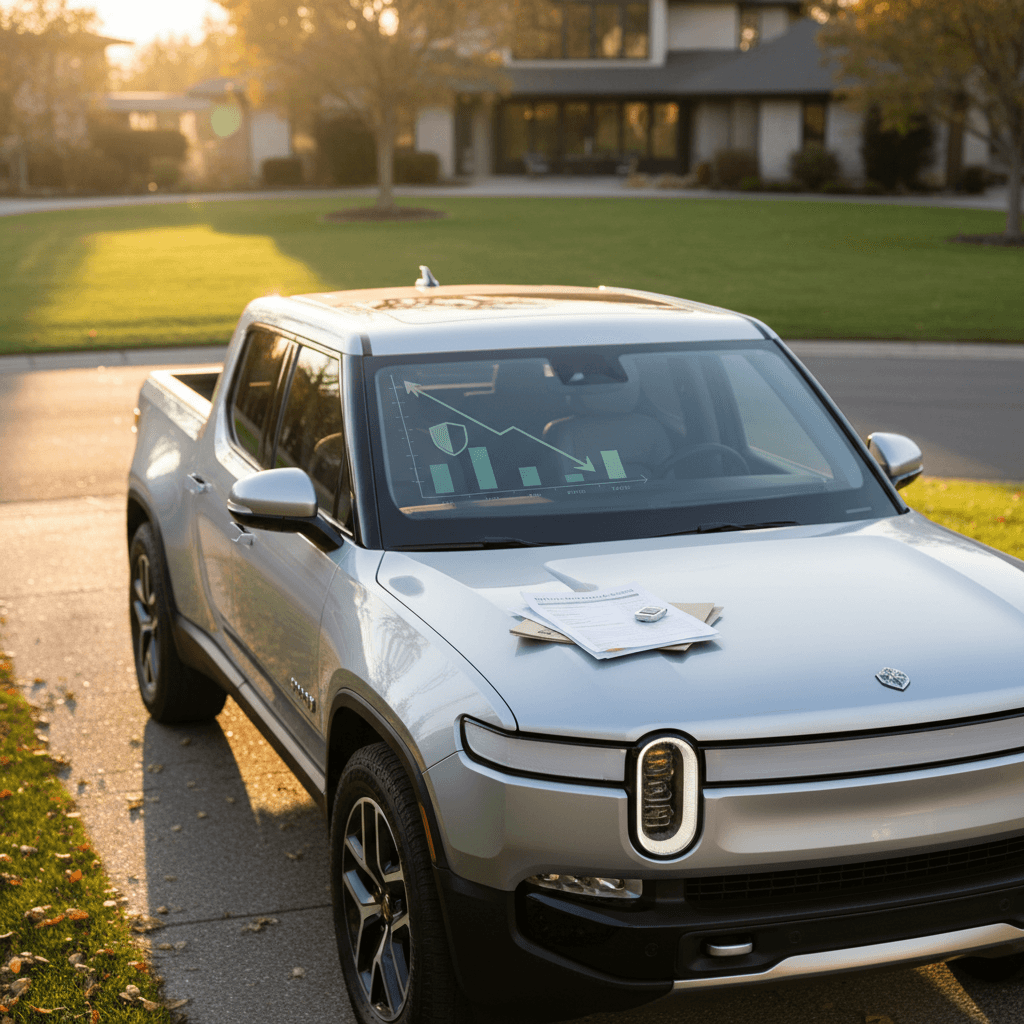
If you’ve shopped quotes for a Rivian R1T lately, you already know the punchline: this truck is fun, fast, and incredibly capable, but it’s not cheap to insure. The good news is that “Rivian R1T cheapest insurance” isn’t a fantasy. With the right carrier, coverage mix, and a little homework, you can trim hundreds of dollars a year off your premium without leaving yourself exposed.
What this guide covers
Why Rivian R1T insurance is so expensive
Before you can find the cheapest insurance for a Rivian R1T, you need to understand why the baseline is so high. In 2024–2025, the average full‑coverage auto policy in the U.S. hovered around the high‑$2,000s per year. Rivian R1T owners routinely see quotes that are 50–150% higher than that, and in some high‑risk segments, 200–300% above early‑EV baselines.
- High vehicle value and repair costs: The R1T is a premium electric truck with a large battery pack and aluminum body panels. Front and rear repairs often require specialized Rivian‑certified shops and can run into the five figures after a serious crash.
- Complex ADAS and sensor suite: The cameras, radar, and sensors that power Driver+ and other safety systems are expensive to replace and often need calibration after even minor collisions.
- Young claims history: Traditional insurers have only a few years of data on Rivian claims. Less data means more conservative (higher) pricing while they figure out real‑world loss costs.
- Big, heavy, very quick: The R1T is quick enough to embarrass sports cars and heavy enough to do serious damage in a crash. That combination tends to raise liability and collision pricing.
- Rapidly rising EV insurance costs overall: Carriers across the board have repriced newer EVs upward as they adjust to higher‑than‑expected repair and total‑loss costs. Rivian sits right in the crosshairs of that trend.
Don’t misread the safety story
How much does Rivian R1T insurance cost in 2026?
Real‑world Rivian R1T insurance quotes in 2025–2026 typically cluster in the $3,000–$4,500 per year range for full coverage, depending on your state, driving record, credit tier, and how you use the truck. That works out to roughly $250–$375 per month for many mainstream drivers, though outliers above and below that range absolutely exist.
Rivian R1T insurance at a glance (2026)
How this compares to average cars
Cheapest insurance companies for the Rivian R1T
There is no single universally cheapest insurer for every R1T owner. Pricing varies wildly by state, ZIP code, credit tier, and your broader insurance relationship. That said, some patterns have started to emerge from quote data, Rivian owner reports, and 2025–2026 EV‑focused insurance guides.
Carriers that often price Rivian R1T cheapest
Shortlist these when you start shopping quotes
USAA
Best for: Active duty, veterans, and eligible family members.
- Consistently among the lowest quotes for high‑value vehicles.
- Strong claims service and EV familiarity.
- Limited eligibility, but a must‑quote if you qualify.
State Farm
Best for: Mainstream drivers who like working with agents.
- Competitive R1T rates in many states.
- Big multi‑policy and safe‑driver discounts.
- Good track record handling newer EVs.
Progressive & GEICO
Best for: Online shoppers and telematics users.
- Snapshot (Progressive) and DriveEasy (GEICO) can reward smooth, low‑mileage R1T driving.
- Quotes are quick to compare.
- Pricing is more volatile, shop around yearly.
Regional and smaller carriers can also be sleepers. Some state‑focused mutuals or regional insurers quietly price Rivians very competitively because they’re chasing high‑income, low‑claim households. It’s worth including at least one local or regional company in your quote stack.
Quote strategy that actually works
Rivian Insurance vs traditional carriers
Rivian offers its own insurance program in many states, usually underwritten by partners like Nationwide. Like Tesla Insurance, the pitch is that they understand Rivian repair costs better than traditional carriers, and can price more precisely as a result.
When Rivian Insurance can be cheapest
- Clean record, newer R1T: Rivian’s data‑driven pricing can undercut large carriers by roughly 15–25% for some profiles.
- You want OEM‑aligned claims handling: Repairs are steered to Rivian’s network, which can reduce friction if your truck is in an accident.
- You bundle multiple EVs: If you also own an R1S or plan to add another Rivian, multi‑vehicle discounts can stack.
When a traditional carrier can be cheaper
- Older R1T or used purchase: As the truck depreciates, mainstream carriers may drop rates faster than OEM insurance programs.
- Big home/umbrella bundle: If your house and other cars sit with one carrier, the bundle discount may outweigh Rivian Insurance’s EV advantage.
- Telematics rockstar: Some telematics programs (State Farm Drive Safe & Save, Progressive Snapshot) can cut rates sharply for low‑risk drivers.
How to compare Rivian Insurance fairly
Coverages you should never cut to get the “cheapest” rate
When premiums feel painful, it’s tempting to strip your policy to the legal minimum. With a Rivian R1T, that’s a dangerous move. The point is not just finding the lowest number, but the lowest number that still protects a six‑figure asset and your liability if something goes wrong.
Non‑negotiable coverages for most R1T owners
1. Adequate liability limits
State minimum liability limits are almost never enough for a truck as capable and heavy as the R1T. Many EV owners opt for at least 100/300/100, and often higher. Liability is usually cheap relative to your collision cost, don’t skimp here.
2. Collision coverage
If you finance or lease, your lender will require collision coverage. Even if you own the R1T outright, dropping collision exposes you to a massive out‑of‑pocket risk after a crash, especially given how expensive EV bodywork is.
3. Comprehensive coverage
Comprehensive covers non‑collision events: theft, vandalism, hail, fallen trees, animal strikes, and more. With the R1T’s value and electronics load, comprehensive is one of the last coverages you should consider cutting.
4. Uninsured/underinsured motorist
Given the number of underinsured drivers on U.S. roads, this coverage can be the difference between being made whole and eating a huge loss if someone with weak insurance hits your Rivian.
5. Gap/loan‑lease protection (if applicable)
If you finance with a small down payment, the R1T can depreciate faster than your loan balance for a while. Gap coverage protects you if the truck is totaled while you still owe more than it’s worth.
What you <em>can</em> dial back
15 ways to get the cheapest Rivian R1T insurance
If you think of insurance as a fixed cost, you’ll overpay for years. In reality, you control more levers than most people realize. Here are 15 of the most effective ones for Rivian R1T owners, grouped into three buckets: vehicle choices, policy design, and how you drive.
Your cheapest‑insurance toolkit
Stack multiple tactics for the biggest savings
A. Vehicle & configuration choices
- 1. Choose a less aggressive wheel/tire setup: 20‑inch wheels with all‑terrain tires may rate better than massive performance packages that imply spirited driving.
- 2. Avoid unnecessary powertrain upgrades: High‑performance trims sometimes carry higher premiums. If you don’t need the quickest variant, you may save on insurance too.
- 3. Add security features: Garaging the truck, installing a robust home camera system, and enabling Rivian’s security features can unlock anti‑theft credits.
B. Policy & coverage design
- 4. Raise physical damage deductibles: Bumping from a $500 to a $1,500–$2,000 deductible can cut a meaningful slice off your premium. Just keep enough cash on hand to cover that hit.
- 5. Bundle home, umbrella, and other vehicles: Multi‑policy discounts are often 10–25%. On a pricey R1T policy, that’s real money.
- 6. Remove duplicative extras: If your Rivian financing or a roadside plan already provides towing or rental coverage, you might drop overlapping endorsements from your auto policy.
- 7. Shop at natural breakpoints: Compare quotes right before adding a teenage driver, moving, or buying a used R1T, major life changes often trigger repricing.
C. How (and how much) you drive
- 8. Enroll in telematics: Programs like Snapshot, DriveEasy, or Drive Safe & Save can reward the smooth, torque‑rich driving style EVs excel at. Rivian’s instant torque is fun; telematics encourages you to use it judiciously.
- 9. Reclassify commuting vs pleasure: If your R1T is a weekend adventure truck rather than a daily commuter, make sure the garaging and use class reflect that.
- 10. Keep annual mileage realistic: Over‑estimating your miles per year can quietly inflate your premium. Update mileage at renewal based on real data from the truck.
- 11. Maintain a clean record: One at‑fault accident or DUI will spike premiums on any vehicle, but the absolute dollar impact is magnified on a high‑value truck like the R1T.
- 12. Improve your insurance credit tier: In most states, credit‑based insurance scores matter. Paying bills on time and reducing revolving debt can pay off in lower premiums over a few renewal cycles.
- 13. Ask specifically about EV or green‑vehicle discounts: Some carriers quietly offer small credits for electric vehicles or for installing a Level 2 charger with a permit.
- 14. Consider a larger umbrella policy: If you carry an umbrella liability policy, some carriers will give small but real discounts on the underlying auto policies.
- 15. Re‑quote yearly, especially early in ownership: The first one to three years in a new EV model’s life are when insurers learn the most. That means pricing shifts frequently. Don’t set‑and‑forget your R1T policy.
Stacking savings with a used R1T
Ready to find your next EV?
Browse Vehicles
Special considerations for used Rivian R1T buyers
If you’re shopping the used market, the cheapest Rivian R1T insurance isn’t just about hunting for discounts, it also hinges on how well you document the truck’s condition and how much it’s worth today, not at launch.
How used‑vehicle factors impact R1T insurance pricing
What underwriters look at when pricing a used R1T, and how you can use that to your advantage
| Factor | How it affects your premium | What you can do |
|---|---|---|
| Actual cash value (ACV) | Lower ACV usually means lower comprehensive and collision premiums. | Shop for a used R1T whose price reflects current market reality, tools like the Recharged Score report help you and the insurer see that clearly. |
| Battery health | A degraded or uncertain pack can worry some underwriters, increasing perceived risk. | Choose R1Ts with documented battery diagnostics. A verified healthy pack makes underwriting simpler and supports better pricing. |
| Prior damage or accidents | Significant prior repairs can scare carriers or push them to surcharge the vehicle. | Ask for body‑shop invoices and Carfax/AutoCheck. Clean, well‑documented histories are easier to insure at competitive rates. |
| Aftermarket mods | Lift kits, oversized wheels, and lighting can drive premiums up, or even trigger declinations. | If cheap insurance is a priority, keep modifications modest and disclose them up front to avoid surprises in a claim. |
| Usage pattern | Weekend adventure truck vs heavy‑mileage work truck will rate very differently. | Be honest but precise about how you use the R1T. If it’s not a high‑mileage workhorse, don’t let it be rated like one. |
Depreciation helps, but condition and history still matter a lot.
Why documentation matters more with EVs
Sample “cheapest insurance” scenarios for typical R1T owners
It’s one thing to talk about levers in the abstract; it’s another to see how they add up in real‑life profiles. These simplified scenarios aren’t quotes, but they illustrate how the same Rivian R1T can produce very different premiums depending on choices you make.
1. Daily‑driver commuter
Profile: 38‑year‑old in a major metro area, excellent credit, 12,000–15,000 miles/year, R1T is the primary car.
- Baseline quotes: $3,600–$4,200/year full coverage.
- Cheapest path: State Farm or Progressive with telematics, $1,000 deductibles, bundled with home.
- Realistic target: $2,800–$3,200/year after stacking discounts and clean telematics data.
2. Weekend adventure truck
Profile: 45‑year‑old suburban owner, two‑car household, R1T is garaged and used mainly for trips and outdoor weekends, 6,000–8,000 miles/year.
- Baseline quotes (misclassified as commuter): $3,200–$3,800/year.
- Cheapest path: Correct usage class to pleasure, lower annual mileage, enroll in telematics.
- Realistic target: $2,400–$2,800/year with a competitive regional carrier or Rivian Insurance.
3. Used R1T value buyer
Profile: 50‑year‑old buyer of a 3‑ to 4‑year‑old R1T purchased via Recharged, with documentation and a clear battery health report.
- Baseline new‑vehicle‑style quotes: $3,000–$3,500/year.
- Cheapest path: Shop mainstream carriers that are quicker to reflect depreciation in ACV, provide battery‑friendly endorsements, and reward low mileage.
- Realistic target: $2,200–$2,700/year, helped by the lower ACV and documented condition.
Why used R1Ts often punch above their weight
FAQ: Rivian R1T cheapest insurance questions, answered
Frequently asked questions about Rivian R1T cheapest insurance
Key takeaways: what to do before you buy or renew
Insuring a Rivian R1T in 2026 isn’t cheap, but it also isn’t a black box you’re powerless to influence. The same high tech and data‑rich nature that make the R1T such an interesting truck are slowly reshaping how underwriters price it, and that creates opportunities for informed owners to come out ahead.
- Start by budgeting realistically: for many owners, full‑coverage R1T insurance lives in the $3,000–$4,500 per‑year band, and planning for that upfront prevents buyer’s remorse later.
- Never chase the absolute lowest premium by stripping core protections. Focus instead on deductibles, bundles, and telematics, the levers that preserve your safety net while cutting waste.
- Always compare Rivian Insurance against at least three to five mainstream carriers using identical coverage limits and deductibles so you’re judging apples to apples.
- If you’re still shopping trucks, give serious thought to a used R1T with verified battery health from a marketplace like Recharged. A lower vehicle value and transparent condition history are two of the cleanest paths to cheaper insurance.
- Treat insurance like any other line in your EV ownership spreadsheet: quote widely, revisit regularly, and be willing to switch if another carrier prices your risk more intelligently.
Do that, and “Rivian R1T cheapest insurance” stops being a slogan and becomes a process: informed, repeatable, and surprisingly effective at keeping the un‑romantic side of electric‑truck ownership under control.