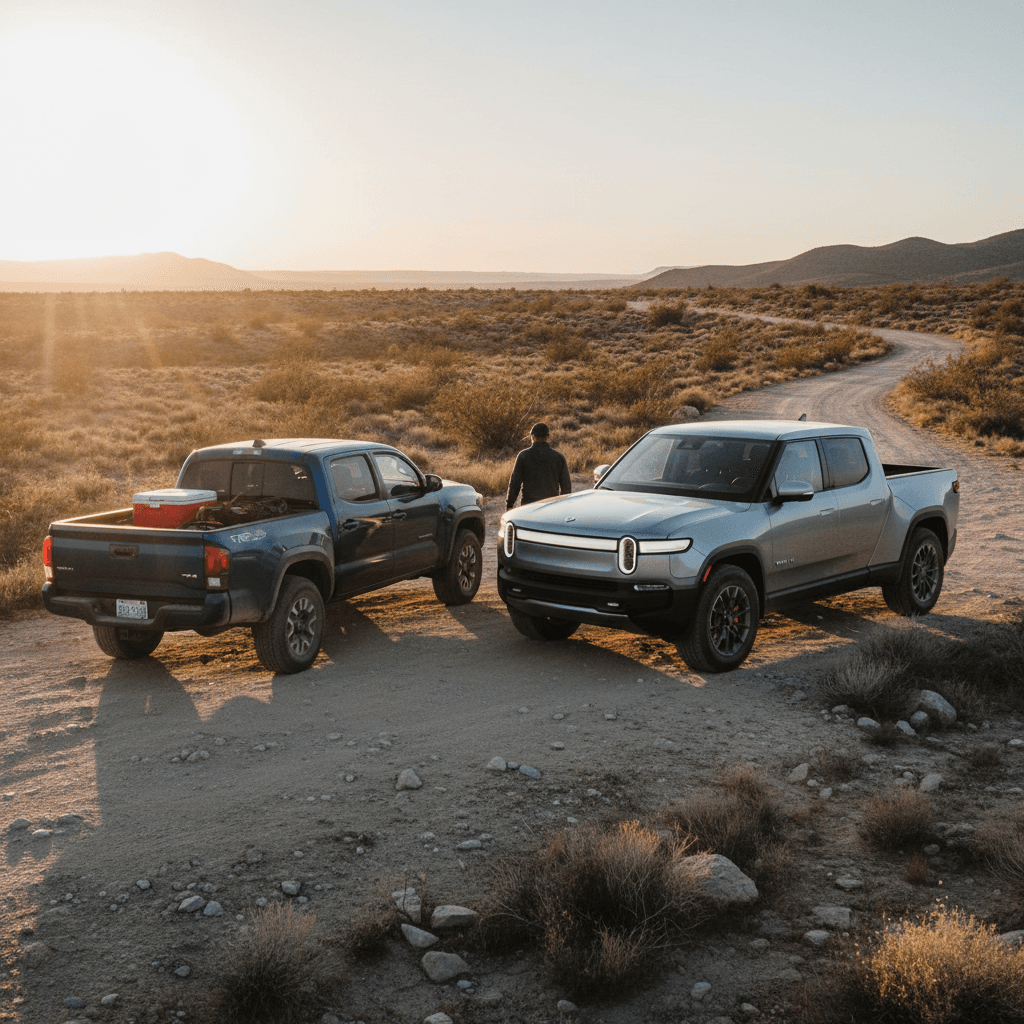
If you’ve owned a Toyota Tacoma for years, you probably know every rattle, gear change and fuel-stop routine by heart. Now you’re eyeing a Rivian R1T and wondering: will this electric truck really replace what my Tacoma does for towing, off-roading and daily life, or is it just an expensive science experiment?
What this review covers
Why Tacoma Owners Are Looking at the Rivian R1T
Tacoma owners tend to be loyal. The truck’s reputation for durability, simple mechanicals and high resale value makes it a default choice for people who keep trucks a long time. But the game has changed. The Rivian R1T brings instant torque, luxury-level comfort and serious off-road tech, all wrapped in a pickup that can tow up to around 11,000 pounds when properly equipped, right in line with or above many half-ton gas trucks.
Former Tacoma owners who’ve moved to an R1T talk about the same themes: the R1T is quicker, quieter and more comfortable, with smarter storage and better towing manners. The tradeoffs are mostly around range while towing, charging logistics, and the long-term durability unknowns that simply don’t exist with a 300,000‑mile Tacoma.
Who’s the ideal candidate?
Specs: Tacoma vs. Rivian R1T at a Glance
Exact figures vary by model year and configuration, but this high-level comparison captures what most Tacoma owners are cross‑shopping against a used Rivian R1T in 2026.
Toyota Tacoma vs. Rivian R1T: Core Specs
How key specs line up for a typical recent Tacoma and a Rivian R1T many truck shoppers are considering on the used market.
| Spec | Recent Toyota Tacoma (V6 or turbo-4) | Rivian R1T (dual/quad-motor, Large or Max pack) | What it feels like |
|---|---|---|---|
| Power & 0–60 mph | 278 hp; 0–60 in ~7–8 seconds | 600–835 hp; 0–60 in ~3–4 seconds | R1T feels like a performance SUV with a bed |
| Drivetrain | Part‑time or full‑time 4WD | Standard AWD with 2–4 electric motors | R1T puts torque to each wheel almost instantly |
| Max tow rating | Typically 6,400–6,800 lbs (properly equipped) | Up to ~11,000 lbs when properly equipped | R1T can tow heavier, but range drops faster |
| Payload | Roughly 1,100–1,600 lbs (trim‑dependent) | Around 1,700+ lbs at the high end | Similar ballpark, but Tacoma options vary widely |
| Fuel/energy | Gasoline, 87–91 octane | Battery: Large/Max pack, DC fast charging | R1T trades fuel stops for charging sessions |
| Off‑road | Strong, especially TRD trims, proven over time | Height‑adjustable air suspension, advanced drive modes | R1T is more capable stock; Tacoma wins on bush‑fixability |
| Cabin | Durable but basic in lower trims | Near‑luxury materials, big screens | R1T is a big jump in comfort and tech |
| Resale reputation | Excellent, long‑proven | Still forming, but used prices have cooled | Tacoma’s track record vs. a newer brand |
The R1T outguns the Tacoma on power and tech, but the Tacoma still wins for simplicity and long‑range towing without planning stops.
Mind the fine print on tow ratings
Towing, Hauling and Off-Road: How the R1T Really Compares
For many Tacoma owners, the question is simple: can a Rivian R1T pull my camper, boat or utility trailer as confidently as my gas truck? On paper, yes, the R1T’s maximum tow rating of around 11,000 pounds (with the right configuration and hitch) beats a Tacoma’s typical 6,400–6,800‑pound ceiling. In practice, your experience depends more on range and charging access than raw pulling power.
How towing and hauling feel in the real world
Where the R1T beats the Tacoma, and where the Tacoma still has an edge.
Towing feel & control
The R1T’s instant torque and low center of gravity make it feel planted with a trailer. Owners often call it the best tow vehicle they’ve driven, especially for moderate loads. Regenerative braking also helps manage downhill grades.
Range while towing
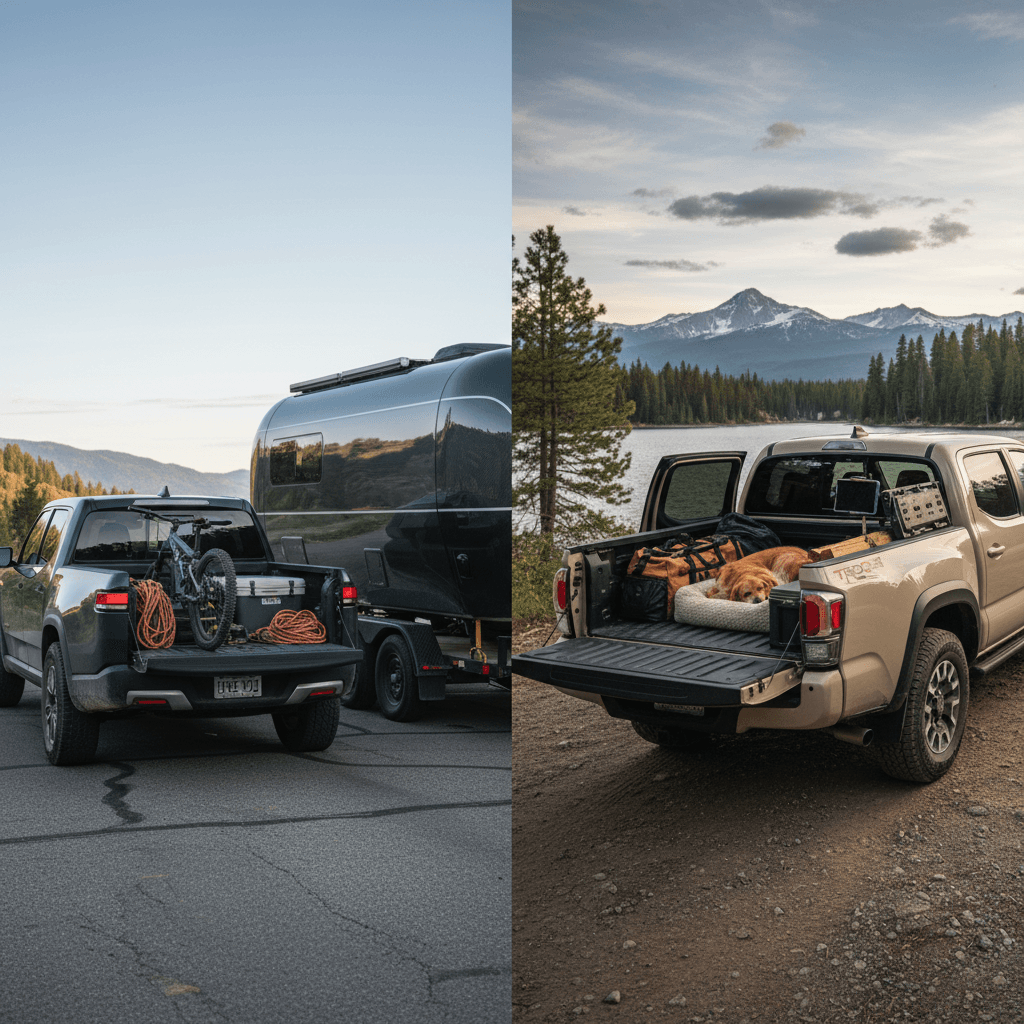
Here’s the tradeoff: a trailer that barely moves your Tacoma’s fuel economy might cut your R1T’s range by half or more. For frequent long‑distance towing, you’ll be planning DC fast‑charge stops carefully, and some owners still keep a gas truck for rare heavy trips.
Payload & bed usability
The R1T’s payload rating is competitive, but its bed is shorter than a Tacoma’s long bed. You gain clever storage, gear tunnel, frunk, under‑bed bin, but lose some of the throw‑anything‑in simplicity of a long‑bed Tacoma.
Off-road, the R1T arrives from the factory with serious credentials: adjustable air suspension, strong underbody protection, and terrain‑specific drive modes. A stock R1T will go places a stock on‑road‑oriented Tacoma may struggle, especially on steep, technical terrain where instant torque and traction control matter more than a manual transfer case.
Where the R1T shines off‑road
- Adjustable ride height lets you clear obstacles on demand.
- Drive modes tune traction, suspension and power for dirt, rock, sand or snow.
- Excellent low‑speed control and torque vectoring make technical climbs feel easier.
- Cabin remains quiet and comfortable even when the trail gets rough.
Where the Tacoma still wins
- Simple, proven hardware that’s easier to field‑repair in remote areas.
- Aftermarket support for bumpers, armor, racks and long‑travel suspension is massive.
- Gas stations are far more common than DC fast chargers in some backcountry regions.
- If you’re scraping frame rails all weekend, you may prefer abusing a cheaper, older truck.
Range is your new limiting factor off‑road
Daily Driving: Noise, Comfort and Tech
If your Tacoma doubles as a commuter or family vehicle, you’ll notice the biggest change here. The Rivian R1T feels more like a luxury SUV than a work truck. There’s no engine noise at idle, no gear hunting in traffic, and acceleration is sports‑car strong even in mild drive modes.
How R1T daily life differs from a Tacoma
Interior materials are another leap. Where a Tacoma emphasizes durability with hard plastics and straightforward controls, the R1T layers in wood trim, premium textiles and a minimalist layout. That’s a plus for comfort, but if you treat your cab like a rolling workshop, you’ll want to think about how those nicer surfaces will hold up to mud, tools and dogs.
Try living with the screens
Ownership Costs: From Gas and Oil to kWh and Tires
A big part of any "+Tacoma owner switch to Rivian R1T review" conversation is cost. You’re moving from a relatively simple, efficient gas truck to a heavier, high‑performance EV with expensive hardware. How that plays out depends on how you drive and where you charge.
Costs that usually go down with an R1T
- Fuel: Charging at home on off‑peak electricity is typically much cheaper per mile than buying gas, especially if you rack up highway miles.
- Routine maintenance: No oil changes, spark plugs, timing chains or exhaust systems. Brake wear is often lower thanks to regenerative braking.
- Stop‑and‑go driving: EVs are most efficient in city and mixed driving, where gas trucks tend to suffer.
Costs that may go up with an R1T
- Upfront price: Even used, many R1Ts still list above comparable Tacomas, though prices have cooled from early hype.
- Tires: Heavy EV trucks with strong torque can eat through aggressive tires faster if you drive hard.
- Out‑of‑network fast charging: DC fast‑charging on road trips can rival or exceed gas prices per mile, especially when towing.
How Recharged helps on total cost
Charging vs. Gas Stops: Life After the Tacoma
The emotional hurdle for many Tacoma owners isn’t towing or off‑road, it’s the idea of trading five‑minute gas stops for charging sessions that can run 20–45 minutes on road trips. Day to day, though, an R1T can actually be more convenient if you have home charging.
- At home, you plug in once and start each day with a "full tank" instead of detouring to a gas station.
- Most commuting and local hauling barely dent a modern R1T battery, especially with a Large or Max pack.
- Public DC fast charging is improving, and the R1T can use multiple networks. Still, coverage is uneven, especially in rural areas many Tacoma owners favor.
Plan road trips differently
Used Rivian R1T Market: What Tacoma Owners Should Know
One reason lifelong Tacoma owners are now eyeing Rivians is simple: used pricing has finally come back to earth. Early R1T buyers paid new‑truck money at luxury‑SUV levels. By 2026, many 2022–2024 R1Ts are trading in the mid‑$40,000s to mid‑$60,000s depending on miles, spec and condition, often not far from what well‑equipped Tacomas command on today’s used market.
R1T used-market snapshot vs. its past
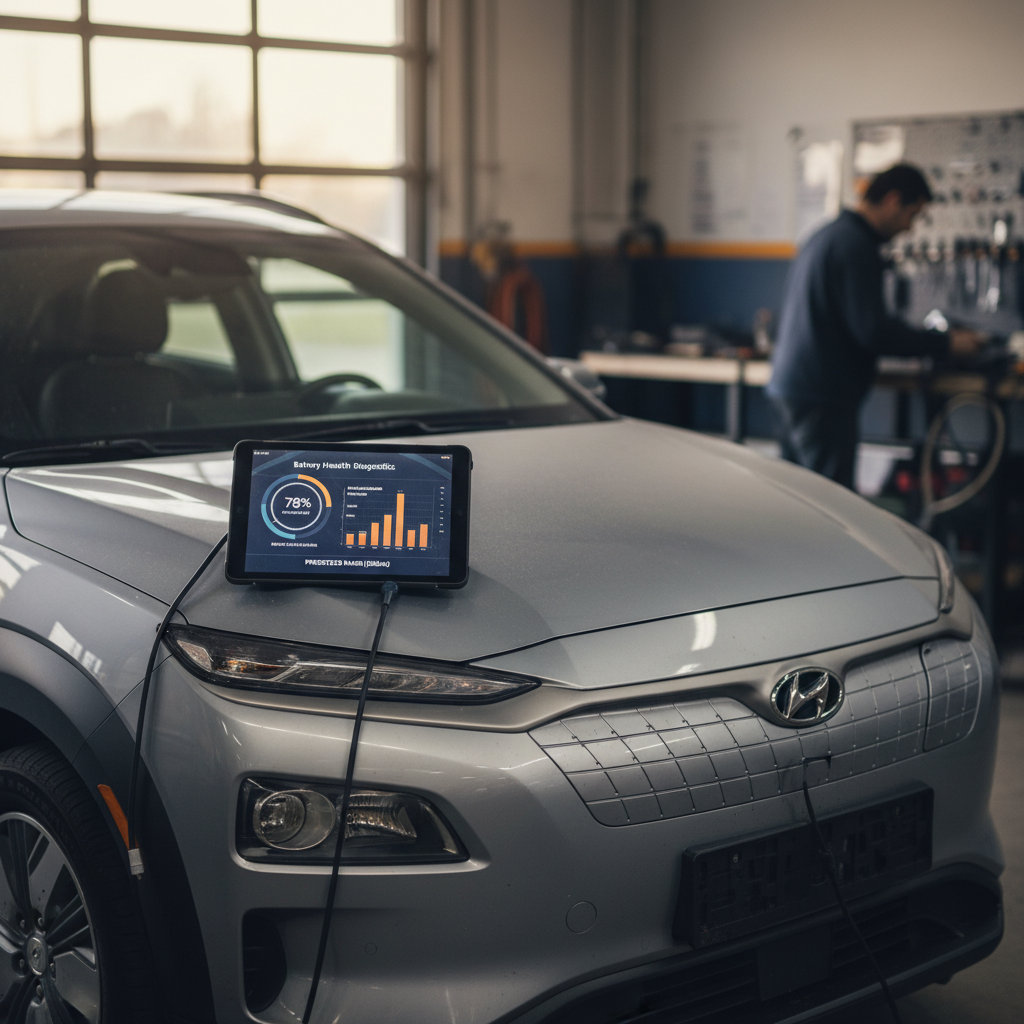
That last point is where buying from a traditional used‑car lot can feel risky. A clean Carfax and a wash don’t tell you how many DC fast‑charge sessions a truck has seen or how its pack is aging. That’s why Recharged leans on battery‑health diagnostics and market data in its Recharged Score, instead of guessing based on odometer alone.
Why battery reports matter to ex‑Tacoma owners
Ready to find your next EV?
Browse VehiclesChecklist: Are You Ready to Switch from Tacoma to R1T?
Self‑check before you trade your Tacoma for an R1T
1. Clarify how you really use your truck
Write down how often you tow, how heavy those loads are, how far you go, and how much time you spend off‑road. If most trips are under 200 miles and your trailer isn’t at the high end of the R1T’s rating, you’re in the sweet spot.
2. Confirm your home charging setup
Can you install a Level 2 charger on a 240‑volt circuit where you park? If you rent or rely on street parking, make sure you understand your daily range needs and local public charging options before committing.
3. Map your key routes and chargers
Look at your regular road‑trip routes and favorite trailheads in a charging app. Are there reliable fast chargers near your usual gas stops or trail exits? If not, are you willing to adjust routes or timing?
4. Decide how much you value comfort and tech
The R1T is a huge upgrade in comfort, noise and tech over a typical Tacoma. If you spend hours on the highway or in traffic, that may matter more than the simplicity of your current truck.
5. Set a clear budget, including resale of your Tacoma
Tacomas hold value extremely well. Get firm trade‑in or private‑party estimates, then compare them to used R1T listings. On Recharged, you can see battery‑health‑adjusted pricing instead of guessing.
6. Think about long-term support
Toyota dealers are everywhere; Rivian’s service and mobile network is growing but smaller. If you live far from a Rivian service point, consider how comfortable you are with over‑the‑air fixes and occasional longer trips for repairs.
FAQ: Tacoma Owner Switch to Rivian R1T
Frequently asked questions from Tacoma owners
Bottom Line: Is the R1T an Upgrade From Your Tacoma?
For many Toyota Tacoma owners, a Rivian R1T will feel like a massive upgrade in every area you notice daily: power, comfort, noise, tech and towing confidence at moderate distances. Where the Tacoma still wins is in long‑range simplicity, proven durability and the ability to shrug off abuse and remote adventures without worrying about charging.
If your truck life is shifting toward highway miles, family duty and weekend trips that stay within a few hundred miles of home, an R1T can absolutely replace, and outperform, your Tacoma. If your identity is built around long‑distance, fully self‑sufficient overlanding with minimal infrastructure, the R1T is more likely a complement than a replacement.
Either way, the smartest path for Tacoma owners is to treat a used R1T like any serious equipment purchase: demand clear data on battery health, pricing and history. That’s exactly what Recharged was built for. With a Recharged Score Report, expert EV guidance, financing options and nationwide delivery, you can move from "maybe" to a confident decision about whether an R1T belongs in your driveway next to, or instead of, your Tacoma.