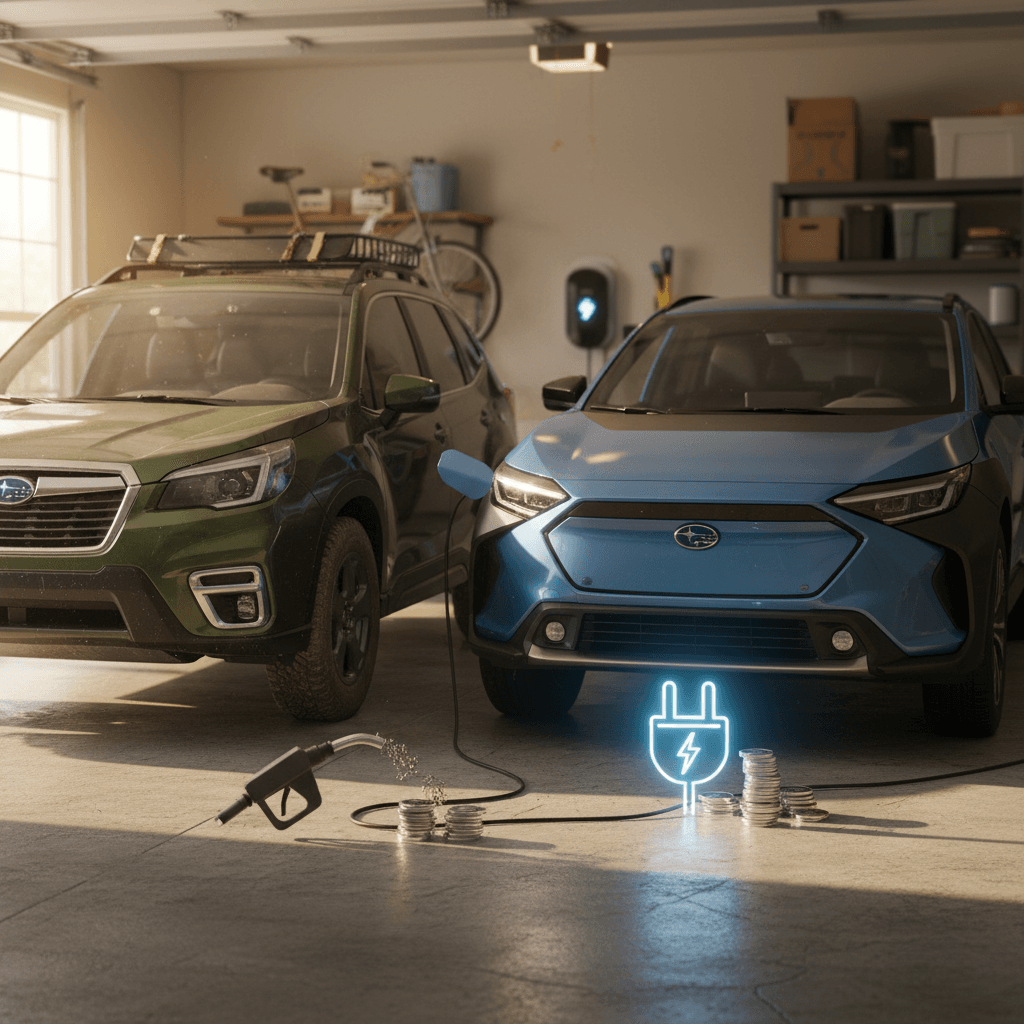
If you love your Subaru Forester but hate watching the gas total climb, you’re not alone. More owners are running the numbers on switching from a Subaru Forester to a Subaru Solterra to see whether the all‑electric SUV can really cut their total cost of ownership, or if it’s just trading a fuel bill for a bigger car payment.
Who this guide is for
Why Forester owners are eyeing the Solterra
The Subaru Forester has earned its reputation as a do‑everything compact SUV: good cargo space, all‑wheel drive, and a loyal following. But even with decent fuel economy, the combination of rising gasoline prices and frequent driving makes many owners wonder if an EV like the Solterra would be cheaper to live with day to day.
- Regular commutes or school runs that rack up mileage quickly
- Weekend trips, skiing, or trailhead access where AWD is non‑negotiable
- Growing frustration with $60–$80 fill‑ups when prices spike
- Curiosity about EVs, but nerves about range, charging, and battery life
Think in total cost, not just monthly payment
Quick answer: how much can you actually save?
Typical savings switching from Forester to Solterra
Those are averages, not promises. Your real savings depend on how you drive, local electricity and gas prices, how you buy the Solterra (new vs. used), and whether you can consistently charge at home. Let’s walk through the math step by step so you can plug in your own numbers.
Forester vs. Solterra by the numbers
To estimate cost savings, it helps to start with some baseline specs for a typical gasoline Forester versus a Solterra. Exact numbers vary by trim and year, but these ballpark figures are a solid planning baseline.
Subaru Forester vs. Subaru Solterra: key efficiency specs
Approximate real‑world specs for recent model years. Always check your specific model for exact ratings.
| Model | Fuel type | Typical combined efficiency | Energy per 100 miles | Usable battery / tank |
|---|---|---|---|---|
| Subaru Forester (gas) | Gasoline | ≈29 mpg combined | ≈3.45 gal/100 mi | ≈16 gal fuel tank |
| Subaru Solterra (EV) | Electricity | ≈3.0–3.4 mi/kWh (mid 20s MPGe) | ≈30–33 kWh/100 mi | ≈72–75 kWh usable battery |
These efficiency numbers are a starting point for cost calculations, they’re not perfection, but they’re close enough to model fuel vs. electricity costs.
Real‑world efficiency will vary
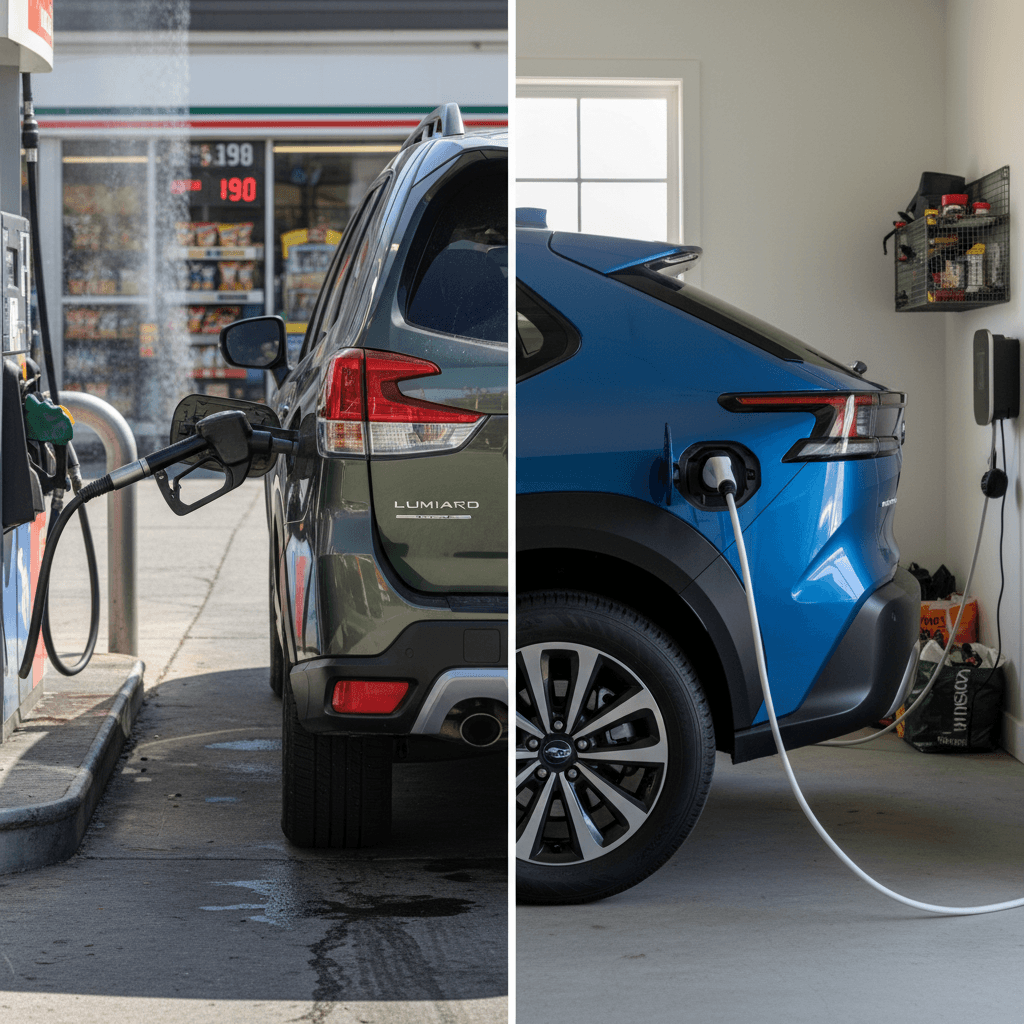
Fuel vs. electricity: what you’ll really spend per mile
To see the cost difference between a Forester and a Solterra, it helps to break it down to cost per mile, then scale that up to your yearly mileage.
1. Gasoline cost per mile – Forester
Let’s use these reasonable assumptions for a current Forester driver in the U.S.:
- Average combined mpg: 29 mpg
- Average gas price: about $4.00 per gallon in early 2026
Cost per mile = $4.00 ÷ 29 ≈ $0.14 per mile.
2. Electricity cost per mile – Solterra
For a Solterra charged mostly at home:
- Efficiency: ~3.1 miles per kWh (≈32 kWh/100 miles)
- Average residential power price: ≈$0.18 per kWh (U.S. average is creeping up into the high‑teens)
Cost per mile = ($0.18 × 32 kWh) ÷ 100 ≈ $0.058 per mile.
On those assumptions, every mile you move from a Forester to a Solterra saves you roughly 8 cents in energy alone. That may not sound like much until you multiply it by your actual driving.
Annual fuel vs. electricity costs at different mileages
Use this as a template, swap in your own mpg, gas price, and kWh rate for more precise results.
10,000 miles/year
- Forester gas: 10,000 × $0.14 ≈ $1,400
- Solterra electricity: 10,000 × $0.058 ≈ $580
- Annual savings: ≈ $820
12,000 miles/year
- Forester gas: ≈ $1,680
- Solterra electricity: ≈ $700
- Annual savings: ≈ $980
15,000 miles/year
- Forester gas: ≈ $2,100
- Solterra electricity: ≈ $870
- Annual savings: ≈ $1,230
What if you fast‑charge a lot?
Maintenance and repairs: where EVs quietly win
Fuel savings grab the headlines, but maintenance and repair costs are where EVs like the Solterra quietly claw back more money over time. There’s simply less to service: no oil changes, no spark plugs, no exhaust system, and far fewer moving parts in the driveline.
Typical maintenance items: Forester vs. Solterra
This table focuses on routine maintenance for an out‑of‑warranty vehicle over 5–10 years of ownership.
| Item | Forester (gas) | Solterra (EV) | Notes |
|---|---|---|---|
| Oil & filter changes | 2–3 per year | None | At $60–$100 each, this adds up quickly. |
| Engine air filter, spark plugs | Every few years | None | No combustion engine in the Solterra. |
| Transmission/gearbox service | Periodic fluid service | Simpler, less frequent | The Solterra’s single‑speed reduction gear is simpler than a multi‑gear automatic. |
| Brake pads/rotors | Moderate wear | Slower wear | Regenerative braking means pads often last much longer on EVs. |
| Coolant & fluids | Multiple systems | Fewer systems | EVs still use coolant for the battery and electronics, but service is less frequent. |
| Exhaust system | Rust, hangers, leaks | Not applicable | Big one‑time repairs simply don’t exist on an EV. |
EVs still need tires, wiper blades, and some fluid service, but they skip many of the routine jobs that keep combustion engines happy.
In practice, many owners see $300–$500 per year less in routine maintenance and minor repairs once they move from a gasoline crossover to an EV, especially after the factory warranty expires.
How Recharged helps on maintenance risk
Ready to find your next EV?
Browse VehiclesInsurance, taxes, and incentives to factor in
Not every line item will tilt in the Solterra’s favor. You may see some costs go up, others go down. The important thing is to consider the full picture over the years you plan to own the vehicle.
Key policy and ownership line items
These will vary widely by state and insurer, check your exact numbers before you make a decision.
Insurance
Insurance premiums for EVs can be a little higher than for similar gas SUVs, especially when new, because parts and labor can be more expensive and there’s less repair history. On the flip side, driver‑assist safety tech can earn discounts. Get real quotes for both your Forester and the Solterra you’re eyeing.
Taxes & registration
Some states add EV registration fees to make up for lost gas‑tax revenue; others reduce sales tax or offer credits for EV purchases. Check your DMV and state energy office. The impact can swing a few hundred dollars a year either way.
Federal & state incentives
New Solterras may qualify for federal tax credits or state rebates depending on current rules and where they’re built. Used EVs can sometimes qualify for a smaller federal credit or local incentives. Always verify current program details before you buy.
Parking, tolls & perks
Some cities and workplaces offer discounted parking, free charging, or HOV‑lane access for EVs. These perks don’t show up in the sticker price but can save you real money and time over years of ownership.
Recharged can help you stack incentives
Upfront cost and realistic break-even math
Most Forester owners don’t have the luxury of ignoring the monthly payment. The Solterra is a newer, pricier vehicle, and even used examples can cost more than a comparable gasoline Forester. The question is whether your fuel and maintenance savings outweigh that higher payment over time.
1. Estimate the price gap
Suppose:
- Your current Forester is worth $18,000 as a trade‑in or private sale.
- A well‑kept used Solterra you like is $30,000.
That’s a $12,000 price gap before incentives and taxes.
2. Compare savings over ownership
From our earlier examples for ~12,000 miles/year:
- Fuel savings: ≈ $980 per year
- Maintenance savings: ≈ $300–$500 per year
Total running‑cost savings: roughly $1,300–$1,500 per year, as long as you charge mainly at home.
If you’re saving around $1,400 per year and you plan to keep the Solterra for at least 7–8 years, that’s roughly $9,800–$11,200 in cumulative running‑cost savings, close to the entire price gap in our example. Drive more than 12,000 miles a year or see higher gas prices than we used here, and you hit break‑even faster.
Where the math can fall apart
Buying a used Solterra: how to protect your savings
If you’re cost‑conscious, a used Subaru Solterra is often the sweet spot: the first owner takes the biggest depreciation hit, while you still benefit from years of battery life and lower running costs. The key is understanding battery health and how the vehicle was used.
Used Solterra cost‑savings checklist
1. Verify battery health
Battery capacity is the heart of long‑term EV value. Look for a documented battery‑health assessment rather than relying only on dashboard range estimates. With Recharged, every used Solterra listing includes a Recharged Score that summarizes verified battery condition.
2. Check DC fast‑charging history
Occasional fast charging is fine. Hundreds of back‑to‑back fast‑charge sessions in very hot climates? That’s tougher on the pack. Ask for service records and any logged battery or charging faults.
3. Understand previous use
A Solterra that lived an easy commuter life in a mild climate will likely age more gracefully than one used for constant highway miles in extreme heat or cold. Location and use matter.
4. Inspect tires and brakes
EVs are heavier than comparable gas SUVs. That can mean faster tire wear if the previous owner drove aggressively. Make sure you’re not walking into an immediate four‑tire bill that eats your first year of savings.
5. Compare financing options
A higher interest rate can wipe out a chunk of your fuel savings. Shop around for EV‑friendly financing. Recharged can help you <strong>pre‑qualify</strong> so you know exactly how a used Solterra fits your budget.
6. Plan for a home charging setup
If you don’t already have a 240‑volt outlet in your garage or driveway, get a quote in advance. A simple installation can be inexpensive; a service upgrade is more costly, but it’s a one‑time investment that pays you back every time you plug in.
How Recharged can de‑risk a used Solterra
Charging, lifestyle changes, and non-monetary benefits
Numbers are only part of the story. Living with a Solterra instead of a Forester changes how and when you "refuel," and that has its own value, good and bad, depending on your situation.
Everyday convenience
- Home charging: Plug in at night, wake up with a full "tank" most mornings. For many drivers this is a major quality‑of‑life upgrade over gas‑station stops.
- Short‑trip efficiency: EVs are happiest in stop‑and‑go traffic, where regenerative braking recovers energy. Gas engines are least efficient on cold, short trips.
- Quieter, smoother drive: Less vibration and noise can make daily commuting less tiring.
Where it can be less convenient
- Long road trips: You’ll plan charging stops, learn which networks you trust, and accept that some days you’re driving at the charging network’s pace.
- Apartment living: If you don’t have reliable home or workplace charging, the convenience equation shifts, and so does the cost math.
- Cold‑weather range: Winter can noticeably reduce range and efficiency, especially on highway runs. Plan with margin, just like you’d factor headwinds or mountain grades in a Forester.
Don’t ignore winter range if you’re a mountain driver
Checklist: steps before you switch from Forester to Solterra
Practical steps to compare your real costs
1. Gather your Forester fuel history
Pull 6–12 months of fuel receipts or card statements and total up your annual spend. Divide by your yearly miles to find your actual cost per mile, not the one on paper.
2. Estimate your electricity rate
Check your utility bill for your all‑in cents per kWh, including delivery charges and fees. Use that number, not just the headline energy rate, to estimate Solterra charging costs.
3. Use a simple EV savings calculator
With your real fuel cost, electricity rate, and mileage, plug numbers into an online EV savings calculator. Compare Forester vs. Solterra side by side over 5, 7, and 10 years.
4. Get insurance quotes for both vehicles
Ask your insurer (or two) for quotes on your current Forester and a Solterra with similar value. Include comprehensive and collision so you’re comparing apples to apples.
5. Price your Forester realistically
Use trade‑in tools and local listings to see what your Forester is actually worth. The more fairly you price it, the cleaner your upgrade math will be.
6. Shop real Solterra inventory
Look at actual Solterra listings, especially used, instead of building a theoretical one on a configurator. Recharged lets you filter by price, mileage, and battery health so you can see what’s available within your budget.
FAQ: Switching from Subaru Forester to Subaru Solterra
Frequently asked questions
Bottom line: when the Solterra swap makes sense
If you’re driving a Subaru Forester today, a Subaru Solterra isn’t just the "electric version", it’s a different ownership model. You swap unpredictable gas bills and engine maintenance for electricity costs you can partially control and a simpler drivetrain that usually needs less attention.
Financially, the move starts to look smart when you drive enough miles, can charge mostly at home, and find a Solterra, often a used one, where the price gap versus your Forester lines up with 5–10 years of fuel and maintenance savings. If your annual mileage is low or your charging options are poor, the math may favor keeping the Forester longer.
If you’re ready to see how the numbers pencil out in the real world, browse used Subaru Solterra listings on Recharged, check the Recharged Score battery‑health reports, and pre‑qualify for financing with no impact to your credit. That way, when you decide to step out of your Forester and into an EV, you’ll know exactly what you’re saving, and why.