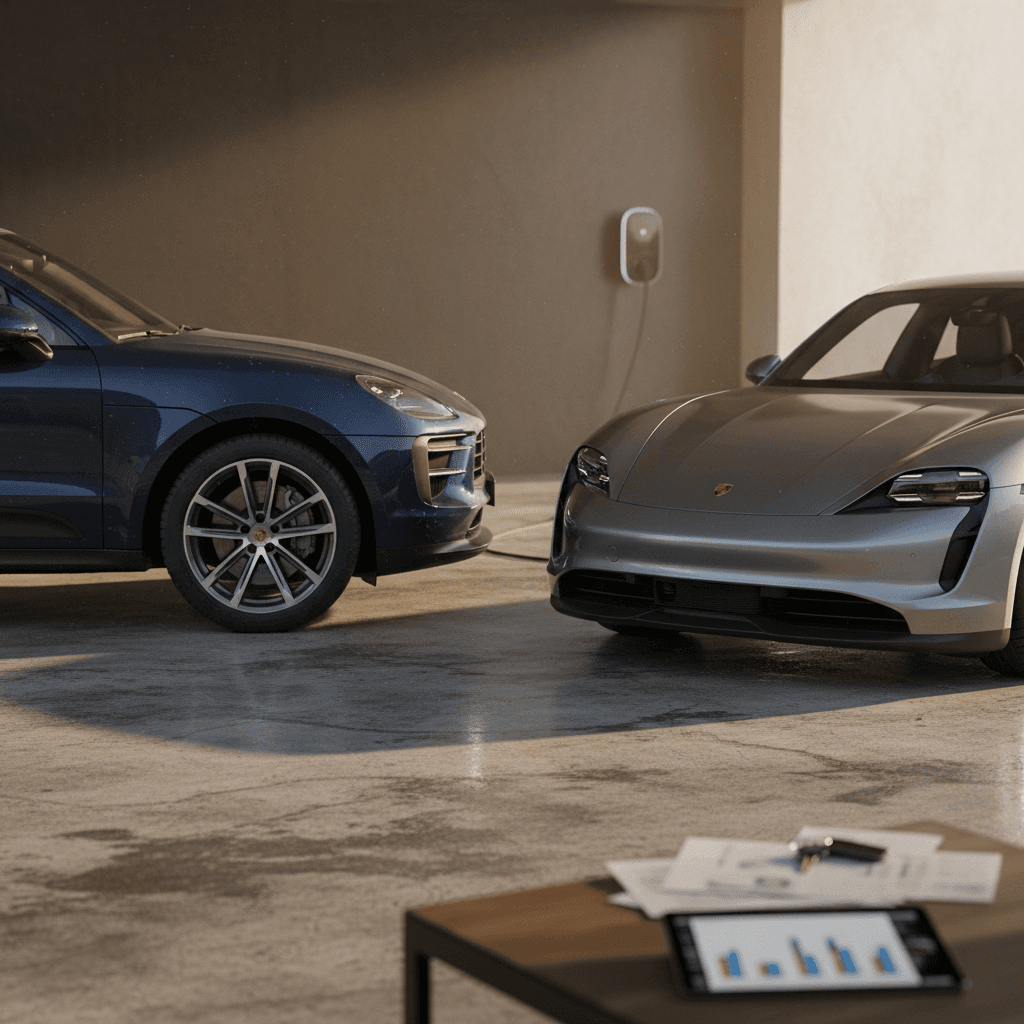
If you love the way your Porsche Macan drives but you’re tired of $4‑a‑gallon fill‑ups, the all‑electric Porsche Taycan can look awfully tempting. The big question is simple: what are the real cost savings when you switch from a Macan to a Taycan, and how long does it take for those savings to add up?
Key takeaway up front
Why drivers consider switching from Macan to Taycan
Common reasons Macan owners look at the Taycan
It’s not just about fuel economy, though that matters a lot.
Running costs
Even with today’s higher electricity prices, energy per mile is typically lower in a Taycan than in a Macan, especially if you can charge at home.
Driving feel
The Taycan delivers instant torque and sports‑car dynamics that are closer to a 911 than a traditional SUV.
Emissions & image
Zero tailpipe emissions, access to HOV lanes in some states, and a more future‑proof image as more cities crack down on combustion engines.
Of course, you’re not just trading fuel for electricity. You’re also moving from a compact SUV to a low, wide sedan, and from a relatively simple gasoline drivetrain to a high‑voltage battery pack. That’s why it’s important to look at the whole ownership picture, not just miles per gallon versus miles per kilowatt‑hour.
Baseline specs and efficiency: Macan vs. Taycan
Macan vs. Taycan: key efficiency metrics
Representative figures for popular trims; your exact numbers will vary by model year, wheel size, and driving style.
| Model | Powertrain | EPA/real-world efficiency | Typical real‑world energy use |
|---|---|---|---|
| Porsche Macan (2.0T / V6) | Gasoline SUV | ~21 mpg combined (19–25 mpg range) | ~0.047–0.053 gal/mi |
| Porsche Taycan RWD / 4S | Battery‑electric sedan | Mid‑70s to low‑80s MPGe combined | ~26 kWh/100 mi (0.26 kWh/mi) |
Efficiency numbers are rounded and based on U.S. EPA and real‑world testing where available.
Mind the model differences
For the rest of this article, we’ll use 21 mpg as a realistic combined figure for a gasoline Macan and 0.26 kWh per mile as a realistic average for a Taycan driven at normal U.S. highway speeds. You can adjust those assumptions later to match your own experience.
Fuel vs. electricity: what you’ll pay per mile
Typical U.S. energy prices in early 2026
Step 1: Macan fuel cost per mile
With a gasoline Macan that averages about 21 mpg and using $4.00 per gallon as a reference point, you can estimate your fuel cost per mile like this:
- Fuel cost per mile = Price per gallon ÷ Miles per gallon
- Fuel cost per mile = $4.00 ÷ 21 ≈ $0.19 per mile
- If you routinely buy premium at $4.50, that jumps to about $0.21 per mile
Step 2: Taycan electricity cost per mile
For a Taycan that uses about 0.26 kWh per mile in mixed driving and charges mostly at home for $0.17/kWh, the math looks like this:
- Electricity cost per mile = kWh per mile × Price per kWh
- Electricity cost per mile = 0.26 × $0.17 ≈ $0.044 per mile (4.4 cents)
- If your electricity is expensive (say $0.25/kWh), that’s roughly $0.065 per mile (6.5 cents)
Quick comparison
Annual and 5‑year cost scenarios
To make the numbers more concrete, let’s look at three mileage scenarios using simple, conservative assumptions. We’ll ignore taxes and fees and just focus on fuel vs. electricity. Later we’ll layer in maintenance and other costs.
Annual energy cost: Macan vs. Taycan
Assumes $4.00/gal gasoline, $0.17/kWh home electricity, 21 mpg for Macan, 0.26 kWh/mi for Taycan, and 90% of Taycan charging done at home, 10% on pricier public DC fast chargers.
| Annual miles | Macan fuel cost | Taycan electricity cost | Estimated annual savings |
|---|---|---|---|
| 8,000 | ≈ $1,520 | ≈ $420 | ≈ $1,100 |
| 12,000 | ≈ $2,280 | ≈ $630 | ≈ $1,650 |
| 15,000 | ≈ $2,850 | ≈ $790 | ≈ $2,060 |
Public DC fast charging is estimated at roughly $0.35/kWh for this example.
Stretch those numbers over five years and the gap gets large very quickly. At 12,000 miles per year, you’re looking at roughly $8,000–$9,000 less spent on energy in the Taycan versus the Macan, assuming today’s average prices and mostly home charging.
When savings can disappear
Maintenance and repairs: where EVs pull ahead
Gasoline Macan
- Oil and filter changes 1–2 times a year.
- Spark plugs, belts, fluids over time.
- Complex drivetrain with turbos, exhaust, emissions hardware.
- More moving parts = more opportunities for out‑of‑warranty repairs.
Porsche Taycan
- No engine, no oil changes, far fewer fluids.
- Brake pads often last longer thanks to regenerative braking.
- Most routine service is inspections, cabin filters, and tires.
- The high‑voltage battery is the big-ticket component, but early data suggests gradual, manageable degradation when properly cared for.
Porsche’s own maintenance schedules and third‑party cost trackers generally show lower routine service and repair costs for EVs compared with similarly powerful gasoline models. On a premium performance SUV like the Macan, it’s not unusual to see $800–$1,200 a year in average maintenance and repair spend once the factory coverage ends. A Taycan that’s still under warranty and maintained properly can often cut that in half.
Typical maintenance savings
Insurance, depreciation and resale value
Energy and maintenance are only part of the story. To decide whether switching from a Macan to a Taycan truly saves money, you also need to think about insurance, depreciation, and resale value.
The other big ownership levers
These items won’t show up on your utility bill but matter just as much to your wallet.
Insurance
EVs can cost a bit more to insure than gas cars in some markets, thanks to higher parts and labor costs. However, switching from a newer Macan to a slightly older Taycan can offset that because insurers price by vehicle value and repair cost, not just powertrain.
Depreciation
New luxury SUVs and EVs both depreciate quickly. The key savings opportunity is in buying used. A 2–4‑year‑old Taycan has already taken the steepest depreciation hit but still offers years of useful life.
Resale value
As cities tighten emissions rules and more buyers prefer electric, a well‑maintained Taycan with documented battery health may be easier to sell than a thirsty gas SUV in some markets.
Where Recharged fits in
Charging at home vs. public networks
Your personal charging mix is the single biggest factor that determines whether switching from a Macan to a Taycan saves hundreds or thousands per year.
How your charging habits change your savings
1. Mostly home charging
If you have a garage or driveway and can install a Level 2 charger, you’ll see the biggest savings. Night‑time charging on a standard residential rate keeps your electricity cost per mile very low.
2. Time-of-use (TOU) plans
Many utilities offer cheaper off‑peak rates overnight. If you can schedule your Taycan to charge only during those hours, your cost per mile drops even further, sometimes below 4 cents per mile.
3. Workplace charging
Free or discounted workplace charging is a hidden gold mine. Even a few free charging days per week can reduce your annual electricity bill by hundreds of dollars.
4. Heavy DC fast‑charging use
If you road‑trip constantly or can’t charge at home and rely on fast chargers at $0.35–$0.50/kWh, your energy savings versus the Macan will shrink. You’ll still avoid oil changes and many engine‑related repairs, but don’t expect a miracle on running costs alone.
Apartment and condo owners
Real‑world ownership examples
Example 1: Suburban commuter (big saver)
Profile: 12,000 miles/year, garage, Level 2 home charger, occasional road trips.
- Macan fuel: ≈ $2,280/year at $4.00/gal.
- Taycan electricity: ≈ $630/year (mostly home, some DC fast charging).
- Maintenance: Macan about $1,000/year; Taycan about $500/year.
Estimated net savings: Around $2,100–$2,300 per year on energy + maintenance alone, before insurance and depreciation.
Example 2: City dweller (modest saver)
Profile: 8,000 miles/year, street parking, heavy use of public DC fast charging.
- Macan fuel: ≈ $1,520/year.
- Taycan electricity: ≈ $700–$900/year (high DC fast‑charge rates).
- Maintenance: Macan about $800/year; Taycan about $500/year.
Estimated net savings: Roughly $400–$800 per year. The emotional and environmental benefits may loom larger than the pure dollars.
For performance‑oriented vehicles, the total cost equation often flips when you look beyond the sticker price. High fuel burn and complex drivetrains make traditional SUVs expensive to run as they age, while well‑chosen EVs get comparatively cheaper per mile the more you drive them.
How to run your own Macan-to-Taycan numbers
Every household is different, and national averages can only take you so far. Fortunately, you can build a personalized Macan‑to‑Taycan cost comparison in less than 10 minutes with a notepad or spreadsheet.
DIY calculation: 6 steps to a personalized answer
1. Capture your true Macan mpg
Use your real‑world number from the trip computer or fuel‑tracking app over a few tanks, not just the EPA sticker. If most of your driving is short‑trip city traffic, 19–20 mpg may be more realistic than 21–22.
2. Note your actual gas price
Look at recent receipts rather than national headlines. If you’re regularly paying $4.50+ for premium, your Macan running costs are on the high side.
3. Estimate your local electricity rate
Check your utility bill for the “$/kWh” line. If you have time‑of‑use rates, write down both on‑peak and off‑peak prices and plan to charge the Taycan during the cheapest hours.
4. Pick a Taycan efficiency assumption
A good starting point is 0.26–0.28 kWh/mi for mixed driving. If you drive mostly freeway at 80+ mph on big wheels, use 0.30–0.32 instead.
5. Run annual energy and maintenance totals
Multiply your per‑mile fuel/electricity cost by your annual miles, then add ballpark maintenance (e.g., $800–$1,200 for Macan, $400–$600 for Taycan). This will give you a reasonable annual operating cost comparison.
6. Layer in financing or cash price
Finally, factor in the difference between what your Macan is worth today and what a comparable Taycan will cost you, especially if you’re looking at a used Taycan. That delta is often the biggest part of the decision.
Use realistic ownership horizons
Shopping smart for a used Taycan
The strongest financial case for switching from a Macan to a Taycan usually involves buying the Taycan used and selling or trading your Macan at a fair market price. That way you let someone else absorb the steepest new‑car depreciation while you reap the ongoing savings.
4 keys to a financially smart Taycan purchase
These factors can matter more than color or options when you’re chasing true cost savings.
Battery health
Battery condition is the single most important factor in a used Taycan. Look for verified state‑of‑health testing, not just a seller’s assurances.
Warranty coverage
Porsche’s high‑voltage battery warranty typically runs 8 years/100,000 miles. A Taycan with several years of coverage left reduces your risk.
Total price vs. Macan value
Compare your Macan’s trade‑in or sale value against the price of the Taycan you’re considering. That difference, plus running costs, is your true cost to switch.
Charging fit
Make sure the Taycan’s range and your local charging options match your lifestyle. The best deal on paper doesn’t help if charging is a daily headache.
How Recharged helps
Ready to find your next EV?
Browse VehiclesFAQ: Switching from Macan to Taycan cost savings
Frequently asked questions
Bottom line: when the switch makes financial sense
If you log average or above‑average miles, can charge mostly at home, and are willing to buy a well‑vetted used Taycan, switching from a Porsche Macan can trim thousands of dollars from your 5‑ to 8‑year cost of ownership, without giving up Porsche performance. On the other hand, if you rarely drive, lack reliable home charging, or would be stretching to afford a new Taycan, the financial advantage may be modest and the decision becomes more about driving feel and emissions than pure dollars.
The smartest path is to run your own numbers, based on your fuel receipts, utility bill, and real‑world mileage, then compare the cost of keeping your Macan against the total cost of moving into a Taycan. If you decide the switch is right for you, a trusted used‑EV marketplace like Recharged, with battery health diagnostics, fair pricing analysis, financing, trade‑in support and nationwide delivery, can make the transition from Macan to Taycan as smooth, transparent, and cost‑effective as possible.