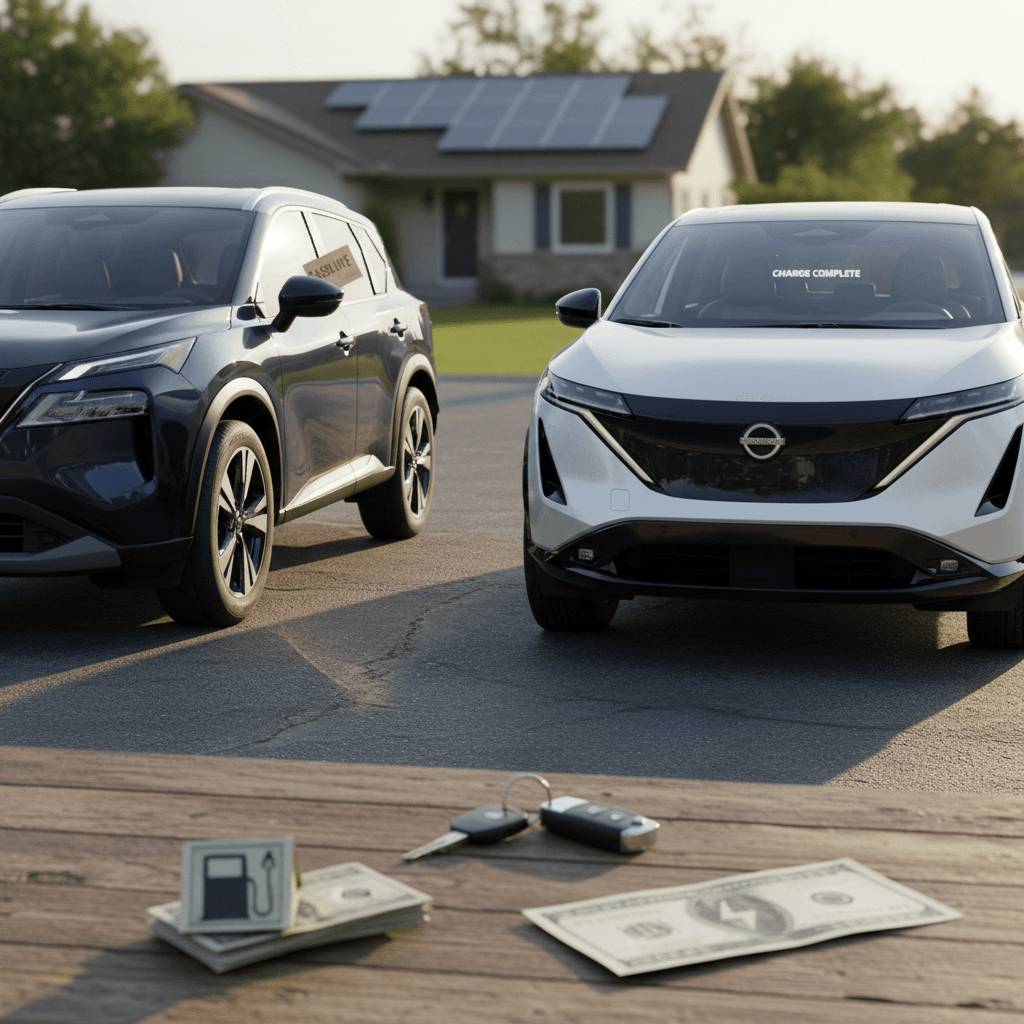
If you’re driving a Nissan Rogue today and wondering whether switching to a Nissan Ariya will actually save you money, you’re asking the right question. The Ariya promises lower fuel and maintenance costs, but EVs often have higher upfront prices. This guide walks through the numbers in plain English so you can see what switching from a Nissan Rogue to a Nissan Ariya really means for your wallet.
Key takeaway in one line
Why Rogue Owners Are Eyeing the Ariya
The Rogue has built its reputation as a comfortable, efficient compact SUV. With EPA combined fuel economy in the low‑30s mpg for recent front‑wheel‑drive models, it’s already one of the thriftier gasoline crossovers on the market. At the same time, the Nissan Ariya brings quiet, all‑electric driving, strong torque, and modern tech, plus a very different cost structure: you trade gas and oil changes for electricity and tires.
Where things get interesting is total cost of ownership over 3–8 years. Fuel prices have been volatile, electricity prices are rising too, and used EV pricing has shifted a lot since 2022. Instead of broad claims, we’ll use realistic U.S. averages and specific Rogue and Ariya trims so you can see where the savings come from, and where they don’t.
Rogue to Ariya: Quick Cost Snapshot (Typical U.S. Driver)
Baseline Assumptions: Rogue vs. Ariya
To talk about cost savings, we need to anchor the discussion to specific versions of each vehicle and realistic U.S. prices as of early 2026. You can adjust the numbers later to match your situation, but this gives you a clear starting point.
Baseline Models and Efficiency Assumptions
Representative late‑model Nissan Rogue and Nissan Ariya setups used for cost comparisons in this article.
| Vehicle | Example Trim (Recent Model Years) | Powertrain | Efficiency (EPA) | Notes |
|---|---|---|---|---|
| Nissan Rogue | SV FWD (2023–2025) | 1.5L turbo gas | ~33 mpg combined | AWD versions are a bit lower (~30–31 mpg) |
| Nissan Ariya | Evolve+ FWD 87 kWh | Single‑motor EV | 34 kWh/100 mi | Equivalent to ~3.0 mi/kWh |
| Nissan Ariya | Engage FWD 63 kWh | Single‑motor EV | 31–32 kWh/100 mi | Slightly more efficient, shorter range |
You don’t have to match these trims exactly, but staying close keeps the math realistic.
For energy prices, we’ll use rough but grounded national averages for the United States:
- Gasoline: $3.75–$4.00 per gallon national average in recent years, with big swings by state.
- Electricity (home): $0.16–$0.18 per kWh average residential price in late 2024–2025, with cheaper rates in some regions and much higher in places like California or the Northeast.
- Public DC fast charging: Often equivalent to paying $0.35–$0.50 per kWh or more; convenient for trips but not where you want most of your miles.
Your local prices matter
Fuel vs. Electricity: Cost per Mile
Let’s put the Rogue and Ariya on equal footing: cost per mile just to move the vehicle down the road. This is where EVs usually shine, and the Ariya is no exception.
Gasoline vs. Electricity: Cost per Mile
Using realistic U.S. averages for a late‑model Rogue and Ariya
Nissan Rogue fuel cost per mile
Assumptions:
- 33 mpg combined
- Gas at $3.75 per gallon
Math: $3.75 ÷ 33 ≈ $0.11 per mile
At $4.25/gal, that climbs to about $0.13 per mile. Heavy city driving or AWD can easily nudge it higher.
Nissan Ariya electricity cost per mile
Assumptions:
- 34 kWh/100 miles (Ariya Evolve+ FWD)
- Home electricity at $0.17/kWh
Math: 34 kWh × $0.17 = $5.78 per 100 miles → about $0.058 per mile.
Even at 20¢/kWh, you’re at about $0.068 per mile.
Rule of thumb
What if you rely on public DC fast charging?
Fast charging is a different story. At 40–50¢/kWh, that same Ariya could cost $0.14–$0.17 per mile in energy, more than gasoline in some markets. That’s why most EV savings calculations assume:
- Home or workplace charging for 70–90% of miles
- DC fast charging just for road trips or occasional top‑ups
Blended energy cost for realistic use
If you do 85% of your miles at home and 15% on DC fast charging, your blended electricity cost per mile might land in the 7–9¢ per mile range, still better than the Rogue on $3.75–$4.00 gas, but not as dramatic as home‑charging only.

Annual Savings by Driving Profile
Not everyone drives the same way. A 9‑mile city commute three days a week looks very different from a 70‑mile daily highway slog. Here are three common profiles to show how switching from a Nissan Rogue to a Nissan Ariya can change your annual fuel/energy bill.
Estimated Annual Energy Cost: Rogue vs. Ariya
Approximate fuel/electricity cost by annual mileage and usage pattern, assuming $3.75/gal gas and $0.17/kWh home electricity with limited DC fast charging.
| Profile | Annual Miles | Rogue Fuel Cost | Ariya Energy Cost | Approx. Annual Savings |
|---|---|---|---|---|
| Light commuter | 8,000 | $880–$960 | $460–$650 | $300–$500 |
| Typical driver | 12,000 | $1,320–$1,440 | $700–$950 | $500–$750 |
| Heavy commuter/road‑warrior | 20,000 | $2,200–$2,400 | $1,150–$1,600 | $900–$1,300 |
These are ballpark figures, not promises, use them as a starting point, then plug in your own numbers.
How to personalize these numbers
Maintenance and Repair Savings
Energy isn’t the whole story. One reason EVs like the Ariya have become so appealing to Rogue owners is their simpler mechanical layout. No engine, no transmission with complex gearsets, no exhaust system, no spark plugs, and far fewer fluids to service.
Where the Ariya Saves You Money on Maintenance
Comparing typical costs over 5 years of ownership
Oil & engine service
Rogue: Oil changes every 5,000–7,500 miles, plus engine air filters, spark plugs, belts, and more over time.
Ariya: No oil changes, no spark plugs, no timing chain or belts. You still have cabin air filters and coolant, but far fewer line items.
Transmission & drivetrain
Rogue: CVT fluid services and potential long‑term wear concerns.
Ariya: Single‑speed reduction gear with far fewer moving parts. Routine fluid checks but dramatically lower complexity.
Brakes & wear items
Both: Tires and brake pads still wear.
Ariya advantage: Regenerative braking means pads usually last much longer than on an ICE vehicle driven the same way.
Independent analyses of EV vs. ICE maintenance often show 25–40% lower routine maintenance costs for EVs over the first 5–8 years, depending on driving conditions. For a Rogue‑to‑Ariya switch, that commonly translates to $200–$400 per year in avoided oil changes, engine services, and brake work, sometimes more if you drive a lot or use dealer service pricing.
Don’t forget tires
Total Cost of Ownership and Payback
So far, we’ve looked at energy and maintenance in isolation. The real question many Rogue owners ask is: “If I buy an Ariya, when do the savings offset the higher price?” That depends heavily on whether you buy new or used, and what your Rogue is worth today.
Example 5‑Year Cost of Ownership Scenarios
Simplified scenarios comparing a late‑model Rogue and a comparable Ariya, assuming 12,000 miles/year and typical U.S. pricing. These figures exclude tax and registration and use ballpark values, not quotes.
| Scenario | Vehicle Purchase Price | 5‑yr Fuel/Energy | 5‑yr Maintenance | 5‑yr Total (excl. tax) |
|---|---|---|---|---|
| Keep Rogue (paid off) | $0 (already own) | $6,600–$7,200 | $2,000–$2,500 | $8,600–$9,700 |
| Buy used Ariya (e.g., $28k) | $28,000 | $3,500–$4,500 | $1,000–$1,500 | $32,500–$34,000 |
| Buy new Ariya (e.g., $40k) | $40,000 | $3,500–$4,500 | $1,000–$1,500 | $44,500–$46,000 |
Use this as a framework, not a precise forecast, market prices and incentives change quickly.
Looked at this way, if your Rogue is paid off and still in good shape, the purely financial payback period for buying a new Ariya can be long. That doesn’t mean it’s a bad move; it just means most of the value comes from fuel/maintenance savings plus comfort, performance, tech, and emissions reduction, not from beating a zero‑payment Rogue on monthly cost.
Where the math flips in the Ariya’s favor
Insurance, Taxes, and Fees
Beyond fuel and maintenance, a handful of line items can move the needle a bit when you switch from a Rogue to an Ariya:
- Insurance: EVs sometimes cost more to insure because of higher repair costs and expensive electronics. In other regions, the difference is modest. Get real quotes on both vehicles before you decide.
- Registration and property tax: Some states charge extra annual fees for EVs to replace lost gas‑tax revenue. Others offer discounts or lower registration for efficient vehicles. Check your state’s DMV or DOT website.
- Incentives and rebates: Federal, state, and utility incentives can dramatically narrow the price gap between a Rogue and Ariya. Many of these now apply to used EVs under certain price and income caps, which is exactly where Recharged focuses.
Always look at the "out the door" picture
Real-World Variables That Change the Math
No two Rogue owners have identical lives. A few real‑world factors can make your switch to an Ariya either a slam‑dunk or a slower burn in financial terms.
Four Factors That Can Make or Break Your Savings
Think through these before you make the jump
1. Home charging access
Owning an Ariya without reliable home or workplace charging is like owning a gas car with no station in your town. If you can install a Level 2 charger or at least use a 120V outlet overnight, your cost per mile drops dramatically compared to living on public DC fast chargers.
2. Your commute and driving style
Long, steady‑speed drives at moderate highway speeds favor EV efficiency. Short hops with lots of idling hurt the Rogue’s mpg and make the Ariya look even better. Aggressive driving cuts into savings in either vehicle, but the Ariya’s torque makes it tempting, keep an eye on that right foot.
3. Electricity plan and time‑of‑use rates
Some utilities offer cheaper overnight EV charging rates. If you can shift most of your charging to off‑peak hours, your effective cost per mile with an Ariya can sink well below the national averages in this article.
4. Local gas‑vs‑power price spread
In high‑gas‑price, moderate‑electricity‑price regions, the Ariya’s advantage snowballs. In areas with cheap gas and expensive electricity, the savings shrink and your decision leans more on driving experience, tech, and emissions than on pure dollars.
How Buying Used with Recharged Changes the Equation
One of the biggest wild cards in any cost‑of‑ownership comparison is what you actually pay for the vehicle and how confident you are in its battery health. That’s where a used Nissan Ariya, purchased through a specialist like Recharged, can tilt the numbers in your favor.
What Recharged adds to a used Ariya purchase
Ready to find your next EV?
Browse VehiclesDriving down the upfront cost
Used Ariya prices have come down significantly compared with the early launch years. Buying a 1–3‑year‑old Ariya through Recharged can:
- Cut thousands off the original MSRP
- Reduce your loan amount and monthly payment
- Still leave plenty of warranty coverage for peace of mind
That narrows or even erases the price gap vs. a comparable late‑model Rogue.
Making the trade-in painless
If you’re moving out of a Rogue, Recharged can help you trade in, get an instant offer, or sell on consignment, then use that equity toward your Ariya. Because the entire process is digital, with an Experience Center in Richmond, VA if you want a physical touchpoint, you can run the numbers from your sofa before you ever commit.
Step-by-Step: How to Evaluate Your Own Savings
To move from theory to your exact situation, you only need a few data points. Here’s a simple, repeatable process you can use, or share with a trusted advisor at your credit union, bank, or Recharged specialist.
DIY Rogue-to-Ariya Savings Calculation
1. Gather your real driving data
Look at your last year of mileage from service records, oil‑change stickers, or your instrument cluster. If that’s not handy, estimate based on your weekly routine, then multiply by 52.
2. Write down your Rogue’s true mpg
Use your trip computer’s long‑term average or calculate manually (miles driven ÷ gallons pumped). EPA stickers are a good starting point, but real‑world numbers make for better math.
3. Pull current gas and electricity rates
Check recent gas receipts for your price per gallon. For electricity, look at your utility bill for your rate in cents per kWh. If you have time‑of‑use pricing, use the off‑peak rate you’d likely charge at.
4. Estimate Ariya efficiency
A reasonable planning number for most Ariya trims is <strong>3.0 mi/kWh</strong> in mixed driving. If you tend to drive fast on the highway or in harsh climates, use 2.6–2.8 mi/kWh to be conservative.
5. Calculate annual fuel vs. electricity cost
For the Rogue: (Annual miles ÷ mpg) × gas price. For the Ariya: (Annual miles ÷ mi/kWh) × kWh price. The difference is your annual fuel/energy savings.
6. Layer in maintenance differences
Estimate what you typically spend on oil changes, engine service, and brakes for the Rogue over a year. Subtract what you expect to spend on an Ariya (usually 25–40% less on routine maintenance). That gives you a more complete annual savings number.
7. Compare vehicles you can actually buy
Finally, compare a specific Ariya you’re considering, new or used, to your Rogue’s current value. A Recharged advisor can help you weigh purchase price, trade‑in value, financing, and expected savings side by side so you see the full picture.
FAQ: Switching from Rogue to Ariya
Frequently Asked Questions
Bottom Line: Is Switching from Rogue to Ariya Worth It?
If you drive a typical amount, have reliable home charging, and can find a fairly priced Ariya, especially a used one with strong battery health, the annual savings over a Nissan Rogue can be substantial. Fuel and routine maintenance alone can easily put $1,000–$1,800 per year back in your pocket, and that’s before factoring in potential incentives.
On the other hand, if your Rogue is paid off, you drive relatively little, or you’d be stuck relying on expensive public fast charging, the financial argument becomes softer and the decision leans more on how much you value the Ariya’s smooth, quiet drive and tech features.
The smartest move is to run your own numbers with the framework in this guide, then compare real vehicles you can actually buy. If you want help pressure‑testing your assumptions, exploring a used Ariya with verified battery health, or figuring out what your Rogue is worth as a trade‑in or consignment, a Recharged EV specialist can walk you through the details so your decision is based on math, not marketing.