If you’re driving an Audi Q7 and eyeing the all-electric Audi Q8 e-tron, you’re probably wondering one thing: will switching from a Q7 to a Q8 e-tron actually save you money, or is it just a feel-good upgrade? This guide breaks down real-world fuel, electricity, maintenance, and ownership costs so you can see the potential cost savings of switching from an Audi Q7 to an Audi Q8 e-tron, especially if you buy used.
Assumptions We’ll Use
Why Switch from an Audi Q7 to a Q8 e-tron?
- You want to cut fuel bills without giving up a quiet, comfortable luxury SUV.
- You drive mostly in the city or suburbs where EV efficiency shines.
- You’re ready to take advantage of lower maintenance costs and EV incentives.
- You’re thinking about long‑term resale and want to be on the right side of the gas‑to‑electric shift.
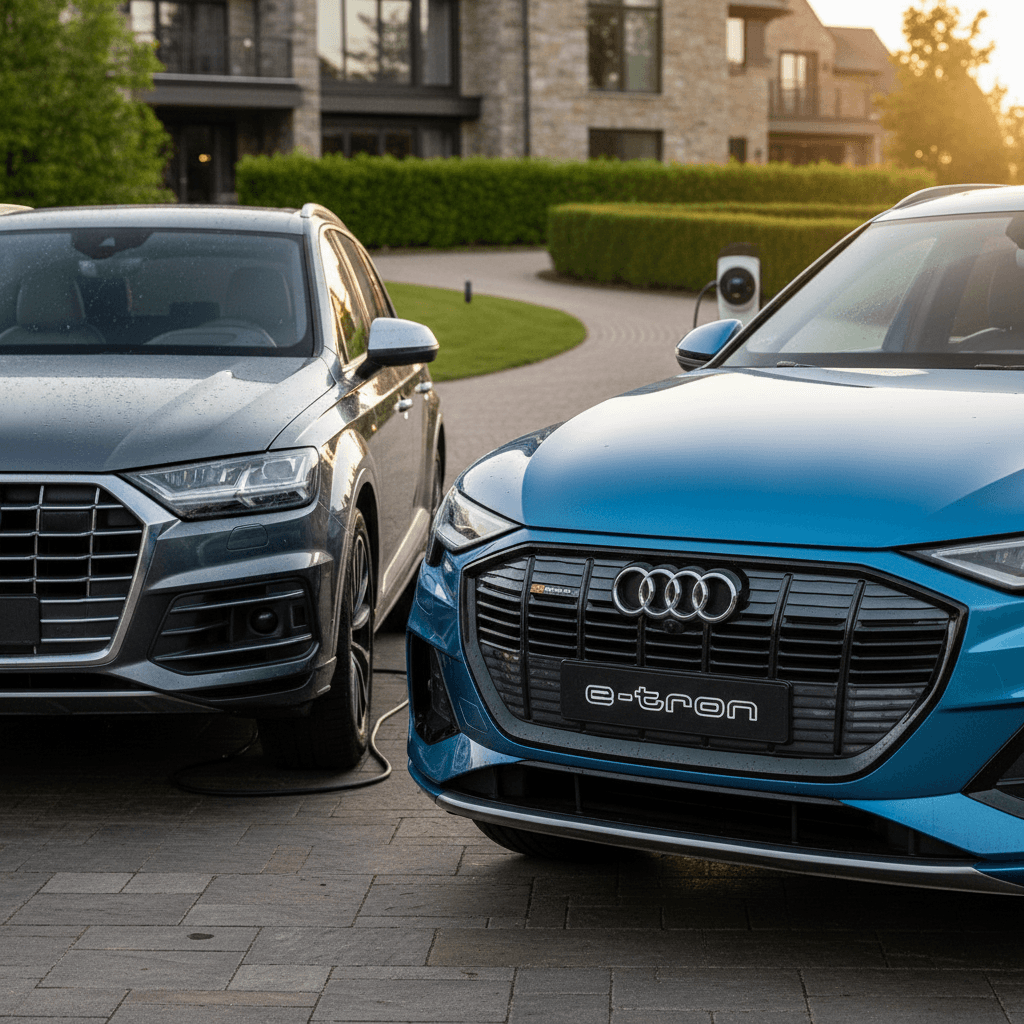
The Q8 e-tron is effectively the electric evolution of the Q7 formula: three-row comfort in the Q7 vs a more coupe-like, two-row layout in many Q8 e-tron configs, strong highway capability, and the premium cabin Audi is known for. The difference is what’s under the floor, an electric battery pack and motors instead of a turbocharged gas V6 or V8, and that’s where your ongoing costs change dramatically.
Key Specs: Audi Q7 vs Audi Q8 e-tron
Audi Q7 vs Audi Q8 e-tron: At-a-Glance Specs
High-level specifications that affect running costs and day-to-day experience.
| Model | Powertrain | Combined Efficiency | Battery / Tank | Est. Range | Drivetrain |
|---|---|---|---|---|---|
| Audi Q7 (gas, typical V6) | Gasoline turbo V6 | ~20 mpg combined | ~22 gal fuel tank | ~400 miles | AWD |
| Audi Q8 e-tron | Dual-motor electric | ~2.5–3.0 mi/kWh | ~106–115 kWh battery (usable lower) | ~270–300 miles (EPA est.) | AWD |
Exact figures vary by model year and powertrain; always check the window sticker or manufacturer data for your specific vehicle.
Spec Sheet Isn’t the Whole Story
Fuel vs Electricity: What You’ll Really Spend
This is where the cost savings of switching from an Audi Q7 to an Audi Q8 e-tron really start to show. Let’s use those 12,000 miles per year and today’s average U.S. prices to keep things concrete.
Estimated Annual Energy Costs (12,000 Miles/Year)
Broken down per mile, that’s roughly $0.19 per mile in fuel for the Q7 vs about $0.05–$0.06 per mile in electricity for the Q8 e-tron when you primarily charge at home. Even if you do some fast charging on the road at higher kWh prices, the Q8 e-tron almost always comes out ahead on pure energy cost.
Watch Your Fast-Charging Habits
Maintenance and Repairs: Where EVs Quietly Win
Typical Audi Q7 Maintenance
- Regular oil and filter changes
- Transmission fluid service
- Complex turbocharged engine components
- Exhaust system, emissions components, and fuel system
- Higher likelihood of out-of-warranty repairs with age
Typical Audi Q8 e-tron Maintenance
- No engine oil, spark plugs, or exhaust system
- Simple single-speed gearbox vs multi-gear transmission
- Brake wear reduced by regenerative braking
- Focus on tires, cabin filters, brake fluid, and inspections
Over 5 years, many owners see maintenance and repair spending drop by 30–50% when moving from a premium gas SUV like the Q7 to a comparable EV like the Q8 e-tron. You’ve removed many of the big-ticket items, engine, transmission, emissions hardware, that tend to generate four‑figure repair bills as a vehicle ages.
Battery Health Matters
Insurance, Depreciation, and Resale Value
Insurance on an Audi Q8 e-tron is often similar to a Q7 in the same driver’s hands, sometimes slightly higher due to parts and repair network differences, sometimes a touch lower thanks to advanced safety tech. The bigger financial story is depreciation.
How Depreciation Affects Your Switch
Why a used Q8 e-tron can be a smart buy even if new EVs drop quickly in value.
New EV Hit, Used EV Advantage
Q7: Gas SUVs Under Pressure
Total Cost of Ownership
Don’t Obsess Over Resale Alone
Tax Credits and Incentives When You Switch
In the U.S., federal and state incentives can dramatically change your real-world cost of switching from an Audi Q7 to an Audi Q8 e-tron. The landscape shifts often, but there are three main buckets to look at:
- Federal tax credits on new EVs – Depending on current rules and final assembly location, some new Q8 e-tron configurations may qualify for a federal tax credit if you meet income and price caps.
- Used EV tax credit – Buying a qualifying used EV from a dealer at or below specific price caps may unlock a separate, smaller federal credit, subject to income limits.
- State and utility incentives – Many states and utilities offer rebates on EV purchases, home chargers, or electricity rates that favor off‑peak charging.
Stack the Deck in Your Favor
5‑Year Cost Comparison: Sample Q7 vs Q8 e-tron
Let’s put all of this into a simple, big-picture example. We’ll compare keeping a paid-off Audi Q7 vs moving into a used Audi Q8 e-tron over 5 years, driving 12,000 miles per year. These are rounded, illustrative numbers, not a quote, but they’ll show you the direction of travel.
Illustrative 5‑Year Cost Comparison (12,000 Miles/Year)
High-level example for a typical U.S. driver. Numbers rounded for clarity and will vary by region, driving style, and vehicle condition.
| Cost Category (5 Years) | Audi Q7 (Gas) | Audi Q8 e-tron (Electric) |
|---|---|---|
| Fuel / Electricity | ≈$11,250 | ≈$3,200 |
| Maintenance & Repairs | ≈$7,000 | ≈$4,000 |
| Total Energy + Maintenance | ≈$18,250 | ≈$7,200 |
| Estimated Net Savings | , | ≈$11,000 saved vs Q7 |
Assumes mostly home charging for the Q8 e-tron and average fuel and electricity prices. Financing costs not included.
Your Numbers Will Differ
How Buying Used Audi Q8 e-tron Multiplies the Savings
Buying a new EV strictly for cost savings over a fully paid-off gas SUV can be a tougher financial case. But buying a used Audi Q8 e-tron changes the equation: you capture both the operating-cost savings and a much lower upfront price because the steepest depreciation is already in the rearview mirror.
Why a Used Q8 e-tron Is Often the Sweet Spot
You get the luxury EV experience without paying new-car depreciation.
Lower Purchase Price
Known Battery Condition
Flexible Financing & Trade‑In
Where Recharged Fits In
Ready to find your next EV?
Browse VehiclesChecklist: What to Do Before You Switch
Pre‑Switch Checklist: From Audi Q7 to Q8 e-tron
1. Map Your Driving Pattern
Write down how many miles you drive per week, how often you take long trips, and where you typically park overnight. This will help you decide if the Q8 e-tron’s range and charging fit your lifestyle.
2. Estimate Your Energy Costs
Use your local gas price, your electricity rate, and your annual mileage to run your own numbers. Even a simple spreadsheet comparing $/mile for the Q7 vs Q8 e-tron will be eye‑opening.
3. Check Home Charging Options
Confirm whether you already have (or can install) a 240V outlet or Level 2 charger at home. If not, factor in installation cost, but remember, you’ll likely recoup that through fuel savings over a few years.
4. Review Incentives and Tax Credits
Look up current federal, state, and utility incentives for EVs and home charging. If a used EV tax credit applies to the Q8 e-tron you’re considering, bake that benefit into your budget.
5. Get a Trade‑In or Instant Offer on Your Q7
Obtain quotes for your Q7 from multiple sources. Recharged can provide an <strong>instant offer or consignment option</strong>, helping you maximize your Q7’s value and reduce your out‑of‑pocket cost for the switch.
6. Compare Specific Q8 e-tron Vehicles
Don’t just shop by price. Compare <strong>battery health, warranty coverage, trim level, and charging equipment included</strong>. A transparent marketplace with reports like the Recharged Score makes this much easier.
FAQ: Switching from Audi Q7 to Audi Q8 e-tron
Frequently Asked Questions
Is Switching from a Q7 to a Q8 e-tron Worth It?
If you like the size, comfort, and image of your Audi Q7 but want to spend far less on fuel and maintenance, switching to an Audi Q8 e-tron can absolutely be worth it, especially if you buy used at the right price. For a typical driver, it’s reasonable to see around $10,000 or more in five‑year operating‑cost savings, plus the everyday convenience of charging at home instead of filling up at the pump.
The key is to run your own numbers, shop intelligently, and insist on transparency, especially around battery health and pricing. That’s exactly where a platform like Recharged shines, pairing used Audi Q8 e-tron inventory with verified Recharged Score reports, fair market pricing, expert EV guidance, and flexible financing. Do that, and your move from Q7 to Q8 e-tron won’t just feel like a technological upgrade; it’ll look like a smart financial decision on your spreadsheet too.