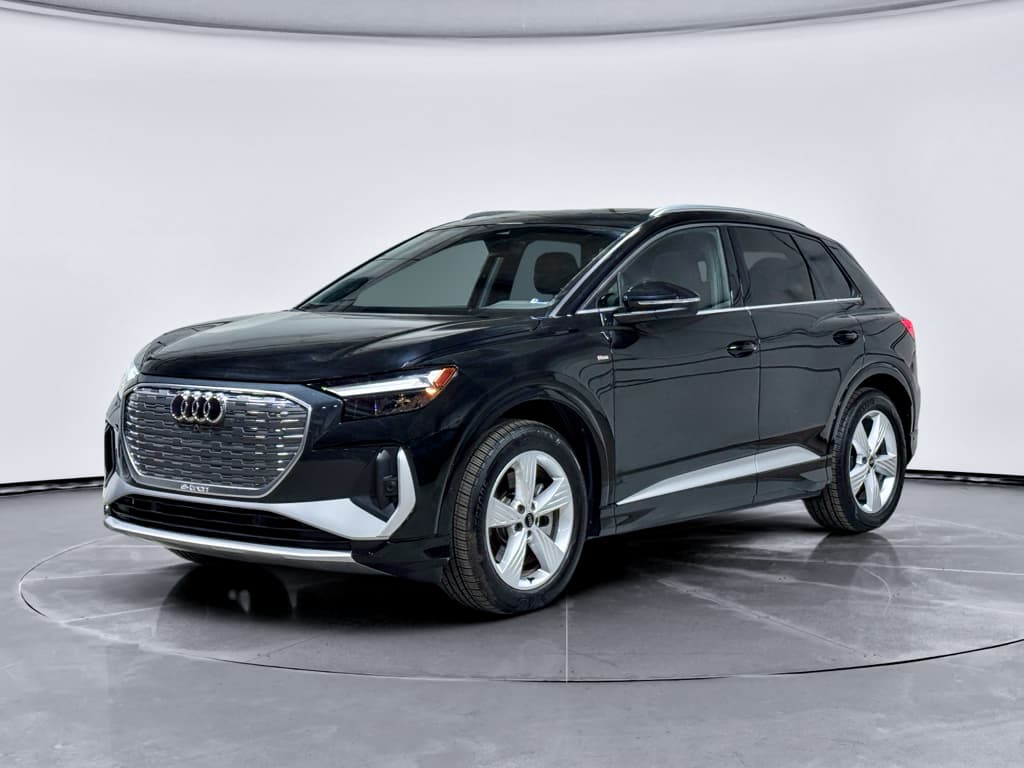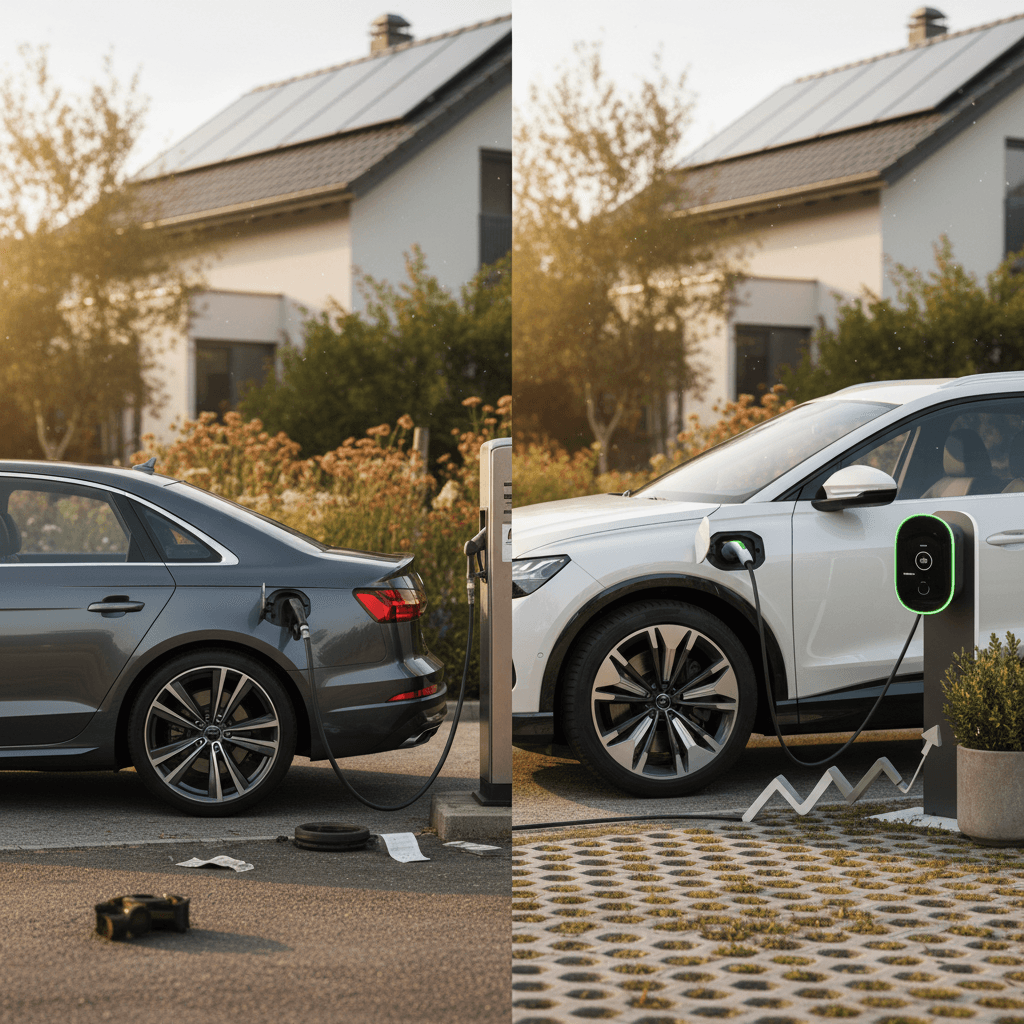
If you’ve spent years in an Audi A4, you already know what a well-sorted German sedan feels like. The question now is whether switching from an Audi A4 to an Audi Q4 e-tron actually saves you money, or just swaps gas bills for an even bigger car payment. Let’s walk through the numbers like adults in a world of $4 gas and 18¢ electricity.
Assumptions Up Front
Why Audi A4 Owners Are Eyeing the Q4 e-tron
The A4 is the classic answer for people who like to drive but also like to arrive with their spine intact. The Q4 e-tron takes that familiar Audi vibe, quiet, tight, understated, and electrifies it, literally. You move from a lean, efficient turbo-four to a battery pack and one or two electric motors, plus a higher seating position that the market has irrationally decided is mandatory for school runs.
Top Reasons A4 Drivers Consider the Q4 e-tron
Comfort and character stay Audi; the drivetrain goes future-forward.
Energy Costs
Gas is volatile and usually trending one way: up. Electricity tends to move more slowly and can be cheaper per mile, especially if you can charge at home off-peak.
Lower Upkeep
No oil changes, fewer moving parts, and less brake wear thanks to regen. EVs often run cheaper to maintain over the long haul.
More Space, Same Badge
The Q4 e-tron gives you compact-SUV practicality with familiar Audi fit and finish. Think A4 comfort, but with a hatch and real rear headroom.
Think in Total Cost, Not Just Payment
Key Specs: Audi A4 vs Audi Q4 e-tron
Let’s ground this in something roughly representative: a 2020–2024 Audi A4 2.0T quattro versus a 2022–2025 Audi Q4 40/50 e-tron. Exact numbers will vary by year and trim, but this is close enough for a household budget.
Audi A4 vs Audi Q4 e-tron: At-a-Glance Specs
Representative specs for recent-model A4 2.0T and Q4 e-tron in the U.S.
| Metric | Audi A4 2.0T (gas) | Audi Q4 e-tron (electric) |
|---|---|---|
| Layout | Compact sedan | Compact SUV |
| Drivetrain | 2.0L turbo gas, quattro AWD | Single or dual-motor electric |
| EPA efficiency | ~30 mpg combined | ~3.0 mi/kWh (≈33 kWh/100 mi) |
| Typical real-world range | 400+ miles per tank | 210–240 miles per charge |
| Fuel/energy type | Premium gasoline | Electricity (mostly home charging) |
These aren’t brochure-perfect numbers; they’re useful ballpark figures.
Where the Big Cost Differences Show Up
Energy Cost Per Mile: Gas vs Electric
This is where the Q4 e-tron starts paying rent. It doesn’t do drama or exhaust. It does quiet, repeatable cheap miles.
Audi A4: Paying the Premium for Premium
Recent A4 2.0T models are efficient for what they are, posting around 30 mpg combined in real-world use.
- Assumed fuel economy: 30 mpg
- Assumed fuel price: $3.75/gal for premium
- Cost per mile: $3.75 ÷ 30 ≈ $0.13/mi
Drive 12,000 miles a year and you’re looking at roughly $1,500–$1,600 annually in fuel, assuming prices don’t suddenly get cute again.
Audi Q4 e-tron: Paying for Electrons
The Q4 e-tron, in U.S. spec, realistically returns about 3.0 mi/kWh in mixed driving for most owners.
- Assumed efficiency: 3.0 mi/kWh
- Average home electricity: ≈$0.17/kWh in 2025–2026 U.S. averages
- Cost per mile: $0.17 ÷ 3.0 ≈ $0.06/mi
At 12,000 miles a year, that’s about $700–$750 in electricity, mostly billed quietly to your utility instead of the gas station.
Public DC Fast Charging Can Spoil the Party
Five-Year Cost Comparison: A4 vs Q4 e-tron
Nobody buys a Q4 e-tron to win on year one spreadsheet theater. You buy it because it changes what the next five to seven years of driving look like. Here’s a simplified 5‑year snapshot using our assumptions and 60,000 miles of driving.
Estimated 5-Year Ownership Costs (60,000 Miles)
Illustrative comparison for a recent Audi A4 vs a comparable Audi Q4 e-tron, excluding taxes and fees.
| Category (5 yrs) | Audi A4 (gas) | Audi Q4 e-tron (EV) | Notes |
|---|---|---|---|
| Fuel / Electricity | ≈$8,400 | ≈$3,600 | A4 at $0.14/mi, Q4 at $0.06/mi, 60,000 miles |
| Routine Maintenance | ≈$4,000 | ≈$2,200 | Oil, filters, fluids vs. tires, cabin filters, brake fluid |
| Unexpected Repairs (out of warranty) | ≈$2,000 | ≈$1,200 | Conservative allowance; EVs still have suspensions and HVACs to fix |
| Total Running Costs | ≈$14,400 | ≈$7,000 | Energy + maintenance + light repairs |
| Average per Year | ≈$2,880 | ≈$1,400 | Not including insurance, financing, or depreciation |
Your actual numbers will vary with local prices, insurance history, and exactly which model year and trim you pick.
Headline Takeaway
How Buying a Used Audi Q4 e-tron Changes the Math
New EVs carry a sticker shock penalty, and the Q4 e-tron is no exception. But the used market quietly fixes a lot of that. Early depreciation has already done its undignified swan dive; you get most of the EV benefits without the biggest chunk of new-car pain.
Why a Used Q4 e-tron Often Makes the Strongest Financial Case
Depreciation works in your favor, if you buy intelligently.
Let Someone Else Take the Big Depreciation Hit
Like most luxury cars, new Q4 e-trons drop sharply in the first 3 years. Buying used means you’re stepping in after that cliff, when depreciation flattens and total cost of ownership becomes more predictable.
Battery Health You Can Actually Measure
With Recharged, every used EV, including the Q4 e-tron, comes with a Recharged Score and a battery health report. You’re not guessing about pack degradation; you’re looking at data, which is how you should treat a four‑figure component.
How Recharged De-Risks Used EVs

Maintenance and Repairs: Where EVs Really Win
The A4 is not a fragile car, but it is a complex gasoline machine that burns fuel at 2,000°F. The Q4 e-tron is, by comparison, a rolling smartphone: software, bearings, and a big battery.
- No oil changes: The A4 needs synthetic oil and filters multiple times a year; the Q4 doesn’t.
- Fewer fluids: The EV still has brake fluid and coolant for the battery/drive unit, but the fluid schedule is sparser.
- Brakes last longer: Regenerative braking means pads and rotors live an easier life, especially in city driving.
- Emissions hardware disappears: No catalytic converters, O2 sensors, or exhaust systems to age, rattle, and throw codes.
The Big, Expensive Elephant: The Battery Pack
Other Factors: Insurance, Depreciation, and Tax Credits
Insurance and Depreciation
Insurance on a Q4 e-tron can run slightly higher than on an equivalent A4, there’s more tech in the bodywork and different repair networks. That might add a few hundred dollars a year depending on your record and ZIP code.
Depreciation is trickier. EVs have historically dropped faster than gas cars, but the curve is flattening as demand normalizes and battery longevity proves itself. Buying used, at a fair price, is the easiest way to avoid being the one funding the steepest part of that curve.
Incentives and Tax Breaks
Federal and state incentives change often, but many buyers still qualify for EV tax credits, utility rebates, or discounted home charging installation.
- Some used EVs qualify for a partial federal credit or state-level rebates.
- Utilities increasingly offer off‑peak EV charging rates that effectively lower your cost per kWh.
- Cities and employers may throw in free or subsidized public charging.
These aren’t guaranteed, but when they apply, they act like retroactive discounts on the Q4 e-tron’s higher purchase price.
Checklist: Should You Switch from an A4 to a Q4 e-tron?
Run Through This Before You Trade Keys
1. Confirm Your Charging Situation
Do you have reliable access to home or workplace charging? A simple 240V outlet in a garage or driveway is enough to unlock the Q4 e-tron’s cost savings. If you’ll rely mostly on pricey fast chargers, the math gets weaker.
2. Look at Your Real Annual Mileage
If you drive 8,000 miles a year, the fuel savings are modest. At 15,000–20,000 miles, the Q4 e-tron’s low per‑mile energy cost becomes a headline feature.
3. Price Out a Used Q4 e-tron
Compare a used Q4 e-tron on Recharged to what your current A4 is worth. The difference, after financing, is the gap your fuel and maintenance savings need to close over 4–6 years.
4. Factor in Your Local Energy Prices
If you live somewhere with sky‑high electricity and cheap gas, the advantage shrinks. In most of the U.S., though, home charging still undercuts gasoline on a cost‑per‑mile basis.
5. Think About How Long You’ll Keep It
If you tend to swap cars every two years, you won’t fully harvest the EV’s low operating costs. If you keep cars five to eight years, the Q4 e-tron starts to look like the more rational long‑term tool.
6. Decide How Much You Value Quiet and Effortless Torque
Numbers aside, the Q4 e-tron drives differently: near‑silent, instant response, one‑pedal feel in traffic. If that appeals to you as much as the savings, the case gets much stronger.
How Recharged Helps A4 Drivers Move into a Q4 e-tron
Moving from a gas Audi to an electric Audi is as much an education problem as a financial one. Recharged is built for exactly this kind of transition.
What Recharged Brings to Your A4 → Q4 e-tron Switch
Not just another classifieds site, an EV‑focused ownership partner.
Battery Health Transparency
Every Q4 e-tron on Recharged comes with a Recharged Score Report that includes verified battery diagnostics, so you know how the pack is aging before you buy.
Financing and Trade-In in One Place
You can finance your Q4 e-tron, get an instant offer or consignment option for your Audi A4, and line up a payment that reflects your lower running costs.
Nationwide Delivery & Local Expertise
Shop digitally from anywhere in the U.S., or visit the Recharged Experience Center in Richmond, VA. EV‑specialist advisors walk you through charging, incentives, and daily use.
Ready to find your next EV?
Browse VehiclesPre-Qualify Before You Fall in Love
FAQ: Switching from Audi A4 to Audi Q4 e-tron
Frequently Asked Questions
Bottom Line: Is the Q4 e-tron Worth the Switch?
If you treat cars like three‑year appliances, the Audi A4 is still a defensible choice: easy to fuel, easy to resell, utterly familiar. But if you’re planning the next five to eight years of driving, and you have reliable access to home or workplace charging, the Q4 e-tron quietly becomes the more rational instrument. It turns $4 gasoline into roughly half‑price electrons, trims your maintenance schedule, and gives you more space without abandoning the Audi feel you bought into in the first place.
Buy it right, ideally as a used Q4 e-tron with verified battery health and sensible financing, and the higher purchase price stops looking like indulgence and starts looking like insulation from rising operating costs. That’s where Recharged comes in: transparent pricing, real battery data, and EV‑savvy support from your A4 trade‑in to your first overnight charge.