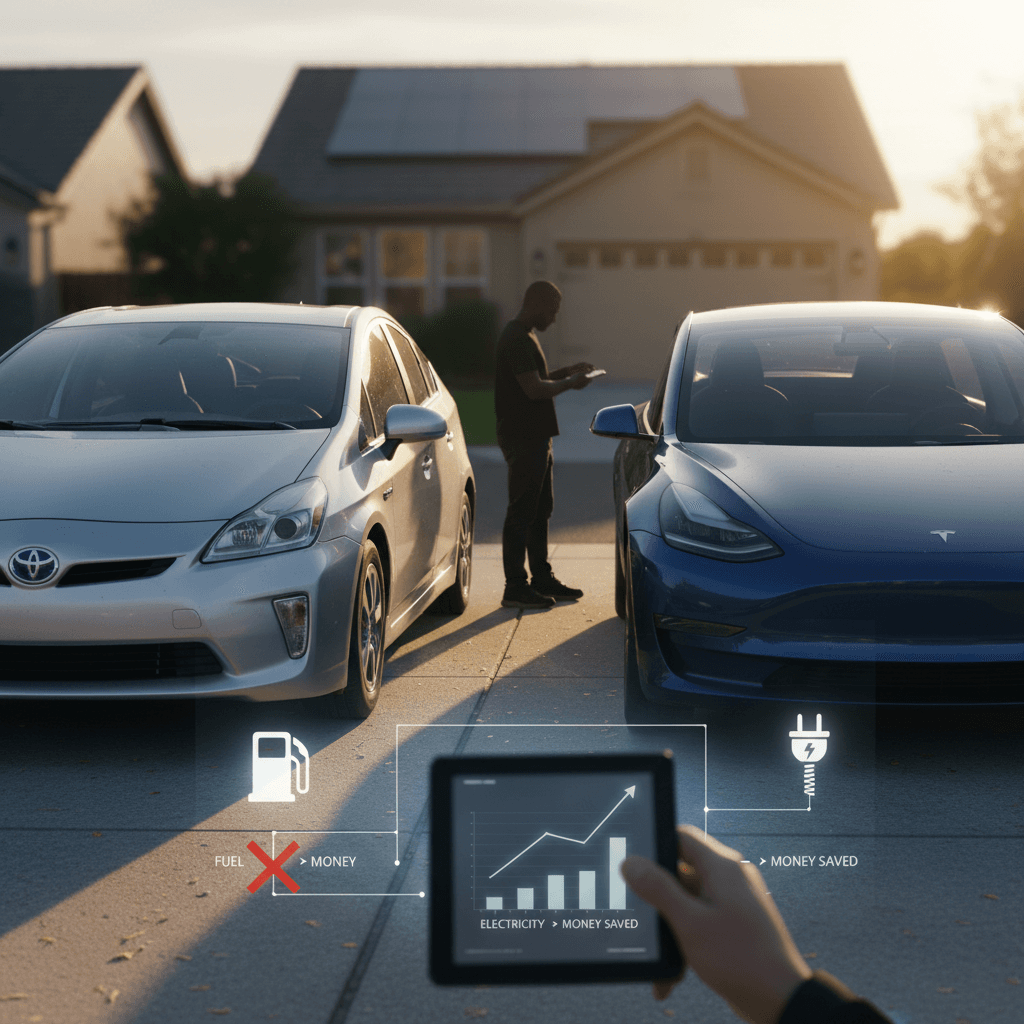
If you’re driving a **35 mpg hybrid** today, you’re already ahead of most gas drivers. So when you hear people rave about electric car savings, it’s fair to ask: *is switching from a 35 mpg hybrid to an electric car really worth it*, or is the benefit mostly hype? In this guide we’ll walk through the numbers, using realistic 2025–2026 U.S. prices, so you can see what the switch could save you in fuel, maintenance, and total cost of ownership.
Quick answer
Why compare a 35 mpg hybrid to an EV?
A 35 mpg hybrid is a solid benchmark. Many popular hybrids, older Toyota Prius models, some compact sedans and crossovers, land right around that combined fuel economy. If an electric car can’t beat a **35 mpg hybrid** on total cost of ownership, it’s a tougher sell than when you’re coming from a 22 mpg SUV.
The good news is that modern EVs are extremely energy‑efficient. Typical 2024–2025 battery‑electric cars fall around **25–30 kWh per 100 miles** (roughly 3.3–4.0 miles per kWh), which translates to well over 100 MPGe in EPA terms. In other words, you’re starting from a frugal hybrid and still moving to something dramatically more efficient, you just need to translate that into dollars and cents for your situation.
Key numbers behind hybrid-to-EV savings
Baseline assumptions for savings calculations
No two households pay the same for energy, so any article about **switching from a 35 mpg hybrid to an electric car** has to be clear about its assumptions. You can (and should) plug in your own numbers later, but here’s what we’ll use for examples:
Baseline assumptions used in this guide
These values are ballpark U.S. averages for 2025–2026. Adjust them to match your reality.
| Variable | Value used | Why we chose it |
|---|---|---|
| Hybrid fuel economy | 35 mpg | Represents a typical compact/midsize hybrid in mixed driving. |
| EV efficiency (conservative) | 30 kWh/100 miles | Covers heavier or less efficient EVs. |
| EV efficiency (efficient) | 25 kWh/100 miles | Represents many compact crossovers and sedans. |
| Gas price | $4.00 per gallon | Near current U.S. average in spring 2026, with some regions higher. |
| Home electricity price | $0.17 per kWh | Approximate recent U.S. residential average. |
| Public fast charging | $0.40 per kWh | Typical retail rate on major DC fast‑charge networks. |
| Annual miles | 12,000 miles | Close to the current U.S. driving average. |
Use this table as a starting point, not gospel, your local prices can swing the math by hundreds of dollars a year.
Regional reality check
Fuel vs electricity: cost per mile
Let’s start with the pure energy math. Once you know your **cost per mile**, you can scale it to any commute or road‑trip pattern.
Cost per mile in your 35 mpg hybrid
Using our $4.00 per gallon baseline gas price:
- Cost per mile = $4.00 ÷ 35 mpg ≈ 11.4¢/mile
- At 12,000 miles/year, that’s about $1,370/year in fuel
Even if your local gas is cheaper, say $3.50/gal, you’re still at about 10¢/mile and $1,200/year at 12,000 miles.
Cost per mile in an EV
Now plug in our electricity assumptions:
- Home charging, efficient EV (25 kWh/100 mi)
• Energy use per mile = 0.25 kWh
• Cost per mile = 0.25 × $0.17 ≈ 4.3¢/mile
• 12,000 miles/year ≈ $510/year - Home charging, less efficient EV (30 kWh/100 mi)
• Cost per mile ≈ 5.1¢/mile
• 12,000 miles/year ≈ $610/year
So against a 35 mpg hybrid at today’s prices, a typical EV charged mostly at home cuts your **energy cost per mile roughly in half**. That’s the core of the savings story.
What if you rely on fast charging?
Annual savings for different driving patterns
Most of us don’t care about fractions of a cent, we care what it adds up to in a year. Here’s how **switching from a 35 mpg hybrid to an electric car** pencils out across common mileage bands, assuming **80% of charging at home and 20% at fast chargers**.
Estimated annual energy cost: 35 mpg hybrid vs EV
Hybrid assumes 35 mpg at $4/gal. EV assumes 27.5 kWh/100 mi blended efficiency (between our two EV scenarios), with 80% home charging at $0.17/kWh and 20% fast charging at $0.40/kWh.
| Annual miles | Hybrid fuel cost | EV energy cost | Approx. annual savings |
|---|---|---|---|
| 8,000 miles | ≈ $910 | ≈ $420 | ≈ $490/year |
| 12,000 miles | ≈ $1,370 | ≈ $630 | ≈ $740/year |
| 15,000 miles | ≈ $1,710 | ≈ $790 | ≈ $920/year |
| 20,000 miles | ≈ $2,285 | ≈ $1,050 | ≈ $1,230/year |
These are ballpark figures. They’re meant to show directionally how savings scale with miles driven, not to predict your bill down to the dollar.
Rule of thumb
Maintenance, insurance, and other running costs
Fuel isn’t the only line item that changes when you go electric. Hybrids already cut some maintenance, engine loads are lower, regenerative braking helps, so the gap between a modern hybrid and an EV is narrower than between a pure gas car and an EV. But there are still meaningful differences.
How running costs change when you switch from hybrid to EV
You’re trading oil and exhaust systems for tires and insurance tweaks.
Maintenance: still a win for EVs
- Hybrids still need regular oil changes, spark plugs, exhaust components, and complex emissions hardware.
- EVs eliminate oil changes and exhaust systems and typically go much longer between brake jobs thanks to regen.
- Real‑world: many owners see **$200–$400 less per year** in routine maintenance with an EV vs a comparable hybrid, especially out of warranty.
Insurance & other costs
- Insurance for EVs can run a bit higher, especially on newer, pricier models, but used EVs often narrow that gap.
- Hybrids and EVs both enjoy access to HOV lanes and local perks in some states.
- Registration or EV fees (in lieu of gas taxes) may apply in your state but are usually modest compared with fuel savings.
Maintenance reality check
Payback period: when do EV savings overtake?
Energy and maintenance savings matter most when you compare them to the **price difference** between your current hybrid and the EV you’re considering. That’s your payback story: how long it takes the EV’s lower running costs to “catch up” to any extra purchase price.
Example payback scenarios
1. Small price gap, moderate driving
Say your 35 mpg hybrid is worth $18,000 as a trade‑in and you’re eyeing a used EV listed at $21,000. That’s a **$3,000 step‑up**. If you save roughly **$800/year** between fuel and maintenance, your payback is under 4 years, after which the EV’s lower operating costs are pure gain.
2. Bigger price gap, high mileage
If upgrading from a $18,000 hybrid to a $26,000 EV (an $8,000 gap) but you drive **20,000 miles a year**, your fuel savings alone might clear **$1,200/year**, plus maintenance. At $1,500–$1,700/year total savings, your payback is closer to **5 years**.
3. Mostly fast‑charging, low mileage
If you drive just 7,000 miles a year and depend on pricey public fast charging, your annual savings might shrink to just a few hundred dollars. In that case the payback period stretches out and the switch may not pencil out purely on money, you’d be switching more for refinement, performance, or emissions reasons.
4. Flat or falling gas prices
If gas drops closer to $3.00/gal for a while, your hybrid looks better on fuel costs. But electricity prices can move too. That’s why it’s smart to re‑run the numbers with your **local, current** prices before you sign anything.
Used EV vs new EV: which makes savings faster?
If your hybrid is already paid off, the most realistic comparison isn’t a brand‑new EV with a big sticker, it’s a **used electric car** that lines up with the value of the car in your driveway. That’s where the savings story often gets compelling.
Why used EVs often win on payback
- Depreciation has already taken a big bite out of the price, but the EV is still efficient.
- Your **monthly payment (if any)** can be similar to or not much higher than what you’d pay to replace your hybrid with another used hybrid.
- Fuel and maintenance savings start from day one, so the payback period shrinks.
Market‑wise, there are now plenty of 2–5‑year‑old EVs with modern range and safety tech that undercut new EV pricing by thousands.
Where Recharged fits in
Because used EVs are such a sweet spot for total cost of ownership, Recharged is built around them. Every EV listed on Recharged comes with a Recharged Score Report that includes verified battery health and fair‑market pricing, so you’re not guessing whether you’re trading a reliable hybrid for a tired battery pack.
They also handle financing, trade‑ins, and nationwide delivery, so it’s easy to line up your outgoing 35 mpg hybrid and incoming EV in one smooth move.
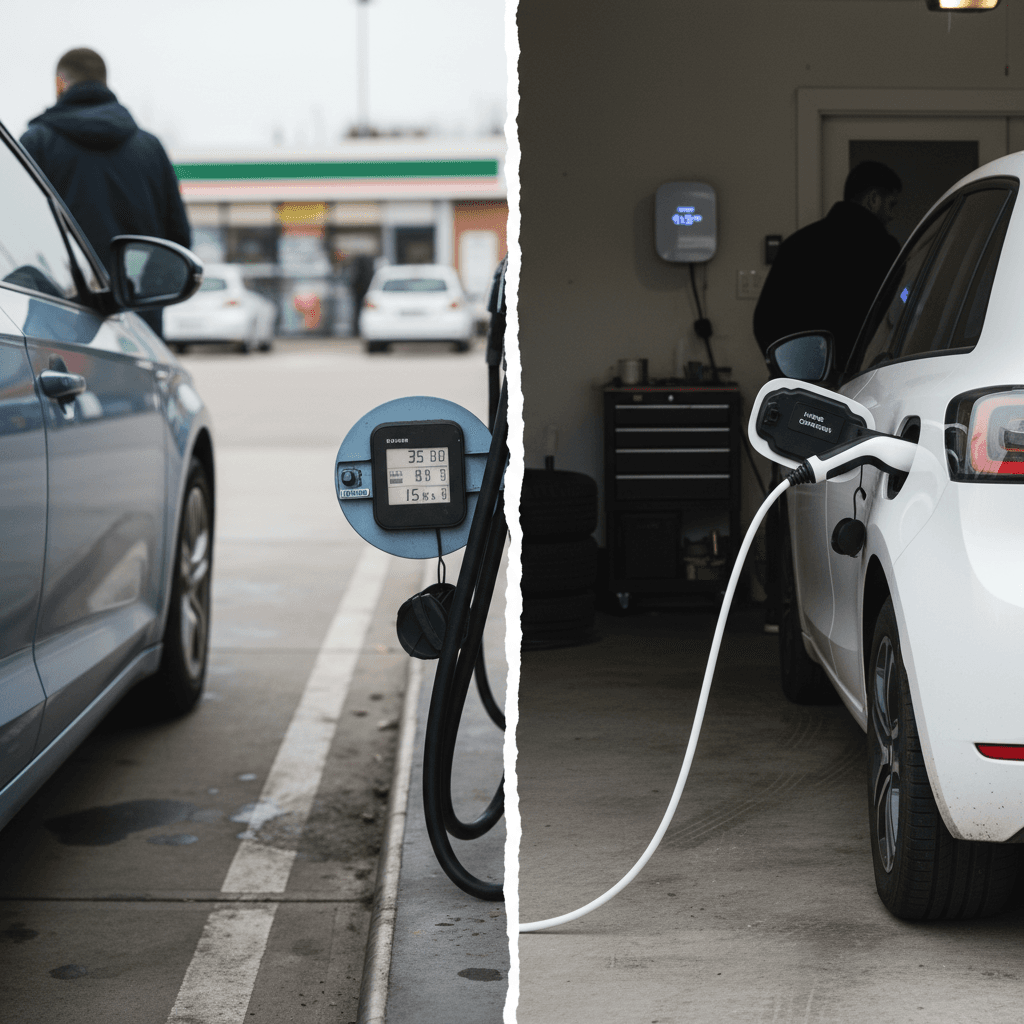
Home charging vs public charging: how it changes the math
You’ve probably noticed a pattern: the savings look great as long as you’re mostly charging at home or at low‑cost workplace chargers. They get fuzzy if you live at the mercy of public DC fast charging rates.
Charging mix impact on savings
Same EV, three very different cost‑per‑mile realities.
1. 90–100% home charging
Best‑case for savings. With typical residential rates, you’re squarely in the 4–6¢/mile range for many EVs. Against an 11¢/mile hybrid, that’s a slam‑dunk.
If you can also charge on off‑peak or EV‑specific rates, it gets even better.
2. 50/50 home + public
Still good, but softer. Blending 17¢/kWh at home with 40¢/kWh on the road might land you around 7–8¢/mile in many EVs.
You’re still ahead of a 35 mpg hybrid at $4 gas, just not by as much.
3. Mostly fast charging
Only modest savings, if any. Live in an apartment with no home charging? You may be paying gas‑like prices for electricity.
Here the choice is more about convenience, performance, and emissions than hard‑nosed savings.
Think about your next home move
Battery health and resale value
Hybrids built their reputation on batteries that just keep going, so it’s natural to worry you’re trading that durability for a giant EV pack that might be expensive to replace. In practice, modern EV batteries have proved more robust than many early skeptics predicted, but **battery health matters a lot** to your long‑term savings.
- Most modern EVs lose only a small percentage of range in the first few years, then degrade slowly, especially if they’re not fast‑charged constantly or parked in extreme heat.
- A healthy pack helps your EV keep its real‑world range, which keeps you using cheap home charging instead of emergency fast charges.
- Resale value hinges heavily on battery condition; a car with a documented healthy pack will be easier to sell or trade than one with unknown history.
How Recharged de‑risks battery health
Step-by-step: how to evaluate your own savings
You don’t need a spreadsheet wizard in the family to figure this out. Here’s a simple process you can run in 10–15 minutes to see what **switching from your 35 mpg hybrid to an electric car** looks like for your household.
DIY hybrid-to-EV savings check
1. Gather your real numbers
Pull the last couple of months of fuel receipts or credit‑card statements and calculate your **actual gallons per month**. Divide your monthly miles by gallons to confirm your real mpg, if it’s lower than 35, your potential EV savings are even bigger.
2. Find your local gas and electricity prices
Check current gas prices at stations you actually use. Then look at your electric bill for your all‑in rate (including fees) or call your utility. If they offer **EV or off‑peak rates**, jot those down too.
3. Estimate your EV’s efficiency
Look up the EVs you’re considering and note their EPA kWh/100‑mile rating. For a quick, conservative estimate, assume **30 kWh/100 miles** if you do a lot of highway driving or live in a cold climate.
4. Calculate cost per mile
Use these shortcuts:<br>• Hybrid: Gas price ÷ 35 mpg = ¢/mile<br>• EV: (kWh/100 miles ÷ 100) × electricity price = ¢/mile (use your home rate and a blended rate if you’ll be using some fast charging).
5. Scale to your annual miles
Multiply your ¢/mile figures by **annual miles** (from your odometer or insurance records). That turns cents into **annual fuel and electricity costs** and reveals your real‑world difference.
6. Compare to the price gap
Now compare those annual savings to the price difference between selling or trading your hybrid and buying the EV you have in mind. That gives you a **rough payback period**. If you’re shopping on Recharged, the transparent pricing and battery reports make it easier to compare apples to apples.
FAQ: switching from a 35 mpg hybrid to an electric car
Frequently asked questions
Bottom line: is switching from 35 mpg hybrid to an EV worth it?
If you strip out the buzz and just look at the numbers, the story is straightforward: **electric cars are usually cheaper to run than a 35 mpg hybrid**, sometimes by a wide margin, as long as you can charge mostly at home and you choose a reasonably efficient EV at a fair price.
For many drivers, that means **hundreds of dollars a year in fuel savings**, another chunk from lower maintenance, and a quieter, smoother daily drive. For others, especially low‑mileage drivers or people stuck with expensive public charging, the savings may be modest, and the decision leans more on comfort, performance, and environmental impact than on pure dollars.
The smartest path is to run your own numbers, then shop accordingly. A well‑priced used EV with a healthy battery, clear history, and support from EV specialists can turn your already‑efficient 35 mpg hybrid into a stepping‑stone toward even lower running costs. That’s exactly the niche Recharged was built for: transparent battery health, fair pricing, financing and trade‑in support, and expert guidance from your first question to the moment your next EV shows up in the driveway.