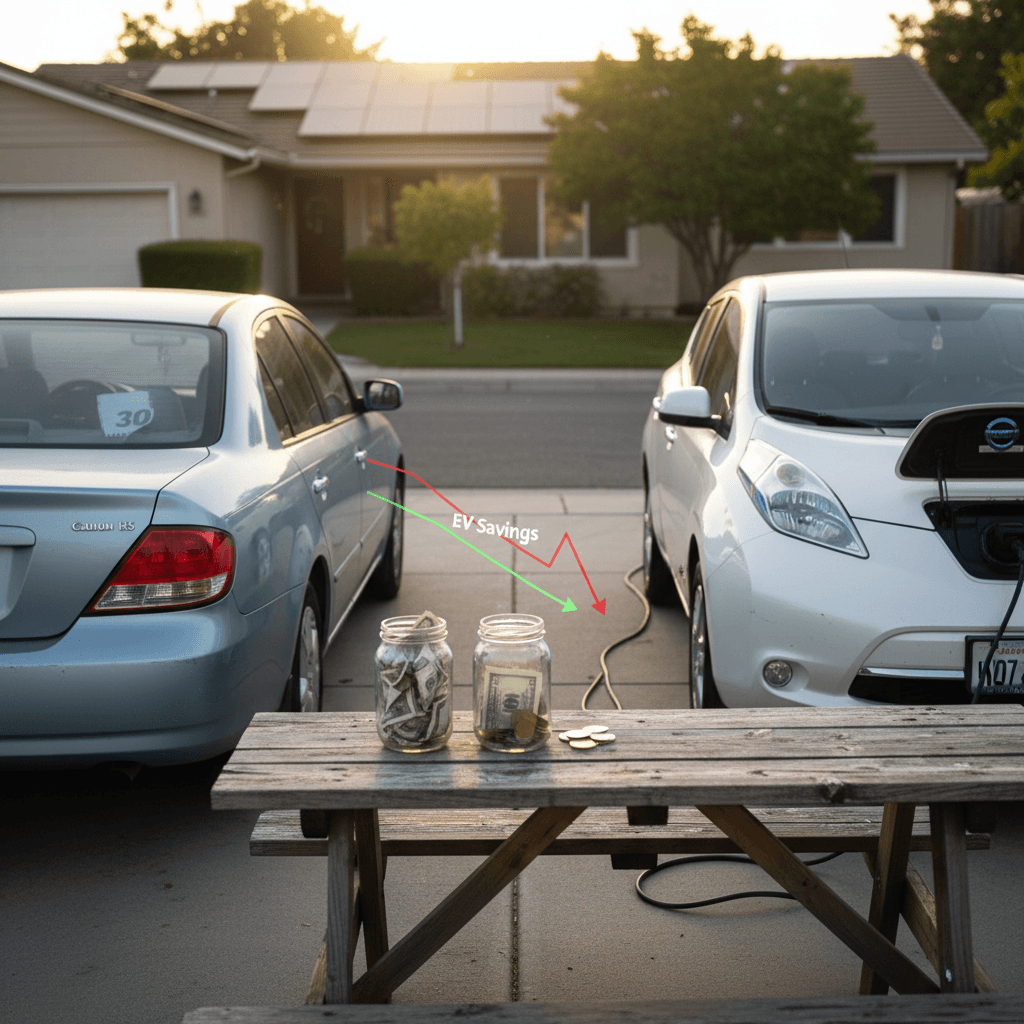
If you’re driving a 30 mpg gas car today, you’re not exactly a gas guzzler. That makes the decision to switch to a used EV feel less obvious: will the savings really be big enough to justify the change? In this guide, we’ll run the numbers on switching from a 30 mpg car to a used EV savings, fuel, maintenance, and total cost of ownership, so you can see what the switch looks like in real dollars, for your kind of driving.
Quick Takeaway
Why a 30 MPG Gas Car Is the Perfect Benchmark
Thirty miles per gallon is the heart of the modern “sensible” gas car, think compact sedans, small crossovers, and older hybrids on mixed driving. If an EV can beat a 30 mpg car on costs, it’s not just competing with thirsty pickups; it’s competing with the efficient middle of the market. That’s why focusing on 30 mpg vs used EV savings gives you a realistic, sometimes surprisingly conservative, picture of what you stand to gain.
- Many compact ICE cars and crossovers land near 28–32 mpg combined in real-world driving.
- Older hybrids that started at 40–45 mpg often drift closer to ~30–35 mpg as they age and see more highway use.
- Lots of families keep these cars long after they’re paid off, so fuel and repairs dominate the monthly cost picture.
Don’t Compare to the EPA Sticker Alone
Fuel Costs: Used EV vs 30 MPG Gas Car
Let’s start where you feel it every week: at the pump. To keep this simple, we’ll look at national-average prices and then show you how to plug in your own numbers.
Fuel Cost per Mile: 30 MPG vs Typical Used EV
Approximate cost per mile using common national averages. Plug in your own rates later in the checklist section.
| Scenario | Assumptions | Cost per Mile |
|---|---|---|
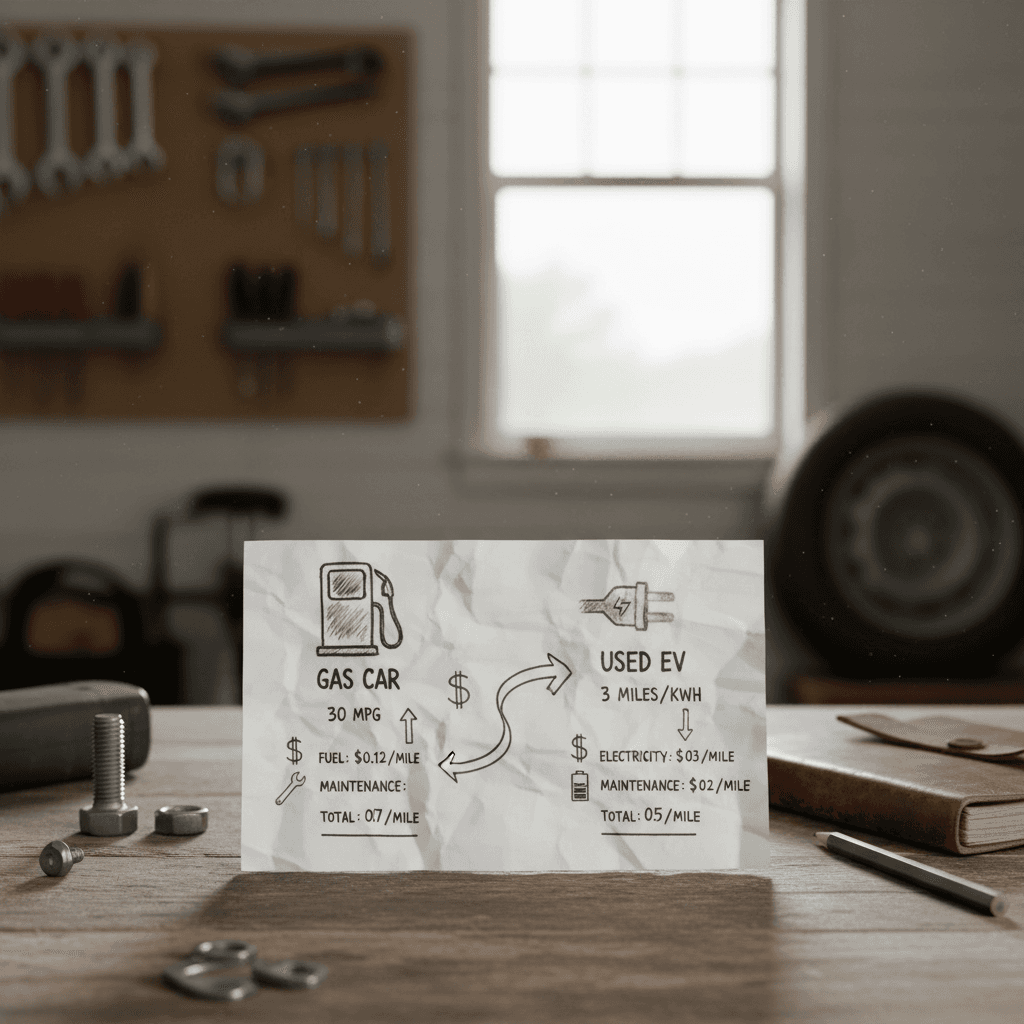
| 30 MPG Gas Car, $3.50/gal | $3.50 ÷ 30 mpg | $0.12/mi |
| 30 MPG Gas Car, $4.00/gal | $4.00 ÷ 30 mpg | $0.13/mi |
| Used EV at 3.3 mi/kWh, $0.16/kWh home | 1 kWh = 3.3 miles | ≈$0.05/mi |
| Used EV at 3.3 mi/kWh, $0.20/kWh home | 1 kWh = 3.3 miles | ≈$0.06/mi |
| Used EV using mix of home + fast charging | 80% home, 20% fast charging | ≈$0.06–$0.08/mi |
These are ballpark comparisons; your local gas and electricity prices may shift the gap, but the pattern almost always favors the EV.
Even with relatively cheap gas, the EV’s energy cost per mile tends to land at about half, or less, of your 30 mpg car, especially if most charging happens at home. Over 10,000–15,000 miles a year, that gap adds up quickly.
Annual Fuel Savings vs a 30 MPG Gas Car (Typical Ranges)
Supercharge Your Savings With Off-Peak Rates
Maintenance and Repairs: Where EVs Really Pull Ahead
Fuel savings get all the headlines, but long-term owners will tell you maintenance is where a used EV keeps quietly paying you back. Compared with a 30 mpg gas car, a typical used EV simply has far fewer moving parts that wear out.
Maintenance: 30 MPG Gas Car vs Used EV
What you’ll still do, what you’ll stop doing, and what changes.
30 MPG Gas Car
- Oil and filter changes every 5,000–7,500 miles
- Transmission service and possible repairs
- Spark plugs, belts, exhaust system, emissions equipment
- Engine cooling system, head gaskets, fuel system issues
- More frequent brake work if mostly city driving
Used EV
- No oil changes, spark plugs, or exhaust
- No conventional automatic transmission to service
- Brake wear is often dramatically lower thanks to regen
- Still need tires, cabin air filters, and brake fluid checks
- Occasional coolant service for the battery/drive unit, depending on model
When you total it up, many owners see maintenance and repair costs drop by several hundred dollars a year vs a comparable gas car, sometimes more if their ICE car needed regular shop visits in its later years.
Rough Annual Maintenance Picture
Real-World Savings Examples for Three Driver Profiles
Everyone’s driving life looks different, so let’s walk through three scenarios. We’ll assume a 30 mpg gas car, $3.75/gallon average gas, and a used EV that averages 3.3 miles per kWh with home electricity at $0.17/kWh and a bit of public charging mixed in.
Example Annual Savings: Switching From 30 MPG to a Used EV
Fuel + typical maintenance savings, not counting insurance differences or tax incentives.
| Driver Type | Miles/Year | Gas Car Annual Fuel | Used EV Annual Energy | Fuel Savings | Estimated Maintenance Savings | Total Annual Savings |
|---|---|---|---|---|---|---|
| City Commuter | 8,000 | ≈$1,000 | ≈$400 | ≈$600 | ≈$200–$300 | ≈$800–$900 |
| Typical Suburban Driver | 12,000 | ≈$1,500 | ≈$600 | ≈$900 | ≈$300–$400 | ≈$1,200–$1,300 |
| Heavy Driver / Long Commute | 18,000 | ≈$2,250 | ≈$900 | ≈$1,350 | ≈$400–$600 | ≈$1,700–$1,950 |
These are conservative, directionally accurate examples meant to help you ballpark your own numbers.
Important Context on These Numbers
What About Upfront Costs, Incentives, and Financing?
Upfront cost is where many shoppers get stuck. A used EV that saves you $1,200 a year doesn’t help if the monthly payment stretches you too far. The trick is to look at total monthly cost, not just the payment.
1. Comparing Monthly Out-of-Pocket
Imagine you’re currently driving a paid-off 30 mpg car but spending $175/month on fuel and $75/month (on average) on maintenance and repairs.
- That’s roughly $250/month just to keep the car running.
- If a used EV payment comes in around $250–$300/month, and your fuel + maintenance drop to around $80–$120/month, your total monthly cost might look very similar, or even lower, even with a car payment.
2. Incentives and Financing for Used EVs
Depending on your income and location, you may qualify for federal or state incentives on used EVs, plus utility rebates on home charging equipment.
- Federal used EV tax credit (for qualifying cars and buyers)
- State or local purchase rebates or HOV perks
- Special low-rate EV financing promotions from some lenders
At Recharged, you can pre-qualify for EV financing online with no impact to your credit, and see how potential fuel savings stack up against the monthly payment.
Use “All-In” Math, Not Just Sticker Price
Battery Health on a Used EV: Will It Eat Your Savings?
This is the question that keeps a lot of smart shoppers on the sidelines. A tired battery that can’t hold much charge or needs replacement early could wipe out years of fuel savings. The good news: most modern EV packs are holding up far better than early skeptics feared, especially in cars that have been charged and cooled properly.
How Battery Health Affects Your Savings
Capacity loss is usually gradual, and manageable, if you buy wisely.
Mild Degradation (5–15%)
You lose a bit of range vs new, but the car is fully usable for daily driving. Your cost per mile barely changes; you just charge slightly more often.
Moderate Degradation (15–25%)
Road trips may need more planning, but for commuting and errands it’s often still fine. Savings vs your 30 mpg car are mostly intact, especially if you charge at home.
Severe Degradation or Failure
This is where a replacement or major repair can sting. It’s rare in modern EVs within normal mileage, but buying without a battery health check increases your risk.
Don’t Buy a Used EV Blind
Every used EV on Recharged includes a Recharged Score Report with verified battery health, charging history insights, and real-world range estimates. That transparency helps you understand whether the car still fits your daily needs, and how confidently you can count on those future fuel savings.
Non-Money Benefits You’ll Notice After Switching
Money might be what nudges you into an EV, but it’s rarely the only reason people stay. Once you live with a used EV for a few months, a different set of perks tends to matter just as much as the dollars and cents.
- Time back in your life. Skipping gas station stops, oil changes, and most routine shop visits means less time spent maintaining your car.
- Quieter, smoother driving. EVs are calm inside, with instant torque that makes merging and passing feel effortless, even in older, more affordable models.
- Better in stop-and-go. Regenerative braking makes traffic less annoying and often reduces fatigue on your right foot.
- Cleaner driveway and garage. No fuel smells, no oil spots, and very little to leak on your floor.
- Environmental benefit. Even accounting for electricity generation, driving electric usually cuts your tailpipe emissions to zero and your overall CO₂ footprint significantly.
Used EVs Are a Double Win
Step-by-Step: How to Evaluate Your Own Savings
Ready to see what switching from a 30 mpg car to a used EV looks like for your driveway, not just the averages? Work through this quick checklist with your own numbers.
Personal 30 MPG-to-Used-EV Savings Checklist
1. Nail Down Your True MPG and Miles
Use your last few months of fuel receipts or app data to confirm your real-world mpg and annual mileage. Don’t rely solely on the dashboard estimate; your savings math is only as good as these inputs.
2. Calculate Your Current Fuel Spend
Multiply your annual miles by your cost per mile. For a 30 mpg car: annual miles ÷ 30 × average price per gallon. That tells you what you’re really feeding the gas station each year.
3. Estimate EV Energy Cost per Mile
Look up your utility’s kWh rate (including fees), then divide it by a realistic efficiency number, 3.0 to 3.5 miles per kWh for many used EVs. If you’ll use some DC fast charging, bump the per-mile estimate up a cent or two.
4. Compare Annual Fuel Costs Side by Side
Multiply your EV cost per mile by your annual miles. The difference between that and your 30 mpg fuel bill is a big chunk of your yearly savings, often hundreds of dollars, sometimes over a thousand.
5. Add Maintenance Expectations
Look at your last 1–2 years of maintenance and repairs on your gas car. Be honest about what an older engine and transmission might need. Then compare that to typical EV maintenance: tires, cabin filters, brake fluid, and occasional service items.
6. Layer in Purchase Price and Payment
Now that you have a feel for annual savings, consider how a monthly payment would change your overall out-of-pocket. On Recharged, you can see estimated payments, trade-in offers for your current car, and the Recharged Score battery health data all in one place.
Let the Marketplace Do Some Math for You
FAQ: Switching From 30 MPG Car to Used EV Savings
Frequently Asked Questions
Bottom Line: Is Switching From 30 MPG to a Used EV Worth It?
If you’re driving a 30 mpg gas car today, you’re already ahead of the big crossovers and trucks at the pump. But that doesn’t mean you’re out of room to save. For many drivers putting 10,000–15,000 miles a year on the odometer, a well-priced used EV can shave $800–$1,500 a year off fuel and maintenance alone, often without raising your monthly out-of-pocket when you factor in the payment. The real key is choosing the right car at the right price, with known battery health and a clear view of your own driving patterns.
That’s exactly what Recharged is built for. With verified Recharged Score battery reports, transparent pricing, financing you can pre-qualify for online, and EV specialists who live this stuff every day, you can stop guessing and start running real numbers. If your 30 mpg car is nudging you toward its next big repair, this might be the moment to let your fuel and maintenance budget upgrade you into a used EV that costs less to live with, and a lot more fun to drive.