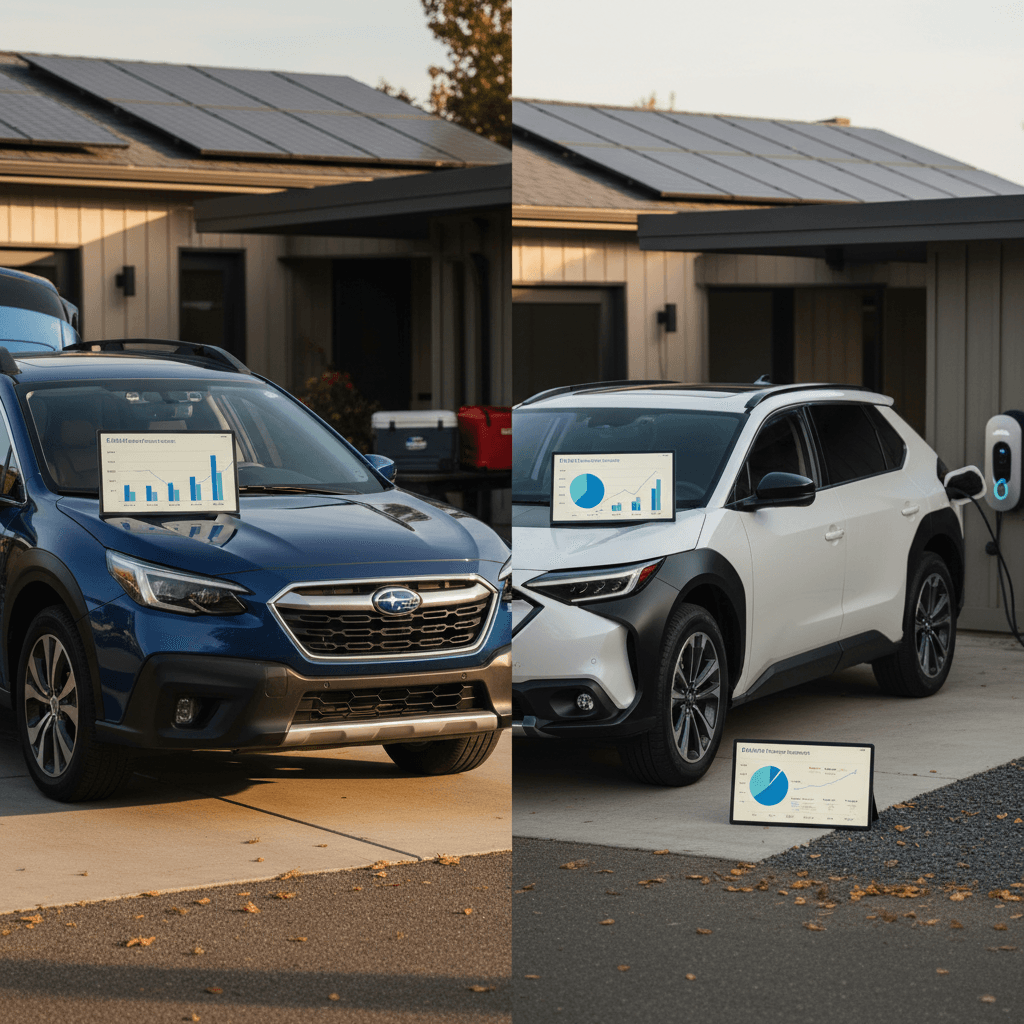
You already know the Subaru Outback is a Swiss‑Army knife of a family hauler. The Subaru Solterra promises the same outdoorsy utility, but with an all‑electric powertrain. The big question is whether the Subaru Outback vs Subaru Solterra total cost of ownership really favors going electric, or if a gas Outback still makes more financial sense for you.
Quick takeaway
Why compare Subaru Outback vs. Subaru Solterra on total cost?
Monthly payments are only one piece of the puzzle. Over five or ten years, you’ll spend thousands on fuel or electricity, routine maintenance, insurance, and the silent budget buster: depreciation. Comparing the Subaru Outback with the Subaru Solterra on total cost of ownership forces all of those pieces onto the same playing field so you can decide whether an EV Subaru is a smart move today, or a “next time” decision.
- You’re driving an Outback today and wondering if it’s time to electrify.
- You’re torn between a new Outback lease and a used Solterra purchase.
- You road‑trip, camp, ski, or live where the weather isn’t always friendly.
- You want real‑world costs, not just marketing promises.
Think in 5‑year chunks
Assumptions: how we’re comparing total ownership costs
To keep this Subaru Outback vs. Solterra comparison grounded, we’ll use conservative, US‑average numbers. Your exact costs will vary by state, driving style, and where you charge, but this framework lets you plug in your own values.
Key assumptions for this comparison
1. Driving: 12,000 miles per year
Recent AAA and FHWA data put typical US driving around 11,500–13,500 miles per year. We’ll use <strong>12,000 miles annually</strong>, about 1,000 miles a month.
2. Time horizon: 5 years
Five years captures a big chunk of depreciation, multiple sets of maintenance visits, and meaningful fuel or electricity costs.
3. Fuel and electricity prices
We’ll assume gasoline at <strong>$3.50 per gallon</strong> and home electricity at <strong>$0.15 per kWh</strong>. Public fast charging is usually higher; we’ll note where that matters.
4. Representative trims
Think mid‑range trims, an Outback Premium/Onyx‑type gasoline model vs. a Solterra Premium/Limited. We’re not chasing exact MSRP but realistic transaction ranges.
5. Typical driver, not edge cases
No commercial use, no extreme off‑road abuse, and no 30,000‑mile‑per‑year sales territory. If that’s you, your numbers will skew heavily toward fuel or charging costs.
Purchase price and depreciation: where most of your money goes
When you talk about total cost of ownership, depreciation is the elephant in the room. Fuel might sting every week, but the biggest check you write is the one you never see: the value your car quietly loses each year.
Typical price and 5‑year depreciation: Outback vs. Solterra
These aren’t exact quotes, but realistic ranges for buyers shopping in 2026, mixing new and nearly new vehicles.
| Model scenario | Example purchase price (2026 market) | Estimated value after 5 years | Estimated 5‑year depreciation |
|---|---|---|---|
| Newish Subaru Outback (2025–2026, mid trim) | $32,000 | $16,500 | ≈ $15,500 |
| Newish Subaru Solterra (2024–2025, low miles) | $37,000 | $19,000 | ≈ $18,000 |
| Older used Outback (2021–2022) | $24,000 | $12,000 | ≈ $12,000 |
| Older used Solterra (early 2023 off‑lease) | $30,000 | $17,000 | ≈ $13,000 |
Illustrative figures based on current market pricing and typical 5‑year retained values for Subaru SUVs and mainstream EVs.
Why Solterra depreciation is tricky
If you buy new, the Outback usually wins on upfront price and often on depreciation. Step into the used Solterra market, though, and the gap narrows fast. At that point, the question becomes whether lower fuel and maintenance costs can overcome slightly higher depreciation.
Fuel vs. electricity: what it really costs to “fill up”
This is where the Solterra finally gets to flex. Instead of gallons, you’re buying kilowatt‑hours (kWh). The math looks dry, but the difference in your monthly budget is anything but.
Efficiency snapshot
Gasoline: Subaru Outback
At 28 mpg and 12,000 miles per year:
- Annual gallons: 12,000 ÷ 28 ≈ 430 gallons
- Annual fuel cost: 430 × $3.50 ≈ $1,505
- 5‑year fuel cost: ≈ $7,525
A turbo Outback or lots of short‑trip winter driving can push this number higher.
Electricity: Subaru Solterra
At 3.0 mi/kWh and 12,000 miles per year:
- Annual kWh: 12,000 ÷ 3.0 ≈ 4,000 kWh
- Home charging only at $0.15/kWh: ≈ $600 per year
- 5‑year electricity cost (home): ≈ $3,000
Heavy use of public DC fast charging, often $0.30–$0.50 per kWh, can easily double your energy spend.
Don’t ignore where you charge
Maintenance and repairs: EV simplicity vs. Subaru familiarity
Subaru has spent decades convincing people that “Love. It’s what makes a Subaru, a Subaru.” Part of that love is predictably reasonable maintenance. The Solterra keeps the Subaru feel but ditches a lot of the moving parts that usually need attention over time.
Typical 5‑year maintenance picture
Less oil, fewer belts, different worries
Subaru Outback (gas)
- Oil and filter changes every 6,000–7,500 miles
- Engine air filter, spark plugs (later), fuel system services
- Certain fluids (coolant, transmission, differential)
- Brake wear depends on your driving and terrain
Across five years, plan for several hundred dollars per year in routine service, plus wear items.
Subaru Solterra (EV)
- No oil changes, no timing belts, no exhaust
- Tire rotations and cabin air filters on schedule
- Brake pads last longer thanks to regenerative braking
- Coolant for battery/drive unit checked on manufacturer intervals
Official Subaru schedules keep the visits, and costs, modest, though tire wear can be higher due to weight and torque.
Looking at real‑world cost‑to‑own data, a late‑model Outback typically runs around $500–$600 per year in maintenance and light repairs over the first five years. An EV like the Solterra usually undercuts that by a couple of hundred dollars annually once you factor out oil changes and engine‑related services.
Estimated 5‑year maintenance and minor repairs
Routine maintenance plus minor unscheduled repairs, not major accidents or catastrophic failures.
| Model | Estimated annual maintenance | 5‑year total |
|---|---|---|
| Subaru Outback (gas) | ≈ $550 | ≈ $2,750 |
| Subaru Solterra (EV) | ≈ $350 | ≈ $1,750 |
Rounded numbers meant for directionally accurate planning, not exact quotes from your local dealer.
A word on Solterra 12‑volt battery complaints
Insurance, taxes, and fees: small line items that add up
Insurance companies care about what it costs to repair a car and what happens when it’s totaled. Right now, EVs like the Solterra often carry slightly higher premiums than comparable gas SUVs, simply because parts and labor can be more expensive and fewer shops are certified to do the work.
Insurance
- Recent data suggest EV insurance can run 5–15% higher than similar gas vehicles.
- Many owners report modest differences, especially if they bundle policies and keep a clean record.
- For this comparison we’ll assume:
- Outback: ≈ $1,300/year
- Solterra: ≈ $1,450/year
Taxes and registration
- Some states charge extra annual fees for EVs to replace gas tax revenue.
- Others discount registration on hybrids/EVs.
- Because these policies change constantly, we’ll treat taxes and fees as roughly similar between Outback and Solterra for our 5‑year snapshot.
It’s worth a quick check with your state DMV for EV‑specific fees before you sign.
Incentives and tax credits: what still applies in 2026
This is where buyers often get tripped up: the rules that made sense last year don’t necessarily apply to cars bought today. For the Subaru Solterra, assembly location is the big sticking point.
Current incentive reality for Outback vs. Solterra
Federal carrots have gotten pickier; used EVs can still shine locally.
New Subaru Outback
- No federal clean vehicle credit, it’s a gasoline SUV.
- Occasional manufacturer rebates or low‑APR financing.
- Standard state sales tax rules apply.
New Subaru Solterra
- Assembled in Japan, so it does not qualify for the main $7,500 US federal clean vehicle tax credit when purchased.
- Some states and utilities still offer rebates or bill credits for EVs or home chargers.
- Local HOV lane or parking perks may sweeten the pot.
Hunt for local EV perks
5‑year Subaru Outback vs. Solterra cost summary
Let’s pull it all together. These are ballpark figures for a buyer choosing between a late‑model Outback and a comparable‑age Solterra in 2026, driving 12,000 miles per year, mostly charging at home.
Illustrative 5‑year total cost of ownership
Assumes late‑model used purchases at realistic 2026 prices, mostly home charging for Solterra, and average US insurance and maintenance costs.
| Cost category (5 years) | Subaru Outback (gas) | Subaru Solterra (EV) |
|---|---|---|
| Depreciation | ≈ $15,500 | ≈ $18,000 |
| Fuel / Electricity | ≈ $7,500 | ≈ $3,000 (home charging heavy) |
| Maintenance & minor repairs | ≈ $2,750 | ≈ $1,750 |
| Insurance | ≈ $6,500 | ≈ $7,250 |
| Taxes & fees | Similar; varies by state | Similar; some states add EV fees |
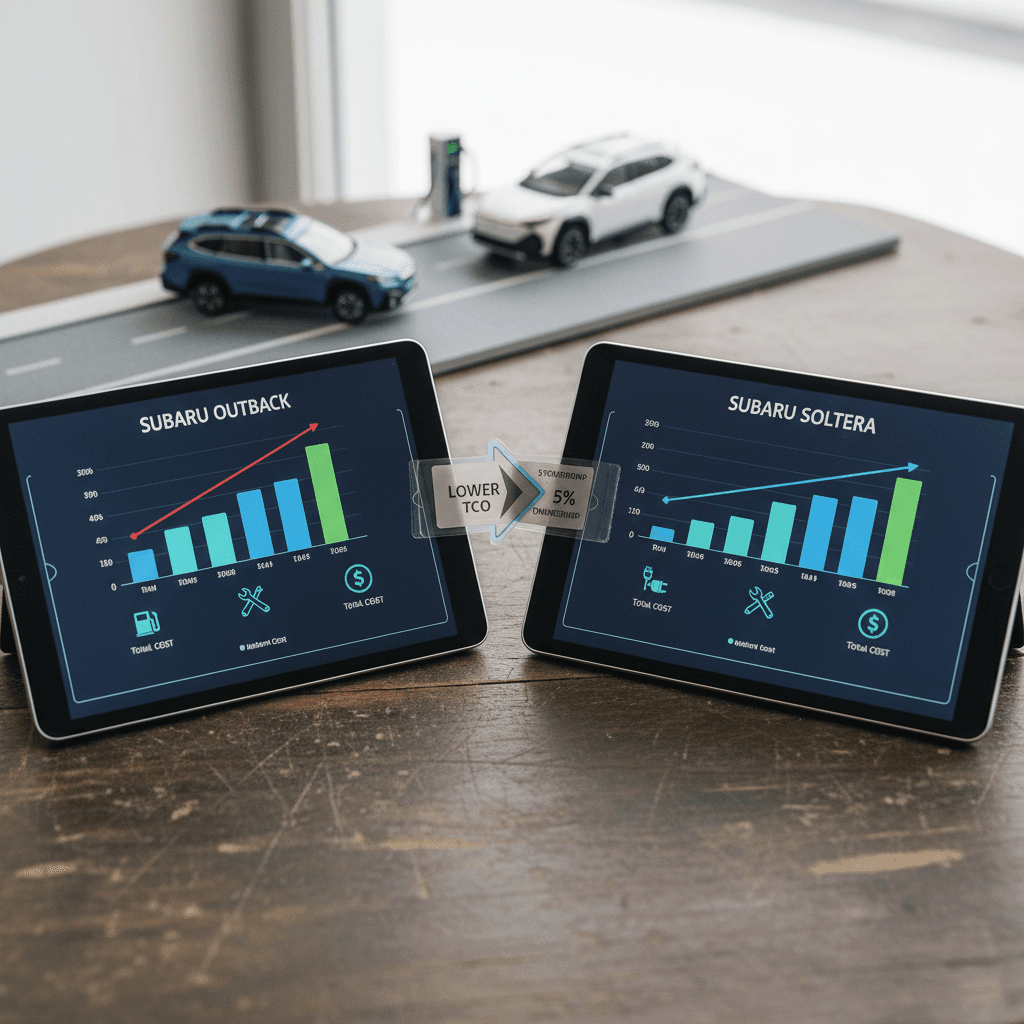
| Estimated 5‑year total | ≈ $32,250 | ≈ $30,000 |
Use this as a template: substitute your own fuel price, kWh rate, and insurance quotes to see your personalized picture.
So who’s cheaper over 5 years?
When the Solterra wins vs. when the Outback still makes sense
Which Subaru fits your life and wallet?
The answer depends less on the logo and more on your routine.
Solterra usually wins if…
- You can reliably charge at home overnight.
- Your daily driving fits comfortably within the Solterra’s real‑world range, with margin for cold weather.
- You live where electricity is relatively cheap vs. gasoline.
- You’re considering a lightly used Solterra that’s already taken its early depreciation hit.
Outback usually wins if…
- You often drive long distances where DC fast chargers are sparse.
- You tow frequently or carry heavy loads in remote areas.
- Your home charging options are poor and public chargers are expensive.
- You prefer the known quantity of gas‑station refueling and traditional Subaru servicing.
Cold weather cuts both ways
How a used Subaru Solterra changes the math
If you’re cross‑shopping a new Outback against a used Solterra, you’re playing the game on home turf. Early Solterra depreciation has already happened, and you’re stepping into the EV curve at a discount.
Depreciation advantage
A two‑ or three‑year‑old Solterra often sells for tens of thousands less than its original MSRP. Over the next five years, its depreciation can look surprisingly similar to an equivalently priced used Outback.
That means more of the EV’s savings on “fuel” and maintenance show up as net savings, not just paying for early tech adoption.
Battery health and warranty
Subaru backs the Solterra’s high‑voltage battery and electric drive unit for 8 years or 100,000 miles against significant defects. Many used Solterras on the market are still deep inside that window.
The key is understanding how much real‑world capacity remains, and whether your daily driving fits comfortably inside it.
Why a battery health report matters
How Recharged helps you compare real cars, not just spreadsheets
It’s one thing to noodle numbers on Subaru Outback vs. Solterra total cost of ownership. It’s another to stand in front of a specific used Solterra and wonder what its battery has been through, or what a fair price is in today’s market.
Shopping tools that make EV math less mysterious
Every EV on Recharged comes with data, not just glossy photos.
Recharged Score battery diagnostics
Fair market pricing
Trade‑in and delivery
Whether you’re swapping out of an older Outback or comparing a Solterra to every other used EV on your shortlist, Recharged’s EV‑specialist team can walk you through the real numbers, not just what fits in an ad.
FAQs: Subaru Outback vs. Subaru Solterra ownership costs
Frequently asked questions
Bottom line: should you go Solterra or stick with an Outback?
If your daily life fits the Solterra’s range and you have access to reliable home charging, the all‑electric Subaru can absolutely compete with, and sometimes beat, a gas Outback on total cost of ownership, especially when you buy used. You trade gas‑station convenience for outlet‑powered savings and a simpler maintenance life.
If your world is defined by long highway hauls to remote ski hills, trailheads, or job sites with sparse charging, the Outback’s familiar fuel stops and stellar resale remain hard to argue with. The key is matching the vehicle to your reality, not to a brochure.
Ready to see how the math looks on actual cars? Explore used Subaru Solterras and other EV SUVs on Recharged, compare them against what your current Outback is worth as a trade‑in, and dig into each vehicle’s Recharged Score battery health report. That way, the Subaru you pick, gas or electric, fits both your driveway and your long‑term budget.