If you own an electric car, or you’re shopping for a used EV, the idea of fueling it with sunshine instead of gasoline is irresistible. A solar panel EV charging savings calculator turns that daydream into numbers you can actually trust: how many panels you need, what your EV miles really cost, and when the investment pays you back.
What you’ll get from this guide
Why solar for EV charging matters right now
Electricity prices in the U.S. have been climbing, and that directly affects what it costs to charge your EV at home. By early 2026, the average residential rate is around 18¢ per kWh nationwide, with some states (California, New England, Hawaii) well above 30–40¢. Meanwhile, gasoline prices swing wildly year to year. Solar lets you lock in a big piece of your future “fuel” cost for decades.
Why homeowners are pairing solar panels with EVs
Rising rates change the math
How a solar panel EV charging savings calculator works
At its core, a solar EV charging savings calculator answers three simple questions: How much energy your EV needs, what it would cost from the grid or at the pump, and how much of that you can cover with solar. Everything else, panel count, payback years, total lifetime savings, flows from those pieces.
Three building blocks of any solar EV savings calculator
If you understand these, you can rebuild the calculator anywhere
1. Your driving & EV efficiency
How many miles you drive and how efficient your EV is.
- Miles per year (or per day)
- kWh per 100 miles or miles per kWh
- Realistic split of home vs public charging
2. Energy & fuel prices
What you’d pay without solar:
- Grid price in ¢/kWh
- Gas price per gallon (for comparison)
- Your car’s old MPG if you’re coming from gas
3. Solar system & financing
The cost and output of your solar array:
- System size in kW
- Installed cost after incentives
- Annual kWh production and share used by the EV
Once you have those, the calculator converts everything into kilowatt‑hours, multiplies by the appropriate price per kWh or per gallon, and compares scenarios: grid only, solar‑boosted EV, and often your old gas car for a reality check.
Key inputs you’ll need for accurate results
Inputs to gather before you start calculating
1. Driving habits
Estimate your <strong>miles driven per year</strong>. If you don’t know, use your odometer readings from the last 12 months, or start with 10,000–12,000 miles as a baseline.
2. EV efficiency
Find your EV’s official <strong>kWh per 100 miles</strong> rating or miles per kWh. For many compact EVs, 25–30 kWh/100 mi (3.3–4.0 miles/kWh) is realistic.
3. Electricity prices
Look at your latest power bill for your <strong>all‑in residential rate</strong> (cents per kWh, including fees). If you have time‑of‑use rates, note the off‑peak price for overnight charging.
4. Gasoline baseline
If you’re switching from gas, grab your current or previous car’s <strong>MPG</strong> and your local <strong>price per gallon</strong>. This lets the calculator show how far ahead you are.
5. Solar system details
For an existing system, use your installer’s estimates for <strong>system size</strong> (kW) and annual <strong>kWh production</strong>. For a planned system, use a quote or an online solar estimator.
6. Upfront cost & incentives
List the <strong>installed cost</strong>, minus any tax credits, rebates, or incentives you know you’ll qualify for. You can also include interest if you’re financing.
Make it a reusable template
Core formulas: from kWh to real-world dollars
Now we’ll turn those inputs into a real solar panel EV charging savings calculator. You don’t need to be an engineer; if you can do basic multiplication and division, or let a spreadsheet do it, you’re set.
Core formulas for a solar EV charging savings calculator
You can copy these directly into Excel, Google Sheets, Notion, or a web app.
| Step | What it calculates | Formula (conceptual) |
|---|---|---|
| 1 | Annual EV energy use (kWh) | ANNUAL_MILES ÷ MILES_PER_KWH |
| 2 | Annual grid charging cost, no solar | EV_KWH_PER_YEAR × GRID_PRICE_PER_KWH |
| 3 | Annual gas cost (old vehicle) | (ANNUAL_MILES ÷ MPG_GAS_CAR) × GAS_PRICE_PER_GALLON |
| 4 | Solar system annual output (kWh) | SOLAR_SYSTEM_KW × KWH_PER_KW_PER_YEAR |
| 5 | Portion of solar used by EV | EV_KWH_PER_YEAR × EV_SOLAR_SHARE |
| 6 | Grid kWh still needed for EV | EV_KWH_PER_YEAR − SOLAR_KWH_TO_EV |
| 7 | Annual EV “fuel” cost with solar | (SOLAR_KWH_TO_EV × SOLAR_EFFECTIVE_RATE) + (GRID_KWH_FOR_EV × GRID_PRICE_PER_KWH) |
| 8 | Annual savings vs grid only | GRID_ONLY_EV_COST − SOLAR_EV_COST |
| 9 | Annual savings vs gasoline | GAS_COST_PER_YEAR − SOLAR_EV_COST |
| 10 | Simple solar payback (years) | NET_SOLAR_SYSTEM_COST ÷ TOTAL_ANNUAL_SAVINGS (house + EV) |
Variables in ALL CAPS are inputs you control.
About solar effective rate
Worked example: typical U.S. driver with rooftop solar
Let’s run a clean, realistic example so you can see how the math behaves. You can plug in your own numbers later.
Assumptions: driving & vehicle
- Annual miles: 12,000
- EV efficiency: 3.3 miles/kWh (about 30 kWh/100 mi)
- Previous gas car: 28 MPG
- Gas price: $3.75 per gallon
Assumptions: electricity & solar
- Grid rate: $0.18 per kWh (all‑in)
- Solar system: 7 kW rooftop array
- Solar output: 1,300 kWh per kW per year → 9,100 kWh/yr
- Solar share to EV: 40% of EV charging covered by solar over a year
- Net solar cost after incentives: $16,000
- Annual EV kWh use: 12,000 miles ÷ 3.3 mi/kWh ≈ 3,636 kWh/year.
- Grid‑only EV charging cost: 3,636 kWh × $0.18 ≈ $654/year.
- Annual gasoline cost (old car): (12,000 ÷ 28) × $3.75 ≈ $1,607/year.
- Solar kWh that effectively go to the EV: 3,636 × 0.40 ≈ 1,454 kWh/year.
- Grid kWh still needed for EV: 3,636 − 1,454 ≈ 2,182 kWh/year.
- EV fueling cost with solar: assume “paid‑off” solar so those 1,454 kWh are effectively $0, and you only pay grid for 2,182 kWh → 2,182 × $0.18 ≈ $393/year.
- Annual savings vs grid‑only EV: $654 − $393 ≈ $261/year (just from EV charging).
- Annual savings vs gasoline: $1,607 − $393 ≈ $1,214/year (EV + partial solar).
What this example shows you
Quick comparison: gas vs grid charging vs solar
Fuel cost comparison for 12,000 miles per year
Using the example assumptions above.
| Scenario | Fuel used | Approx. annual cost | Effective cost per mile |
|---|---|---|---|
| Gasoline car (28 MPG) | ~429 gallons/year | $1,607 | 13.4¢/mile |
| EV, grid only (18¢/kWh) | 3,636 kWh/year | $654 | 5.5¢/mile |
| EV, 40% solar + 60% grid | 3,636 kWh/year (1,454 solar, 2,182 grid) | $393 | 3.3¢/mile |
Your numbers will differ, but the relative advantage of solar‑boosted EV charging generally holds.
Want to stress‑test it?

Build your own solar EV charging savings calculator
You don’t need a fancy app to get started. A basic spreadsheet can become a powerful solar panel EV charging savings calculator in about 10 minutes. Here’s a layout that works well in Excel, Google Sheets, or Numbers.
Suggested layout for your solar EV calculator sheet
Group inputs at the top, then calculate everything below
1. Inputs section
Reserve the top of your sheet for inputs only:
- Cells for miles/year, MPG, gas price
- Cells for EV efficiency and grid rate
- Cells for solar size, cost, kWh/yr, EV share
2. EV & fuel math
Below that, create labeled rows for:
- EV kWh/year
- Gas gallons/year
- Fuel cost per year (gas vs grid vs solar)
- Cost per mile in each scenario
3. Payback & scenarios
Finally, add:
- Solar payback in years
- Total 10‑year or 20‑year savings
- Optional columns for low/medium/high energy prices
Logic checks to keep your calculator honest
Label every assumption clearly
Name cells or add comments so you remember what you assumed for gas price, grid rate, and solar output. It’s easy to forget when you revisit the sheet months later.
Separate inputs from formulas
Keep all your inputs in one color or section and all calculation cells in another. That makes it obvious what you’re allowed to edit.
Test extreme cases
Try high miles, low miles, cheap gas, expensive electricity. If the numbers ever start behaving strangely, like solar looking worse when rates go up, you know a formula needs fixing.
Include a notes area
Jot down where you got key numbers, utility bill date, solar quote, Recharged article, etc., so you can update them confidently later.
Tips to maximize your solar + EV savings
Once your calculator is working, you can play “what if” games that go beyond the averages. This is where you turn a dry spreadsheet into a decision‑making tool tailored to your driveway, your commute, and your utility.
Four levers that move your solar EV savings
Tweak these in your calculator and watch the numbers change
Charge during solar‑heavy hours
If your EV is home mid‑day, even a few extra kWh pulled when your panels are cranking can increase the solar share of your charging and cut your grid costs.
Right‑size your solar system
Oversizing a system way beyond your house + EV needs can lengthen payback. Use your calculator to see whether adding an extra kW or two really moves the needle.
Factor in financing
If you’re taking out a loan for solar, add the monthly payment to your calculator. Compare that payment to what you’re avoiding in gas and grid costs.
Consider a second EV or plug‑in hybrid
Adding more electric miles can actually improve your solar value, because you’re using more of your own clean power instead of exporting it at low credit rates.
Don’t forget local policies
How this fits into used EV shopping with Recharged
If you’re running the numbers on solar, odds are you’re also thinking hard about which EV, or which used EV, deserves a spot in your driveway. That’s where Recharged comes in.
Battery health + solar savings
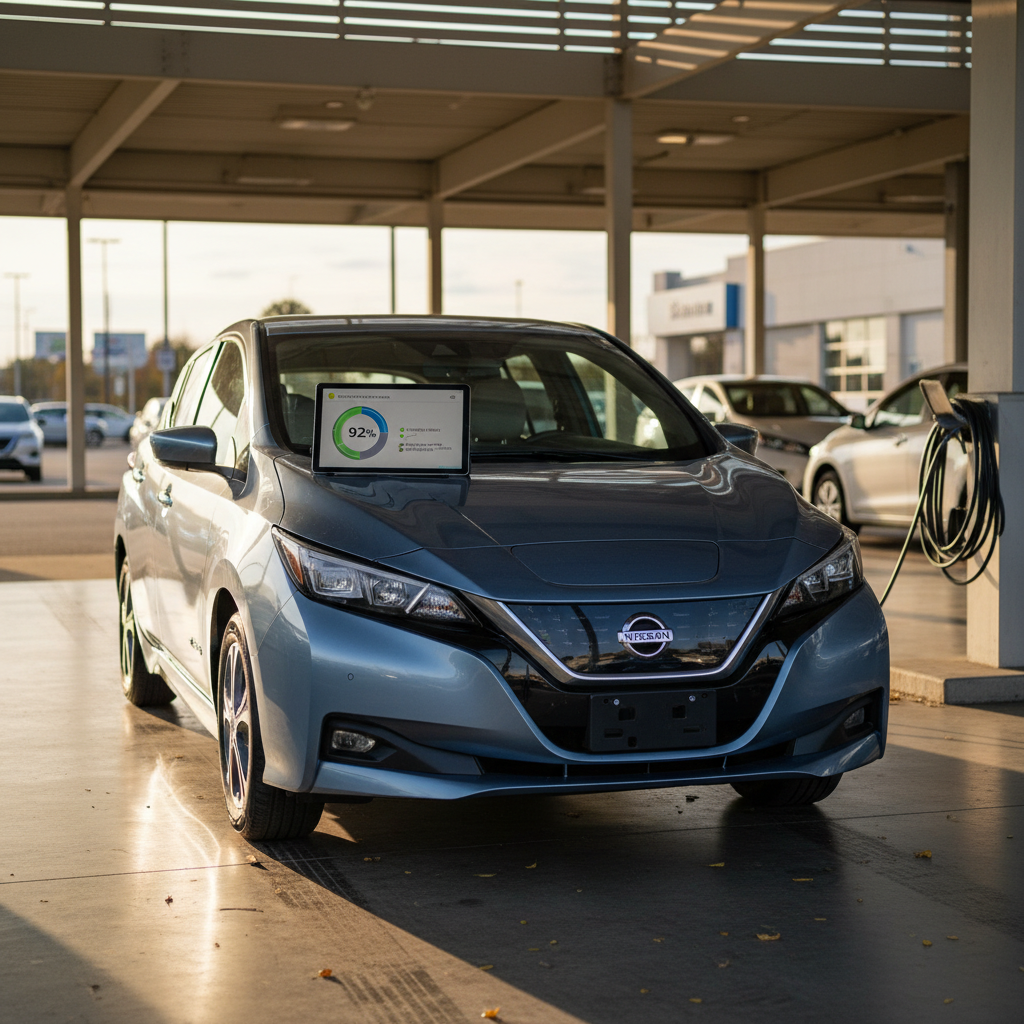
Every EV on Recharged includes a Recharged Score Report with verified battery health. When you plug that into your solar EV savings calculator, you’re basing your math on a pack that’s been properly evaluated, not wishful thinking.
Healthy batteries charge more efficiently and hold more usable energy, which means your rooftop solar kWh turn into more real‑world miles.
End‑to‑end cost clarity
Recharged pairs that battery insight with fair market pricing, financing options, trade‑in offers, and nationwide delivery. You can browse and buy 100% online or visit the Recharged Experience Center in Richmond, VA.
Use your solar calculator to understand your fuel savings, and lean on Recharged’s EV‑specialist support team to understand total ownership costs for the vehicles you’re considering.
Turn your calculator into a buying tool
Ready to find your next EV?
Browse VehiclesFrequently asked questions about solar EV savings calculators
Solar panel EV charging savings calculator FAQ
The bottom line: what your calculator should tell you
A good solar panel EV charging savings calculator doesn’t just spit out one big number. It tells you, in plain terms, how many kWh your EV needs, what those kWh cost from the grid or the pump, how much solar can realistically cover, and how long it takes the whole package to pay you back.
Once you’ve built your own calculator, you can stop guessing. You’ll see exactly how much each future rate hike or gas price spike hurts, and how much less it hurts when you’re fueling with sunshine. When you’re ready to pair that solar investment with a used EV that has verified battery health and transparent pricing, explore the lineup on Recharged and let your calculator guide you to the smartest long‑term choice for your driveway.