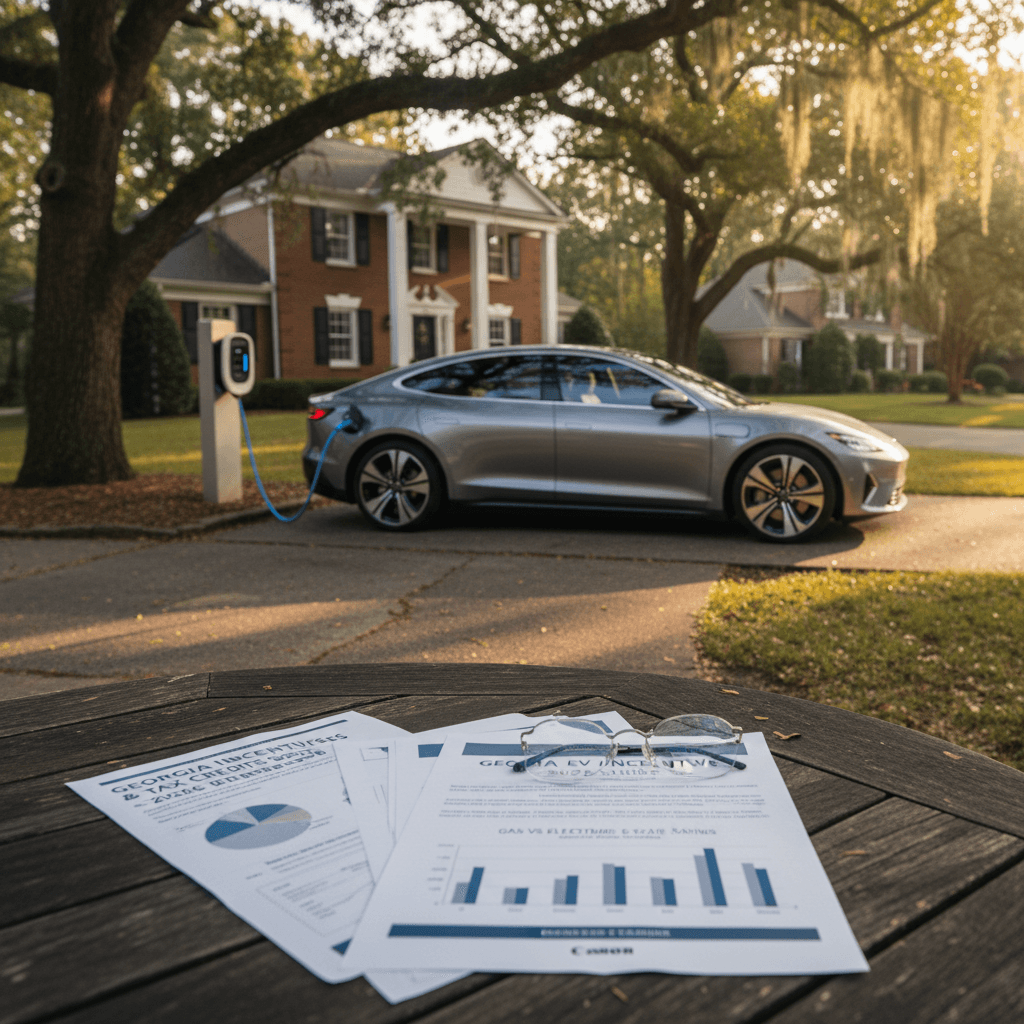
If you live in Georgia, you’re seeing more electric cars on I‑75, I‑85, and around metro Atlanta, and you’re probably wondering: should I switch to an electric car in Georgia right now, or wait? The answer depends less on national headlines and more on Georgia‑specific realities: electricity rates, state EV fees, charging build‑out, and your own driving patterns.
Georgia is becoming an EV hub
Is an EV Right for Georgia Drivers in 2026?
Georgia’s EV landscape at a glance
Georgia is a bit of a mixed bag for EVs. Cheap off‑peak electricity and growing charging infrastructure are real advantages. On the other hand, the state imposes one of the higher annual EV registration fees in the country and, after federal policy changes in late 2025, the purchase‑side incentive picture is less generous than it was a few years ago.
Quick checklist: should you switch now or wait?
Quick decision guide for Georgia drivers
You have (or can get) home or workplace charging
If you park in a driveway or garage, or have reliable charging at work, an EV in Georgia is far more convenient and cheaper to run. If you rely entirely on apartment or public charging, it can still work, but you’ll need to plan more carefully.
Your daily driving fits an EV’s sweet spot
Most modern EVs easily cover 180–300 miles on a charge. If you usually drive under 120 miles a day and take a few longer trips a year, an EV is a strong fit. If you routinely drive 250+ miles in rural areas with sparse charging, you’ll need to be more selective.
You can tolerate a higher upfront price for lower running costs
In Georgia, you’ll likely pay more upfront than for a comparable gas car, but spend much less on fuel and maintenance over time. If you keep vehicles 6–10 years, the math often favors EVs, even with Georgia’s EV fee.
You’re comfortable with new tech and planning charging
Owning an EV in Georgia is straightforward once you learn a few basics, apps for public charging, off‑peak rate plans, and how fast different chargers really are. If you enjoy a bit of tech and planning, you’re a good candidate.
You can live with public charging still being patchy
Georgia’s fast‑charging build‑out is accelerating along interstates and around Atlanta, Savannah, and Augusta. But rural coverage and some older stations can be hit‑or‑miss. If ‘always‑available gas‑station convenience’ is non‑negotiable, you may want to wait a few years.
You’re open to a used EV
Used EV prices have come down meaningfully, and Georgia’s climate is relatively mild on batteries compared with northern states. A well‑vetted used EV can give you most of the benefits of going electric with a smaller financial leap.
Rule of thumb
What EV Ownership Really Costs in Georgia
Upfront costs
- Purchase price: New EVs still cost more than comparable gas models, though the gap has narrowed. Used EVs in Georgia often start well under $20,000 for earlier models.
- Financing: EVs qualify for conventional auto loans. Marketplaces like Recharged offer EV‑focused financing and can help you see the true total cost of ownership, not just monthly payment.
- Home charging: Installing a Level 2 charger can range from a few hundred dollars (simple install) to a few thousand if you need panel upgrades.
Ongoing costs
- Electricity: On Georgia Power’s EV or time‑of‑use plans, overnight charging can be just a few cents per kWh, dramatically cutting fuel costs if you charge off‑peak.
- Registration fee: Georgia adds an annual EV surcharge, roughly in the low‑ to mid‑$200s in 2025–2026, for non‑commercial EVs, indexed over time.
- Maintenance: No oil changes, fewer moving parts, and far less brake wear. You’ll mainly pay for tires, cabin filters, brake fluid over time, and eventual out‑of‑warranty repairs like any car.
Don’t forget the Georgia EV fee
Georgia EV fees, taxes, and incentives in 2026
Key Georgia EV money factors (2026 snapshot)
These are high‑level patterns, not individual tax advice. Always confirm details with current state and federal resources.
| Item | How it works for Georgia EV owners in 2026 | What it means for you |
|---|---|---|
| State EV registration fee | Georgia charges an additional indexed annual fee for non‑commercial battery EVs (in the low‑ to mid‑$200s as of 2025–2026). | Adds a meaningful annual cost, partially offsetting your fuel savings compared with gas. |
| Sales tax | Georgia historically applied standard sales tax to vehicles; specific EV exemptions or credits have shifted over time. | Don’t assume you’ll get a big state‑level purchase break, run numbers with and without any incentive. |
| Federal EV incentives | Federal EV tax credits were significantly weakened or sunset for many vehicles after September 30, 2025, under national legislation. | New‑EV incentives are far more limited than early‑2020s headlines suggest. Used EV credits and other programs may still apply for some buyers. |
| Utility/charger rebates | Utilities like Georgia Power have offered time‑of‑use EV rates and occasional rebates for home chargers or panel upgrades. | Even if purchase incentives are weaker, you may still save on charging equipment or ongoing electricity costs. |
| Local perks | Some Georgia localities and workplaces offer free or discounted charging or preferred parking for EVs. | These aren’t guaranteed, but they can further improve the EV value proposition if available to you. |
Georgia’s policy landscape is evolving; check official sites before you buy.
How to verify current incentives

Electricity vs Gas: What You’ll Actually Pay per Mile
The most compelling everyday argument for EVs in Georgia isn’t ideology, it’s fuel arithmetic. Georgia’s electricity isn’t the cheapest in the country, but off‑peak EV rates can be extremely low compared with gasoline, especially when gas prices spike.
Typical fuel‑cost math for a Georgia commuter
Illustrative numbers only, run your own calculations with your exact rates and MPG.
1. Your current gas car
- Assume 28 mpg combined.
- At $3.20/gal gasoline, that’s about 11.4¢ per mile.
- 12,000 miles/year = ~$1,370 in fuel.
2. EV on standard rate
- Assume 3.0 mi/kWh.
- At ~14¢/kWh retail, that’s about 4.7¢ per mile.
- 12,000 miles/year = ~$560 in electricity.
3. EV on EV/TOU rate
- On EV plans, overnight power can drop to just a few cents/kWh.
- At 4¢/kWh off‑peak, that’s about 1.3¢ per mile.
- 12,000 miles/year = ~$160 if most charging is off‑peak.
Include the EV fee in your math
Charging Access in Georgia Today, and What’s Coming
From Atlanta’s perimeter to coastal I‑95 and the I‑16 and I‑75 corridors, fast‑charging coverage is improving, but uneven. Urban and interstate travel is getting easier every quarter, while rural areas and secondary highways still lag.
How easy is it to charge around Georgia?
A high‑level view of where EVs feel seamless vs. where you still need to plan carefully.
| Area / corridor | Current experience | What’s changing in 2024–2027 |
|---|---|---|
| Metro Atlanta | Multiple DC fast‑charging options from national networks (plus mall, workplace, and municipal Level 2). | Ongoing infill fast‑charging, more workplace chargers, and higher‑power hubs tied to new development and data‑center build‑out. |
| I‑75 / I‑85 / I‑20 | Generally reliable DC fast‑charging at major exits; some gaps remain between larger towns. | Federal NEVI dollars are funding additional highway sites to meet corridor‑coverage rules roughly every 50 miles. |
| Savannah / I‑95 corridor | Decent coverage in Savannah and along I‑95; thinner as you head toward the coast and barrier islands. | More tourist‑oriented and hotel‑based chargers coming as visitor demand grows and automakers ship more road‑trip‑ready EVs. |
| Smaller cities (Macon, Augusta, Columbus) | Reasonable Level 2 and some DC fast options, but far from gas‑station density. | Utility and private‑network investment is targeting these cities as regional EV adoption rises. |
| Rural north & south Georgia | Sparse public fast‑charging; often a single station per town, if any. | Modeling studies and state plans are prioritizing additional coverage, but it will lag urban build‑out for several years. |
Coverage is improving quickly thanks to federal NEVI funding and private network expansion.
Plan for redundancy on long trips
How Your Driving Patterns Fit (or Don’t Fit) an EV
- You mainly commute in or between metro areas like Atlanta, Athens, Augusta, Savannah, or Columbus.
- You can charge at home or at work most days.
- Your longest regular trips are under ~200 miles one way.
- You take a handful of longer road trips a year and are okay spending a bit longer at charging stops.
- You don’t tow heavy trailers long distances on a regular basis.
If that sounds like you, an EV probably fits your life in Georgia extremely well. Where it gets trickier is if you’re a high‑mileage rural driver, tow frequently, or rely on street parking with no realistic option for overnight charging. Those use cases can work, but they demand more careful model selection and route planning.
Great EV candidates in Georgia
- Suburban families in Atlanta who can install a Level 2 charger in the garage.
- City dwellers with workplace charging and predictable commutes.
- Sales or service workers who drive mostly between major cities and return home nightly.
- Households with two cars where the EV handles most miles and a gas car covers edge cases.
Better to wait or be very selective
- Rural drivers regularly covering 250–300+ miles a day away from interstates.
- Apartment residents with no realistic access to overnight or workplace charging.
- Frequent long‑distance towers (boats, heavy trailers) who rely on fast, ubiquitous refueling.
- Drivers extremely sensitive to any added planning or uncertainty on road trips.
Used EVs in Georgia: a Lower-Risk Way to Switch
Given the shifting incentive landscape, the most compelling way to switch to an electric car in Georgia right now is often via the used market. Depreciation has already taken a bite out of early‑ and mid‑cycle EVs, and Georgia’s moderate climate is easier on batteries than extreme cold states.
Why a used EV can make particular sense in Georgia
You get most of the benefits with less financial risk.
Lower upfront price
Known battery health
Clear total‑cost picture
How Recharged helps in Georgia
Ready to find your next EV?
Browse VehiclesCommon Concerns: Battery Life, Weather, and Road Trips
Top EV concerns from Georgia drivers
Where EVs still disappoint
Step-by-Step: How to Switch to an EV in Georgia
Practical roadmap for Georgia shoppers
1. Audit your charging options
Confirm whether you can install a Level 2 charger at home or have reliable workplace charging. If you rent, talk to your landlord or HOA about future EV plans and outlet capacity.
2. Pull your last 12 months of fuel and mileage data
Look at how many miles you drive and how much you spent on gas. This lets you compare realistic EV electricity costs, including Georgia’s EV fee, against your actual current costs.
3. Check current incentives and utility rates
Visit your utility’s EV page to explore <strong>EV or time‑of‑use rate plans</strong>, plus any rebates for chargers or panel upgrades. Then check federal and any remaining state‑level incentives for new or used EVs.
4. Decide new vs used (and budget)
Set a realistic budget based on total cost of ownership, not just price. A used EV with a healthy battery and low operating costs can often beat a cheaper‑to‑buy gas car over 5–8 years.
5. Shortlist 2–4 EV models that fit your life
Filter by required range, cargo space, charging speed, and tech features. Make sure they support North American Charging Standard (NACS) or have robust adapter options for fast charging as networks converge.
6. Get a battery‑health report before you buy used
If you’re considering a used EV, insist on <strong>independent battery diagnostics</strong>. Recharged’s Score Report gives you pack health, fast‑charging history, and pricing context tailored to EVs.
7. Line up financing and trade‑in
Explore EV‑friendly lenders or marketplaces that understand residual value and battery condition. If you’re trading in a gas car, compare instant offers with consignment‑style options that may net you more.
8. Install (or plan) home charging
Schedule a licensed electrician to install a Level 2 charger if needed and confirm you’re on the best rate plan. In many Georgia homes, this is a straightforward job, especially in newer construction.
FAQ: Switching to an Electric Car in Georgia
Frequently asked questions from Georgia shoppers
Bottom Line: Should You Switch to an EV in Georgia?
For a typical Georgia driver with home charging and a mostly urban or suburban commute, switching to an electric car in 2026 is more than a feel‑good environmental move, it’s a rational financial decision over a 5‑ to 10‑year ownership window, even after you account for Georgia’s EV registration fee and a less generous federal credit landscape.
Where the decision gets murkier is if you lack consistent charging, drive long rural routes, or are extremely sensitive to any friction in refueling. In those cases, you either wait a few years for charging to catch up, or treat a used EV as a second car that gradually takes over more of your miles as the network improves.
If you’re leaning toward switching, your next steps are straightforward: audit your charging, run your own fuel vs electricity math, and compare a few EVs side‑by‑side with comparable gas cars on total cost, not just sticker price. Marketplaces like Recharged exist precisely to make that analysis easier, with verified battery‑health data, transparent pricing, EV‑savvy financing, and nationwide delivery, including right here in Georgia.