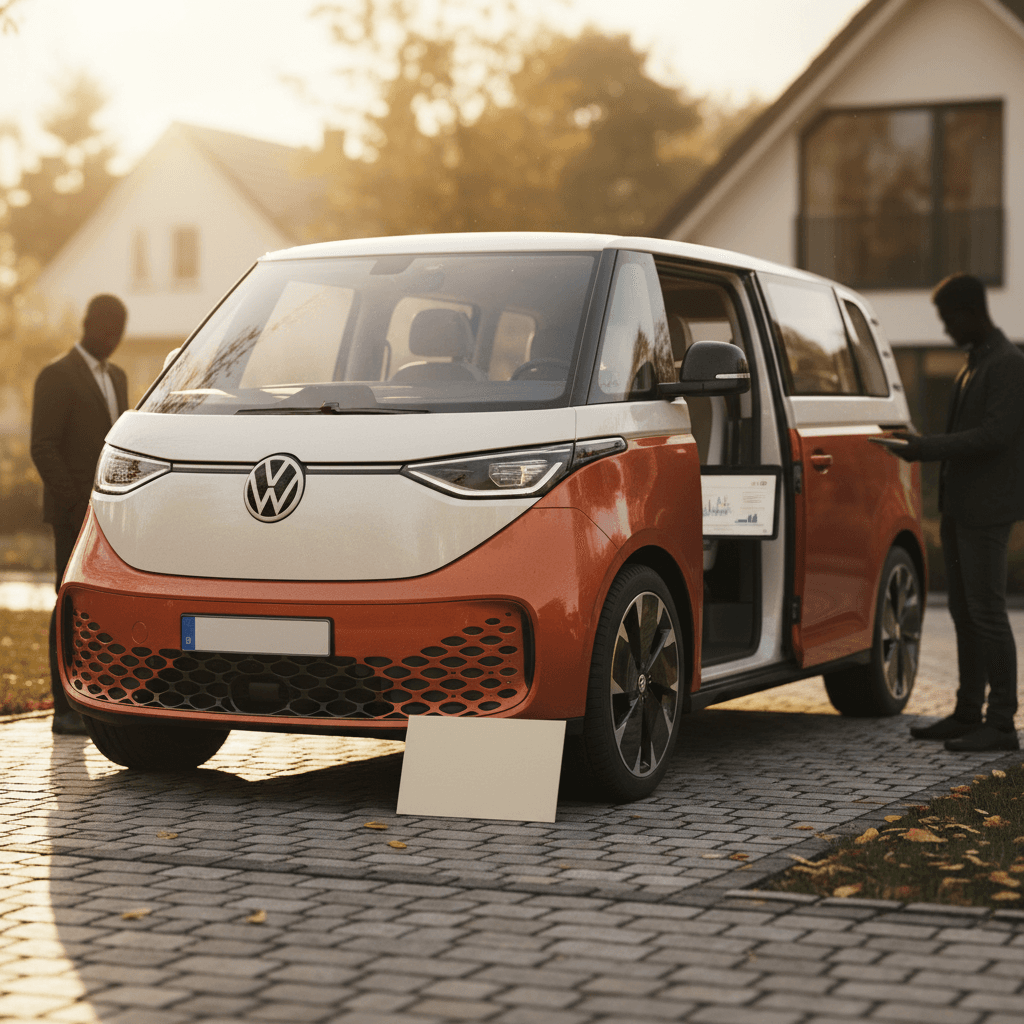
If you’re thinking, “it’s time to sell my Volkswagen ID. Buzz,” you’re in a fairly unique club. The electric microbus is still a niche, high-visibility vehicle with limited supply and very specific buyers. That combination can either work massively in your favor or quietly cost you thousands if you don’t understand how this young market works.
Quick context
Why Selling Your ID. Buzz Is Different From Other EVs
What Makes the ID. Buzz a Special Case
Three things that shape how and when you should sell
Iconic design, niche demand
EV van with real utility
Young, volatile market
Traditional pricing tools lag reality when an EV is this new and this scarce. Online estimators may show wide ranges, and a generic dealer trade-in offer often ignores the nuances that make your specific ID. Buzz more (or less) desirable: color, wheelbase, interior layout, software updates, and especially battery health.
The Current Market for Used Volkswagen ID. Buzz Models
Early ID. Buzz Value Signals (U.S. 2025–2026)
Don’t over-read the early data
By 2025–2026, the ID. Buzz has established itself as a real alternative to three‑row crossovers, minivans, and even camper vans. But it competes in the used market against longer‑range, more familiar EVs like Tesla’s Model Y and Hyundai’s Ioniq 5, which can push less‑informed buyers away from the quirky van. Your job as a seller is to surface the Buzz’s strengths and price it where the right shopper sees value, not just novelty.
Step-by-Step: How to Sell My Volkswagen ID. Buzz
A Simple Process to Sell Your ID. Buzz
1. Decide your timing
Seasonality matters. Family haulers and adventure vans usually sell faster heading into spring and summer. If you can choose when to list, target March through August rather than the depths of winter.
2. Get a real-world value range
Start with online valuation tools, then look at live listings for similar ID. Buzz trims, mileages, and colors. Finally, get at least one real offer (dealer, instant‑offer platform, or marketplace) to ground your expectations.
3. Pull your service and charging history
Buyers are wary of poorly maintained EVs. Export service records from your VW dealer account and, if possible, show consistent home charging rather than repeated DC fast charging.
4. Verify battery health
If you can, get a third‑party battery health report, this is standard on every vehicle sold through Recharged’s <strong>Recharged Score</strong>. A clean report can justify a higher asking price and faster sale.
5. Decide how you want to sell
Choose between trading in, selling to an EV‑focused retailer like Recharged, consigning, or going private‑party. Each path trades time and effort for price; we’ll break down options below.
6. Prepare photos and listing details
If you go private or consignment, take high‑quality photos and highlight what matters for EV shoppers: range, battery warranty status, charging speed, and software/feature packages.
How to Price Your Volkswagen ID. Buzz Correctly
Getting the price wrong is how ID. Buzz sellers either sit on a listing for months or leave thousands on the table. Because pricing tools are still catching up, you need to triangulate.
Pricing Inputs to Consider for Your ID. Buzz
Use multiple signals instead of relying on a single "book value".
| Input | What It Tells You | How to Use It |
|---|---|---|
| Online valuation tools | Algorithmic estimate based on sparse early data | Good as a lower bound; don’t assume it reflects your options or color. |
| Live marketplace listings | What similar vans are being offered for | Aim to price slightly below stale listings and near fresh, well‑optioned ones. |
| Recent sales comps | What similar vans actually sell for | Look at days‑to‑sell and discounting trends, not just headline prices. |
| Battery health report | How much usable capacity the pack still has | Stronger battery = justify top‑of‑market pricing within your range. |
| Local EV incentives & gas prices | How attractive EV ownership looks in your area | High gas prices and strong incentives support higher asking prices. |
| Dealer or instant‑offer quotes | A floor price and hassle‑free option | Treat these offers as a baseline; private or consignment should beat them. |
Combine data sources and adjust for battery health, options, and local demand.
Smart pricing band strategy
How mileage affects your price
With most used ID. Buzz vans still well under 20,000 miles, even a small difference in mileage changes how your van looks next to the competition. A Buzz with 8,000 miles and a clean battery report should command a noticeable premium over a similar one at 25,000 miles with no documentation.
As the odometer climbs, buyers will focus more on remaining battery warranty and how the van has been used (gentle family duty vs. hard commercial use).
How trim and options play in
Interior layout, wheelbase, and options matter a lot. A long‑wheelbase, three‑row Buzz with desirable colors and driver‑assist packages will attract a broader audience than a bare‑bones spec. That doesn’t mean base models are unsellable, but it does mean you should lean into the specific use case (simple work van, minimalist camper build, etc.) when you craft your listing.
Battery Health and Range: What Buyers Look For
For combustion vans, buyers obsess over engine and transmission wear. For an ID. Buzz, the equivalent is battery health and real‑world range. Two Buzz vans with the same model year and mileage can have very different appeal depending on how they’ve been charged and driven.
Battery & Charging Signals That Reassure Buyers
Make these easy to see in your listing or sales conversation
Battery health report
Charging habits
Range consistency history
How Recharged handles this
Should I Sell, Trade In, or Consign My ID. Buzz?
When people say “I want to sell my Volkswagen ID. Buzz,” they often haven’t decided what that actually means. Are you trying to squeeze every last dollar out of it, or is your priority to move on quickly with as little friction as possible?
Ways to Sell Your Volkswagen ID. Buzz
Different paths depending on whether you value time, price, or convenience most.
| Option | Pros | Cons | Best For |
|---|---|---|---|
| Trade-in at a dealer | Fast, offsets tax on your next vehicle in some states, one‑stop experience | Usually the lowest net value, many dealers still misprice EVs, especially niche ones like the ID. Buzz | If you’re already buying another car today and value speed over every last dollar |
| Sell to a specialist like Recharged | EV‑savvy pricing, battery‑health based valuations, fully digital process with nationwide reach | Cash offer may still be below top‑dollar private‑party pricing | If you want strong value without handling marketing, tire‑kickers, or paperwork |
| Consignment with Recharged or similar | Professional photos, listing, and negotiation; your van is marketed nationwide while you retain ownership until it sells | Takes more time than an instant sale; fees or revenue share apply | If you can wait a bit longer to maximize price but don’t want to sell it yourself |
| Private-party sale | Potentially the highest price, especially for rare colors or unique builds | You handle everything: marketing, test drives, paperwork, and fraud screening | If you enjoy the process and have time to manage messages, showings, and negotiation |
You can mix approaches, get instant offers to establish a floor, then explore consignment or private‑party listings for upside.
Stack the deck in your favor
Prepping Your ID. Buzz to Sell
- Deep clean inside and out, including the panoramic glass, light‑colored seating, and any kid‑ or pet‑heavy areas.
- Fix cheap turn‑offs: scuffed wheels, missing trim pieces, worn wiper blades, and cracked phone mounts are all low‑cost but high‑impact.
- Update software at a VW dealer if you’re behind; buyers value the latest range and driver‑assist improvements.
- Gather both keys, the original charging cable, and any accessories (cargo dividers, floor mats, camper modules).
- Take 20–30 high‑quality photos: three‑quarter front and rear, both sides, interior rows, cargo space, wheels, infotainment, and close‑ups of wear points.
Don’t hide cosmetic issues
Common Pitfalls When Selling an EV Van
Mistakes That Quietly Cost ID. Buzz Sellers Money
Most are easy to avoid once you know they exist
Relying on generic book values
Waiting too long to react
Ignoring geography
Watch for EV‑specific scams
How Recharged Helps You Sell Your ID. Buzz
Selling a distinctive EV like the ID. Buzz is exactly where a specialist marketplace makes more sense than a traditional dealer lot. Recharged is built specifically for used EVs, including electric vans and people movers like yours.
What You Get When You Sell an ID. Buzz Through Recharged
Built for EVs, not generic used cars
Recharged Score battery diagnostics
Fully digital, nationwide reach
Ready to find your next EV?
Browse VehiclesTrade-in or instant offer
If you’re moving into another EV, maybe a longer‑range crossover or a different configuration, Recharged can provide a competitive, EV‑savvy offer. Because valuations incorporate real battery data and live market trends, you’re less likely to see the kind of head‑scratching lowball you get from generic dealers.
Consignment for maximum value
If you have time and want to target that niche buyer who truly appreciates the ID. Buzz, consignment lets Recharged handle marketing, tire‑kickers, and paperwork while you keep ownership until the right buyer steps up. It’s often the sweet spot between an easy instant sale and a full DIY private‑party effort.
FAQ: Selling My Volkswagen ID. Buzz
Frequently Asked Questions About Selling an ID. Buzz
Bottom Line: Getting the Most for Your ID. Buzz
Selling a Volkswagen ID. Buzz isn’t like unloading a generic crossover. You’re marketing a rare, charismatic EV van in a young, still‑evolving market. That can be a liability if you lean on outdated book values and hope for the best, but it’s an opportunity if you treat your Buzz like the distinctive asset it is, with transparent battery data, thoughtful pricing, and smart channel selection.
If your priority is absolute simplicity, a trade‑in or instant offer gives you a quick, clean exit. If you’re willing to invest a bit more time, consignment or a well‑run private‑party sale can reward you with a higher price and a buyer who genuinely appreciates what the ID. Buzz does differently. Either way, using EV‑savvy partners like Recharged, with tools like the Recharged Score, expert pricing support, and nationwide reach, tilts the economics in your favor when you’re ready to say, “yes, it’s time to sell my Volkswagen ID. Buzz.”