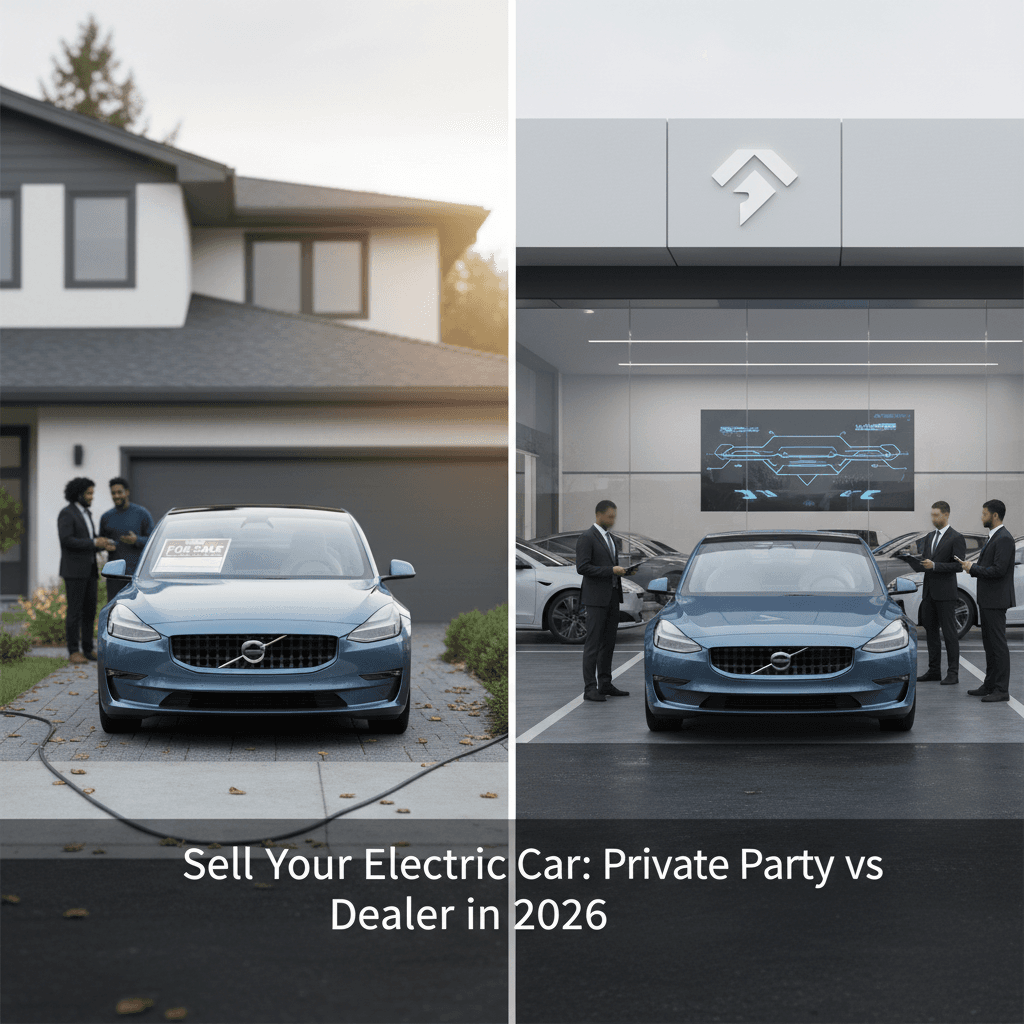
You’ve decided it’s time to sell your electric car, and now you’re staring at two very different paths: sell privately or take a dealer offer. With EVs, that decision is more complicated than it was in your gas‑car days. Battery health, tax credits, fast‑changing prices, and skeptical buyers can easily swing the numbers by thousands of dollars either way.
Used EV prices are volatile
Why selling an electric car feels different
1. Battery health is the new mileage
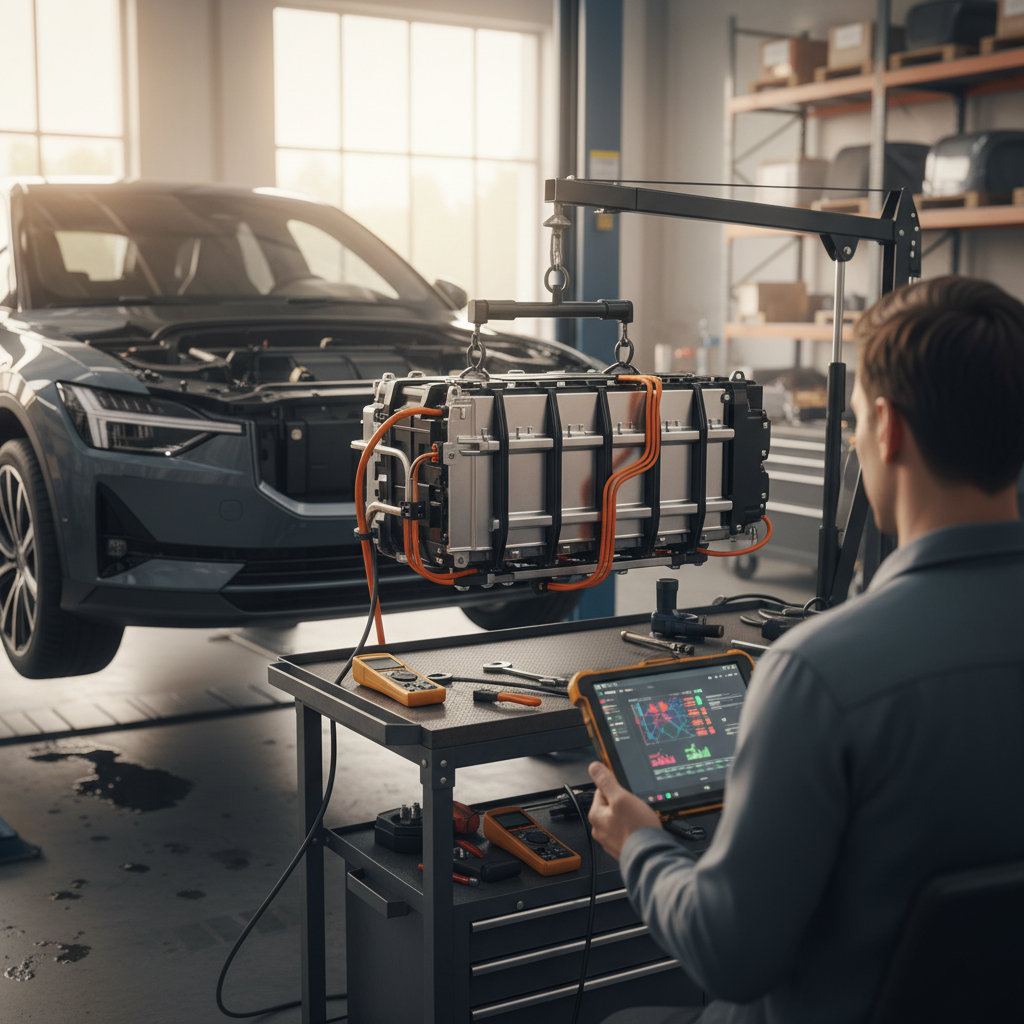
On a gas car, buyers focus on miles and maintenance records. On an EV, they want to know: how healthy is the battery and how far will it really go? Many shoppers have heard scary headlines about replacement costs, so a vague answer here can kill a private‑party deal.
2. The market is still catching up
Used EV prices fell hard between 2022 and 2025 as more supply hit the market and new EV discounts grew. That’s good when you’re buying, frustrating when you’re selling. Dealers watch auction data daily, but many private buyers just see a wide spread of asking prices and feel unsure what’s fair.
Because of those two realities, the gap between private‑party and dealer prices on an electric car isn’t always as predictable as it was for internal‑combustion models. That makes it important to understand what you’re really trading off when you choose one route over the other.
Big picture: private party vs dealer for electric cars
Private sale vs dealer: quick comparison for EVs
Use this as a snapshot before you dive into the details
Sell private party
- Pros: Highest potential sale price, you control the story around battery health, more flexible on timing and terms.
- Cons: Time‑consuming, you handle test drives and paperwork, need to educate buyers about EV ownership and charging.
Sell to a dealer
- Pros: Fast, low‑hassle, you’re done in a day, no strangers at your home, dealer handles payoff and title.
- Cons: Lower price than private sale, some dealers still undervalue EVs or are cautious about battery risk.
What today’s used EV market looks like
How much more can you get selling your EV privately?
With gas cars, a 10–20% spread between dealer trade‑in and private‑party price is a good rule of thumb. For electric cars, the percentage can look similar, but the actual dollars depend heavily on what’s happening in the EV market this quarter and how desirable your specific model is.
Typical price difference: dealer vs private‑party sale
Illustrative examples assuming a well‑equipped EV in good condition with average mileage and clean history. Real numbers will vary by model and region.
| Scenario | Approximate Dealer Offer | Likely Private‑Party Price | Realistic Spread |
|---|---|---|---|
| Mainstream compact EV (e.g., Bolt EUV, Leaf Plus) | $14,000 | $16,000–$17,000 | $2,000–$3,000 |
| Popular Tesla Model 3/Y | $20,000 | $22,000–$24,000 | $2,000–$4,000 |
| Older short‑range EV (e.g., early Leaf) | $4,000 | $4,500–$5,000 | $500–$1,000 |
| High‑end luxury EV (e.g., Taycan, iX) | $40,000 | $43,000–$46,000 | $3,000–$6,000 |
Use this as a ballpark, then check live listings and instant offers for your VIN.
Don’t chase last year’s prices
Remember, the extra money from a private sale isn’t “free”, you’re earning it by putting in time, handling marketing and screening, and taking on a bit more risk. The right question is not just “Can I get more privately?” but “Is the extra money worth the work in my situation?”
EV‑specific factors that change the math
Four EV factors that matter more than with gas cars
These can tilt the decision toward private sale or dealer
1. Battery health transparency
2. Rapid price shifts
3. Charging and accessories
4. Warranty and recall status
Turn battery fear into an asset
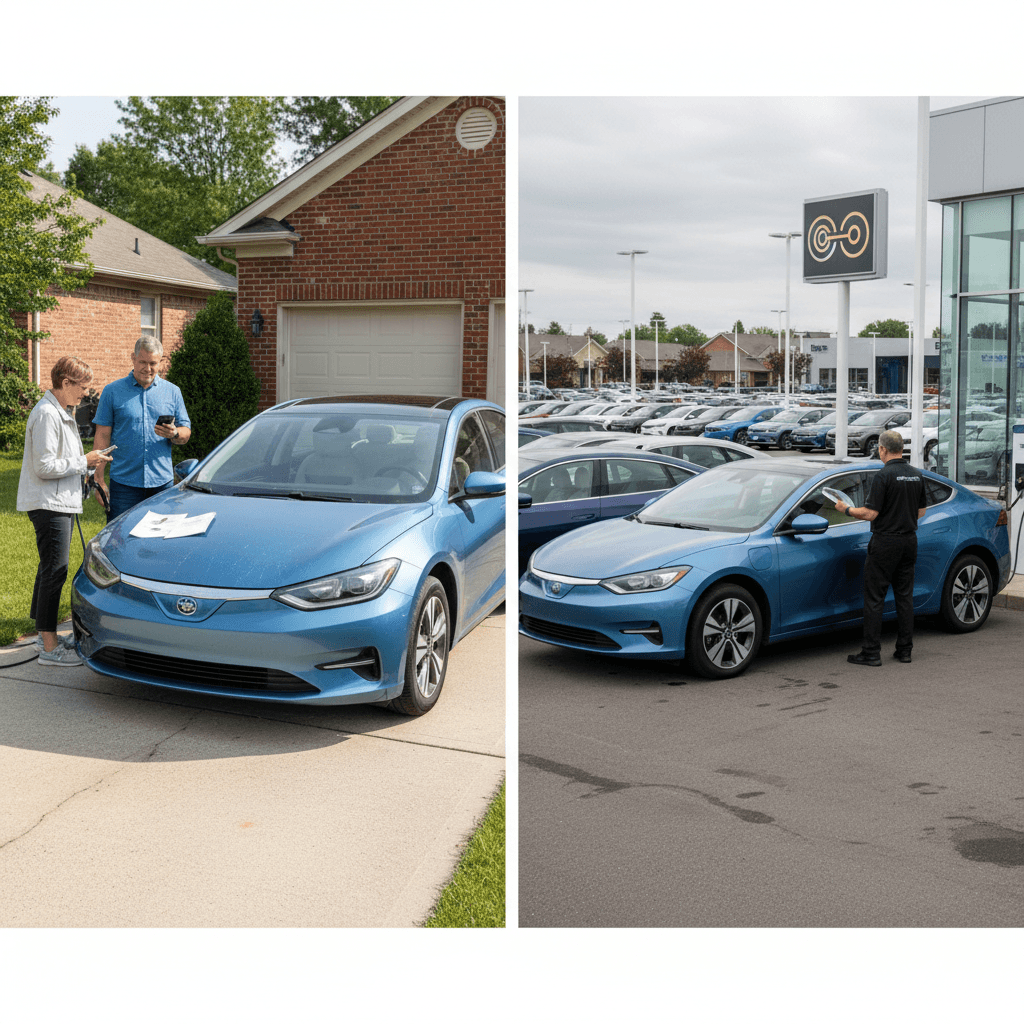
Dealer options: trade‑in, instant offer, and consignment
- Traditional trade‑in: You roll your EV into the price of your next vehicle. Dealers may show less for your trade but make it back on the new‑car side or in financing.
- “We’ll buy your car” / instant cash offer: Dealers and online players will simply cut you a check, whether or not you buy from them. This is the cleanest way to walk away from your EV in a single move.
- Consignment: A dealer or marketplace advertises and sells your EV on your behalf, taking a fee in exchange for handling marketing, test drives, and paperwork. You keep more of the upside than a straight trade‑in, but it’s not instant.
For EV owners, instant‑offer and consignment models can be attractive because you’re outsourcing buyer education and test drives. A good EV‑focused retailer will explain range, home charging, and battery reports far more efficiently than you want to on a Saturday afternoon in your driveway.
When a private‑party sale makes the most sense
Signs you should sell your EV privately
Your EV is in a sweet‑spot segment
Clean, well‑optioned Teslas, popular crossovers, and late‑model long‑range EVs with warranty left attract enthusiastic shoppers who will pay more than a conservative dealer bid.
You can prove battery health clearly
You’ve got a recent battery‑health report (for example, a Recharged Score), service records, and maybe even real‑world range logs that put buyers at ease.
You’re not in a rush for cash
You can afford to wait a few weeks, answer messages, and schedule test drives instead of needing the car gone today to fund your next purchase or clear a lease payoff.
You’re comfortable screening strangers
You don’t mind vetting buyers, verifying funds, and meeting in neutral locations like your bank. You’re willing to say no if something feels off.
Your payoff is straightforward
Either you own the EV outright or your lender is easy to work with on payoff and title release, so you’re not asking a private buyer to navigate a messy lien situation.
Where private sellers often win big
When selling your EV to a dealer is smarter
Situations where a dealer is the better move
You prioritize speed and simplicity
You want the car gone this week with minimal friction, and you’re willing to leave some money on the table in exchange for that convenience.
Your EV is harder to explain
Short‑range early EVs, cars with incomplete charging gear, or models with confusing recall histories are often best offloaded to a dealer who knows how to retail or wholesale them.
Your local market is cold on EVs
If you’re in an area where charging infrastructure is sparse and dealers struggle to move used EVs, private buyers may be very thin on the ground.
You need help with payoff and paperwork
Complex payoff, multi‑state title, or a lease buyout are all headaches a dealer can absorb. They’ll coordinate with your lender and the DMV while you move on.
You want to pair it with your next purchase
Trading your EV when you buy your next vehicle can simplify sales tax in some states and give you more leverage on the overall deal, even if the trade line alone doesn’t look spectacular.
Watch for lowball EV bids
How to compare real‑world offers step by step
Step‑by‑step: dealer vs private‑party decision
Track A: Start with dealer and work outward
Get at least two instant‑offer or trade‑in quotes for your VIN from EV‑friendly buyers.
Ask each buyer how they are accounting for your battery health, can they see a report? Are they assuming worst case?
Total your <strong>net</strong> proceeds (after payoff, fees, and taxes) for each dealer scenario.
Use those dealer numbers as a realistic floor for what you’d accept privately, plus a premium for your extra effort.
Track B: Start with private‑party pricing
Look up current private‑party values and real sold prices for cars like yours, don’t rely on a single listing.
Decide on a target "walk‑away" number that’s meaningfully higher than your best dealer offer (for example, $2,000–$3,000).
Factor in your timeline: how long can you comfortably wait before dropping to your dealer “backup” offer?
If serious private interest doesn’t materialize in that window, execute your backup plan instead of chasing the market down.
Compare total deal, not just sale price
Tax credits and paperwork quirks with electric cars
One curveball in the EV world is the used clean vehicle federal tax credit, which, under current rules, only applies when a qualified buyer purchases from a dealer or dealer‑like entity, not in a simple peer‑to‑peer cash sale. That means a buyer may find your car more attractive if they can structure the deal in a way that still qualifies for the credit.
- In a straight private‑party sale, the buyer generally cannot claim the federal used EV tax credit, even if the car and buyer otherwise qualify.
- Some third‑party services act as the “dealer of record” for a private‑party transaction, allowing the buyer to capture the credit while you still negotiate directly.
- If your EV still qualifies for a new‑ or used‑vehicle incentive in your state, dealers may be better set up to apply that benefit at the point of sale than a private buyer will be when dealing with DMV paperwork.
Talk incentives early
How Recharged fits between private sale and traditional dealers
Recharged was built specifically around used EVs, which puts it in a unique spot on the spectrum between private sale and old‑school dealerships. Instead of treating your EV like an oddball, the entire process revolves around battery health, transparent pricing, and convenience.
What you can do with your EV at Recharged
Options that blend private‑sale pricing with dealer‑level simplicity
Get a Recharged Score
Instant offer or consignment
Financing & nationwide delivery
Ready to find your next EV?
Browse VehiclesExperience center support
FAQ: selling your electric car private party vs dealer
Frequently asked questions
Bottom line: choose the right exit, not just the highest price
Selling an electric car isn’t just a rerun of selling your last gas sedan. Battery health, market swings, and buyer education all play outsized roles, and they’re exactly where the choice between private‑party sale and dealer really shows up in dollars and stress level.
If you have a desirable EV, time on your side, and strong documentation, a private sale can reward you for doing the work. If you value speed, simplicity, and someone else handling the questions about kilowatts and kilowatt‑hours, a dealer or EV‑focused marketplace like Recharged may be worth a slightly lower headline price.
The smart move is to treat every offer as data. Get dealer bids, understand what similar EVs are truly selling for, and, if possible, arm yourself with a professional battery‑health report. Then pick the path, private‑party or dealer, that leaves you most confident, not just about the check you’ll deposit next week, but about the decision you’ll look back on a year from now.