If you’re thinking about how to sell a 2025 Kia EV9 for the best value in 2026, you’re not alone. The EV9 launched into one of the most volatile EV markets we’ve seen, with aggressive incentives, fast‑moving tech, and shifting tax‑credit rules. The good news: if you understand how depreciation, battery health, and timing work together, you can keep thousands of dollars from slipping through your fingers when you sell.
Context: what this guide covers
Why 2025 Kia EV9 value is tricky in 2026
The 2025 EV9 sits at the intersection of three big forces: a rapidly maturing three‑row EV segment, generous launch‑year incentives, and a still‑evolving used EV market. New‑vehicle MSRP for the 2025 EV9 spans roughly the mid‑$50,000s for a Light trim to the mid‑$70,000s for a GT‑Line once destination is included, depending on options and region. That wide price band and a mix of lease cash, dealer discounts, and federal incentives means two seemingly similar EV9s can have very different real‑world depreciation curves.
2025 Kia EV9 value snapshot in 2026
Depreciation varies more than the guides suggest
What is a 2025 Kia EV9 worth today?
As of early 2026, mainstream appraisal tools show a wide value range for 2025 EV9s. A typical mid‑trim EV9 with average mileage and no major damage can often appraise somewhere in the low‑$30,000s on the trade‑in side and into the $40,000s as a retail asking price. Higher‑spec Land and GT‑Line models, or low‑mileage examples, can sit toward the top of that band or a bit beyond.
Illustrative 2025 Kia EV9 value ranges in 2026
These are broad, example ranges based on typical guide data and early used‑EV market behavior. Your specific EV9 may fall outside these bands based on condition, incentives, and region.
| Trim & condition (2026) | Approx. miles | Likely trade‑in range | Likely private‑party / retail range |
|---|---|---|---|
| Light / Light Long Range – good condition | 10,000–20,000 | $31,000–$35,000 | $38,000–$44,000 |
| Wind AWD – good condition | 15,000–25,000 | $33,000–$37,000 | $40,000–$46,000 |
| Land AWD – good condition | 15,000–30,000 | $35,000–$40,000 | $43,000–$49,000 |
| GT‑Line AWD – excellent condition | 10,000–20,000 | $38,000–$43,000 | $47,000–$52,000 |
Use this table as a directional guide, then refine with live appraisals and a battery‑health report.
How to sanity‑check your EV9’s value
How EV9 depreciation actually works
Depreciation on a 2025 EV9 has two layers: the usual new‑car curve and a set of EV‑specific forces. Cost‑to‑own models suggest a five‑year drop of roughly mid‑$30,000s from original MSRP under typical use, which works out to around $7,000 per year in the early years. But 2024–2026 has not been a “typical” period for EVs, and the real story is in when and how that value disappears.
- The steepest hit usually comes in the first 12–24 months, especially if you bought early when dealer markups were still happening or incentives were shifting.
- Aggressive leases with high residual values can make lease buyouts uneconomical, your residual may be above market value, even if the EV9 is in great shape.
- Tax credits and state rebates compress used prices: if a new EV9 still effectively benefits from incentives, buyers will demand a discount on yours to compensate.
If you financed or paid cash
Your depreciation story is straightforward: compare your original transaction price (after incentives) to today’s market value.
- Focus on out‑the‑door cost, not MSRP on the window sticker.
- Big rebates you received in 2025 are already “baked in” to your depreciation.
- If you secured a strong discount plus incentives, your percentage loss may be better than it looks on paper.
If you leased your 2025 EV9
Kia and its finance partners often set optimistic residuals on EV9 leases to move volume. That can cut both ways.
- If the buyout number is higher than market value, don’t force the buyout, treat your EV9 like any other leased car and just shop your options.
- If market value is higher than the residual, you may be sitting on equity. Getting competitive bids (including from EV‑specialist buyers) will reveal whether that equity is real.
Don’t assume your lease residual equals market value
Factors that move your EV9’s value up or down
Key value drivers for a 2025 Kia EV9
These are the levers you can’t change, and the ones you can.
Trim & options
GT‑Line and Land trims with dual‑motor AWD, premium audio, and tech packages typically command meaningful premiums over base Light models.
List your exact trim, wheels, seating configuration, and options when you sell, buyers shopping three‑row EVs are cross‑shopping features.
Mileage & use pattern
Most pricing tools assume around 12,000 miles per year. Lower mileage generally supports higher value, but documented highway miles can be viewed more favorably than short‑trip urban use.
Condition & history
No accidents on the vehicle history report, clean interior (remember, it’s often a family hauler), and documented maintenance all help the EV9 stand out in a used‑EV market where trust is a pain point.
EV-specific value drivers you shouldn’t ignore
These are especially important for savvy used‑EV buyers.
Battery health & warranty
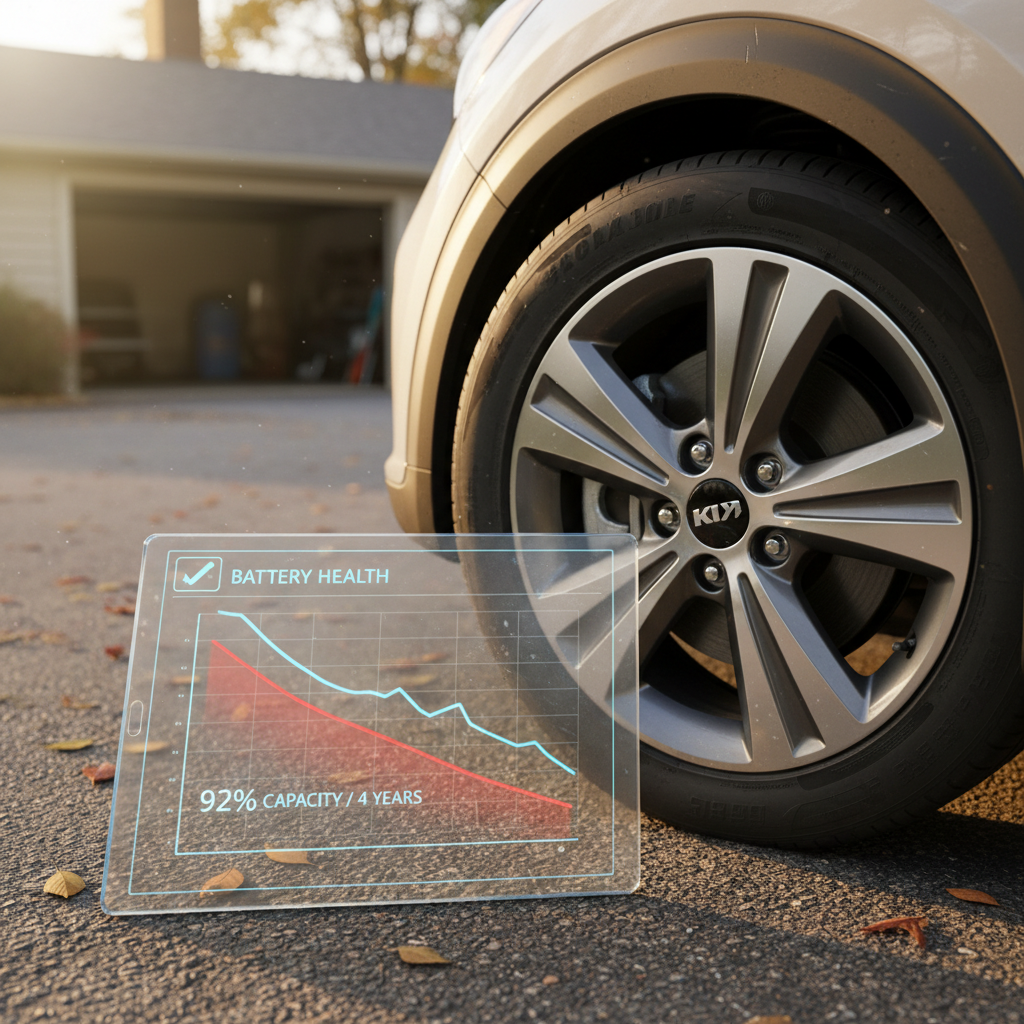
Your remaining 10‑year / 100,000‑mile battery warranty is a major selling point. Independent battery‑health documentation can differentiate your EV9 from others that only show a generic state of charge.
Charging experience
Buyers care about real‑world charging: how quickly the EV9 charges at DC fast chargers, what home setup you used, and whether you’ve had issues. Clear, honest information builds confidence.
Local demand & competition
A three‑row EV like the EV9 may command stronger prices in suburban family markets than in dense urban cores. Local inventory, especially of new EV9s with incentives, also affects what your used one is worth.
Battery health: the silent swing factor
For an electric three‑row SUV, the battery isn’t just a component, it’s the asset. Yet most conventional appraisals barely scratch the surface of actual battery condition. Two EV9s with the same trim and mileage can have materially different real‑world range and long‑term value, and the onboard battery‑health readouts many owners see aren’t always reliable.
Why generic SOH readouts aren’t enough
This is where EV‑specific diagnostics matter. At Recharged, every vehicle gets a Recharged Score Report that includes independent battery‑health data, not just what the car’s dashboard wants to show. That level of transparency helps buyers pay more for the right EV9, and gives you a defensible story when someone tries to use vague “battery concerns” to lowball you.
How Recharged uses battery data to support value
Ready to find your next EV?
Browse VehiclesSelling options: trade‑in vs private sale vs Recharged
Once you understand roughly what your 2025 EV9 is worth, the next decision is how to sell it. Your three main paths each trade convenience for price in different ways, and EV‑specific complexity like battery health and tax credits can tilt the scales.
1. Traditional dealer trade‑in
- Fast and easy, especially if you’re buying another vehicle.
- Value is often on the low end of the range.
- Most stores still treat an EV9 like any other SUV plus some generic EV risk.
Good if time and simplicity matter more than squeezing out every last dollar.
2. Private‑party sale
- Often yields the highest headline price if you find the right buyer.
- Requires photos, listings, test drives, and handling payment and paperwork.
- You’ll spend time educating buyers about range, charging and warranties.
Best if you’re comfortable marketing and screening buyers yourself.
3. EV‑specialist buyer (Recharged)
- Instant offer, or consignment if you want to aim higher on price.
- Uses EV‑specific data like battery health and market demand by trim.
- Fully digital experience, plus an Experience Center in Richmond, VA.
A middle path: more than a basic trade‑in, less work than going fully private‑party.
When Recharged makes the most sense
Step‑by‑step checklist to maximize your EV9 sale price
Pre‑sale checklist for a 2025 Kia EV9
1. Gather your paperwork
Collect your purchase or lease documents, title or payoff info, window sticker if you have it, and records of any service or software updates. Buyers and EV‑specialist platforms will use these to verify options and history.
2. Pull multiple value estimates
Get trade‑in and private‑party estimates from at least two pricing guides, plus instant offers from both traditional dealers and an EV‑focused marketplace like Recharged. Build your own value “band” instead of fixating on a single number.
3. Get an independent battery‑health report
If you’re not using a service that includes diagnostics, consider getting a third‑party battery‑health assessment. A strong report can justify a higher ask, and a weaker one lets you price realistically instead of chasing top‑of‑market numbers you’ll never actually get.
4. Recondition the basics
Have the EV9 professionally detailed, address obvious cosmetic issues like curb‑rashed wheels if the repair cost is modest, top off washer fluid and tire pressures, and clear non‑essential items from the cabin and cargo area. A family SUV that looks cared‑for simply sells easier.
5. Document charging behavior
Note your typical charging routine (home Level 2 vs DC fast charging), any patterns like avoiding frequent 100% fast charges, and your real‑world range at common state‑of‑charge points. This reassures buyers that you haven’t abused the pack.
6. Decide your minimum acceptable number
Before you list or walk into a store, decide the <strong>walk‑away price</strong> that still makes sense for you given your payoff, replacement plans, and tax situation. It’s much easier to negotiate when you’ve already done that math at home.
Don’t overspend on last‑minute repairs
Pricing strategy: how to set a realistic asking price
Once you’ve done the homework, you’ll probably have a range, say $32,000 to $38,000, within which your 2025 EV9 should reasonably sell. The goal is to anchor high enough to leave room to negotiate without scaring off qualified buyers or getting ignored by algorithms on marketplaces.
- Start 3–7% above the midpoint of your realistic range if you’re listing privately, assuming your EV9 is clean and well‑documented.
- If you’re using Recharged consignment, work with their pricing specialists; they’ll factor in trim, color, battery health, and current demand for three‑row EVs in your region.
- If you’re taking an instant offer, treat it as a floor. Show competing offers and your documentation (especially a battery‑health report) to see if the buyer can close part of the gap toward retail value.
- Watch comparable listings: if similar EV9s are sitting unsold at prices you’re targeting, the market is telling you where resistance is. Better to price slightly under the big pile of stale listings than slightly over.
Use your battery report in negotiations
Timing your sale: 2026 EV market considerations
Timing matters more for EVs than for most gas vehicles because policy, incentives, and tech move quickly. The 2025 EV9 is already facing competition from newer three‑row EVs and refreshed 2026 EV9 trims with range and equipment tweaks, and dealers may be using incentives to keep the new ones moving. That usually puts downward pressure on used values, but not uniformly.
When to lean toward selling your 2025 EV9 now vs later
Think less in terms of calendar year and more in terms of market phases.
Signals it’s better to sell sooner
- New‑vehicle incentives on 2026 EV9s or rival three‑row EVs just increased.
- You’re approaching a mileage threshold (e.g., 30,000 or 36,000 miles) where buyers and warranties become more cautious.
- Your life situation changed and you don’t need three rows or the payment anymore.
Signals you can wait or be picky
- You’re on a particularly favorable lease with low payment and no immediate need to switch.
- Your 2025 EV9 has uncommon, high‑demand spec (color, GT‑Line, tow package) and comparatively low miles.
- Local inventory of both new and used EV9s is thin, and your early value checks are already strong.
Nationwide vs local timing
FAQ about selling a 2025 Kia EV9
Frequently asked questions about 2025 Kia EV9 value & selling
Selling a 2025 Kia EV9 in 2026 doesn’t have to be a guessing game. If you anchor your expectations in real transaction data, understand where depreciation actually comes from, and put hard numbers behind your battery’s health, you’ll be miles ahead of most sellers. Whether you decide to trade in, go private‑party, or tap into an EV‑only marketplace like Recharged, the key is to treat your EV9 like the sophisticated electric product it is, not just another big SUV with a price pulled from a generic guide.