Running out of charge in an electric vehicle feels very different from running out of gas. You can’t just grab a can, walk to the nearest station, and be back on the road in 15 minutes. That’s exactly why roadside EV charging service, mobile trucks or vans that can give your battery a quick boost where you’re stranded, has become one of the most talked‑about backup options for EV drivers in 2025.
Big Picture
What Is Roadside EV Charging Service?
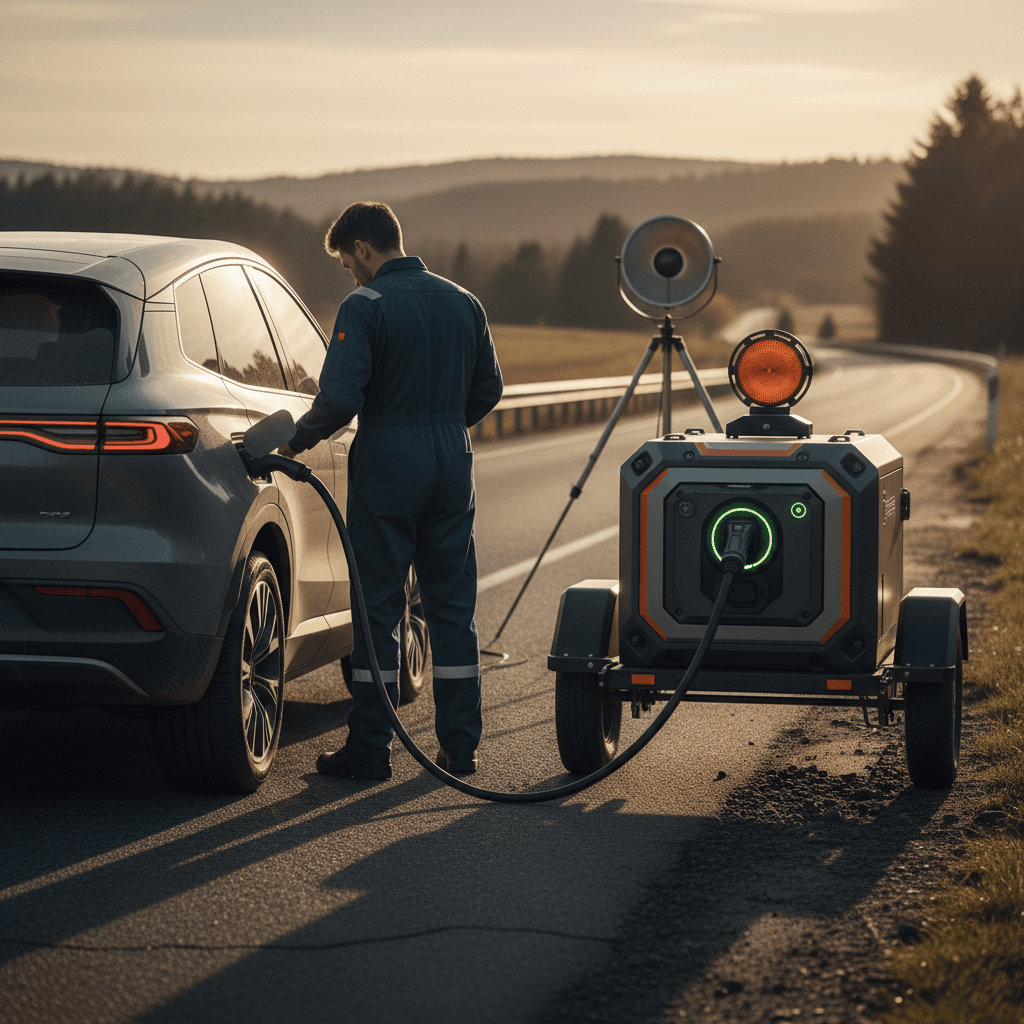
A roadside EV charging service is a specialized form of roadside assistance that brings electricity to your car instead of towing your car to electricity. Instead of a fuel can, a provider sends a service truck equipped with a mobile battery pack or generator capable of providing Level 2 or DC fast charging long enough to get you to the nearest station.
- You call your roadside assistance provider or use an app when your battery is depleted or nearly empty.
- A dispatcher confirms your location, vehicle model, and state of charge (SoC).
- A mobile charging unit, usually a van or pickup with a battery pack or generator, is sent to your location.
- The technician connects a cable to your EV and delivers enough energy for 10–60 miles of range, depending on your car and equipment.
- You drive to a nearby public charger or home to fully recharge.
Not a Full Recharge
How Roadside EV Charging Actually Works
There are two main ways roadside EV charging is delivered today: mobile DC fast charging and portable Level 2 charging. The experience is similar (a technician plugs in your car), but the power level, and therefore speed, can be very different.
Two Common Types of Roadside EV Charging
Both get you moving, but one is much faster than the other.
Mobile DC Fast Charging
These trucks carry high‑capacity battery packs or generators and DC chargers similar to what you see at public fast‑charging stations.
- Power: typically 25–120 kW
- Use case: Highways, fleets, busy metro areas
- Pros: Fast, often 15–30 minutes for a usable boost
- Cons: Equipment is expensive, so coverage is limited
Portable Level 2 Charging
Technicians use compact Level 2 units powered by an onboard generator or battery pack.
- Power: usually 6–9 kW
- Use case: Urban and suburban breakdowns, parking lots
- Pros: Cheaper equipment, easier to deploy
- Cons: Slower, 20–60 minutes may only add 10–20 miles
Compatibility Matters
Who Actually Offers Roadside EV Charging Today?
Coverage is still patchy, but your odds of getting roadside EV charging service are improving, especially in major metro areas and along busy interstates. In practice, services fall into three buckets: traditional roadside-assistance brands, automaker programs, and independent mobile-charging startups.
- Traditional roadside assistance: Some major roadside providers now offer EV‑specific plans. In many urban and suburban markets, they can dispatch a mobile charger instead of, or in addition to, a flatbed tow.
- Automaker programs: Many new EVs include limited-time roadside coverage that may provide a charge or tow if you run out of battery. Coverage and charge amount vary by brand and model year.
- Mobile EV charging startups: App‑based services in select cities send mobile DC fast chargers or large battery trailers. These services often cater to fleets but may serve individual drivers on demand.
- Utilities and municipalities: A few utilities and city programs have pilot projects where mobile chargers support events, construction zones, or underserved areas, occasionally helping stranded drivers as well.
Urban vs. Rural Reality
What Does Roadside EV Charging Cost?
Pricing models are still evolving, but roadside EV charging is generally more expensive per kilowatt‑hour than charging at a fixed station, just like emergency fuel delivery is pricier than a normal gas stop. You’re paying for convenience, specialized equipment, and the technician’s time.
Typical Cost Structures for Roadside EV Charging
Real‑world pricing varies by provider, region, and membership status, but most services fall into these patterns.
| Scenario | How You Pay | What You Might Pay | What You Get |
|---|---|---|---|
| Included with EV/roadside plan | Covered as part of membership; may have limits | $0 at time of service (annual fee already paid) | One emergency charge per year or per term, often 10–20 miles of range |
| Pay‑per‑use via roadside provider | Dispatch fee + per‑kWh or per‑minute charge | $75–$200+ for a visit, depending on distance and time | Enough charge to reach a station; sometimes capped at 15–30 minutes |
| On‑demand mobile charging app | Per‑session plus energy/time pricing | Often similar to premium DC fast charging plus a service fee | Convenience of choosing your location (home, office, roadside) |
| No mobile charging available | Standard tow fee, sometimes covered by plan | $0–$250+ depending on coverage and distance | Flatbed tow to nearest compatible charging station |
Always check your specific roadside or automaker program for exact coverage details.
Read the Fine Print
Tow vs. Roadside Charging: Which Is Better for Your EV?
A lot of EV drivers assume a tow is always worse than a roadside charge, but it depends on where you’re stranded and what’s available. Here’s how to think through the trade‑offs.
When Roadside Charging Is Better
- You’re within 10–20 miles of a high‑speed charger but stuck on the shoulder or in a parking lot with no plugs.
- You’re on a busy interstate where getting a tow truck safely positioned is difficult.
- Your roadside plan includes one free mobile charge per year.
- You want to avoid the wear and logistics of a tow, especially with an all‑wheel‑drive EV.
When a Tow Is Better
- You’re far from the nearest public charger, common in rural areas.
- Your plan covers towing but not mobile charging, or the mobile service is very expensive.
- Your vehicle has multiple warning lights or potential high‑voltage faults where a technician recommends a dealer visit, not just a charge.
- Weather or traffic conditions make it unsafe to sit roadside for 20–40 minutes while charging.
Safety First
How Much Charge You’ll Really Get at the Roadside
Even with DC fast‑capable mobile chargers, most providers aim to deliver a small, targeted boost rather than a big refill. The exact miles you gain depend on your car’s efficiency, the charger power, and how long the technician stays connected.
What a Roadside EV Charge Usually Looks Like
Think in Miles, Not Percent
How to Avoid Ever Needing Roadside EV Charging
The best roadside EV charging service is the one you never have to call. Public charging options are growing quickly, non‑home chargers in the U.S. climbed past 200,000 by the end of 2024, but gaps remain, especially off major highways. Planning and good habits go a long way toward making roadside emergencies extremely rare.
Practical Ways to Stay Out of “Turtle Mode”
1. Use real‑time charging apps
Apps that show live status and user check‑ins help you avoid broken or busy chargers. Always have two or three backup stations along your route.
2. Respect the last 10–15%
Don’t treat 0% like the bottom of a gas tank. Many EVs slow down or shut down earlier than you expect to protect the battery. Try to arrive at chargers with at least 10–15% remaining.
3. Account for weather and speed
Cold temperatures, high speeds, headwinds, and heavy loads can all cut range dramatically. In winter, it’s smart to assume you’ll see 20–30% less range than the EPA number.
4. Know your true highway range
Take a controlled test trip to learn how far your EV really goes at 65–75 mph. Use that real‑world number, not just the dashboard estimate, when planning road trips.
5. Keep cables and adapters in the car
A Level 1 or Level 2 portable charger, plus any needed adapters, can turn a friend’s dryer outlet or RV park into a backup charging option if you’re stuck overnight.
6. Choose hotels and workplaces with charging
Whenever possible, pick lodging and daily parking with Level 2 charging. Routine overnight charging dramatically lowers your risk of ever running down to 0% on the road.
What Roadside Charging Means for Used EV Buyers
If you’re shopping the used EV market, roadside EV charging service is one more piece of the overall ownership puzzle: a safety net you hope you’ll never need. Two factors matter most, your battery’s health and how you plan to use the car.
Used EVs, Battery Health, and Roadside Risk
Why a strong battery and realistic expectations matter more than ever.
Battery health and range confidence
A healthy battery means more usable range and more buffer when plans change. With a degraded pack, the same warning light might come on 15–20 miles sooner than you expect.
Every EV listed on Recharged comes with a Recharged Score Report, including verified battery health and fair‑market pricing. That makes it easier to match your real‑world range needs to the right car, and avoid living on the edge of empty.
How you actually drive
Daily commute, weekend errands, or regular 300‑mile road trips? Be honest about your use case.
- Short‑range city EVs are fine if you rarely leave town and have solid home charging.
- Long‑range models are a better fit if you often run close to the pack’s limits.
- Either way, pairing the right car with a good charging plan makes roadside emergencies very unlikely.
How Recharged Helps
Ready to find your next EV?
Browse VehiclesRoadside EV Charging Service: FAQ
Common Questions About Roadside EV Charging
Roadside EV charging service is a helpful safety net, not a substitute for smart trip planning and a solid daily charging routine. As public infrastructure grows and mobile charging matures, getting stranded with a dead battery should become even rarer, but your experience will still come down to how well you understand your car, your routes, and your backup options.
If you’re considering a used EV, it pays to think about charging and roadside support up front, not after your first close call with 0%. Every vehicle sold through Recharged comes with a detailed Recharged Score Report, verified battery health, and access to EV‑savvy support that can help you choose the right car and charging strategy for how you actually drive. That way, roadside EV charging stays what it should be: a rare backup you’re glad you have, but hardly ever need.