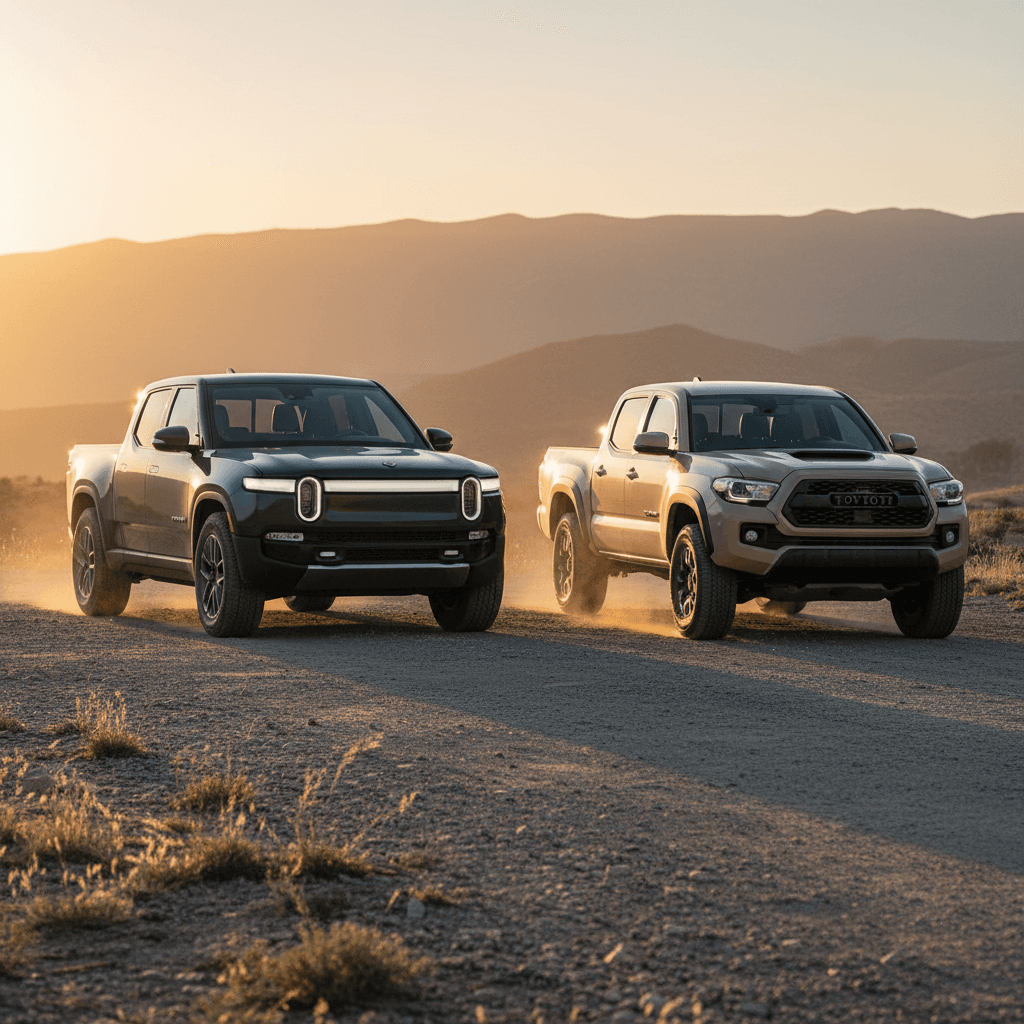
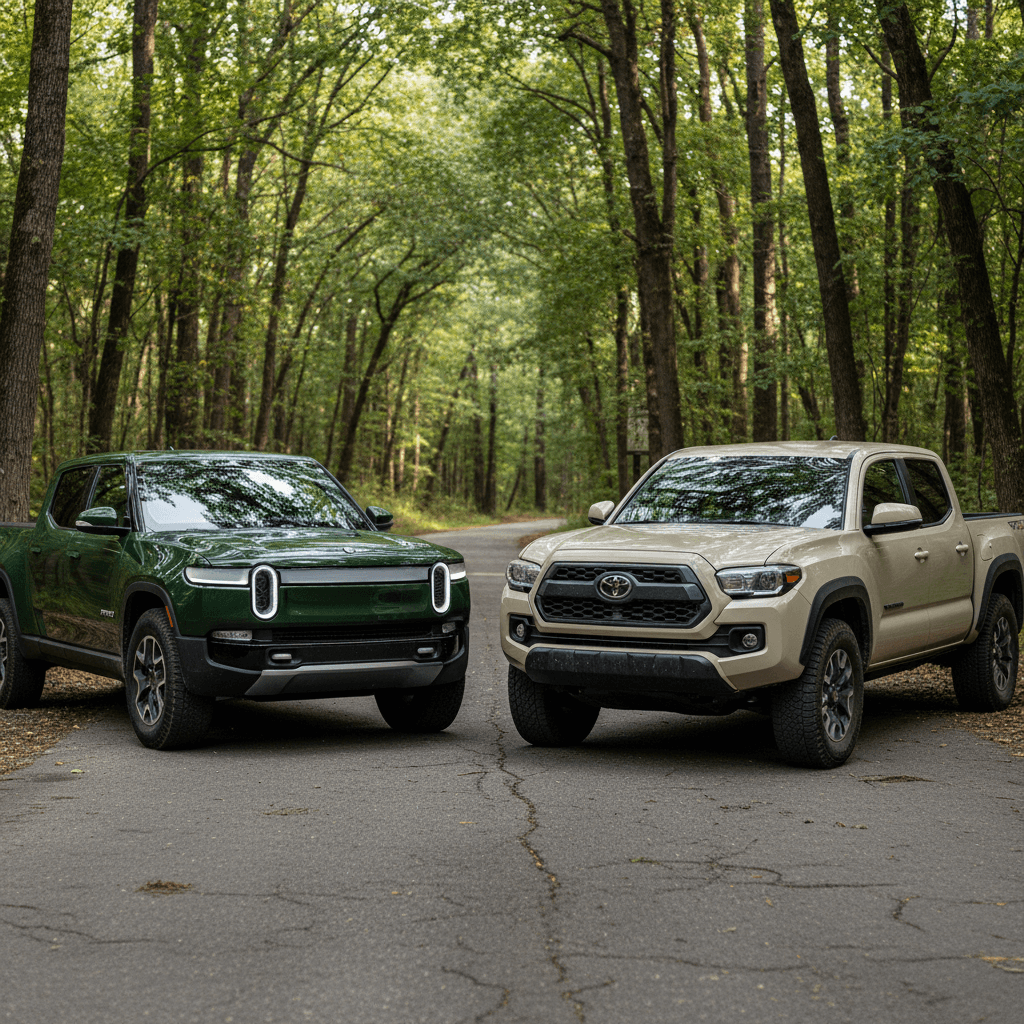
You don’t cross-shop a Rivian R1T and a Toyota Tacoma by accident. One is an all-electric, 7,000‑lb torque monster with a silent whoosh; the other is the dependable, gas (or hybrid) midsize truck that’s been hauling dirt bikes and kayaks for decades. If you’re asking yourself, “Rivian R1T vs Toyota Tacoma, which should I buy?”, this guide is here to walk you through the tradeoffs without the fanboy noise.
Two very different trucks, one shopper
Who this comparison is really for
- You own a Tacoma and are wondering if it’s time to jump to an electric truck like the Rivian R1T.
- You’re eyeing a used R1T (maybe on a marketplace like Recharged) and want to sanity-check it against a new Tacoma payment.
- You tow occasionally, boats, campers, utility trailers, but also need a daily driver.
- You take real trips: ski runs in the Rockies, trailheads down washboard forest roads, family road trips across a couple of states.
If your truck never leaves the city and never tows, either will do the job. Where the Rivian R1T and Toyota Tacoma really diverge is long-distance travel, towing, and how you pay for energy over the next 5–10 years.
Rivian R1T vs Tacoma: the quick take
Rivian R1T vs Toyota Tacoma at a glance
Two good answers to very different questions
Why you buy a Rivian R1T
- Instant shove: 533–835 hp depending on motor setup, sports-car acceleration with a bed on the back.
- 11,000‑lb tow rating and around 1,760 lbs of payload, solid half‑ton territory.
- Low “fuel” cost: home charging can undercut gas costs dramatically, especially off‑peak.
- Luxury cabin + tech: airy interior, big screens, quiet, refined ride.
- Adventure toys built in: gear tunnel, power outlets, clever storage, air suspension.
Why you buy a Toyota Tacoma
- Price and availability: an all‑new 2024+ Tacoma starts thousands below a new R1T and is on dealer lots everywhere.
- Familiar gas or hybrid power: easy road‑trip logistics, gas stations everywhere, no planning.
- Excellent resale and reputation: Tacomas are famous for durability and holding value.
- Off‑road chops: TRD Off‑Road and TRD Pro trims are trail‑proven with lockers and beefy suspension.
- Service network: any Toyota dealer can work on it, often in small towns a Rivian service van may never visit.
The 10‑second answer
Pricing, trims, and what you actually get
Rivian R1T vs Toyota Tacoma: price and basics (2024–2025 ballpark)
Approximate new price ranges before incentives and options. Always check current configurators for exact numbers.
| Truck | Typical new price range* | Powertrain highlights | Cab/bed options |
|---|---|---|---|
| Rivian R1T | ≈$70,000–$95,000+ | Dual‑Motor, Performance Dual‑Motor, Tri/Quad‑Motor AWD; large battery options | Crew cab only, 4.5‑ft bed |
| Toyota Tacoma | ≈$32,000–$60,000+ | 2.4‑liter turbo gas; 2.4‑liter i‑Force Max hybrid (up to 326 hp) | XtraCab (2‑door) or Double Cab; 5‑ or 6‑ft beds |
The Rivian R1T starts much higher than a Tacoma, but equipment and performance aren’t apples-to-apples.
Don’t forget used pricing
Yes, a new R1T is in another league price‑wise, but it also comes loaded, dual‑motor AWD, air suspension, big battery, advanced driver assistance, and a luxury‑grade interior. A base Tacoma SR is much cheaper, but if you start optioning TRD Off‑Road or TRD Pro trims with the hybrid powertrain, the sticker climbs into the $50,000–$60,000 neighborhood.
Power, towing, and payload: spec sheet vs reality
On-paper capability snapshot
Rivian R1T: towing and payload
- Tow rating: up to 11,000 lbs with the right hitch setup.
- Payload: roughly 1,760 lbs, enough for passengers, gear, and tongue weight, but easy to max out with a heavy trailer loaded for a trip.
- Real-world towing: owners and tests typically see 30–50% range loss with a mid‑size camper or boat at highway speeds. A 300‑mile truck can effectively become a 150‑mile truck between fast charges.
- Driving feel: towing is effortless, tons of torque, strong regen, integrated trailer brake control, and excellent stability thanks to the R1T’s weight and low center of gravity.
Toyota Tacoma: towing and payload
- Tow rating: depending on engine and configuration, generally around 6,000–6,500 lbs, less for some off‑road trims.
- Payload: often in the 1,400–1,700‑lb range, comparable to the R1T on paper.
- Real-world towing: no range anxiety, but you will feel grades and headwinds more. The hybrid Tacoma has plenty of torque, but it’s working harder and burning more fuel than the Rivian burning electrons.
- Driving feel: familiar gas‑truck experience. You’ll hear the engine and feel shifts, but fueling is simple and predictable.
The big towing tradeoff with the R1T
Range, MPG, and what you’ll spend on energy
Energy use snapshot: Rivian R1T vs Toyota Tacoma
Approximate EPA ratings; your results will vary with driving style, weather, tires, and how much you tow.
| Truck | Typical range/MPG | Energy type | What it means day to day |
|---|---|---|---|
| Rivian R1T | ≈270–410 miles rated range, depending on battery and wheels | Electricity (kWh) | Home charging can make daily driving cheap and convenient; long trips require DC fast charging stops. |
| Tacoma gas | Low‑20s combined mpg for many 4x4 trims | Gasoline | Easy to refuel anywhere; fuel costs add up if you rack up highway miles. |
| Tacoma hybrid | Low‑ to mid‑20s combined mpg (slightly higher than gas in many trims) | Gasoline + electric assist | Better efficiency and torque than gas alone, but still burns fuel every mile. |
Electricity vs gasoline: very different ways to spend money over the life of a truck.
Back-of-napkin cost comparison
Where the Rivian really shines is the grind of weekly commuting and errands. Plug in at home, wake up to a full “tank,” and your cost per mile plummets. The Tacoma is the opposite: long highway hauls are easy, fuel stops are fast and everywhere, but you pay steady money at the pump for the life of the truck.
Daily driving, comfort, and tech
Living with a Rivian R1T
- Ride and noise: air suspension, adaptive dampers, near‑silent drivetrain. It drives more like a premium SUV than a work truck.
- Interior: modern, minimalist cabin with big glass and high‑resolution screens. Materials feel upscale; storage is clever (gear tunnel, front trunk, under‑bed compartments).
- Tech: native navigation that knows about charging, over‑the‑air updates, strong driver assistance. Phone app integration is robust.
- Size feel: similar overall footprint to a Tacoma, but packaging gives you a more spacious-feeling cabin.
Living with a Toyota Tacoma
- Ride and noise: improved for the new generation, but it’s still a body‑on‑frame truck. Expect more engine noise, more jiggle over broken pavement.
- Interior: vastly nicer than older Tacomas, with better seating positions and more tech, but not as airy or futuristic as the Rivian.
- Tech: Toyota’s infotainment has come a long way, wireless Apple CarPlay/Android Auto are available, and modern safety tech is standard, but it’s not as deeply integrated as an EV‑first system.
- Size feel: narrow trails and tight city parking lots still feel friendly; the truck is sized right for real‑world use.
Quiet vs character
Off-road, overlanding, and adventure duty
Rivian R1T vs Tacoma off-road strengths
Both trucks can get you to the trailhead, just in different ways
Rivian R1T off-road
- Ground clearance: air suspension can lift to around 15 inches of clearance.
- Traction: electric motors deliver precise torque to each wheel (especially in tri/quad‑motor setups), making rock crawling feel easy.
- Approach/departure: better than many full‑size trucks; short overhangs help.
- Downside: hard off‑roading far from civilization demands charging access, and damage to a battery pack is a bigger deal than denting a fuel tank skid plate.
Tacoma off-road
- TRD trims: factory lockers, skid plates, off‑road dampers, and all‑terrain tires are baked into TRD Off‑Road and TRD Pro models.
- Aftermarket: decades of parts support, lifts, armor, racks, bumpers, from every brand under the sun.
- Simplicity: if you bash a lower control arm in the backcountry, any decent shop that works on trucks can help.
- Downside: less torque control and no silent creep; you’ll be working the throttle more on technical trails.
Overlanding reality check
Ownership experience, maintenance, and reliability
Rivian R1T ownership
- Maintenance: no oil changes, far fewer moving parts in the drivetrain, and most service items are tires, brakes, and the occasional cabin filter.
- Repairs and support: mobile service and a growing but still small service center network. Collision repairs and out‑of‑warranty work can be expensive.
- Battery health: long‑life battery chemistry plus software management, but real‑world health varies by use and climate. A third‑party health report is invaluable when buying used.
- Warranty and updates: strong factory warranty and regular over‑the‑air improvements that can add features or refine driving behavior after you buy.
Toyota Tacoma ownership
- Maintenance: traditional, oil, filters, fluids, spark plugs, belts. Hybrids add complexity but Toyota has deep experience there.
- Repairs and support: enormous dealer and aftermarket network. Almost any shop can service a Tacoma; parts are plentiful.
- Reliability: Tacomas have a hard-earned reputation for durability and high resale value, especially when maintained.
- Longevity: 200,000+ miles with routine care is common; frame rust and neglected maintenance are bigger enemies than the powertrain itself.
Buying used? Check the battery or the frame
Charging vs gas: living with each truck
What day-to-day life really looks like
1. Where you “fuel” most often
With a Rivian R1T, your driveway becomes your primary “station.” With a Tacoma, it’s still the corner gas station. If you can’t reliably plug in at home or work, the R1T loses a huge advantage.
2. Long-trip planning
R1T road trips require apps and planning, stringing together DC fast chargers that can handle your truck and possibly your trailer. A Tacoma road trip means watching the low‑fuel light and pulling off at the next exit.
3. Weather and range
Cold snaps and headwinds hit the Rivian harder, especially at highway speeds. The Tacoma also loses MPG in winter and with big tires, but not as dramatically.
4. Urban vs rural life
If you live near interstates and metro areas, fast chargers are multiplying. If you live in rural mountain country or far off interstates, gas is still king for now.
5. Home setup costs
Budget a few hundred to a couple thousand dollars to add a 240V Level 2 charger for the R1T. The Tacoma can live with whatever fuel station is already down the road.
When you probably shouldn’t buy the R1T (yet)
Which should you buy? Real-world scenarios
Rivian R1T vs Toyota Tacoma: pick the profile that sounds like you
Daily commuter + weekend adventurer
You drive 30–80 miles most weekdays and take 3–6 weekend trips a year within a few hundred miles.
You can install a Level 2 charger at home (garage or driveway).
You tow occasionally, campers, boats, or toy haulers, but can live with more frequent stops when towing long distances.
You care a lot about ride quality, quiet, and tech.
<strong>Best fit:</strong> Rivian R1T. You’ll save on energy, enjoy a much nicer daily drive, and still have plenty of capability.
Backcountry overlander and remote hunter
Your favorite places are 100–200 miles from the nearest interstate or major town.
You spend days off‑grid without guaranteed access to power.
You prioritize simple, field‑repairable hardware and massive aftermarket support.
You don’t mind a bit of engine drone; you want a tool you can bash and fix.
<strong>Best fit:</strong> Toyota Tacoma, ideally a TRD Off‑Road or TRD Pro. Gas in jerry cans beats hoping for a working DC fast charger near the trailhead.
Heavy towing and big family trips
You tow a big camper, boat, or enclosed trailer multiple times a month.
Your tow routes are long, 250+ miles each way, and sometimes cross charging deserts.
Family road trips are about making time, not savoring long charging stops.
You want the truck that keeps schedule disruptions to a minimum.
<strong>Best fit:</strong> Tacoma today, unless your routes are very EV‑friendly. The Rivian can tow beautifully, but charging logistics add complexity and time.
Urban or suburban family truckster
You mostly haul kids, groceries, and home‑improvement runs, with the occasional IKEA flat‑pack or bike trail day.
You live in or near a metro area with plenty of public charging and modern infrastructure.
You like the idea of cutting your fuel bill and emissions without sacrificing capability.
You treat your truck like a premium family vehicle, not a job‑site beater.
<strong>Best fit:</strong> Rivian R1T, especially as a well‑priced used example. It behaves like a luxury SUV that just happens to have a very useful bed.
How Recharged can help if you’re leaning R1T
If this comparison nudges you toward the Rivian, your next question is usually, “New, or can I trust a used R1T?” That’s where a specialist marketplace like Recharged earns its keep.
Shopping a Rivian R1T through Recharged
What you get beyond a regular used-truck listing
Verified battery health
Fair-market pricing
Finance, trade-in, and delivery
Ready to find your next EV?
Browse VehiclesIf you love the idea of an R1T but your budget says “lightly used,” this is arguably the smartest way to get into one while still knowing exactly what you’re buying.
Rivian R1T vs Toyota Tacoma FAQ
Frequently asked questions: Rivian R1T vs Toyota Tacoma
Bottom line: Rivian R1T vs Toyota Tacoma
Line them up side by side and the Rivian R1T looks like a Tacoma that went to the future and came back with 800 horsepower and a conscience. But trucks are tools, and the right one depends on the jobs you actually ask it to do. If you can charge at home, live in or near decent charging infrastructure, and want a truck that drives like a luxury SUV while still hauling serious gear, the R1T is a fantastic choice, especially as a carefully vetted used buy from a specialist like Recharged. If you roam far off the fast‑charging map, tow heavy over long distances, or simply value dead‑simple logistics and a bulletproof support network, the Toyota Tacoma is still the truck to beat. Know your routes, know your tolerance for planning, and the right answer between these two very different pickups will come into sharp focus.