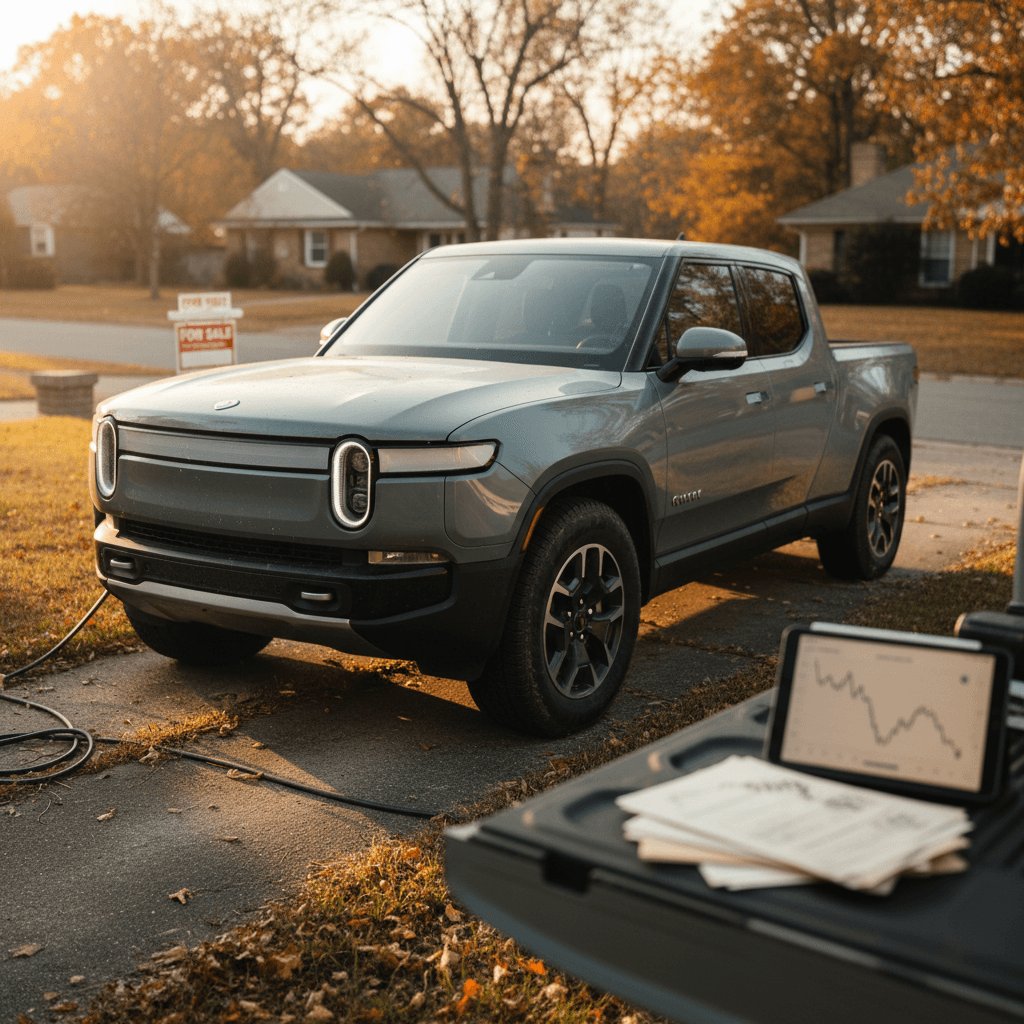
If you bought a Rivian R1T when it was the only cool electric pickup in town, you’ve probably watched the used market like a hawk. By 2026, early trucks are finally hitting their 3–4 year birthdays, incentives have whiplashed, and new Rivian pricing keeps getting tweaked. The result: a depreciation story that looks chaotic from the outside, but actually follows some clear patterns once you dig into the data.
Why 2026 is a turning point
Rivian R1T depreciation rate in 2026: the short version
Rivian R1T depreciation snapshot in early 2026
Those numbers put the Rivian R1T depreciation rate in 2026 a little steeper than a comparable gas truck in the first few years, but not catastrophically so, and in some cases better than other premium EVs that fell off a cliff when incentives shifted.
How fast is the Rivian R1T losing value by 2026?
To talk about depreciation you need two anchors: what the truck cost new and what similar trucks are actually selling for today. Early Rivian pricing was all over the place, pre-hike reservations in the $70Ks, later builds in the $90Ks-plus, then price cuts and equipment reshuffles around 2024–2025. By the 2026 model year, new R1T MSRPs commonly sit in the low–mid $70Ks for dual-motor trucks and much higher for tri- and quad-motor halo builds.
Typical Rivian R1T depreciation ranges by age (early 2026)
Illustrative ranges based on common U.S. used-market transactions in early 2026. Individual trucks can sit above or below these bands depending on spec, battery, and condition.
| Model year / age in 2026 | New MSRP when sold* | Typical miles | Common 2026 used asking prices | Approx. depreciation |
|---|---|---|---|---|
| 2022 (≈4 years) | $80,000–$95,000 | 30k–60k | $48,000–$60,000 | ≈35–45% |
| 2023 (≈3 years) | $80,000–$100,000+ | 20k–40k | $55,000–$68,000 | ≈30–40% |
| 2024 (≈2 years) | $75,000–$95,000 | 10k–30k | $60,000–$76,000 | ≈20–30% |
| 2025 (≈1 year) | $73,000–$90,000 | 5k–15k | $65,000–$82,000 | ≈10–20% |
These are not guaranteed prices, but realistic brackets you’ll see in many U.S. markets when shopping or selling a Rivian R1T in 2026.
About those asterisked MSRPs
Big picture, the Rivian R1T in 2026 is behaving like an expensive luxury truck: a sizable 20–25% hit early, then a flattening curve as the market decides what these things are really worth. The volatility is more about the EV segment and Rivian’s pricing history than some fatal flaw with the truck.
3-year and 5-year Rivian R1T depreciation forecast
Zooming out from individual sales, EV analysts in 2026 see electric vehicles losing a bit more value in the early years than comparable gas vehicles, then stabilizing as the market matures. Put simply: the first-owner takes the punch; later owners benefit from the reset.
Where Rivian R1T values likely go next
Not gospel, but a realistic glide path if the EV market keeps cooling and then stabilizing.
3-year-old R1T (2023 in 2026)
Real-world: ~30–40% off MSRP.
If the original buyer paid $90,000, a sensible 2026 resale number is often in the $55,000–$65,000 band depending on spec and miles.
5-year-old R1T (2022 in 2027)
Forecast: ~45–50% off MSRP.
That same $90,000 truck may realistically live in the $45,000–$55,000 range at five years old if Rivian’s brand holds and the battery tests well.
Long-term floor
Assuming Rivian survives, supports software, and keeps parts flowing, the R1T should eventually settle into a depreciation curve similar to other premium 1500-class trucks, just shifted a bit lower because it’s an EV.
How to use these forecasts
Why Rivian R1T depreciation looks “weird” on paper
If you’ve browsed owner forums, you’ve seen horror stories: someone pays mid-$90Ks for a launch-edition quad-motor, then two years later a dealer waves $40,000 at them as a trade. That’s a 55–60% paper loss, brutal. But it’s not the whole story.
1. MSRP vs what people actually paid
Rivian shocked the world with early price hikes, then backtracked part of the way for reservation holders. Two owners with identical trucks might have wildly different MSRPs and out-the-door numbers. Trade-in bids and auction results often key off today’s transaction prices, not the highest historic MSRP.
2. Trade-ins vs retail vs private-party
A lowball dealer offer can make depreciation look worse than it really is. That same truck might retail on a used-vehicle marketplace for $10,000–$15,000 more. Always compare apples to apples: wholesale to wholesale, retail to retail.
Throw in a young brand, shifting tax credits, and large six-figure builds that naturally fall faster in absolute dollars, and you get a depreciation picture that looks chaotic in screenshots, but is actually fairly normal for a high-end EV truck.
Rivian R1T vs other electric trucks: depreciation comparison
No truck depreciates in a vacuum. Shoppers in 2026 are often cross-shopping the R1T with the Ford F-150 Lightning, GMC Hummer EV, and Tesla Cybertruck. The Rivian sits in an interesting middle lane: pricey and niche, but also in relatively low supply and increasingly respected as an all-rounder.
Rivian R1T vs key electric truck rivals (depreciation feel, early 2026)
A directional comparison of how the R1T behaves in the used market relative to major EV truck competitors.
| Model | New-price positioning | Used-market tone in 2026 | Depreciation vs R1T (first 3 years) |
|---|---|---|---|
| Rivian R1T | Premium adventure truck, high-spec pricing | Limited supply, strong enthusiast demand, values stabilizing | Baseline |
| Ford F-150 Lightning | Broad range from work truck to luxury | Heavy incentives and fleet sales pulled some trims down faster | Often slightly worse |
| GMC Hummer EV Pickup | Ultra-high MSRP, niche appeal | Big absolute dollar drops, small buyer pool | Similar or worse |
| Tesla Cybertruck | Polarizing, constrained but volatile | Wild swings tied to hype and supply; some early flips, then corrections | All over the map |
These are generalized impressions from transaction data and listings, not exact model-for-model math.
The good news for Rivian owners
What actually moves Rivian R1T values up or down
If you want to understand your own Rivian R1T depreciation rate in 2026, ignore generic “EVs depreciate X%” headlines and focus on the levers that really matter for this truck.
- Battery pack and health. Larger packs and healthier state-of-health scores command clear premiums. A verified strong pack can be worth five figures compared with a similar truck with a tired battery.
- Motor configuration. Dual-motor trucks anchor the market; Performance Duals and Quad/Tri-motor builds bring more power and tow rating but depreciate harder in pure dollars because their MSRPs were so high.
- Model year and software. Later trucks with the latest driver-assistance features, updated infotainment, and NACS-native charging ports are easier to sell, especially to first-time EV buyers.
- Mileage and use case. A 60,000-mile adventure truck that actually went adventuring is a different animal than a 20,000-mile city commuter. Buyers can read that in the underbody, wheels, and Carfax.
- Color, spec, and options. The Rivian crowd favors certain color/trim combos and practical adds like tow packages over expensive, niche cosmetic options that don’t add resale value.
- Brand stability and incentives. Rivian’s financial headlines, plus whatever Congress and states are doing with EV credits, ripple directly into resale values. A new $7,500 incentive on new trucks can instantly pressure used prices.
Red flags that hammer R1T resale
How to read an R1T used price in 2026
You’re staring at a 2023 Rivian R1T listed for $61,000 and wondering: deal or daylight robbery? In 2026, you need to look beyond the sticker and decode what you’re actually paying for.

Quick checklist to sanity-check a 2026 Rivian R1T asking price
1. Line up MSRP and actual transaction price
Ask for the original build sheet or purchase paperwork. A truck that *sold* for $82,000 and is now listed at $58,000 has a very different depreciation story than a $98,000 build at the same price.
2. Normalize for miles and usage
Compare listings with similar mileage and use patterns. A lightly used, pavement-only truck can fairly sit several thousand dollars above an off-roaded, high-mile example.
3. Verify battery health, not just range estimate
Use a proper battery diagnostic (like the <strong>Recharged Score</strong>) to see state of health. Don’t assume the dash-estimated range tells the whole story, especially in cold weather.
4. Check for major software and hardware updates
Confirm key recalls and updates are done and that the truck has current software. OTA updates that add range or features can meaningfully support resale value.
5. Benchmark against several price guides
Use multiple guides (KBB, Edmunds, listing aggregators) plus real marketplace listings. If one number is way out of line, dig into why before you trust it.
6. Remember taxes, fees, and logistics
If you’re buying across the country, factor in transport, sales tax, and any inspection costs. A slightly higher local price can be cheaper than a “deal” 1,500 miles away.
Where Recharged fits in
How to protect your Rivian R1T’s resale value
You can’t control Rivian’s stock price or federal policy, but you can absolutely influence how hard depreciation hits you personally. In 2026, protecting R1T resale is mostly about preserving confidence for the next owner.
Practical ways to slow your personal depreciation curve
These don’t just feel good, they show up in appraisals and buyer behavior.
Document battery-friendly habits
Keep a log (even if it’s digital notes) of how you typically charge, avoiding constant 100% fast charges, limiting extreme heat exposure, and staying within Rivian’s recommended ranges. Coupled with a strong health report, this reassures savvy buyers.
Keep service and recall records tight
Store invoices, recall paperwork, and screenshots of key software versions. A clean, well-documented history is worth real money when a buyer is cross-shopping your truck against a similar but mystery-history example.
Resist oddball mods
Wheels and tires are one thing; hacked suspension controllers and aftermarket lighting science projects are another. The more stock (or reversible) your R1T is, the easier it is to get strong offers.
- Stay ahead of cosmetic damage, fix chips, curb rash, and windshield cracks before they mushroom into negotiation ammo.
- Limit unnecessary high-mile, heavy-tow use if you know you’ll be selling in the next year or two.
- Time your sale around major model refreshes or big incentive changes where possible, not directly after them.
- Market the truck properly with detailed photos of underbody, bed, tires, and charge-port area to show it’s been cared for.
Should you buy a used Rivian R1T in 2026?
For the right buyer, a used Rivian R1T in 2026 is exactly the kind of depreciation story you want: somebody else absorbed the unpleasant first-owner drop, while you get the truck closer to its long-term value floor.
Why a used R1T in 2026 makes sense
- Prices have corrected from the early-pandemic EV bubble and are now grounded in reality.
- You can pick from several model years, battery sizes, and motor configs instead of taking whatever new allocation exists.
- Rivian’s software and charging ecosystem have matured, especially with NACS compatibility improving road-trip usability.
- Depreciation from here should be slower and more predictable than the first 12–24 months.
When you might want to wait
- You’re extremely sensitive to residual value and may be happier in a lower-priced R2 or other EV arriving in 2026–2027.
- You need heavy commercial use and can fully use Section 179 or other business write-offs on a new truck.
- You’re betting that another year of production and brand proof will stabilize used values even further.
Let depreciation work for you
At Recharged, we lean into that logic. Our marketplace exists specifically to make used EV ownership simple and transparent. Every Rivian R1T we sell comes with a Recharged Score battery diagnostic, fair-market pricing analysis, financing options, and nationwide delivery, so you can take advantage of depreciation without lying awake wondering what you missed.
Rivian R1T depreciation FAQ (2026)
Frequently asked questions about Rivian R1T depreciation in 2026
Depreciation isn’t a moral failing; it’s just the price of time, technology, and taste. By 2026, the Rivian R1T has moved past its speculative early phase and into a more rational, data-backed curve. If you understand the levers, battery health, spec, miles, and market timing, you can make depreciation work for you instead of against you, whether you’re cashing out of an R1T or hunting for the right used truck on a marketplace like Recharged.