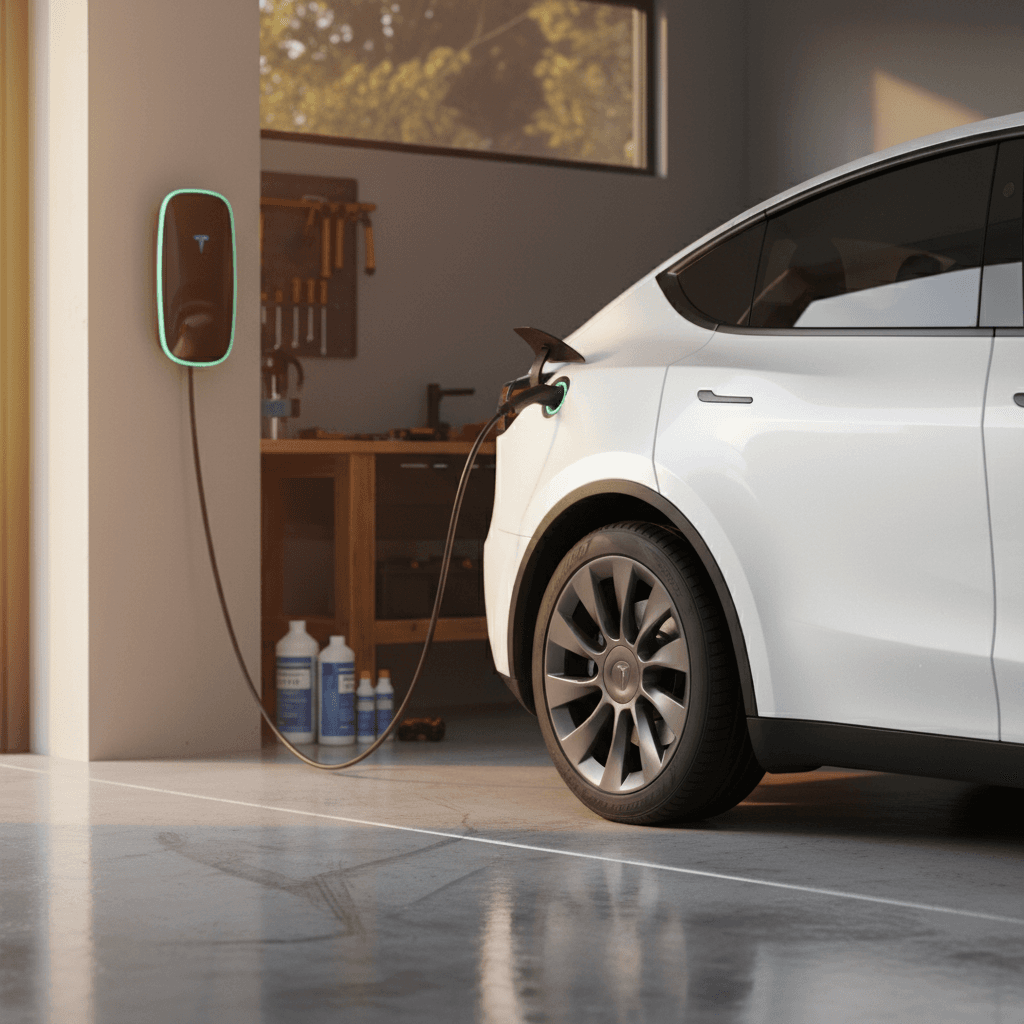
If you’re wondering how to charge a Tesla Model Y at home, you’re not alone. For most owners, home charging is where 80–90% of their miles come from, and it’s the difference between an EV that always feels ready and one that’s constantly on your mind. The good news: whether you have a simple 120-volt outlet or you’re ready for a dedicated 240-volt charger, getting your Model Y set up at home is straightforward once you understand your options.
Quick takeaway
Why home charging matters for Model Y owners
Convenience you can’t get at a gas pump
Once your Model Y is set up for home charging, you plug in when you get home and wake up to a "full tank" every morning. There’s no detour for fuel, no waiting in line, and no wondering which public charger is working today.
Lower, more predictable fuel costs
Electricity is usually cheaper per mile than gasoline, especially if you charge overnight on off-peak rates. Instead of prices changing every time you drive past a station, your cost per mile is largely locked in by your utility plan.
Think about your routine first
Tesla Model Y home charging basics
Every Tesla Model Y sold in North America supports the same core home-charging options. Under the skin, you’ve got an onboard AC charger (up to 48 amps on most trims) that converts household AC power into DC to charge the battery. What you choose at home mainly affects how much power you can deliver to that onboard charger.
Two levels of home charging for your Model Y
Both work. One is just much faster.
Level 1: 120V household outlet
What it is: A standard U.S. wall outlet (NEMA 5-15) like you’d use for a lamp or phone charger.
- ~1.3 kW of power
- About 3–4 miles of range added per hour
- Good for light commuters or overnight top-ups
Level 2: 240V home charging
What it is: A 240V circuit, similar to what powers an electric dryer or oven, feeding a dedicated EV charger.
- Up to ~11.5 kW on a Tesla Wall Connector
- Roughly 30–44 miles of range added per hour
- Best for most Model Y owners
Onboard charger limits
Option 1: Charge your Model Y on a standard 120V outlet
Every Model Y can charge using a standard 120-volt household outlet. Tesla’s Mobile Connector (sold separately in the U.S. as of 2026) includes an adapter for a typical NEMA 5-15 outlet. You plug the Mobile Connector into the wall, plug the other end into your Model Y, and charging starts automatically once you set your charge limit in the car or app.
- Charging power: about 1.2–1.4 kW
- Typical speed: ~3–4 miles of range per hour of charging
- Overnight reality: around 30–40 miles of range added during a 10–12 hour night
- Best for: apartment or street parkers with no 240V access, or low-mileage drivers
Don’t treat an old outlet like a fast charger
Making 120V charging workable
1. Park close to the outlet
The Tesla Mobile Connector cable is only so long. Before you commit to 120V, confirm your car can reach the outlet without stretching the cable or using extension cords (which Tesla strongly discourages).
2. Set a realistic charge limit
If you only add 30–40 miles overnight, don’t plan your life around waking up to 100% every day. Set your limit (often 70–80% for daily use) and build in a buffer for unexpected trips.
3. Keep an eye on the wiring
Check the outlet and plug occasionally. If anything feels hot to the touch or charging stops unexpectedly, pause and have a licensed electrician inspect the circuit.
Option 2: Install a 240V Level 2 home charger
For most Tesla Model Y owners in the U.S., a 240-volt Level 2 setup is the sweet spot. It’s fast enough that even big driving days can be refilled overnight, and it’s still relatively gentle on the battery compared with constant DC fast charging.
Two main ways to get Level 2 at home
Both use a 240V circuit, how you deliver it differs.
Hardwired Level 2 wall unit
Best-in-class experience. A dedicated wall-mounted charger, like a Tesla Wall Connector or third-party Level 2 unit, wired directly to a 240V circuit.
- Clean install with cable management
- Typically up to 40–48 amps (on a 50–60A breaker)
- Often supports Wi‑Fi, load sharing, or scheduling
240V outlet + Mobile Connector
Flexible and portable. You or your electrician install a 240V receptacle (for example, NEMA 14‑50), then use a compatible adapter with the Tesla Mobile Connector.
- Good mix of cost and speed
- Easier to move when you sell or move homes
- Still needs a proper dedicated circuit
Get an electrician involved early
Tesla Wall Connector vs other Level 2 chargers
You don’t have to buy Tesla’s own Wall Connector to charge a Model Y at home, but it’s a strong option if you’re all-in on the Tesla ecosystem. There are also excellent third-party chargers that use the Tesla (NACS) connector or J1772 plus an adapter.
Tesla Wall Connector vs third-party Level 2 chargers
Key differences that matter for Model Y owners in North America.
| Feature | Tesla Wall Connector | Third-party Level 2 (NACS/J1772) |
|---|---|---|
| Max power (Model Y) | Up to ~11.5 kW (48A) | Usually 7.6–11.5 kW (32–48A) |
| Connector type | Tesla NACS | NACS or J1772 (use Tesla adapter if needed) |
| Smart features | Wi‑Fi, load sharing between units | Often Wi‑Fi/app, some with dynamic load management |
| Aesthetics | Matches Tesla design, compact | Varies widely by brand |
| Best for | Households with one or more Teslas | Mixed-EV homes or renters who want portability |
All options below assume a properly installed 240V circuit by a licensed electrician.
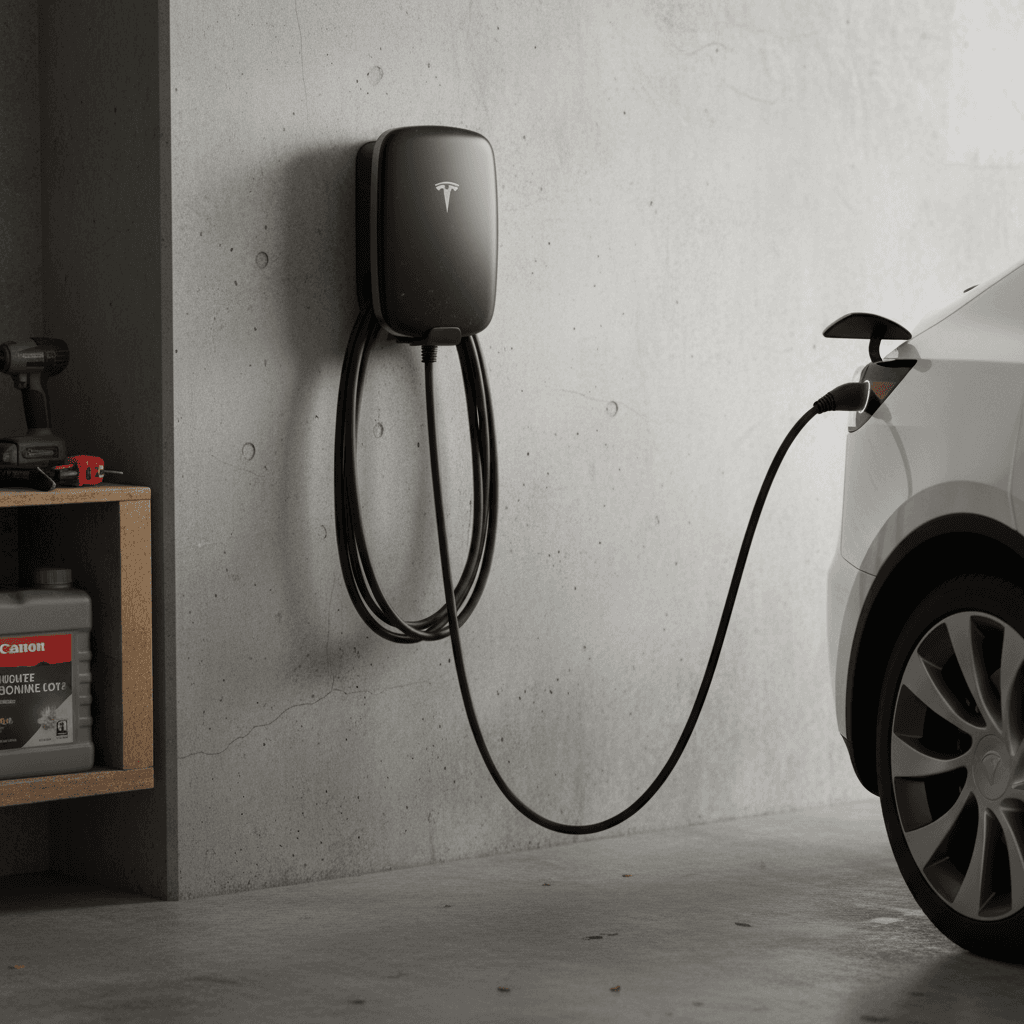
When a Wall Connector shines
How long it really takes to charge a Model Y at home
Exact charging times depend on your specific Model Y trim, battery size, starting state of charge, and temperature. But you can use ballpark numbers to plan your day. Think in terms of miles of range added per hour instead of 0–100% time, because in daily life you’re usually topping up, not refilling from empty.
Typical Tesla Model Y home charging speeds
Approximate real-world speeds for U.S. owners.
| Setup | Voltage & amps | Power (approx.) | Miles of range per hour | Use case |
|---|---|---|---|---|
| Standard outlet + Mobile Connector | 120V / 12A | ~1.3 kW | ~3–4 mi/hr | Light commuters, emergency backup |
| 240V outlet + Mobile Connector | 240V / 32A | ~7.6 kW | ~22–30 mi/hr | Most daily drivers, overnight full charges |
| Tesla Wall Connector (50A breaker) | 240V / 40A | ~9.6 kW | ~30–35 mi/hr | Heavier daily use, regular highway trips |
| Tesla Wall Connector (60A breaker) | 240V / 48A | ~11.5 kW | ~35–44 mi/hr | Maxing out Model Y AC charging for frequent long drives |
Assumes a healthy battery and moderate temperatures; your exact numbers may vary slightly.
Top-up vs empty-to-full
How much does it cost to charge a Model Y at home?
To estimate cost, you only need three numbers: your local electricity rate, your battery size, and how efficient the Model Y is. U.S. electricity averages hover around $0.14–$0.20 per kWh, and most Model Y variants use roughly 26–30 kWh per 100 miles in mixed driving.
Rough cost benchmarks for a Tesla Model Y
Many utilities now offer time-of-use plans, where electricity is cheaper overnight. If you can schedule your Model Y to charge during those off‑peak hours, something both Tesla’s app and many smart chargers support, you can shave even more off your running costs.
Step-by-step: setting up Model Y home charging
From driveway to done: your home charging checklist
1. Decide how many miles you need each day
Look at your last month of driving. If you’re under 30 miles most days, a 120V outlet might get you by. If you’re over 40–50 miles regularly, plan on 240V Level 2.
2. Review your electrical panel
Take a clear photo of your breaker panel with labels. An electrician (or an EV-focused retailer like Recharged when you’re shopping) can help determine if you’ve got room for a 40–60A circuit.
3. Choose your hardware
Pick between a Tesla Wall Connector, a third-party Level 2 charger, or a 240V outlet plus Mobile Connector. Think about future vehicles, whether you might switch brands, and whether you’ll add a second EV.
4. Hire a licensed electrician
Have them pull permits if required, run the new 240V circuit, install the outlet or hardwire the charger, and test everything under load. Avoid DIY on 240V circuits, mistakes here are expensive and dangerous.
5. Configure the charger and the car
Connect smart chargers or Wall Connectors to Wi‑Fi, set the correct circuit breaker size, and then in your Model Y or Tesla app, set your charge limit and preferred schedule.
6. Do a supervised first full session
Stay nearby for the first full charge. Watch for tripped breakers, error messages, or unusual heat from plugs or wiring. Once everything behaves as expected, you can relax and let it do its thing nightly.
Buying a used Model Y?
Safety tips and common mistakes to avoid
- Don’t use extension cords or power strips with EV charging cables. They’re not designed for continuous high current.
- Avoid sharing circuits with big loads like space heaters, compressors, or dryers while charging.
- Match breaker, wire, and charger settings. The charger must be configured to the correct circuit size so it never pulls more than the wiring can safely handle.
- Watch for heat and discoloration at outlets or plugs, both are warning signs to stop and call an electrician.
- Keep the charging cable off the floor where possible, away from puddles, sharp edges, or spots where tires will roll over it.
Red flags: stop charging and investigate
Home charging with solar and smart features
If you’ve added solar, or you’re planning to, your Model Y can become one more big appliance that soaks up sunshine. Tesla’s ecosystem supports features like Charge on Solar when paired with Powerwall, letting your car prioritize excess solar instead of grid power for part of the day.
Scheduling and time-of-use rates
In your Tesla app, you can set a departure time or off-peak schedule so the car automatically starts charging when electricity is cheapest. Many third-party chargers offer similar scheduling and tracking through their own apps.
Monitoring energy use
Both Tesla and most smart Level 2 chargers provide logs of how many kWh you’ve used to charge. That makes it easy to track your true cost per mile and compare it to a gas car or another EV in the household.
Solar later? Plan ahead now.
FAQ: Tesla Model Y home charging
Frequently asked questions about charging a Model Y at home
Bottom line: is your home ready for a Model Y?
A Tesla Model Y is easiest to live with when you treat your driveway like your own personal charging hub. A standard 120V outlet can work if your daily driving is light, but a 240V Level 2 setup turns your home into a true fueling station, giving you a full battery overnight and freedom from public‑charger roulette.
If you’re still in the shopping phase, pairing the right home-charging plan with the right used Model Y is where the real magic happens. At Recharged, every vehicle comes with a Recharged Score report so you understand its battery health and real‑world range before you ever plug in. From there, a good electrician and the right charger are all that stand between you and a car that’s always ready to go when you are.