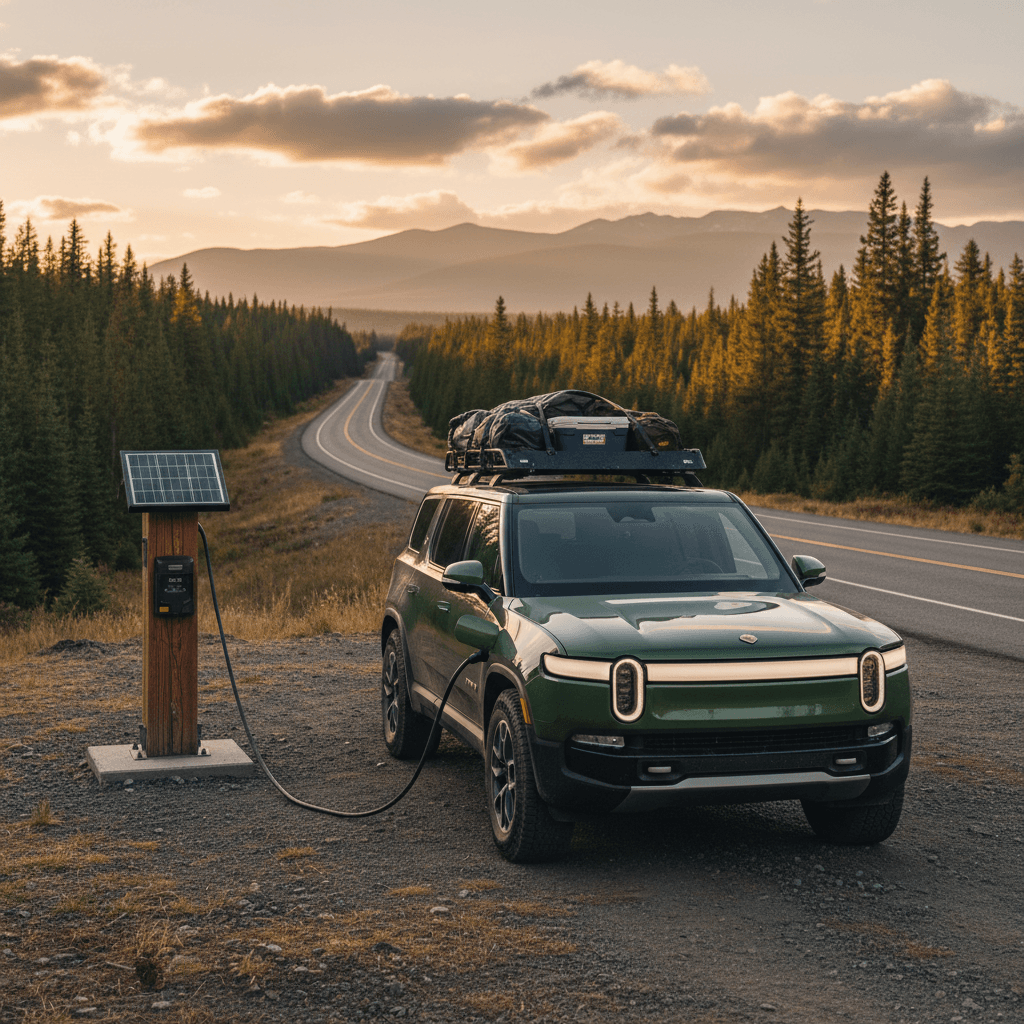
The Rivian R1S is one of the few electric SUVs that actually wants you to leave town. Massive battery packs, serious off‑road hardware, three rows, and a DC fast‑charging curve that’s getting better with every over‑the‑air update, it’s built for long-distance driving. But to make an R1S road trip feel effortless rather than experimental, you need a plan. These Rivian R1S long-distance driving tips will help you go from “Will I make it?” to “Where are we going next?”
Who this guide is for
Why the Rivian R1S Is Built for Long-Distance Travel
Rivian R1S long-distance performance highlights
On paper, the R1S looks like a range hero: big pack options, a claimed 270–400 miles of EPA range, and a charging system that can pull over 200 kW when conditions are right. In the real world, especially at 70–80 mph with a full cabin and roof box, you should think of it as a very comfortable 200–300‑mile cruiser between charges. That’s still plenty for normal families; it just means your road‑trip rhythm becomes “drive a couple hours, stretch, charge, repeat.”
Think in hours, not miles
Know Your Real-World Range Before You Go
The R1S’s EPA range figures assume a standardized blend of city and highway driving at moderate speeds. Road trips are a different sport. Long distances, higher speeds, elevation changes, crosswinds, big wheels, roof boxes, and heavy cargo can all drag efficiency down into the 1.7–2.2 mi/kWh neighborhood. That’s why the best long‑distance driving tip is simple: calibrate your expectations *before* you’re 80 miles from the next charger.
- On your home turf, take a 50–100‑mile highway loop at the speeds you actually drive (70–80 mph) and note your mi/kWh.
- Repeat the test at night with climate control set the way you like it; A/C or heat will change the picture.
- If you tow or use a roof box, do at least one test loop with that setup, you’ll see quickly how much range you sacrifice.
- Use the built‑in Energy screen to track average consumption over time; that’s what really matters on trips.
EPA range is not “road-trip range”
Smart Charging Strategy for Rivian R1S Road Trips
The R1S charges fastest when the battery is low and warm. That means your job on a road trip is not to stay at 80–90% all day; it’s to surf the fast part of the charging curve and keep moving. Owners who treat the R1S like a gas SUV, filling to 100% every time, lose hours they don’t need to lose.
Core R1S fast-charging habits that save hours
These simple rules make a huge difference in how long your trips actually take.
Arrive low, leave mid
Target 10–20% state of charge when you roll into a DC fast charger, and unplug somewhere in the 60–75% range unless the next leg truly demands more.
Above ~70%, power usually tapers sharply; you’re paying for electrons and time you don’t really need.
Precondition the pack
Use navigation to route to a DC fast charger so the truck can precondition the battery on the way, or use Rivian’s updated manual preconditioning in the Energy/Charging screen when available on your software build.
A warm pack means higher peak power and less time parked.
Plan around meals
When possible, line up your longer charging sessions with meals and kid breaks. A 30–40 minute lunch stop often feels shorter than a 20‑minute “just stand around the charger” stop.
Let the truck do its thing while you’re doing yours.
Use the 70% rule
Example fast-charging strategy for a 350-mile day
Assumes an R1S with roughly 280‑mile usable highway range at your chosen speed.
| Leg | Start SOC | Arrive SOC | Miles driven | Charge target | Time stopped (approx.) |
|---|---|---|---|---|---|
| Morning | 90% | 20% | 170 mi | 70% | 30–35 min (coffee + bathroom) |
| Midday | 70% | 15% | 150 mi | 65% | 25–30 min (lunch) |
| Short hop / hotel | 65% | 40% | 50–60 mi | Leave it overnight on Level 2 | 0 min DC charging |
Your exact numbers will vary by pack size, speed, weather, wheels and load, but the pattern stays similar.
Don’t abuse 0–100% fast charges
Using Drive Modes and Ride Height to Save Range
Rivian’s drive modes aren’t just for off‑roading bravado. They meaningfully affect how your R1S behaves on the highway, everything from which motors are powered to the ride height and steering weight. Long‑distance efficiency is basically a question of air resistance and rolling resistance, and the truck gives you a few knobs to turn.
- For dry highway cruising, use Conserve when it’s safe. It primarily drives the front axle and lowers the truck for better aerodynamics, trading some all‑weather traction for range.
- If weather is wet, snowy, or sketchy, switch back to Standard All‑Purpose for full‑time all‑wheel drive. Range will dip, but you keep stability and traction.
- On long freeway stretches, let the adaptive suspension settle into its Low or Standard height. The taller you sit, the more wind you push.
- Resist the urge to use Sport mode just because you can. It’s fun, yes, but that instant torque binge shows up directly on your Energy graph. Save it for on‑ramps and passing.
Be careful with Conserve mode in bad weather
Planning Your Route: Networks, Apps and Tesla Access
In a gas SUV, “planning” means looking for a shell logo every 300 miles. In an R1S, you’re cross‑referencing charge speeds, reliability, amenities, and now, depending on your adapter situation and region, access to Tesla Superchargers. The good news is that once you learn the ecosystem, planning becomes second nature.
Best tools for Rivian R1S road-trip planning
Use at least two sources: one to plan, one to sanity‑check.
Rivian navigation
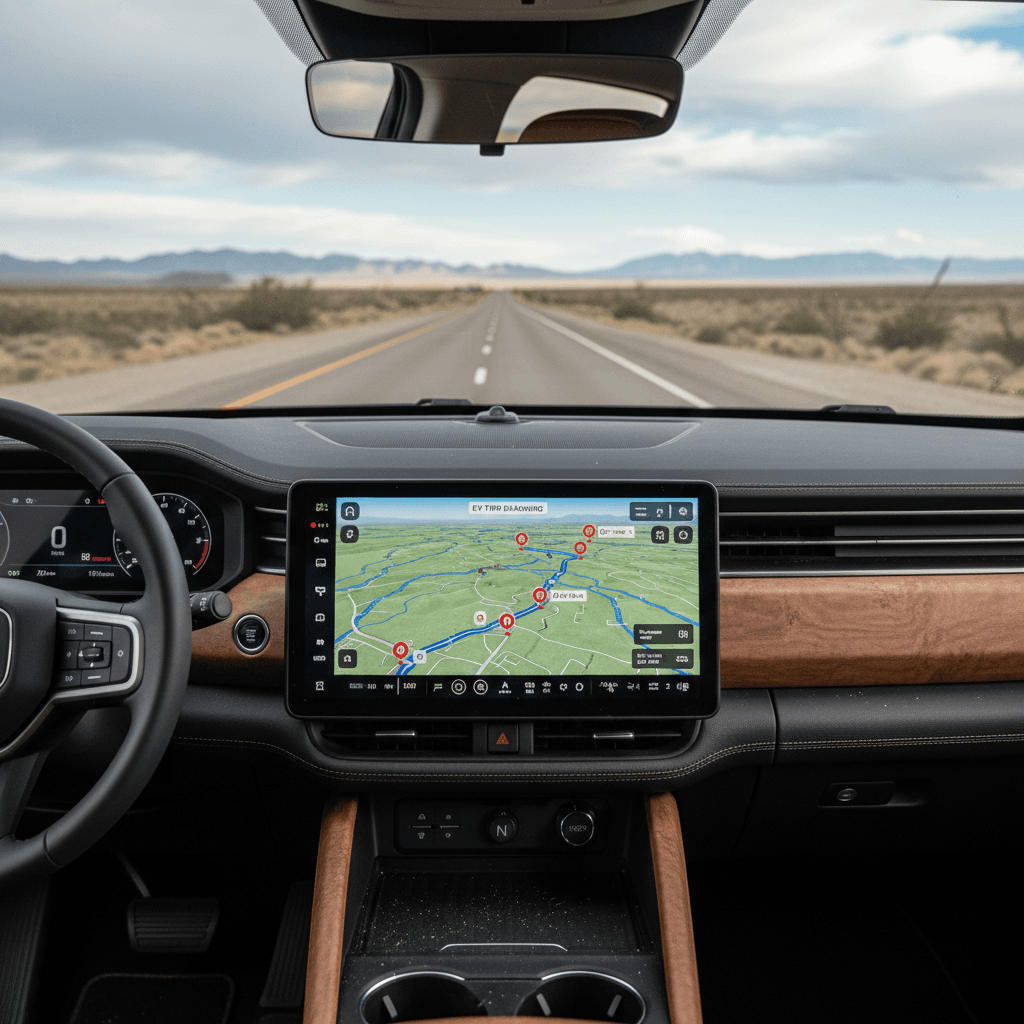
Start by building your route in the R1S itself. Rivian’s built‑in navigation can recommend DC fast chargers, estimate arrival state of charge, precondition the battery, and adjust on the fly if your efficiency changes.
Third-party planners
Apps like A Better Routeplanner (ABRP) and PlugShare let you customize your speed, weather, and occupancy assumptions, then model your real‑world consumption.
They’re excellent for stress‑testing a long itinerary before you ever leave the driveway.
Network apps
Install the apps for major networks along your route, Electrify America, EVgo, ChargePoint, regional co‑ops, and set up payment ahead of time.
If Tesla access is enabled for your R1S in your region, add the Tesla app as well.
What about Tesla Superchargers?
As you refine your route, look for clusters of chargers rather than single stations in the middle of nowhere. A town with six CCS stalls across two networks is far better than a lone 350‑kW charger at a shuttered strip mall. If one station is down or crowded, you have a fallback without re‑planning the whole day.
Packing and Loading Tips for Families and Gear
The R1S is a packing cheat code: front trunk, rear cargo area, under‑floor storage, roof rails, plus three rows for humans. But weight and aero punishment are real. A fully loaded R1S with a roof box at 80 mph is a different animal than a bare truck at 65. Here’s how to stay on the right side of that equation.
Packing your R1S for long-distance efficiency and sanity
1. Keep heavy items low
Put the densest items, tools, water, cooler, jack, in the rear lower well or on the floor behind the second row. Lower center of gravity improves stability and helps the suspension do its job.
2. Use the frunk for light, clean gear
The R1S frunk is great for backpacks, snacks, and kid stuff you want fast access to. Avoid loading it with bricks, dumbbells, or dense tools; that’s what the rear is for.
3. Minimize roof drag
Only install the roof rack or box if you truly need the space. If you do run a box, keep speeds closer to the right lane; aero drag climbs dramatically above 70 mph in a tall SUV.
4. Create a charging routine kit
Keep a small bin accessible with charging cards, gloves, wipes, a headlamp, and a short extension for kids’ devices. That way every stop doesn’t become a scavenger hunt.
5. Plan kid entertainment around stops
If you’re traveling with children, build a rhythm: prize or new activity at each charging stop, not every time they get bored. The R1S makes an excellent bribe delivery vehicle.
Use the space to travel better, not just heavier
Comfort, Safety and Driver Assist on Long Days
Long-distance driving isn’t just about making the next charger; it’s about arriving with your shoulders and sanity intact. One advantage the R1S has over many early EVs is a genuinely comfortable cabin and competent driver assistance. Used correctly, those systems make a 600‑mile day feel like a 400‑mile day in an older truck.
Dial in your seating and climate
- Spend the first 10 minutes of your trip getting seat, steering wheel, and mirrors perfect; you’ll live with them all day.
- Use seat heaters or coolers first before cranking cabin temps, especially in shoulder seasons, this uses less energy than heating a big volume of air.
- Take advantage of driver profiles so swapping drivers doesn’t mean 5 minutes of fiddling at each stop.
Use Driver+ as an assistant, not a chauffeur
- On well‑marked highways, Rivian’s Driver+ lane‑keeping and adaptive cruise can meaningfully reduce fatigue.
- Stay engaged: hands on wheel, eyes up. Consider it a second set of eyes, not an excuse to tune out.
- Turn it off when conditions deteriorate, construction, heavy rain, poor lane markings, so you’re not fighting the system.
Fatigue is a bigger risk than range
Battery Health and Charging Habits on Road Trips
Occasional road trips are not bad for your R1S battery. In fact, getting the pack warm and cycling through a healthy mid‑range is part of normal use. What shortens battery life is the combination of time, high temperatures, and holding the pack at very high or very low state of charge. Road‑trip strategy and battery‑health strategy mostly point in the same direction, with a few key nuances.
- At home, keep daily charging targets around 60–80%. Save 100% for departure days when you’ll hit the highway soon after unplugging.
- On the road, don’t panic if you need to go to 90–100% occasionally, just avoid letting the truck sit at 100% for hours, especially in hot weather.
- When you arrive at a hotel with Level 2, it’s perfectly fine to plug in overnight. The R1S will manage the pack; you don’t need to babysit it.
- If you’re parking for several days mid‑trip, aim to leave the truck somewhere around 40–70% state of charge, not near empty or full.
Use Level 2 as your secret weapon
Sample Rivian R1S Road Trip Playbook
To tie the theory together, imagine a 900‑mile, two‑day family trip in a Dual‑Motor R1S with the Large or Max pack. You’re running at 75 mph where legal, with two adults, two kids, and vacation gear, but no trailer or roof box. Here’s what a sane, low‑stress plan looks like.
Two-day, 900-mile R1S road-trip rhythm
Day 1: 450 miles
Leave home at ~90% after an overnight charge.
Drive ~170 miles (2.5 hours) to your first DC fast charger, arrive near 20%.
Precondition on approach and charge to ~70% while the family hits bathrooms and grabs coffee (30 minutes).
Drive another 160–170 miles, arrive near 15–20%.
Stop for lunch at a charger hub, charge back to ~70% (30–40 minutes).
Finish the day with a shorter 100–120‑mile leg to the hotel, arriving with 30–40% remaining. Plug into Level 2 overnight if available.
Day 2: 450 miles
Wake to 80–100% depending on hotel charging, no morning DC stop needed.
Repeat the pattern: two ~160–180‑mile legs with a mid‑day DC fast charge while you eat.
Use the last stop as a stretch break rather than a full charge if the destination has overnight charging.
Arrive with at least 20% in the pack; if you’re heading somewhere remote, top up more on your last stop.
What if you’re buying used?
FAQ: Rivian R1S Long-Distance Driving
Frequently asked questions about R1S road trips
When a Used Rivian R1S Makes Sense for Road-Trippers
If you do a couple of big road trips a year and lots of shorter drives the rest of the time, the Rivian R1S is a deeply compelling way to travel: quiet, brutally quick when you need it, absurdly spacious, and, once you understand its rhythms, predictable. The trick is to stop thinking like a gas‑station refugee and start thinking like a battery manager: arrive low, leave mid, drive a touch slower than your worst impulses, and let the truck’s software do some of the worrying for you.
If you’re shopping for a used R1S specifically with road trips in mind, focus less on brochure range and more on verified battery health, wheel and tire setup, and charging behavior. That’s where Recharged comes in. Every used EV on our marketplace includes a Recharged Score battery‑health report, expert guidance on real‑world range, and support with financing, trade‑in, and nationwide delivery. That way, when you point your Rivian’s nose at the horizon, the only question left is which playlist to start with.