If you’re looking at a Rivian R1S, you already know it’s not a bargain‑bin SUV. The real question is what it costs per mile to drive once it’s in your driveway. In this guide we’ll turn kilowatt‑hours, MPGe, and electric rates into clear cents‑per‑mile numbers so you can see what driving a Rivian R1S really costs in 2026.
Key takeaway up front
Why Rivian R1S cost per mile matters
Sticker price grabs the headlines, but over a few years of ownership it’s the cost per mile that quietly determines whether an EV makes financial sense. With a three‑row SUV like the Rivian R1S, you’re likely piling on family miles, ski trips, and road‑trip duty, so a difference of just a few cents per mile can add up to thousands of dollars over time.
- Helps you compare an R1S to a gas SUV in apples‑to‑apples terms
- Shows how much you save (or don’t) by using home charging vs public fast charging
- Highlights how driving style and wheel/tire choices impact your wallet
- Matters even more if you’re cross‑shopping a new vs used Rivian R1S
Think in lifetime miles
Rivian R1S efficiency: kWh per mile explained
Cost per mile is a simple formula: electricity price × energy used per mile. To make that work, we need a realistic efficiency number for the Rivian R1S.
Typical Rivian R1S efficiency numbers
EPA ratings and real‑world owner reports translated to kWh per mile.
| Configuration | Driving mix | Energy use | Miles per kWh | kWh per mile |
|---|---|---|---|---|
| EPA reference (dual‑motor, large/Max pack) | Mixed city/highway | ~37–49 kWh/100 mi | 2.0–2.7 mi/kWh | 0.37–0.49 kWh/mi |
| Real‑world owner reports, efficient driving | Mostly suburban, 55–65 mph | ~30–40 kWh/100 mi | 2.5–3.3 mi/kWh | 0.30–0.40 kWh/mi |
| Real‑world owner reports, faster highway | 70–80 mph, loaded | ~45–55 kWh/100 mi | 1.8–2.2 mi/kWh | 0.45–0.55 kWh/mi |
Actual results vary by climate, speed, tires, and how much you load the vehicle.
For this article, we’ll use a conservative, realistic average of 0.40–0.45 kWh per mile for a Rivian R1S in normal mixed driving, and we’ll call out where your results might be better or worse.
Cold weather penalty
Home charging: Rivian R1S cost per mile
Most owners in the U.S. still do the bulk of their charging at home. Nationally, average residential rates in 2025–2026 are hovering in the $0.16–$0.18 per kWh range, with plenty of states above and below that band. To keep things simple, we’ll run the math at $0.17 per kWh and then show how to adjust for your own bill.
Rivian R1S home charging cost per mile (national‑average power price)
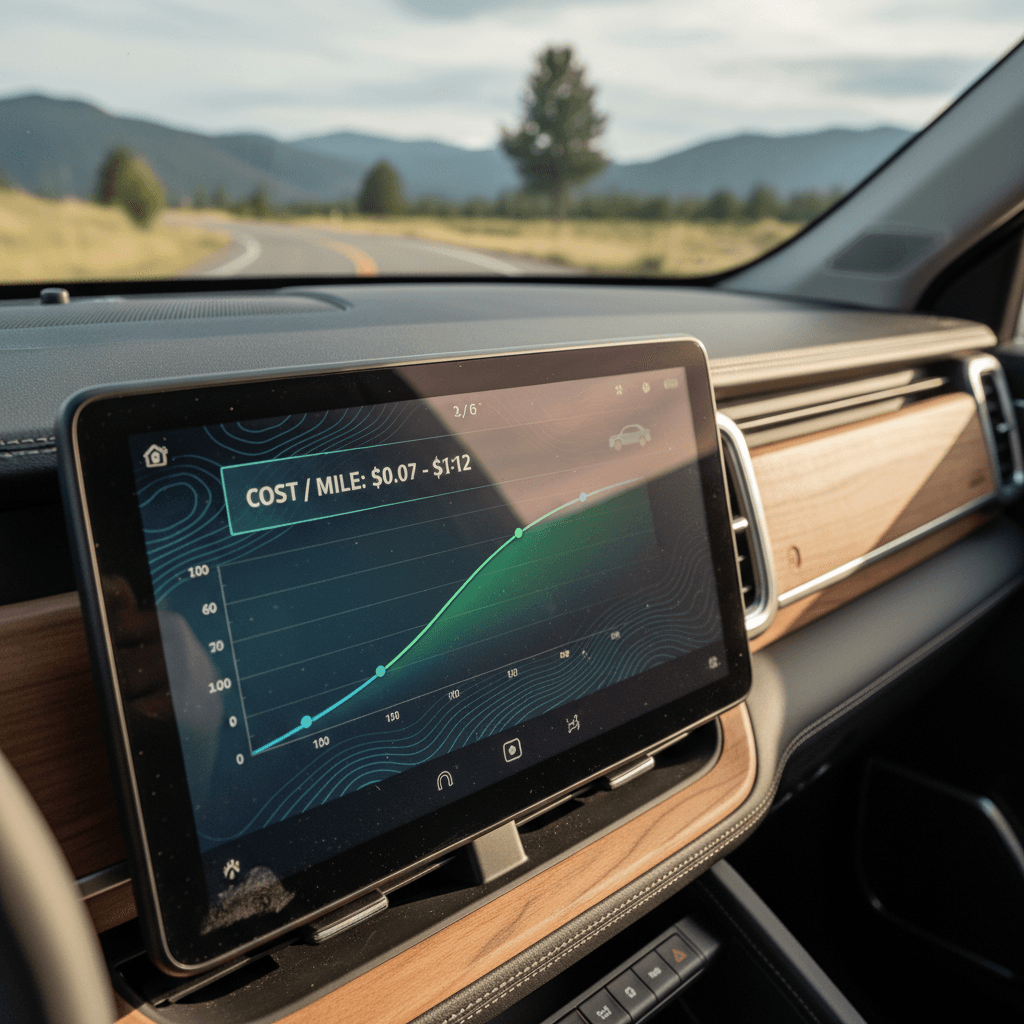
So if you’re an average‑rate U.S. homeowner with a Level 2 charger, your Rivian R1S will generally cost around 7–10 cents per mile to drive. In states with cheap power, think large hydro or wind resources, it can be materially less.
How your local rate changes R1S cost per mile
Plug in your own cents‑per‑kWh number to estimate your cost.
Low‑cost power: $0.12/kWh
If you’re in a low‑cost state or have a great overnight EV rate:
- 0.40 kWh/mi → $0.048/mi
- 0.45 kWh/mi → $0.054/mi
- 0.60 kWh/mi → $0.072/mi
Average power: $0.17/kWh
Use this if you’re close to the national average:
- 0.40 kWh/mi → $0.068/mi
- 0.45 kWh/mi → $0.077/mi
- 0.60 kWh/mi → $0.102/mi
High‑cost power: $0.25/kWh+
Coastal metros and high‑rate utilities can land here:
- 0.40 kWh/mi → $0.10/mi
- 0.45 kWh/mi → $0.11/mi
- 0.60 kWh/mi → $0.15/mi
Check for EV time‑of‑use plans
Public Level 2 and DC fast charging costs
Public charging is where Rivian R1S cost per mile swings the most. You’re paying not just for electricity, but for infrastructure, real estate, and convenience. In 2025–2026, typical U.S. pricing looks like this:
Typical 2026 public charging prices (national snapshot)
Representative price bands for major public charging networks; exact prices vary by region and membership.
| Charging type | Typical pricing model | Price range | What it means for R1S cost/mi* |
|---|---|---|---|
| Public Level 2 (AC) | Per kWh + fees | $0.24–$0.35/kWh | ~$0.10–$0.16/mi at 0.45 kWh/mi |
| DC fast, member rate | Per kWh, membership fee | ~$0.28–$0.40/kWh | ~$0.13–$0.18/mi at 0.45 kWh/mi |
| DC fast, pay‑as‑you‑go | Per kWh or per minute | ~$0.40–$0.65/kWh | ~$0.18–$0.29/mi at 0.45 kWh/mi |
| Idle/session fees | Per minute or flat fee | $0.30–$1.00/min or $1–$5 | Can spike effective cost/mi if you overstay |
Use these as ballpark figures when estimating your own cost per mile on trips.
Those ranges are wide by design; urban DC fast charging on a peak‑priced network can cost several times what you’d pay at home. The flip side is that a smart use of memberships and off‑peak time can keep long‑distance cost per mile surprisingly reasonable.
Beware idle fees
Real‑world Rivian R1S cost‑per‑mile examples
Let’s put the pieces together and walk through three realistic scenarios so you can map them to your own life. We’ll assume 12,000 miles per year, which is close to the U.S. average.
1. Suburban homeowner, mostly home charging
- Charging: 90% home at $0.17/kWh, 10% DC fast at $0.40/kWh
- Driving efficiency: 0.43 kWh/mi (mix of errands and highway)
- Weighted energy price: ≈ $0.20/kWh
- Cost per mile: 0.43 × $0.20 ≈ $0.086/mi
- Annual energy cost: 12,000 × $0.086 ≈ $1,030
2. Apartment dweller, heavy public Level 2
- Charging: 20% home at $0.20/kWh, 80% public L2 at $0.30/kWh
- Driving efficiency: 0.45 kWh/mi
- Weighted energy price: ≈ $0.28/kWh
- Cost per mile: 0.45 × $0.28 ≈ $0.13/mi
- Annual energy cost: 12,000 × $0.13 ≈ $1,560
3. Frequent road‑tripper, lots of DC fast
- Charging: 40% home at $0.16/kWh, 60% DC fast at $0.45/kWh
- Driving efficiency: 0.47 kWh/mi (higher speeds, roof box)
- Weighted energy price: ≈ $0.34/kWh
- Cost per mile: 0.47 × $0.34 ≈ $0.16/mi
- Annual energy cost: 12,000 × $0.16 ≈ $1,920
Where most R1S owners land
What actually changes your cost per mile
Five levers that move your Rivian R1S cost per mile
Some you control, some you don’t, but it helps to know them all.
1. Where you live
Power prices vary by a factor of four between the cheapest and priciest U.S. states. A driver in Washington might pay half the cents per mile of the same R1S in coastal New England.
2. Speed & driving style
The R1S is a brick‑shaped, powerful SUV. At 75–80 mph, you’ll use far more energy per mile than at 60–65 mph. Chill driving can easily be worth a few cents per mile.
3. Climate & trip length
Short hops in cold weather are a double‑whammy: cabin heating and battery conditioning dominate, and you never reach steady‑state efficiency. Longer trips narrow the penalty.
4. Wheels, tires & load
22‑inch wheels, aggressive all‑terrain tires, bikes on the roof, and a full cabin all push kWh per mile up. If low cost is a priority, stick with more efficient wheel/tire combinations.
5. Charging mix
Once you know your efficiency, the single biggest lever is how often you pay public rates. More home or workplace charging usually beats chasing ultra‑fast speeds.
6. Software & battery health
Rivian continues to refine efficiency via software. Over time, battery health matters too. A healthy pack and recent software can slightly improve your effective cost per mile.
How the R1S cost per mile compares to gas SUVs
To see if a Rivian R1S makes financial sense for you, it helps to compare those electric‑only numbers to a conventional three‑row SUV.
Rivian R1S vs gas SUV: cost per mile at different fuel prices
Comparison using 12,000 miles per year and typical fuel economy for large 3‑row SUVs.
| Vehicle type | Assumed efficiency | Fuel/energy price | Fuel cost per mile |
|---|---|---|---|
| Rivian R1S (mostly home charging) | 0.43 kWh/mi | $0.17/kWh | ≈ $0.07/mi |
| Rivian R1S (heavy DC fast use) | 0.47 kWh/mi | $0.40/kWh | ≈ $0.19/mi |
| Gas 3‑row SUV, 20 mpg | 20 mpg | $3.50/gal | ≈ $0.18/mi |
| Gas 3‑row SUV, 20 mpg | 20 mpg | $4.50/gal | ≈ $0.23/mi |
| Gas 3‑row SUV, 25 mpg | 25 mpg | $3.50/gal | ≈ $0.14/mi |
Gas prices and electricity rates swing around; re‑run this table with your own local numbers.
When you lean on home charging, the Rivian R1S undercuts typical gas SUVs by a wide margin on energy-only cost per mile. If you live at public DC fast chargers, that advantage shrinks or disappears, but you still avoid oil changes, transmission service, and several other line items that hit gas‑SUV owners over time.
Where the R1S shines
Cost per mile on a used Rivian R1S
If you’re considering a used Rivian R1S, energy cost per mile works the same way, but you’ll want to factor in battery health and your purchase price as part of total cost of ownership.
What to look at on a used R1S beyond cost per mile
1. Battery health & usable range
A healthy pack helps keep your real‑world efficiency in line with expectations and preserves resale value. A degraded pack can force more frequent, and more expensive, fast‑charging stops.
2. Previous owner’s charging habits
An R1S that lived on DC fast charging every day likely saw more battery stress than one that mostly charged slowly at home. Ask for service records and look at trip efficiency history if available.
3. Tires and wheel package
Already on 22‑inch wheels with aggressive tires? Your kWh per mile (and therefore cents per mile) will be higher than Rivians on smaller or more efficient tires.
4. Software version and updates
Later software often includes refinement to drive modes and efficiency. Make sure the truck is up to date; it can improve your experience and, in some cases, your effective cost per mile.
How Recharged can help
Checklist: quick ways to lower your cost per mile
Six simple moves to cut your Rivian R1S cost per mile
1. Maximize home and workplace charging
Every kWh you buy at home instead of on a premium DC fast network usually saves you several cents. Even a standard 240‑V outlet at work is a win.
2. Enroll in an EV‑friendly rate plan
Ask your utility about EV or time‑of‑use rates. Charging in off‑peak windows can drop your per‑kWh cost enough to save hundreds of dollars per year on an R1S.
3. Dial back highway speeds
Cruising at 70 instead of 80 mph may not feel dramatic, but in a big, boxy SUV it can change your kWh per mile significantly, and with it, your cost per mile.
4. Keep roof racks and boxes off when not needed
Anything that adds frontal area or turbulence hurts efficiency. If you use a roof box for trips, take it off when you get home.
5. Watch the energy screen for a month
Use the R1S trip meters and energy graph to track your mi/kWh over several weeks. Once you know your personal number, multiply by your real electric rate for a dialed‑in cost per mile.
6. Choose tires with efficiency in mind
If you don’t genuinely need all‑terrain rubber, consider more road‑biased tires when replacement time comes. They often pay you back in lower energy cost and quieter ride.
FAQ: Rivian R1S cost per mile
Frequently asked questions about Rivian R1S cost per mile
Bottom line: what to expect from R1S running costs
If you treat your Rivian R1S like a long‑term family SUV and lean on home charging, you can realistically expect an energy cost in the $0.07–$0.11 per mile range, plus modest EV maintenance. That’s compelling when you compare it to a similarly sized gas SUV drinking fuel at 18–22 mpg.
Where R1S cost per mile creeps up is heavy DC fast‑charging use, very high local electricity prices, or lots of high‑speed, high‑drag driving. None of those are deal‑breakers, but they’re worth understanding before you buy, especially if you’re choosing between new and used.
If you’re ready to run the numbers on a specific vehicle, a used Rivian R1S with a verified battery and transparent pricing can be a smart way to lock in low running costs without paying new‑SUV money. With Recharged, you get a Recharged Score battery report, fair pricing, trade‑in options, and nationwide delivery, so you can focus on the drive, and keep an eye on that pleasantly low cost‑per‑mile number on your energy screen.