If you own an EV and like to hit the road, a portable EV charger for travel can be anything from a smart backup plan to an expensive piece of luggage you never use. The difference comes down to what you buy, how you travel, and how well you understand your options. This guide breaks down real-world use cases, charging speeds, and safety so you can decide what kind of portable charger, if any, actually makes sense for your next trip.
Portable doesn’t always mean pocket-sized
Why portable EV chargers matter for travel
Portable EV charger market at a glance
The booming portable EV charger market is a direct response to how people actually use their cars. Reports peg 2025 global market value in the low hundreds of millions of dollars, with double‑digit annual growth driven heavily by personal-use, travel, and backup charging demand. For many drivers, a portable charger is a way to tame range anxiety: it gives you a guaranteed way to add miles anywhere you can safely access power, even if public stations are busy, broken, or far apart.
When a portable charger pays off
Types of portable EV chargers for travel
Four kinds of “portable EV chargers” you’ll see
From simple cables to trunk‑sized power banks
1. Portable Level 1 cable (120V)
This is the basic cord many EVs include from the factory. It plugs into a standard 120V household outlet and delivers Level 1 charging, usually around 1.2–1.4 kW.
- Adds roughly 3–5 miles of range per hour.
- Excellent for overnight top‑ups at a relative’s house.
- Slow for road trips if you arrive nearly empty.
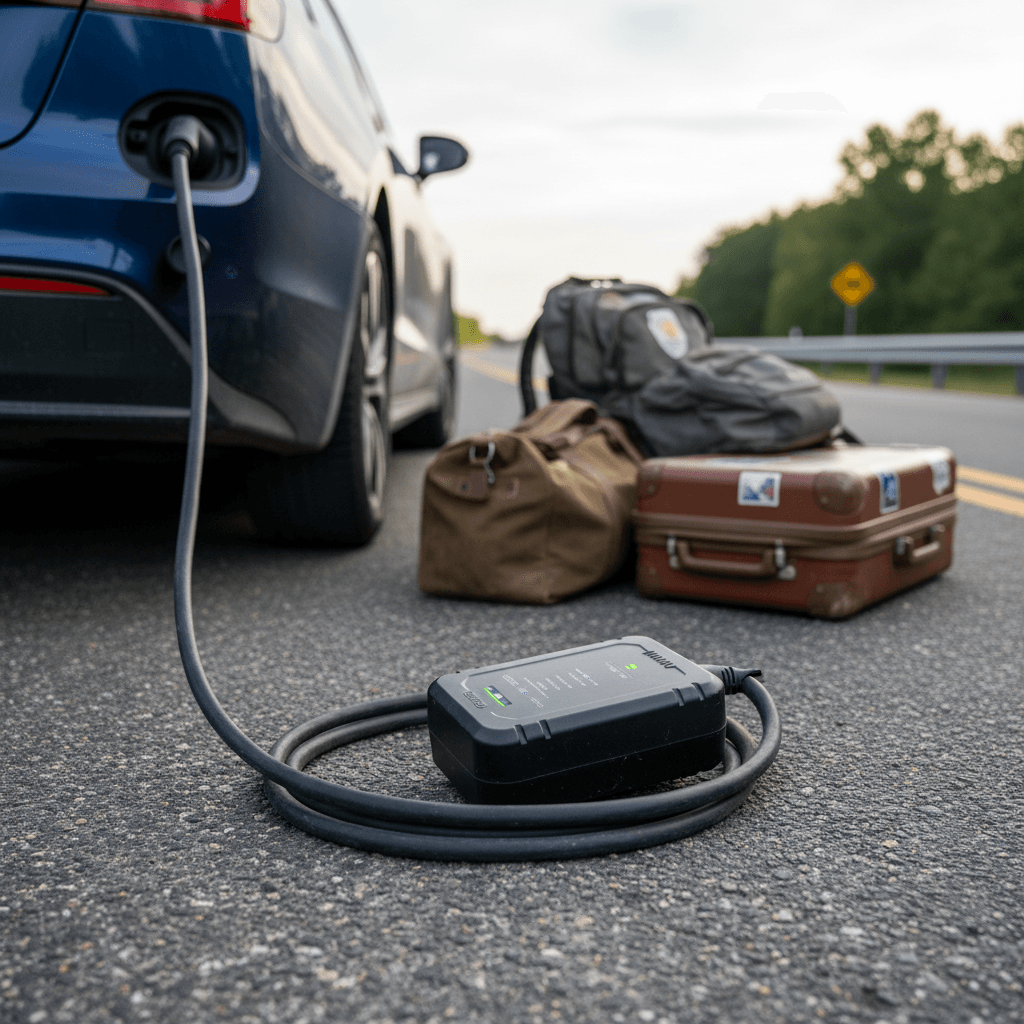
2. Portable Level 2 EVSE (240V)
These look like heavier-duty cables with a control box. You plug one end into a 240V outlet (NEMA 14‑50, 6‑50, etc.) and the other into your car’s inlet.
- Commonly 32–40A, about 7–9.6 kW of power.
- Adds ~25–35 miles of range per hour for many EVs.
- Needs a compatible 240V outlet where you’re staying.
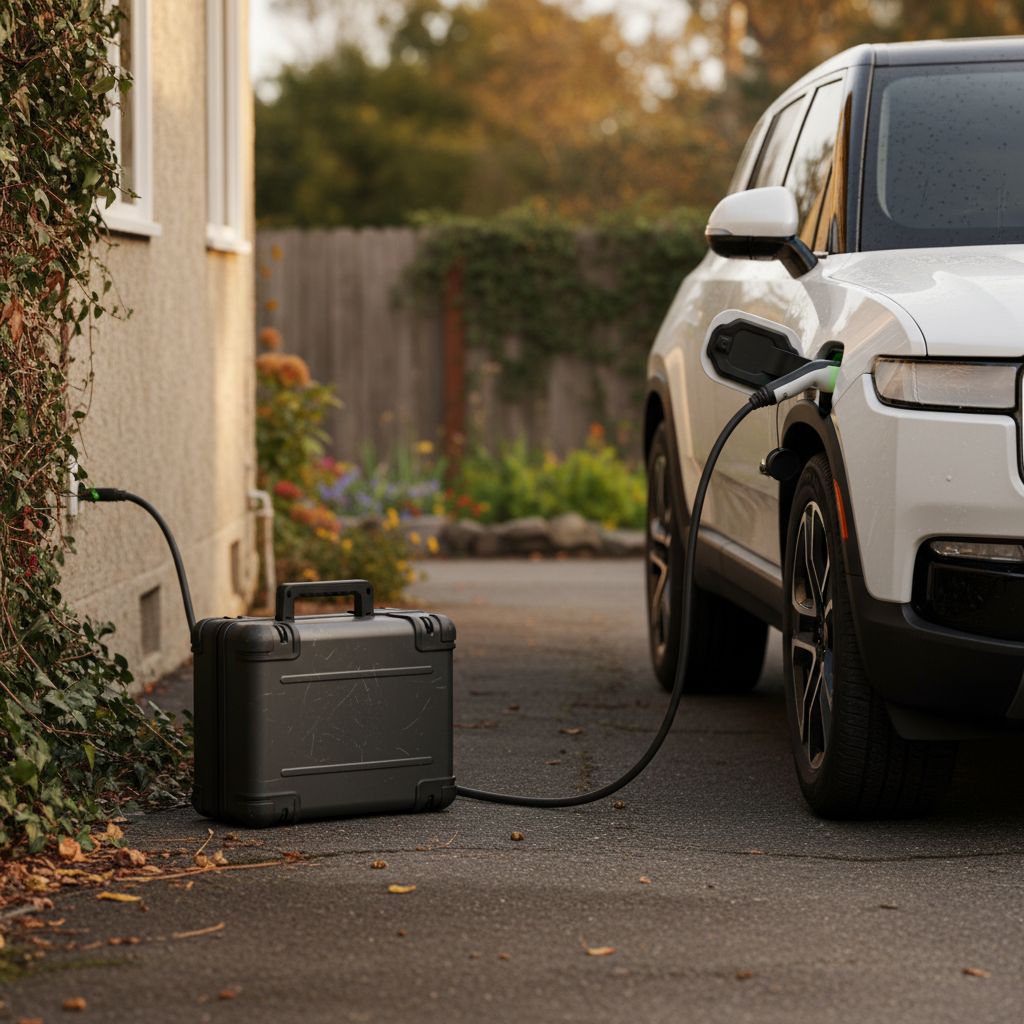
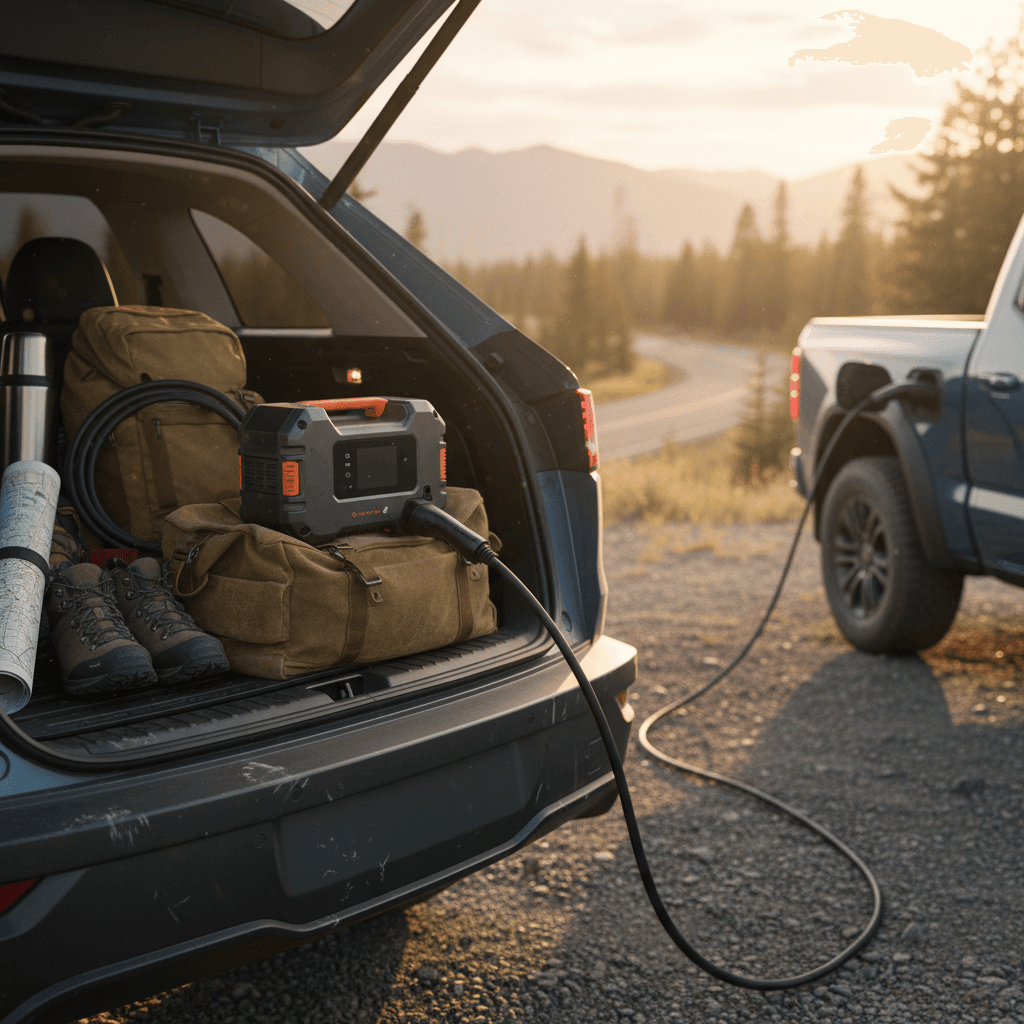
3. Portable battery power station + EVSE
Think of this as a giant power bank on wheels. Brands like Anker, EcoFlow, Bluetti and others sell LiFePO4 power stations from 1–3 kWh or more.
- Can power a Level 1 (or small Level 2) charger from battery.
- Adds “emergency” miles when there’s no outlet nearby.
- Bulky and expensive; best for off‑grid camping or vanlife.
4. Mobile DC fast‑charging trailers
These are commercial units, essentially roadside rescue DC chargers with built‑in battery storage delivering 60–120 kW.
- Used by fleets, dealers, and roadside services.
- Can restore 20–40 minutes of fast charge in the field.
- Not something you tow behind your Model 3 for fun.
For most individual drivers, the practical travel choices are portable Level 1 and Level 2 EVSEs, possibly paired with a compact power station if you camp off‑grid. Commercial mobile DC fast chargers are changing how dealers and fleet operators handle stranded EVs, but they’re not consumer gear. When you hear “portable EV charger for travel” in reviews and product pages, it almost always means a Level 1/2 cable that lives in your trunk.
How fast will a portable EV charger actually charge?
Portable charging speeds: what to expect on the road
Typical real‑world charging speeds for common portable options. Actual results depend on your EV’s onboard charger and conditions.
| Charger type | Typical power | Miles added per hour* | Best for travel use |
|---|---|---|---|
| Portable Level 1 (120V, 12A) | 1.2–1.4 kW | 3–5 mi/hr | Overnight top‑ups at relatives’ homes or rentals |
| Portable Level 2 (240V, 32A) | 7.2 kW | 20–30 mi/hr | Fast overnight charging at RV parks or homes with 240V outlets |
| Portable Level 2 (240V, 40A) | 9.6 kW | 25–35 mi/hr | Heavier EVs and drivers who cover big daily miles |
| 1–2 kWh power station + Level 1 | ~1.2 kW until battery depletes | 5–10 miles total | Last‑resort rescue in remote areas |
| Large mobile DC charger (60–100 kW) | 60–100 kW | 150–250 mi/hr | Commercial roadside rescue and fleet support |
Use these as planning numbers, not promises, always check your vehicle’s maximum AC charge rate.
Don’t overspend on power you can’t use
Portable Level 2 units are the sweet spot for travel: small enough to toss in the trunk, but powerful enough to refill a typical battery overnight if you find a 240V outlet. Level 1 matters more than you think, though. For slower trips where you’re parked for 12–18 hours at a relative’s house, that trickle charge can quietly add 40–80 miles of range while you sleep.
Key features to look for in a travel charger
Travel‑ready portable EV charger features
1. Dual‑voltage flexibility (120V + 240V)
Look for a charger that can run on both 120V and 240V, often via interchangeable NEMA 5‑15 and 14‑50 plugs or an adapter set. That way you can trickle‑charge anywhere and speed up when a 240V outlet is available.
2. Adjustable amperage
Being able to dial current down (for example from 40A to 24A or 16A) lets you safely match older wiring or undersized circuits you encounter at rentals, RV parks, or barns.
3. Weather resistance and durability
A travel charger needs robust strain relief on the cable, an impact‑resistant control box, and at least basic water resistance. Many well‑reviewed units pass crush tests and carry UL or equivalent safety listings.
4. Clear display and controls
A simple screen showing voltage, current, energy delivered, and error codes makes troubleshooting on the road easier. Timer or delay‑start features help you avoid peak rates when you’re on home or hotel power.
5. Connector and adapter options
In North America, that means J1772 or NACS depending on your car, and possibly a J1772–NACS adapter if you drive a Tesla or your used EV pre‑dates native NACS. Make sure every adapter in the chain is rated for the amps you plan to pull.
6. Cable length and storage
A 16–25 ft cable gives you flexibility when you can’t park nose‑to‑outlet. A rugged carry case keeps the cable clean and prevents damage from luggage shifting around the trunk.
Portable charger vs. just using public networks
Pros of bringing a portable EV charger
- Backup when stations are full or down: If you arrive at a site with broken or busy chargers, a portable unit lets you salvage the stop if there’s a working outlet nearby.
- Freedom to charge where you sleep: RV parks, cabins, barns, and relatives’ garages often have outlets but no EV hardware.
- Peace of mind in thin infrastructure zones: Rural corridors, mountain regions, and parts of the Midwest and Rockies still have long gaps between public fast chargers.
- Better economics on longer stays: An overnight 240V connection at a vacation rental can be cheaper than stacking multiple DC fast‑charging stops.
When public charging alone is enough
- Dense fast‑charging coverage: On high‑traffic interstates and coastal corridors, you may rarely need anything beyond DC fast chargers and destination Level 2 stations.
- Shorter trips: If your travel is mainly weekend visits within your EV’s round‑trip range, a portable unit may ride along unused.
- Hotel chains with robust EV setups: Many newer hotels offer multiple Level 2 ports that cover overnight needs without extra equipment.
- You already have reliable home charging: For some owners, the dollars are better spent on a robust home charger and a good charging‑network subscription.
How Recharged helps road‑trip planners
Ready to find your next EV?
Browse VehiclesMatching a portable charger to your EV and connectors
- Charging inlet: Newer North American EVs are moving to NACS, but millions of used models still use CCS with a J1772 AC inlet. Confirm which you have before buying.
- Onboard AC charging limit: Check your car’s spec sheet for its maximum AC charge rate (for example, 7.2 kW or 11 kW). There’s no benefit to buying a higher‑powered EVSE than your car can accept.
- Outlet options where you travel: RV parks usually offer 14‑50 outlets; older outbuildings might have 6‑50 or dryer outlets. Match the plug type on your charger, and any adapters, to what you’re realistically going to find.
- Cable and adapter ratings: Every link in the chain (extension cord, adapter, EVSE) must support the amperage you’re drawing. Underrated components are a fire risk.
- Software and lock‑in: Some “smart” portable chargers pair with apps for scheduling and monitoring. That can be handy, but avoid any product that requires cloud access just to start a charge while traveling.
Used EV buyers: connector questions to ask
Safety and what not to do
Travel charging mistakes to avoid
- Don’t daisy‑chain sketchy adapters. Stacking multiple cheap plug adapters between your charger and the wall is a common cause of overheated connections.
- Don’t use undersized extension cords. If you must use one, it should be a heavy‑gauge, outdoor‑rated cord designed for continuous high loads, and ideally avoided for Level 2 charging altogether.
- Don’t ignore warm outlets or plugs. If a receptacle, adapter, or plug face is hot to the touch, stop charging and investigate. Heat is an early warning sign.
- Don’t charge from damaged or unknown wiring. Old barns and outbuildings can hide questionable DIY work. If breakers trip repeatedly or lights flicker when you plug in, move on.
- Don’t leave connections sitting in puddles. Most modern chargers are weather‑resistant, but standing water plus high current is still a bad combination. Elevate connections whenever possible.
Travel scenarios: which portable charger fits you?
Choose a portable EV charger based on how you travel
Apartment dweller visiting family
You rely mostly on public charging at home.
Family has at least a standard 120V outlet near the driveway or garage.
Best fit: Keep a reliable Level 1 cable in the trunk. Consider a compact dual‑voltage charger if they have or can add a 240V outlet.
RV parks, campgrounds, and lake houses
Your trips involve long, stationary stays.
Many sites have 30A or 50A service hookups.
Best fit: Portable Level 2 with a 14‑50 plug and adjustable amperage. This turns campground power into overnight full charges.
Long‑distance interstate road trips
You mostly stick to major interstates with good fast‑charging coverage.
Time matters more than squeezing every penny out of electricity.
Best fit: Public DC fast charging plus your OEM cable as a backup. Consider a sturdier Level 1/2 unit only if you frequently stay at rural rentals.
Off‑grid camping & overlanding
You purposefully go where outlets are rare or nonexistent.
You may already carry a large portable power station for other gear.
Best fit: Larger LiFePO4 power station plus Level 1 EVSE, strictly as an emergency buffer, expect just a few extra miles per kWh, not full refills.
Portable EV charger travel checklist
Before you hit the road, confirm these items
Confirm outlet options at your destination
Ask hosts or property owners what outlets are available near parking. A quick photo of the panel or receptacle saves a lot of guesswork.
Match plugs, adapters, and amps
Verify that your portable EV charger’s plug type and amperage match the outlets you plan to use, and pack only high‑quality, properly rated adapters.
Test your setup at home first
Do a full test charge before you travel. Confirm your EV recognizes the charger, that cables don’t overheat, and that you understand the display and error codes.
Plan your public charging fallback
Even with a portable charger, map out DC fast and Level 2 options along your route. Apps from major networks and automakers make this much easier.
Account for real‑world range
Your battery’s health and temperature matter. A Recharged Score Report on a used EV helps you plan with realistic range expectations instead of brochure numbers.
Secure trunk space and cable storage
Make sure your charger is stored so bags and gear won’t crush connectors or kink cables. A dedicated case or bin goes a long way.
Portable EV charger for travel: FAQ
Frequently asked questions about portable EV chargers for travel
Bottom line: do you really need a portable EV charger for travel?
A portable EV charger for travel is less about raw charging speed and more about control. For some drivers, especially those sticking to busy interstate corridors and newer hotels, the public network plus the cable that came with the car is plenty. For others who run older or higher‑mileage EVs, head off the beaten path, or stay at properties with only basic electrical service, a durable portable Level 2 charger can turn marginal stops into reliable overnight refills.
If you’re already thinking about road trips and wondering whether your next EV will keep up, it may be worth starting with the car rather than the cable. At Recharged, every used EV comes with transparent battery‑health data and expert guidance on home and travel charging, so you can decide, with eyes open, whether a portable charger belongs in your trunk, or if smart vehicle choice and route planning are all you really need.