If you’re choosing between the Porsche Taycan and the Tesla Model S, you’re shopping at the top of the EV food chain. Both are brutally quick, tech-heavy electric flagships, but they deliver that experience in very different ways. This guide breaks down Porsche Taycan vs Tesla Model S on performance, range, charging, tech, and real-world ownership so you can pick the one that actually fits your life, especially if you’re looking at the used market.
Context: model years this comparison covers
Porsche Taycan vs Tesla Model S: who each car is for
Porsche Taycan: the driver’s EV
- Priorities: Steering feel, chassis balance, repeatable performance, brand cachet.
- Experience: Feels like an electric 911 for four people, hunkered down, communicative, and composed even when you’re pushing hard.
- Trade-offs: Less range per dollar than a Model S, pricier options, and a more traditional dealer/servicing experience.
Tesla Model S: the range and tech play
- Priorities: Maximum range, charging convenience, minimalist tech, big-screen UX.
- Experience: Effortlessly rapid, quiet, and efficient with huge cargo space and strong highway comfort.
- Trade-offs: Interior materials and build quality lag Euro luxury rivals, and depreciation has accelerated on the used side.
Used-vehicle angle
Quick specs: Taycan vs Model S at a glance
Headline numbers: Taycan Turbo S vs Model S Plaid
Core specs: representative trims
Specs vary by trim and year; these representative configurations show how the cars stack up if you’re cross-shopping higher-performance versions.
| Model | Representative trim (2025-ish) | Power (approx.) | 0–60 mph (approx.) | Max DC charge | Battery (gross) | Real-world highway range* |
|---|---|---|---|---|---|---|
| Porsche Taycan | Taycan 4S / Turbo S | ≈509–938 hp (overboost) | 3.5–2.3 s | Up to 320 kW | Up to ~105 kWh | Roughly 280–330 mi, depending on trim and battery |
| Tesla Model S | Dual Motor AWD / Plaid | ≈670–1,020 hp | 3.1–≈2.0–2.5 s | Up to 250 kW | ≈100 kWh | Roughly 360–400+ mi, depending on wheel/tire and year |
Always verify exact specs for the specific VIN you’re considering, especially on the used market.
EPA vs real-world range
Performance and driving feel
On paper, the top Taycan and the Model S Plaid trade tenths of a second. In reality, the bigger difference is how they feel when you’re not doing 0–60 launches in front of your friends.
How they drive: sport sedan vs electric missile
Both are fast; only one really feels like a Porsche.
Porsche Taycan: precision weapon
- Chassis: Adaptive air suspension and Porsche’s latest control software give the Taycan a remarkably flat, composed attitude in corners, especially in 4S and Turbo models.
- Steering feel: Heavier and more communicative than the Tesla; you feel the front tires and road surface more clearly.
- Braking: Aggressive regen blended with powerful friction brakes (including Porsche’s surface-coated and carbon-ceramic options) inspires confidence on back roads and track days.
- Repeatability: The thermal management and two-speed rear gearbox help the Taycan deliver strong acceleration pulls back-to-back without throttling as quickly.
Tesla Model S: effortless thrust
- Acceleration: In Plaid form, the Model S is still one of the quickest production cars you can buy. The shove from 40–80 mph is borderline surreal.
- Ride/handling balance: Softer and more comfort-biased than the Taycan. Great highway car, less talkative on a twisty road.
- Track work: Capable with the Track Package, but thermal limitations and brake fade show up faster compared with the Taycan’s more motorsport-minded setup.
- Noise & refinement: Very quiet cabin, though wind and road noise control can vary by build year and wheel choice.
If you love to drive…
Range and efficiency: daily use and road trips
Tesla built its brand on range leadership, and the Model S still stretches a kilowatt-hour farther than most rivals. But the 2025 Taycan update narrowed that gap with a larger, more efficient battery and revised aerodynamics.
Typical real-world highway range (recent models)
Approximate 70–75 mph highway ranges for recent trims in mild weather; actual results vary by wheel size, temperature, and driving style.
| Model & trim | Approx. highway range | Notes |
|---|---|---|
| Tesla Model S Dual Motor (2024–2025) | ≈360–390 mi | One of the longest-range EVs on the market when driven sensibly. |
| Tesla Model S Plaid (2024–2025) | ≈340–360 mi | Slightly less efficient than the Dual Motor but still strong. |
| Porsche Taycan RWD (2025 update) | ≈320–360 mi | New battery chemistry and aero deliver much better real-world range than early Taycans. |
| Porsche Taycan 4S / Turbo (2025 update) | ≈280–330 mi | More power and grip, but still a big step up from earlier years. |
Smaller wheels and careful driving can add meaningful range to both cars.
Range reality check
Charging experience and networks
Charging is where Tesla has long had a structural advantage. The Supercharger network is dense, reliable, and well integrated with the car’s navigation. Porsche counters with cutting-edge charging hardware on the Taycan and growing access to third-party high-power stations.
Charging: hardware vs ecosystem
Taycan focuses on peak speed; Model S leans on network depth.
Porsche Taycan charging
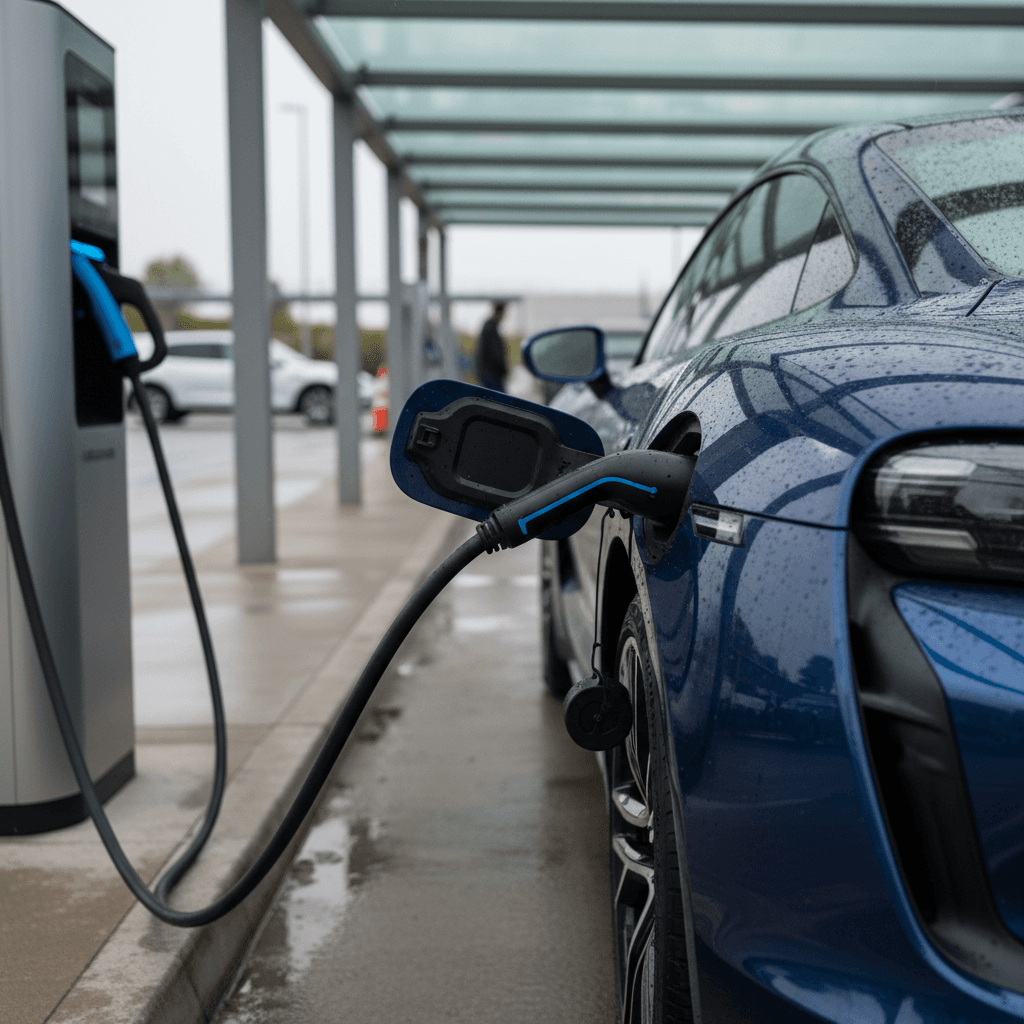
- Peak DC speed: Updated Taycan models can charge at up to 320 kW on 800‑V DC fast chargers, hitting 10–80% in roughly 18 minutes under ideal conditions.
- 400‑V optimization: A standard 150‑kW DC/DC converter helps the Taycan pull strong power even from 400‑V stations.
- Network experience: You’ll typically use networks like Electrify America, EVgo, and other CCS providers. Station quality can vary by operator and location.
- Home charging: Like the Model S, the Taycan works seamlessly with a 240‑V Level 2 charger at home.
Tesla Model S charging
- Peak DC speed: Around 250 kW on V3 Superchargers when the pack is warm and at a low state of charge.
- Network depth: Superchargers remain the most cohesive DC fast-charging network in North America, with excellent uptime and plug‑and‑charge simplicity.
- Non‑Tesla access: Increasing numbers of Superchargers support CCS‑equipped non‑Tesla EVs, but as a Model S owner you get native access without adapters.
- Home charging: Tesla’s Wall Connector and a growing ecosystem of third‑party NACS chargers make home charging straightforward.
Connector standards are shifting
Technology, infotainment, and interior experience
Porsche Taycan cabin
- Design: Low-slung, driver-oriented cockpit with familiar Porsche switchgear and materials. Optional passenger display adds wow factor without turning the car into a rolling tablet.
- Infotainment: Responsive, but menu systems are denser than Tesla’s. Wireless Apple CarPlay and Android Auto support make smartphone mirroring easy.
- Seats & comfort: Firm, supportive seats with excellent lateral bolstering. Rear space is adequate, but not as generous as the Model S, especially for taller passengers.
- Noise & materials: High-quality leathers, metals, and trims; generally tighter fit-and-finish than the Tesla, especially in earlier Model S years.
Tesla Model S interior
- Design: Minimalist, open-feeling cabin dominated by a large central touchscreen and a smaller driver display. Later refreshes added ambient lighting and updated trim.
- Infotainment: Quick, intuitive UI with built‑in streaming services, native navigation tightly linked to charging, and frequent OTA software updates.
- Space & practicality: More usable rear legroom and a massive hatchback cargo opening. Great if you haul bikes, luggage, or pets.
- Driver assistance: Autopilot and optional Full Self‑Driving (FSD) add lane centering and advanced cruise features, but capabilities and behavior have varied by software version and regulatory climate.
Driver-assist expectations
Ownership costs, depreciation, and used-market reality
Sticker prices tell only part of the story. What you’ll actually pay over time depends on depreciation, maintenance, and energy costs. Both Taycan and Model S will be among the more expensive EVs to own, but for different reasons.
Price, depreciation, and warranty: big picture
Luxury badges vs tech brand in a cooling used-EV market.
New and used pricing
- New: Recent Taycans generally start around the high‑$90Ks and climb quickly past $170K in Turbo S form. Recent Model S Dual Motor and Plaid variants typically list lower, roughly mid‑$80Ks to around $100K depending on equipment.
- Used: On the used market, Model S prices have softened noticeably, reflecting broader Tesla sentiment and high supply. Taycans tend to transact for more, but with steeper initial depreciation from their higher MSRPs.
Depreciation trends
- Tesla Model S: Earlier years held value well, but recent data show double‑digit price drops for used Teslas as inventory grows and competition heats up.
- Porsche Taycan: Luxury-brand cachet helps long-term, but the first three years usually see a sharp drop from MSRP, creating interesting opportunities for used shoppers.
Warranty and long-term peace of mind
- Basic warranties: Both cars typically carry 4‑year/50,000‑mile new-vehicle coverage.
- Battery & powertrain: Recent Model S examples commonly feature up to 8‑year/150,000‑mile battery and drive-unit coverage; Taycan coverage is often 8 years/100,000 miles. Always verify remaining coverage on a specific used car.
Energy and maintenance costs
Key checks when buying a used Taycan or Model S
1. Battery health and fast-charging history
Ask for a recent battery health report and look at how often the car was DC fast-charged. Aggressive fast-charging and frequent 0–100% cycles can accelerate degradation.
2. Warranty status and transferability
Confirm in writing how much factory battery/drive-unit coverage remains and whether it transfers automatically to you.
3. Software and feature set
Tesla features like FSD and premium connectivity, or Porsche options like adaptive suspension and upgraded audio, materially change the ownership experience and resale value.
4. Alignment and suspension inspection
Both cars are heavy and powerful. Check for uneven tire wear, suspension noise, or prior curb impacts, especially on low-profile wheel setups.
5. Charging hardware and adapters
Confirm what home charging equipment, adapters, and charging-network memberships are included. That can save hundreds of dollars up front.
6. Independent pre-purchase inspection
On a six-figure EV, a brand-specialist inspection is money well spent. At Recharged, every vehicle goes through EV-focused checks before it ever appears on our site.
How Recharged helps
Ready to find your next EV?
Browse VehiclesWhich should you buy: Porsche Taycan or Tesla Model S?
Decision guide: match the car to your priorities
Use these scenarios to narrow your choice.
Choose the Porsche Taycan if…
- You care more about driving feel than ultimate range specs.
- You want a cabin that feels like a top-tier German sports sedan, with higher perceived material quality.
- You track your car occasionally or drive hard on back roads and want repeatable performance.
- You’re comfortable paying more for the badge and dealer network, and you’re fine planning around CCS fast chargers instead of Superchargers.
- You’re eyeing a used Taycan that has already taken its biggest depreciation hit.
Choose the Tesla Model S if…
- Range and charging convenience are your top priorities, especially for frequent road trips.
- You like a minimalist, software-first experience with frequent over‑the‑air feature updates.
- You need maximum cargo room and rear-seat space.
- You’re intrigued by Autopilot/FSD and don’t mind living with their evolving nature.
- You want more performance-per-dollar and aren’t as concerned about leather grain or panel gaps.
In the end, there’s no wrong answer, just a better fit. The Tesla Model S remains the pragmatic powerhouse: long legs, abundant charging, and outrageous acceleration at comparatively accessible prices, especially used. The Porsche Taycan is the emotional play: a true driver’s car that finally marries EV performance with Porsche’s handling and build quality, even if you’ll stop for electrons more often. If you’re browsing the used market and want help weighing a specific Taycan or Model S, Recharged can walk you through battery reports, pricing, and financing so you’re not making a six-figure decision in the dark.