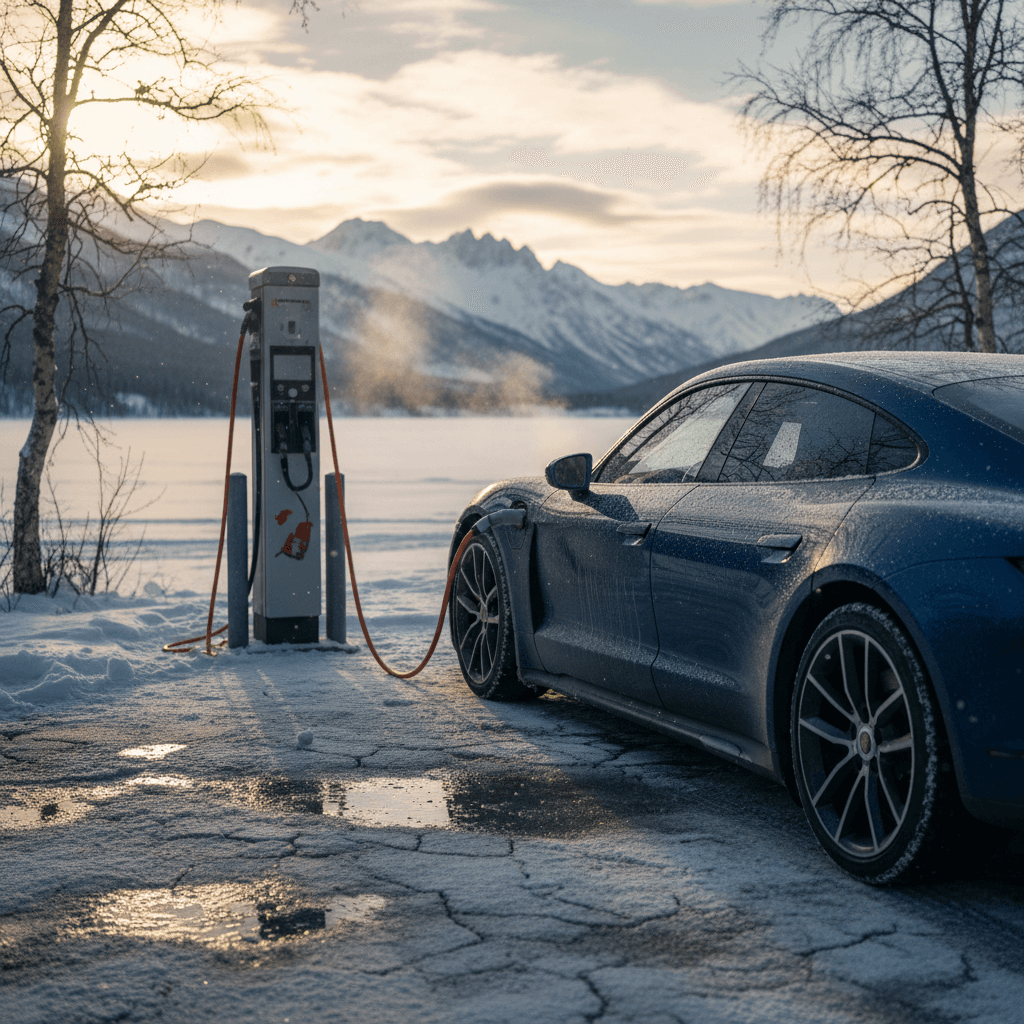
If you live where winter actually means winter, you’ve probably wondered how much the Porsche Taycan’s range drops in cold weather. Official EPA numbers are one thing; driving through sleet at 25°F with the heater blasting is something else entirely. The good news: the Taycan generally handles winter better than many EVs, but you still need to plan for a noticeable hit to range.
Cold-weather range in one glance
Why Porsche Taycan range drops in cold weather
Every battery‑electric vehicle loses range in the cold, and the Taycan is no exception. You’re fighting three things at once: cold battery chemistry, cabin heating, and denser air.
- Battery chemistry slows down: Lithium‑ion cells can’t accept or deliver energy as efficiently when they’re cold, so you use more kWh per mile and see slower DC fast‑charging until the pack warms up.
- Cabin and seat heating draw real power: In an EV, all cabin heat is electric. In a Taycan, sustained heating can easily use 2–5 kW while you’re driving, which adds up quickly on shorter trips.
- Higher drag at winter speeds: Cold, dense air and winter tires both increase rolling and aerodynamic resistance, so highway efficiency suffers more than gentle city driving.
Why short winter trips are so inefficient
How much Taycan range you actually lose in winter
Cold‑weather range loss varies by temperature, speed, and how you drive, but across EVs, independent testing usually finds 14–39% less range in winter compared with official ratings. The Taycan tends to land toward the better side of that spread thanks to good thermal management, but it’s still subject to the same physics.
Typical Porsche Taycan winter range impact
Real‑world owner reports and winter tests often show earlier Taycans delivering ~180–220 miles of practical range in freezing conditions where the same car might comfortably do 230–260 miles in mild weather. The refreshed 2025+ Taycan, with its larger battery and efficiency tweaks, raises both of those numbers but keeps a similar percentage drop in deep winter.
A simple planning rule for winter Taycan trips
2025+ Taycan: what’s different in the cold
For the 2025 model year, Porsche gave the Taycan a major overhaul: more efficient motors, a revised thermal system, and a larger battery pack (up to 105 kWh gross) on many trims. EPA ranges climbed into the mid‑200s to low‑300s miles depending on model and wheels, which also helps winter performance because you’re starting from a higher baseline.
Older Taycan vs. 2025+ Taycan in the cold
Same car, smarter hardware and software
Pre‑2025 Taycan (Gen 1)
- Smaller usable battery on many trims.
- Excellent thermal management, but less efficient motors and electronics.
- High‑speed winter range typically in the low‑200s miles when new.
- DC fast‑charging is strong, but colder packs may take longer to ramp up.
2025+ Taycan (Refreshed)
- Larger battery (up to 105 kWh gross) standard on many trims.
- More efficient rear motor and improved power electronics.
- Higher EPA ranges (up to around 300+ miles) mean more cushion in winter.
- Charge curve optimized to hold high power longer, even as the pack warms.
Why this matters for cold‑climate buyers
Highway vs. city driving in winter
Unlike gasoline cars, EVs are usually more efficient in city driving than on the highway. That pattern still holds in winter, but the spread gets tighter, and sometimes reverses for very short trips.
City / mixed driving
- Stop‑and‑go traffic lets the Taycan recover energy via regen braking.
- Lower speeds mean much less aerodynamic drag.
- If your battery and cabin are already warm, you’ll often see better efficiency than on the freeway.
- However, many short trips from a cold start can be inefficient because you keep reheating everything.
Highway driving
- Steady 70–80 mph speeds in 25°F air can push consumption way up.
- Winter tires and slush increase rolling resistance.
- Range drops the most on long, fast winter runs, plan for the high end of the loss range.
- The upside: long drives keep the pack warm, so fast‑charging performance improves after the first stop.
Beware of ‘EPA mindset’ on winter road trips
Real-world winter range planning by Taycan model
Exact numbers depend on wheel size, options, software version, and how and where you drive. But you can build a sensible planning envelope by taking known EPA figures and applying a conservative winter‑loss factor. The table below is for trip planning, not lab data, it assumes healthy batteries and typical winter highway use around freezing temperatures.
Rule-of-thumb winter planning ranges for popular Taycan trims
Approximate values assuming a healthy battery, mostly highway driving near freezing, and a 25–30% winter range loss. Always leave buffer for weather, detours, and closed chargers.
| Model (illustrative trims) | EPA range when new (mi) | Conservative winter planning range (mi) | Notes |
|---|---|---|---|
| Early Taycan RWD (Performance Battery Plus) | 240–250 | +/- 170–185 | On 19" wheels; winter highway use in the 20s–30s °F. |
| Taycan 4S (Performance Battery Plus) | 260–280 | +/- 185–205 | Popular sweet spot; plenty for most winter commutes and regional trips. |
| Taycan GTS / Turbo (Performance Battery Plus) | 240–260 | +/- 170–190 | Higher power and wider wheels can slightly hurt efficiency at speed. |
| 2025+ Taycan RWD (updated battery) | 270–300+ | ~200–220 | Refreshed pack and motor help offset winter losses; still plan conservatively. |
| 2025+ Taycan 4S / higher trims | 290–320+ | ~210–235 | More buffer on paper, but your usable winter range still depends heavily on speed and temperature. |
If your own driving is mostly city at moderate speeds, you may see better numbers than these; deep cold or high speeds can easily push you below them.
Why these aren’t official Porsche numbers
Charging your Taycan in cold weather
The Taycan is one of the fastest‑charging EVs on the market, with peak DC rates north of 250–300 kW on many trims. In the cold, it can still be impressively quick, but only if the battery is warm enough. Understanding how to treat charging in winter can save you time and preserve battery health.
- Use preconditioning before fast charging: Navigating to a DC fast charger in the Taycan’s navigation system lets the car warm the pack on the way, so you hit higher charge speeds sooner.
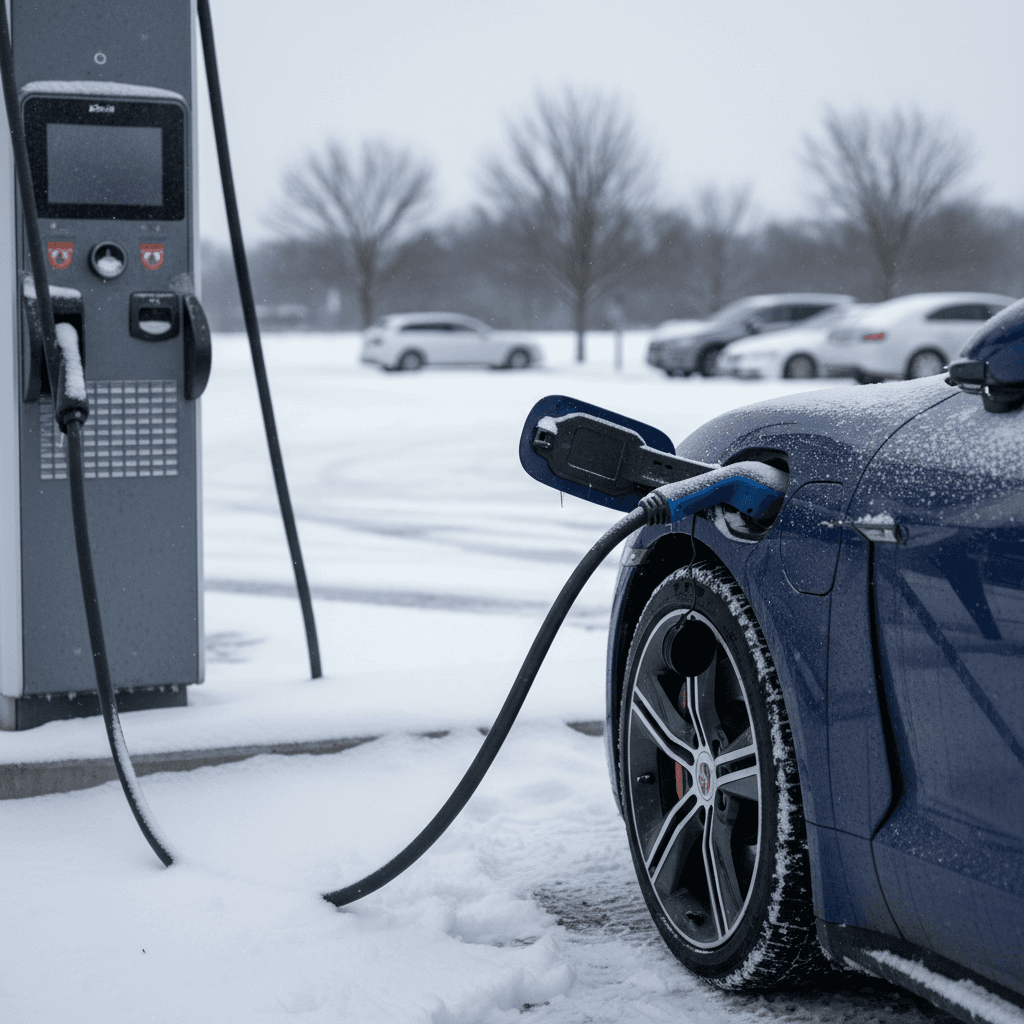
- Expect slower charging on the first stop: If you start your day with a cold battery and drive straight to a charger, the car may spend the first minutes gently heating the pack instead of hammering it with power.
- Don’t obsess over 100%: Just like in warm weather, the Taycan charges fastest between roughly 10–60%. In winter, it’s even more efficient to ‘stop more often, charge less’ on road trips instead of waiting for a full charge each time.
- Use AC home charging to warm overnight: Plugging in at home in cold weather lets the car maintain the pack in a more favorable temperature window, which improves efficiency and saves you fast‑charging time the next day.
Cold + high DC power = why the Taycan babysits its battery
Winter tips to protect your Taycan’s range
Cold weather doesn’t have to turn every Taycan drive into a math problem. A few habits make a big difference in how much range you see on the dash, and how confident you feel using it.
Practical Taycan winter range tips
1. Precondition while plugged in
Use the Taycan’s departure timer or climate controls to warm the cabin and battery <strong>while the car is still charging</strong>. That way, most of the ‘heat tax’ comes from the grid, not your battery.
2. Use Range or Normal drive modes
In slippery, cold conditions you rarely need full Sport response. Range and Normal modes optimize power delivery, ride height, and climate settings to stretch miles without turning the car into a slug.
3. Dial in your climate settings
Seat and steering‑wheel heaters use far less energy than blasting hot air. Try a slightly lower cabin temperature, rely on heated surfaces, and turn off defrost once windows are clear.
4. Consider winter wheels and aero
Dedicated winter tires are non‑negotiable in snow, but avoid the widest, most aggressive wheel/tire combos if you care about range. Smaller‑diameter wheels with higher‑profile winter tires usually help efficiency a bit.
5. Plan conservative state of charge (SoC) windows
In winter, it’s smart to arrive at chargers with at least <strong>15–20%</strong> remaining and leave with ~60–80% for the next leg. That window keeps you in the Taycan’s fastest‑charging zone and gives room for detours.
6. Use reliable route planners
Apps and built‑in planners that understand elevation, temperature, and charger locations, like the Taycan’s native system or third‑party EV apps, make winter trip planning far less stressful.
Leverage charging networks for peace of mind
Buying a used Taycan for cold climates
If you’re eyeing a used Taycan and you live in a snow belt, you’re asking two questions at once: How healthy is the battery? and How realistic is the winter range for my life? Both are answerable with the right data and a bit of honest math.
Key checks for cold‑climate buyers
- Look for detailed battery health information, not just ‘good condition’ on a listing.
- Confirm which battery pack the car has (standard vs. Performance Battery Plus) and what wheels/tires it’s riding on.
- Ask for recent consumption or range screenshots from cold‑weather drives if the seller has them.
- Factor in your typical winter routes: are you doing 30‑mile commutes, or 180‑mile ski runs every weekend?
How Recharged helps with winter confidence
Every EV sold through Recharged comes with a Recharged Score Report that includes verified battery health and fair market pricing. If you’re shopping a Taycan specifically for winter duty, our EV specialists can help you:
- Translate battery health into realistic winter range for your routes.
- Compare older Taycan models vs. refreshed 2025+ cars.
- Estimate road‑trip stop patterns to your cabin, ski hill, or family out of state.
And with nationwide delivery plus digital paperwork, you can buy the right Taycan for your climate without spending weekends at dealerships.
Thinking of trading into a Taycan?
Ready to find your next EV?
Browse VehiclesFAQ: Porsche Taycan range in cold weather
Common questions about Taycan winter range
Bottom line: Is the Taycan a good winter EV?
If you understand the physics and plan accordingly, the Porsche Taycan is a very capable winter EV. You’ll still pay a 15–30% range tax in real cold, especially on fast highway runs, but you get predictable behavior, strong thermal management, and some of the quickest DC fast‑charging available when the pack is warmed up.
For daily commuting and weekend winter drives, especially in a 2025+ Taycan, range is rarely the limiting factor as long as you plug in at home and precondition. For longer ski‑town runs or cross‑country road trips, conservative planning and good charger coverage matter more than the badge on the hood.
If you’re considering a Taycan, new or used, and you live where snow sticks around for months, pairing real battery‑health data with honest winter‑range expectations is the best way to fall in love with the car instead of fighting it. That’s exactly what Recharged was built for: helping you choose the right used EV, understand its range in your climate, and enjoy the kind of effortless, quiet winter driving that makes you wonder why you didn’t go electric sooner.