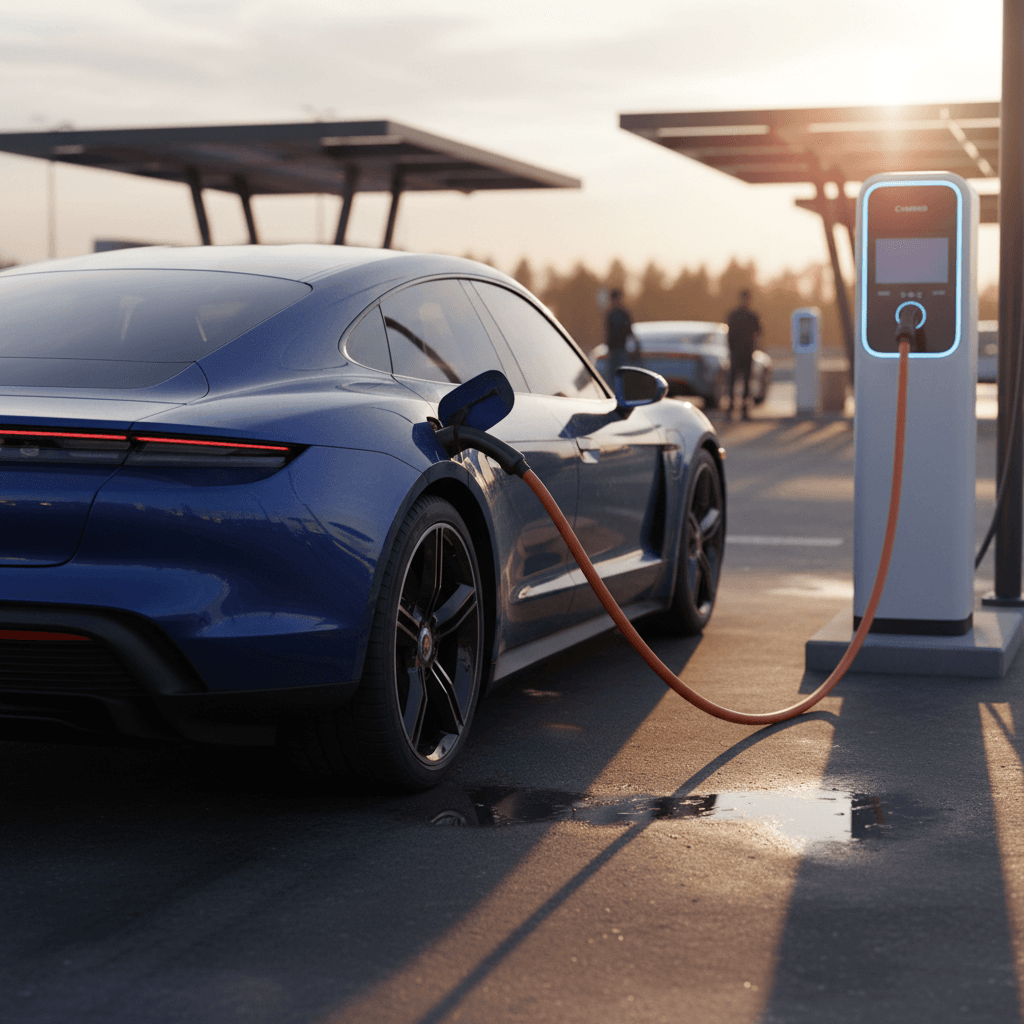
If you’re considering a Porsche Taycan, or you already own one, the big question is simple: **how fast does it really charge** at home and on the road? The Taycan’s 800‑volt architecture makes it one of the quickest-charging EVs you can buy, but the numbers on paper don’t always match what you see at a random public charger. This Porsche Taycan charging speed guide breaks down what you can actually expect in minutes, not just kilowatts.
At a glance
How fast does a Porsche Taycan charge?
Porsche Taycan headline charging stats
Real‑world charging speeds depend on three things: **the charger**, **the car**, and **conditions**. Peak numbers like 270–320 kW DC fast charging are impressive, but you’ll only see that for part of the session and only on the right equipment. To make good decisions, especially if you’re cross‑shopping used Taycans, it helps to understand how Porsche’s 800‑volt system behaves from 0–100%.
Taycan charging basics: 800-volt architecture & why it matters
What 800 volts actually does
The Taycan runs an 800‑volt electrical architecture instead of the 400‑volt systems used by many other EVs. Doubling the voltage lets the car deliver the same power with half the current, which keeps cables cooler and allows higher sustained charging rates.
- Higher peak DC power (270–320 kW depending on model year)
- Shorter 10–80% charging times at compatible stations
- Better performance repeatability on spirited drives
What it doesn’t do
800 volts isn’t magic. Charging speed is still limited by:
- The station’s maximum power and voltage
- Battery temperature (cold or very hot packs charge slower)
- State of charge, speeds fall off as you approach 80–90%
On a lower‑power 400‑V DC fast charger, a Taycan will still charge quickly, but you won’t see the headline numbers from Porsche’s marketing materials.
Tip for first-time Taycan fast chargers
DC fast charging speeds: 10–80% in real life
Porsche has steadily improved Taycan charging since the first 2020 models. Broadly, you’ll see **two generations** in the market today:
- **First-generation Taycan (≈2020–2024 in the U.S.)** – Peak DC power up to about 270 kW in ideal conditions. Officially, a 5–80% charge can take around 22–23 minutes on a high‑power 800‑V charger, but more typical real‑world numbers are closer to the low 30‑minute range if the battery isn’t perfectly pre‑conditioned.
- **Updated Taycan (≈2025+ refresh)** – Porsche broadened the fast‑charge “sweet spot” and raised peak power toward 320 kW. Factory info now cites roughly **10–80% in about 18 minutes** at a compatible 800‑V station in ideal conditions.
Understanding the Taycan charging curve
DC fast charging use cases for Taycan owners
How long you’ll actually sit at a charger
Highway road trips
On an 800‑V high‑power charger, many Taycan drivers plan **15–25 minute stops** from about 5–10% up to 60–75%. That’s enough for a bathroom break, a drink, and a quick email check.
Quick mid-week top-ups
Arrive at 30–40% and leave at 70–80%? You might only need **10–15 minutes** on a strong DC fast charger, especially with the updated 2025+ models.
Worst-case scenarios
Cold weather, shared chargers, or older 50–100 kW stations can double your charging time. In those situations you may see **30–45 minutes** from low state of charge up to 80%.
Cold packs charge slower
Home and Level 2 charging speeds for the Taycan
DC fast charging grabs headlines, but **most Taycan charging happens at home**. Porsche itself expects a large majority of owners to plug in overnight. The exact speed you’ll see depends on your Taycan’s onboard charger and your home circuit.
Typical Taycan home charging setups
What different Level 2 options look like in hours, not just kilowatts
11 kW onboard charger (most cars)
Many Taycans in the market have an **11 kW AC onboard charger**. On a 48‑amp Level 2 wall box (about 11 kW), you’re looking at roughly:
- 0–100%: 8–10 hours overnight from very low state of charge
- 20–80%: around 4–6 hours
For a typical U.S. commute, that’s plenty, plug in when you get home, wake up to a full battery for daily use.
19.2 kW onboard charger (optional/upgrade)
Some Taycans were ordered with, or later upgraded to, a **19.2 kW AC onboard charger**. Paired with a 100‑amp circuit and compatible wall box, this can effectively **cut AC charge times nearly in half** compared with 11 kW.
That’s especially valuable if you arrive home late with a low battery and need a big refill before an early‑morning departure.
Don’t oversize your home charger blindly
Setting up an ideal home charging situation for a Taycan
1. Confirm your Taycan’s onboard AC charger
Check the window sticker, build sheet, or owner’s manual to see whether your Taycan is equipped with the standard 11 kW charger or an optional 19.2 kW unit. This governs the maximum AC charging speed you’ll ever see.
2. Evaluate your home electrical panel
A licensed electrician can quickly tell you whether your existing panel can support a 40–60 amp circuit (typical) or a 100‑amp circuit for the highest power setups. Don’t assume, verify.
3. Choose the right Level 2 charger
Match the wall box output to your Taycan. For most owners, a **40–48 amp Level 2 unit** is the sweet spot between speed, cost, and panel capacity. You rarely need more unless you know you have the 19.2 kW onboard charger and heavy daily mileage.
4. Use scheduled charging
Take advantage of the Taycan’s charging profiles, timers, or your wall box’s app to charge during **off‑peak hours** where time‑of‑use rates apply. It doesn’t make the car charge faster, but it can make every kilowatt‑hour cheaper.
5. Keep a mobile cable for flexibility
A portable Level 2 cable (or the factory mobile charger) lets you charge at friends’ homes or workplaces with suitable outlets, even if they don’t have a hard‑wired wall box.
Quick reference: Porsche Taycan charging times
Approximate Porsche Taycan charging times by scenario
These are ballpark figures for a Taycan with a large battery pack in good conditions. Actual times will vary by model year, battery condition, temperature, and station quality.
| Charging scenario | Power source | Start–End (SoC) | Approx. time | Best use case |
|---|---|---|---|---|
| Fastest possible DC | 800‑V DC fast charger (270–320 kW) | 10–80% | ≈18–25 minutes | Long‑distance trips on high‑power corridors |
| Typical DC fast charge | 150–200 kW DC fast charger | 10–80% | ≈25–35 minutes | Mixed highway driving, average public stations |
| Lower-power DC | 50–75 kW DC fast charger | 10–80% | ≈45–70 minutes | Rural areas or legacy hardware |
| Standard home Level 2 | 11 kW (48A, 240V) | 0–100% | ≈8–10 hours | Overnight charging from low SoC |
| Standard home Level 2 | 11 kW (48A, 240V) | 20–80% | ≈4–6 hours | Daily top‑ups while you sleep |
| High-power home Level 2 | Up to 19.2 kW (100A, 240V) | 20–80% | ≈2–3 hours | Heavy daily usage and quick turnarounds |
Use this table as a planning tool rather than a promise, treat the lower times as best‑case results.
Used Taycan buyers: ask for real charging history
How to charge your Taycan faster in the real world
You can’t change physics, but you can **stack the deck in your favor**. The Taycan responds especially well when you pay attention to state of charge and temperature.
Five ways to minimize Taycan charging time
Practical habits that matter more than chasing the biggest kW number
Arrive low, leave mid
Plan DC fast‑charge stops so you arrive around **5–15%** and unplug around **60–75%**. That keeps you in the highest‑power section of the charging curve and usually gets you back on the road the quickest.
Pre‑condition before fast charging
Use the built‑in navigation to route to a fast charger or manually enable **battery pre‑conditioning**. Warming the pack before arrival can shave many minutes off your stop, especially in cold weather.
Choose the right station
Look for 800‑V or 300+ kW stations where available, but also check reviews in charging apps. A well‑maintained 150 kW charger can outperform a neglected 350 kW unit that constantly throttles or fails.
Don’t chase 100% on the road
Beyond **80–90%**, every extra percent takes significantly longer. Unless you truly need it for a long gap between chargers, it’s usually faster overall to leave earlier and make a shorter next stop.
Avoid peak congestion
At busy highway plazas, shared power cabinets can cut output when multiple cars plug in. If possible, favor stations with open stalls or slightly off‑peak times.
Use multiple apps
Combine Porsche’s tools with third‑party apps (PlugShare, Chargeway, etc.) so you see station status, user comments, and alternate sites if your first choice is offline.
Battery health best practices for Taycan owners
The Taycan’s pack is designed for repeated fast charging, but your day‑to‑day habits still matter. The goal is to **balance convenience, speed, and long‑term battery health**.
Charging habits that are kind to your Taycan battery
1. Use 20–80% for daily driving
For routine commuting, it’s wise to live mostly between **20–80% state of charge**. Many owners set their charge limit in that range and only go higher for trips.
2. Save 100% for departure day
If you need a full battery, aim to finish charging close to the time you’ll leave, not hours earlier. That way, the pack doesn’t sit at 100% for long periods.
3. Don’t fear fast charging, just be smart
High‑power DC fast charging is fine when used as intended: to quickly add miles on trips. It’s extended, frequent 0–100% DC sessions in hot weather that are hardest on any EV battery.
4. Avoid deep discharges when possible
Occasional dips below 5–10% aren’t a crisis, but repeatedly running the pack extremely low and then fast‑charging hard isn’t ideal. If you’re often that low, consider adjusting your charging schedule.
5. Watch for software updates
Porsche has rolled out updates that tweak charging curves and thermal management. Keeping your Taycan’s software current can improve both speed and longevity.
How Recharged helps with battery confidence
Ready to find your next EV?
Browse VehiclesCharging tips when shopping for a used Taycan
The Taycan’s charging strengths make it especially appealing on the used market, if you choose carefully. Beyond color and options, it pays to dig into how the car has been charged and which hardware it has onboard.
Key Taycan charging questions to ask a seller
These details can change your daily experience, and resale value
Does it have the 19.2 kW onboard charger?
If you want the fastest possible home charging and your panel can support it, that optional **19.2 kW onboard charger** is a major plus. On a used car listing, look for it in the options list or ask for a build sheet.
How was it usually charged?
Occasional DC fast‑charging on road trips is normal. What you want to understand is whether the prior owner often left it at 100% on a fast charger or routinely deep‑cycled the battery. A structured battery report, like the Recharged Score, can give you objective insight.
What’s your real-world range?
A quick conversation about **typical highway range** at 70–75 mph can reveal a lot about both battery health and the seller’s expectations. Don’t be afraid to compare their experience with independent test data.
Leverage expert help
Porsche Taycan charging FAQ
Frequently asked questions about Taycan charging
Key takeaways on Taycan charging speed
The Porsche Taycan sets a high bar for **charging performance**, especially on modern 800‑volt high‑power DC stations. In the best cases, you’re looking at **roughly 18–25 minutes** from 10–80% on the road and a simple **overnight refill** at home on a well‑sized Level 2 charger. The real trick isn’t memorizing peak kW numbers, it’s understanding how to work with the car’s charging curve, temperature sensitivity, and your own driving patterns.
If you’re exploring a **used Taycan**, pay close attention to its onboard charger options, typical charging history, and real‑world range. Buying through a platform like Recharged adds an extra layer of confidence: every car includes a **Recharged Score Report** with verified battery health, fair pricing, and EV‑savvy guidance from first click to delivery. Get those pieces right, and Taycan charging becomes what it should be, quick, predictable, and almost invisible in your day‑to‑day life.