If you own, or are shopping for, a Porsche Taycan, you’ll eventually run into the topic of 12V battery replacement. Unlike most EVs, the Taycan uses a relatively expensive 12‑volt lithium battery that can strand the car when it fails, even if the high‑voltage pack is full. Understanding how this system works, what replacement really costs, and how to avoid premature failure is key to long‑term Taycan ownership, especially if you’re looking at a used example.
Quick takeaway
Why the Taycan’s 12V battery matters more than you think
Every modern EV has a low‑voltage system, but the Porsche Taycan leans heavily on its 12V battery. The 12V packs run the body computers, high‑voltage contactors, power steering, brakes, and the systems that let the car transition from “off” to “ready to drive.” If that battery is weak or fails, you can see red "electrical system fault" warnings, random error messages, or a Taycan that simply won’t start or charge, even while the main traction pack is healthy.
- The 12V battery powers safety‑critical systems long before the high‑voltage pack is connected.
- A dead 12V battery can prevent you from opening the frunk electronically to reach the battery itself.
- Taycan owners report that 12V issues often show up after storage, infrequent driving, or software glitches.
- Because many Taycans use a lithium 12V pack, replacement is far pricier than the $200 AGM battery you may be used to in an ICE car.
Why this matters for used buyers
How the Porsche Taycan 12V system works
Taycan 12V system, explained in plain English
Two batteries, two voltages, one car that needs both to be happy
12V auxiliary battery
The Taycan uses a dedicated 12‑volt battery (lithium on most trims, some early cars used AGM) to power control modules, relays, interior electronics, and safety systems.
High‑voltage traction pack
The large underfloor battery pack (up to ~93 kWh gross) actually moves the car. It also charges the 12V battery through a DC‑DC converter when the vehicle is awake and working correctly.
DC‑DC converter “bridge”
A DC‑DC converter sits between the big pack and the 12V system. When the Taycan is on (or sometimes while charging), it uses the main pack to keep the 12V battery topped up.
In a perfect world, you rarely think about the 12V system. But if the Taycan sits for days or weeks, or if a software bug keeps the DC‑DC converter from waking up, that small battery can run down. Once voltage drops far enough, the car may not boot its control units, and you’re effectively immobilized until it’s recharged or replaced.
Pro tip for parked Taycans
Signs your Taycan 12V battery needs replacement
Taycan owners often see 12V issues telegraphed well before the car becomes completely undriveable. Watch for these common warning signs that point toward a weak or failing auxiliary battery.
Common Taycan 12V battery symptoms
Repeated “12V battery low” or electrical system warnings
Intermittent yellow or red messages about the electrical system, 12V battery, or charging system that keep returning, even after charging the high‑voltage pack, often indicate the 12V is losing capacity.
Car won’t wake up or shift into gear
You press the start button and see limited or no instrument cluster activity, or the Taycan refuses to go into Drive/Reverse despite a full main battery.
Random module faults that resolve after a power cycle
Clusters of error messages for brakes, steering, or driver assistance that magically disappear after the car sits or is restarted can be low‑voltage related, not multiple independent failures.
Problems after long storage or infrequent driving
Coming back from vacation or letting the Taycan sit for a week or two and finding it won’t wake, won’t charge, or needs a jump from the under‑frunk posts is classic 12V behavior.
Dealer or shop measures low resting voltage
If a shop sees a resting voltage significantly below spec, or the battery fails a load test, it’s a strong indicator that replacement is due even if you haven’t yet been stranded.
Don’t ignore repeated warnings
Porsche Taycan 12V battery location and battery type
Where the Taycan 12V battery lives
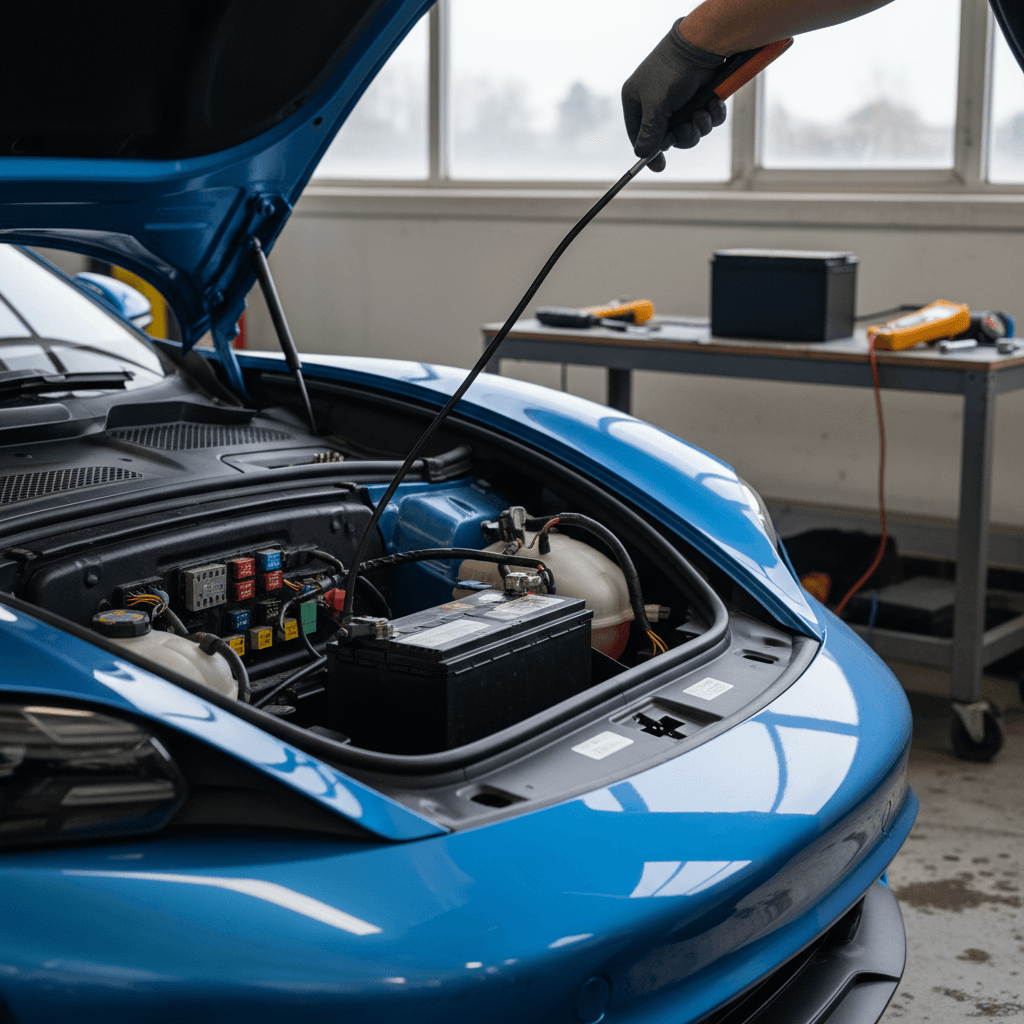
On most Taycan variants, the 12V battery is mounted under the front trunk (frunk) trim, on the passenger side. To access it, you typically:
- Open the frunk using the interior release or key fob.
- Remove the plastic trim panels and storage tray to expose the battery cover.
- Remove additional covers or braces that secure the battery in place.
There are also jump/charging posts under the frunk that can be used to supply 12V power if the battery is too low to open or wake the car normally.
Lithium vs AGM: what your Taycan uses
Porsche has used both lithium‑ion 12V batteries and traditional AGM (Absorbent Glass Mat) units on different Taycan trims and model years. The lithium pack is lighter and more efficient, but it’s also much more expensive to replace and more sensitive to incorrect handling.
Before you assume a quick $200 parts‑store fix, check your specific VIN’s parts catalog or ask a Porsche specialist which type your car uses, and whether there are any open 12V‑related service campaigns or recalls.
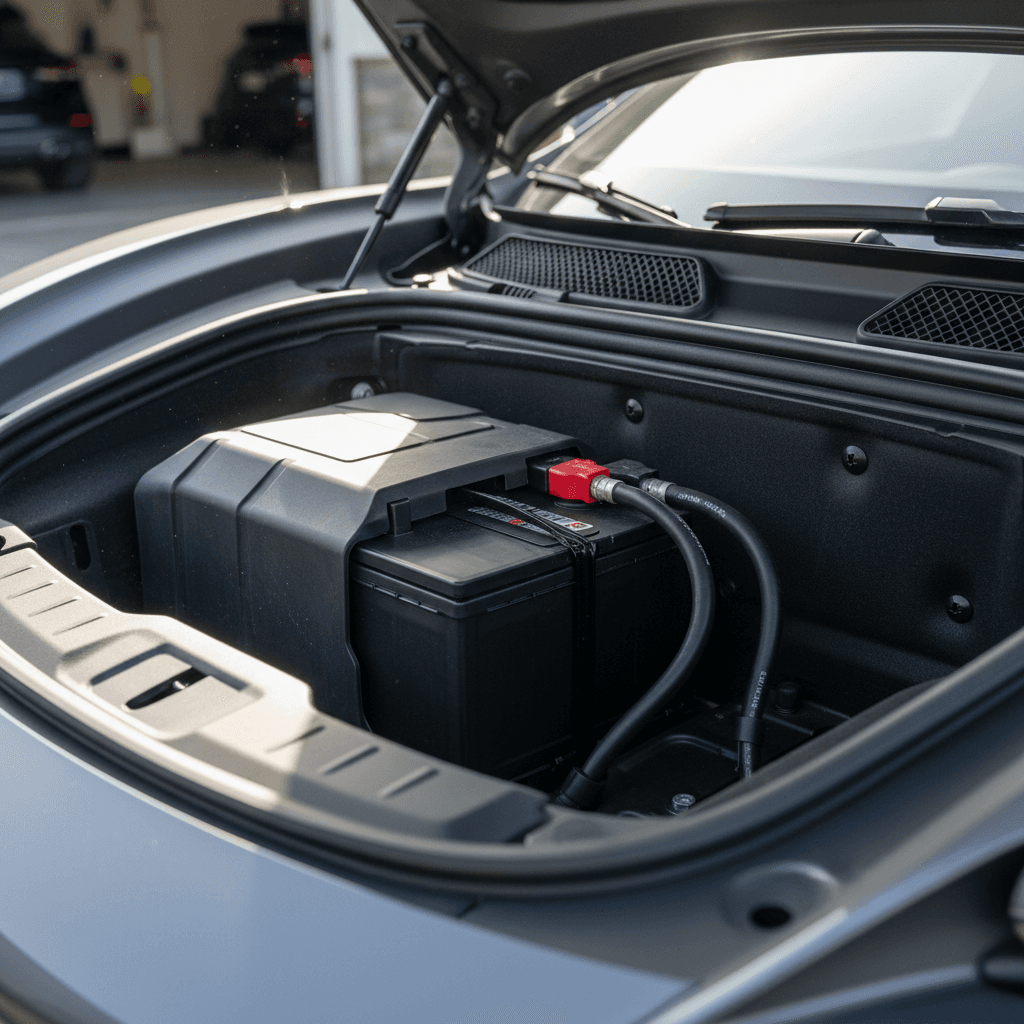
Battery type matters
Porsche Taycan 12V battery replacement costs
Typical Taycan 12V replacement cost ranges (United States)
Why the spread? It comes down to battery chemistry, where you live, and who does the work. A straightforward AGM swap at an independent shop that’s comfortable with EVs can look almost like any other luxury‑car 12V job. A lithium pack at a Porsche dealer, especially if diagnostic time, software updates, and storage fees are involved, can quickly climb into four‑figure territory.
Is it ever covered under warranty?
Can you DIY a Taycan 12V battery replacement?
Mechanically, swapping a Taycan 12V battery isn’t wildly more complex than on other vehicles: you’re still loosening terminals, removing a hold‑down, and lifting out a heavy box. But on the Taycan, the stakes and procedures are very different because that little battery is tied into a high‑voltage architecture with strict safety logic and fault monitoring.
DIY vs professional Taycan 12V battery replacement
How a weekend‑mechanic battery swap compares to having a Porsche dealer or EV specialist do the job.
| Factor | DIY at home | Porsche dealer / EV specialist |
|---|---|---|
| Parts cost | Potentially lower (if you source OEM‑equivalent correctly) | Higher, but guaranteed correct latest‑revision part |
| Tools needed | Basic hand tools, torque wrench, memory saver, safety gear | OEM tools, battery support equipment, Porsche diagnostic software |
| System knowledge | You’ll be relying on forum posts and service PDFs | Techs follow factory procedures and test plans |
| Fault clearing & software | You may not be able to clear stored 12V fault codes or perform required adaptations | Dealer can update software, clear codes, and verify DC‑DC operation |
| Risk profile | Higher risk of improper shutdown/startup, short circuits, or lingering faults | Lower risk, but at a higher labor rate |
| Impact on goodwill/warranty | Dealer may scrutinize previous DIY work if related issues appear later | Service history is clean and fully documented |
If you’re not already comfortable with high‑end German vehicles and EV safety protocols, this is a job to hand off.
Why dealers warn against DIY 12V swaps
If you’re an experienced DIYer who understands EV safety and has access to proper service information, a careful 12V swap is possible. But for most owners, especially if your car is still under any factory or CPO coverage, having a dealer or trusted EV specialist handle the job is the lower‑risk path.
High‑level Taycan 12V replacement process (what the shop does)
You don’t need the full workshop manual to be an informed customer. Here’s the typical high‑level flow a Porsche dealer or EV‑savvy shop will follow when replacing a Taycan 12V battery.
Typical professional 12V replacement workflow
1. Verify the complaint and test the battery
The tech confirms warning messages, checks resting voltage, and performs a load test. They’ll also scan for stored fault codes that might point to the DC‑DC converter or other components instead of the battery itself.
2. Safely shut down and secure the vehicle
The Taycan is put into a defined safe state. Doors and frunk are left open, key is removed from the area, and the high‑voltage system is left undisturbed, this is about managing the low‑voltage side without waking other systems unnecessarily.
3. Access the 12V battery under the frunk
Trim panels, covers, and any supports over the 12V bay are removed. On some cars, this is straightforward; on others, there may be braces and ducts that add time to the job.
4. Disconnect and remove the old battery
The negative terminal is disconnected first, then the positive, following Porsche’s order of operations. The hold‑down and any sensors or vent lines are detached, and the battery is carefully lifted out.
5. Install, secure, and reconnect the new battery
The replacement 12V is installed, torqued to spec, and reconnected in the reverse order (positive first, then negative). Any sensors, temperature probes, or monitoring leads are reattached exactly as before.
6. Clear faults and verify charging behavior
Using Porsche diagnostics, the tech clears any stored 12V‑related codes, checks that the DC‑DC converter is charging the new battery properly, and confirms that all systems boot without new warnings.
How to extend your Taycan 12V battery life
You can’t make a 12V battery last forever, but you can avoid the kind of abuse that shortens its life or leaves you stranded at the worst possible moment. Think of it as low‑cost insurance on a high‑dollar EV.
Practical ways to treat your Taycan’s 12V kindly
Small habits that can save you from big 12V bills
Avoid long idle periods
If you don’t drive your Taycan for weeks at a time, schedule regular pre‑conditioning or a short drive so the DC‑DC converter can recharge the 12V system.
Mind extreme temperatures
Batteries hate heat and extreme cold. Whenever possible, park in a garage or shaded area and avoid leaving the Taycan fully powered for long stretches in high heat.
Use a quality maintainer when stored
If you’re storing the car and have access to AC power, talk to a Porsche‑savvy shop about whether a compatible 12V maintainer on the under‑frunk posts makes sense for your usage.
Respond to early warnings
Don’t ignore recurring 12V or electrical system messages. Addressing a weak battery early is cheaper than dealing with a dead car plus a tow and rush diagnostics.
Keep software up to date
Some early Taycan 12V quirks have been improved via software updates. Keeping your car current can help ensure the 12V is charged correctly from the main pack.
Have health checked before long trips
Before a major road trip, ask your shop to test the 12V battery and charging system, especially if it’s more than a few years old.
12V battery checklist for used Taycan buyers
If you’re shopping for a used Taycan, the 12V system is one of those small‑line items that can have outsized impact on your first months of ownership. Here’s how to factor it into your decision.
Used Taycan 12V due‑diligence list
1. Ask about 12V replacement history
Has the auxiliary battery been replaced before? At what mileage and by whom? A documented replacement in the last 1–2 years can be a positive sign rather than a red flag.
2. Check for stored or recent 12V‑related warnings
Scan the car for codes or ask for a printout. Repeated low‑voltage or DC‑DC‑related faults suggest the 12V system may need attention soon.
3. Look at usage patterns
Cars that sit for long stretches or only do very short trips are more likely to have stressed the 12V system. A Taycan that’s been driven regularly and charged sensibly is usually a better bet.
4. Have the 12V battery tested
As part of a pre‑purchase inspection, have a shop check resting voltage, load performance, and the health of the DC‑DC converter. Treat a borderline battery as a near‑term maintenance item in your budget.
5. Build 12V replacement into your cost model
If the battery is original or clearly near end of life, assume you’ll replace it within your ownership horizon. Factor $1,000+ into your mental budget if it’s a lithium pack at dealer rates.
6. Use objective reporting
A <strong>Recharged Score Report</strong> on a used Taycan includes verified battery health, error history, and fair‑market pricing, so you can see 12V‑related patterns and negotiate from facts rather than guesses.
FAQ: Porsche Taycan 12V battery replacement
Frequently asked questions about Taycan 12V batteries
Bottom line on Taycan 12V battery replacement
The Porsche Taycan is one of the most compelling EVs on the road, but its 12V battery is a small part with outsized influence on day‑to‑day reliability. Knowing how the low‑voltage system works, what real‑world replacement costs look like, and when DIY stops being worth the risk can save you thousands of dollars and a lot of frustration.
If you’re already an owner, treat the 12V warnings as early‑warning signals rather than background noise, and plan for replacement on a 4–6‑year horizon. If you’re shopping used, bake a potential 12V job into your budget and insist on objective reporting rather than assurances. On Recharged, every used Taycan comes with a Recharged Score Report, EV‑specialist support, and transparent pricing, so a dead 12V battery becomes a manageable maintenance line item, not a deal‑breaking mystery.