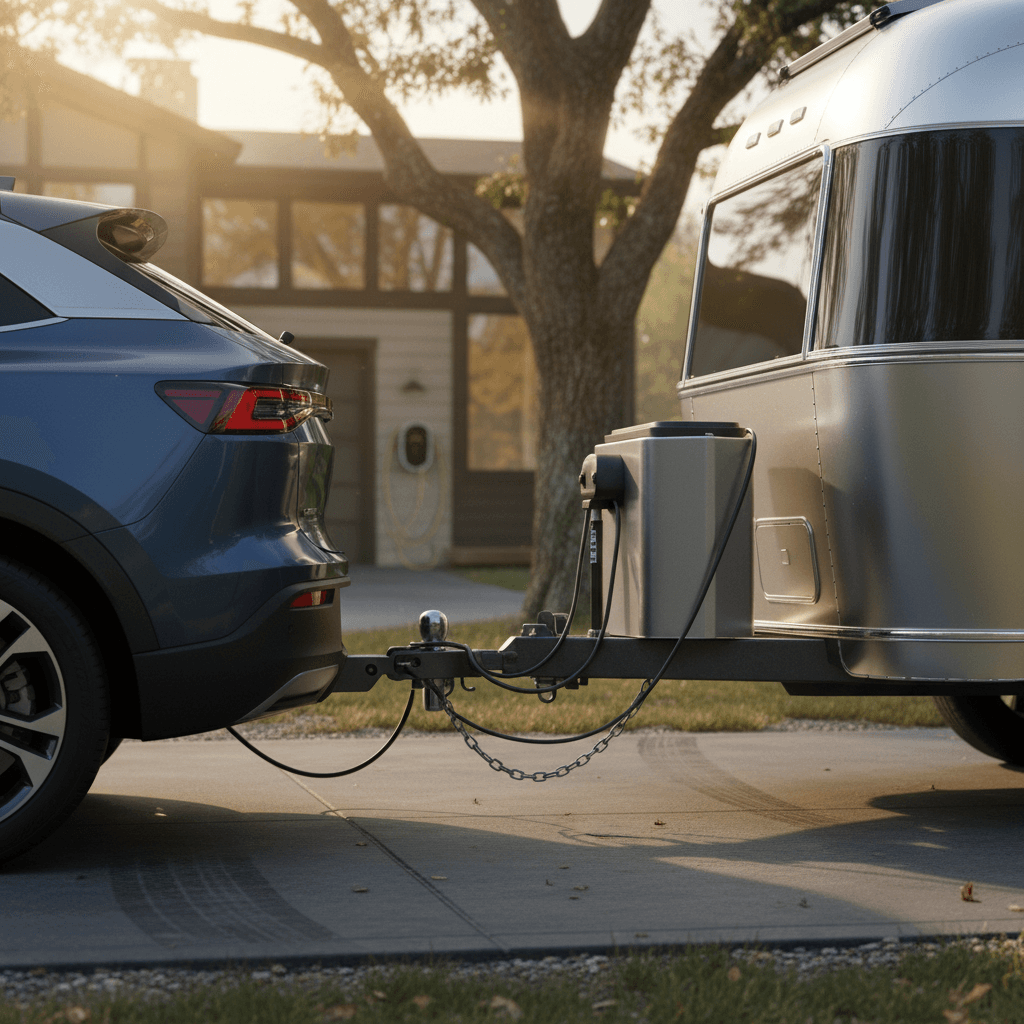
You bought an electric car for the quiet, instant torque and low running costs. Now you’re wondering if it can pull a small camper, a utility trailer, or even just a bike rack, and what electric car towing hitch options actually exist. The good news: more EVs than ever are tow-rated, and high-quality hitch options are finally catching up. The bad news: you can’t treat an EV like a gas truck and hope for the best.
Quick takeaway
Why towing with an electric car is different
On paper, EVs seem perfect for towing: instant torque, heavy curb weights, and fine control at low speeds. The catch is the battery. When you hang a trailer off the back of a car that moves on electricity alone, every extra pound and every square foot of trailer frontal area shows up directly as higher energy consumption and shorter range.
Where EVs shine when towing
- Instant torque: Pulling away on an incline or backing a trailer is smoother and more controlled.
- Low center of gravity: The battery pack helps stability when a trailer starts to wiggle.
- One‑pedal control: Regenerative braking can help manage speed on descents, taking some load off the friction brakes.
Where EVs struggle when towing
- Range loss: Real‑world road tests show towing can slash range by roughly 50% compared with solo driving.
- Charging logistics: With a trailer attached, many fast‑chargers are simply hard to access or require unhitching.
- Heat management: Long grades at highway speeds can push motors and batteries toward their thermal limits faster.
Don’t assume your EV can tow
Common electric car towing hitch options
Once you’ve confirmed your EV is tow‑rated, you’ll find familiar hardware, but with a few EV‑specific wrinkles. Broadly, electric car towing hitch options fall into a handful of classes and styles that dictate what you can safely pull and how the vehicle looks when unhitched.
Popular hitch classes on electric cars and SUVs
From bike racks to small campers, your hitch class sets the ceiling.
Class I (up to ~2,000 lbs)
Found on smaller EV hatchbacks and compact crossovers. Good for:
- Light utility trailers
- 1–2 e‑bikes on a rack
- Cargo carriers
Often limited by low tongue weight, think ~200 lbs on the ball.
Class II (up to ~3,500 lbs)
Common on compact and midsize electric SUVs like the Tesla Model Y and similar crossovers.
- Small campers and teardrop trailers
- Single‑axle utility or landscape trailers
- Larger bike racks and cargo trays
Class III and above (5,000+ lbs)
Reserved for heavier vehicles such as Rivian R1T/R1S, Tesla Model X, and electric pickups.
- Boat and car haulers
- Mid‑size travel trailers
- Toy haulers and work trailers
- Fixed (visible) receiver: Traditional square receiver always visible under the bumper. Most common and robust; great for frequent towing.
- Detachable/removable hitch: Receiver tube or towball neck can be removed when you’re not towing, preserving aero and aesthetics.
- Retractable hitch: Available on some premium European EVs; swings or powers out from behind the bumper when needed.
- Accessory‑only hitch: Rated only for bike racks or cargo, not for pulling a trailer. Easy to mistake for a tow hitch, check the rating label.
Look for wiring and brake support
Factory vs. aftermarket EV hitches
You’ll usually have two ways to add a hitch to your electric car: order it from the factory or dealer, or bolt on a third‑party aftermarket receiver. Both can be safe and effective, if you understand the tradeoffs.
Factory vs. aftermarket towing hitch options for EVs
How OEM and third‑party hitches compare for electric cars and SUVs.
| Option | Pros for EV owners | Watch‑outs |
|---|---|---|
| Factory/OEM tow package | Designed around the EV’s cooling, structure and software; often includes upgraded wiring, bigger cooling loops, and a dedicated towing mode. Clean integration with parking sensors and driver assists. | Usually more expensive; may be hard to retrofit later. On some trims, bundled with wheels or features you don’t want. |
| Dealer‑installed OEM kit | Same hardware as factory in many cases, added later. Keeps documentation tidy for warranty and resale. | Quality varies with installer. Some dealers will not retrofit kits to trims that weren’t tow‑rated from the factory. |
| Aftermarket hitch (hidden/stealth) | Less expensive, often available sooner than OEM. Hidden designs keep only the receiver exposed, preserving aero and looks. | Many are accessory‑rated only. You must still obey the vehicle’s tow rating, and poorly installed hardware can cause sensor errors or warranty debates. |
| Aftermarket wiring & brake controller | Lets you add 7‑pin wiring, brake controller functions, and more flexible trailer options. | Incorrect wiring on a high‑voltage platform is a bad adventure. Choose an installer who understands EVs; never splice blindly into unknown circuits. |
Factory hitches typically integrate more cleanly and preserve warranty clarity, while quality aftermarket options can add versatility or lower cost.
Never tow beyond the vehicle’s rating
Understanding EV towing ratings, tongue weight, and payload
Towing with an electric car is a three‑number game: maximum trailer weight, tongue weight, and payload. Get any of them wrong and you’re the proud owner of a very heavy, very overloaded science experiment.
Key weight numbers for safe EV towing
Your EV’s owner’s manual and door‑jamb sticker list the gross vehicle weight rating (GVWR) and gross combined weight rating (GCWR). The difference between those, minus your passengers and gear, is the room you have left for trailer weight and tongue weight. For most electric crossovers, that works out to a small camper or single‑axle utility trailer, not a 30‑foot travel trailer.
Do this quick driveway calculation
- Weight of all passengers
- Estimated cargo in the car (coolers, tools, luggage)
- Estimated tongue weight (about 10–15% of loaded trailer weight)
How towing affects your EV range in the real world
Here’s where expectations collide with physics. An electric SUV that comfortably does 260–300 miles on the highway solo might only manage 120–160 miles with a boxy camper in tow. Independent road tests with models like the Audi e‑tron and Rivian R1T consistently show range drops of roughly 40–50% when towing near their maximum rating in real conditions, cold weather, hills, and highway speeds.
What that looks like on the road
- Unhitched, a 300‑mile EV might cruise at 2.7–3.0 mi/kWh.
- With a 4,000 lb trailer, efficiency can fall to around 1.2–1.5 mi/kWh.
- That same 300‑mile truck suddenly has a usable towing range closer to 130–160 miles between charges.
Planning around the hit
- Assume you’ll lose about half your rated range while towing.
- Plan charging stops every 80–120 miles, not every 250–300.
- Stick to 55–60 mph where possible; aero drag is brutal at higher speeds.
- Choose campgrounds and routes with trailer‑friendly chargers or pull‑through parking.
Charging with a trailer is its own puzzle
Matching hitch options to popular electric cars and SUVs
Different EVs approach towing very differently. Some arrive with serious tow packages and cooling upgrades; others allow only bike racks. Here’s how hitch options generally line up with popular models you’ll see on the used market.
Typical hitch and towing patterns on common EVs
Always confirm exact ratings for your model year and trim, but these trends are a useful starting point.
| EV type (examples) | Typical factory hitch option | Typical max trailer rating* | Good use cases |
|---|---|---|---|
| Compact EV hatchbacks (Chevy Bolt EV/EUV, Nissan Leaf, Hyundai Kona Electric) | Often no North American tow rating. Aftermarket Class I/II receivers usually rated for bikes/cargo only. | 0–2,000 lbs (often trailer towing not recommended). | Bike racks, small cargo carriers. In Europe some trims tow light trailers; in the U.S., assume accessories only unless manual says otherwise. |
| Compact/midsize electric SUVs (Tesla Model Y, VW ID.4, Hyundai Ioniq 5/6, Kia EV6) | Factory tow packages usually Class II receivers with integrated wiring; many also support aftermarket hidden hitches. | ~2,000–3,500 lbs when tow‑rated. | Small campers, jet skis, single‑axle utility trailers, multiple bikes or a large cargo rack. |
| Premium electric SUVs (Audi Q8 e‑tron, Genesis Electrified GV70, Mercedes EQE SUV) | Tow packages often optional; some include retractable or detachable hitches from the factory. | ~3,000–4,000 lbs. | Boat trailers, medium camping trailers, small car haulers with light loads. |
| Electric trucks and big SUVs (Rivian R1T/R1S, Tesla Model X, Ford F‑150 Lightning, Chevy Silverado EV) | Factory‑engineered heavy‑duty hitches, often Class III or higher, with robust cooling and trailer modes. | ~5,000–11,000+ lbs depending on model and configuration. | Serious towing: midsize campers, larger boats, enclosed trailers, off‑road campers. Range management becomes the limiting factor, not power. |
Tow ratings and hitch availability can change year to year, check your specific VIN and manual before you buy hardware or a trailer.
If you’re evaluating a used EV specifically for towing, ask sellers to provide build sheets or window stickers that confirm the tow package. At Recharged, every vehicle comes with a Recharged Score Report, and our specialists can walk you through which used EVs on the site are realistically suited to your trailer and how much range you should expect when hitched.
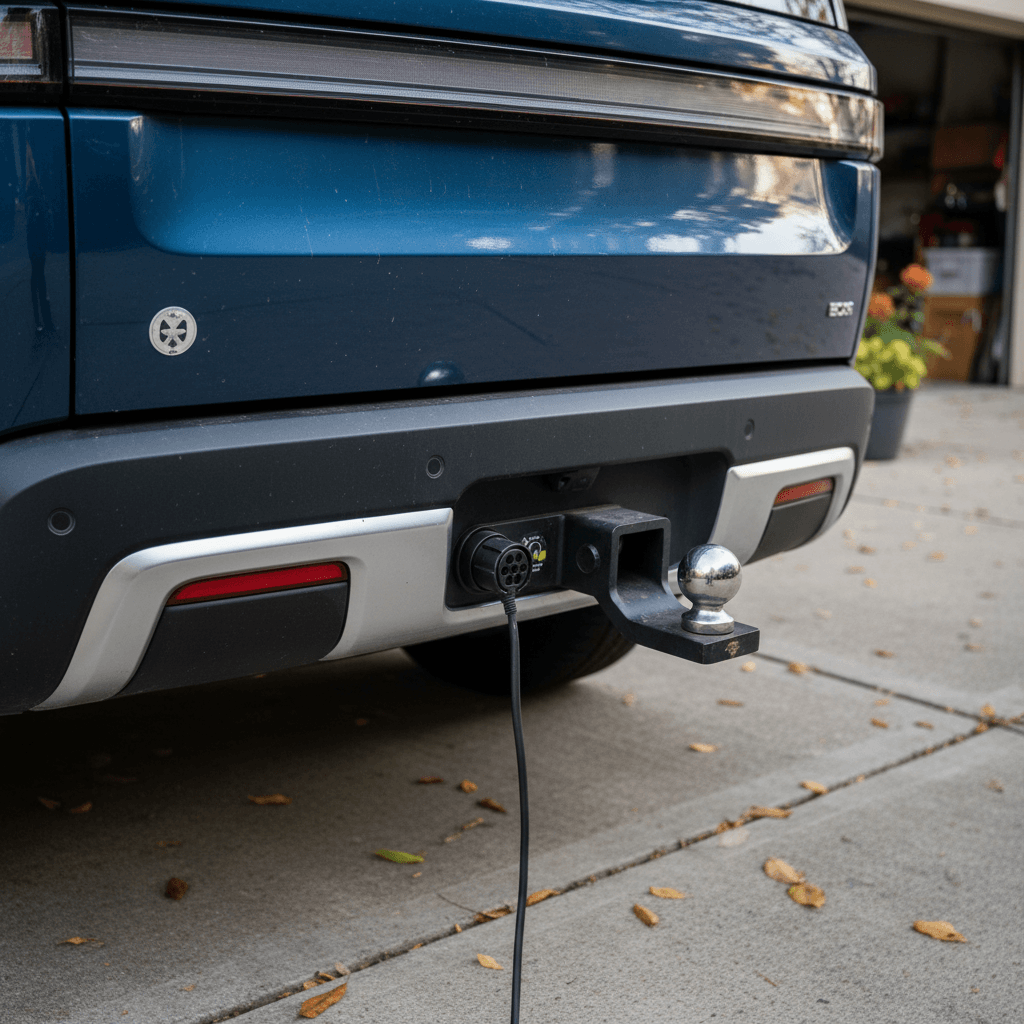
Installation, safety, and warranty considerations
You can absolutely DIY a hitch on some EVs. You can also absolutely drill into a high‑strength rear subframe, upset parking sensors, and earn yourself a nasty conversation at the service desk. The structure and electronics on modern EVs are less forgiving than the old body‑on‑frame pickups you might be used to.
Key questions before you install a hitch on your EV
Is the car officially tow‑rated in your market?
If your VIN or owner’s manual doesn’t show a towing capacity, treat that as a hard stop. Some EVs can physically tow but lack the cooling, software, or certification to do it safely.
Will the hitch interfere with sensors?
Rear parking sensors, cross‑traffic radar, and even power liftgates can misbehave if a hitch or bike rack sits where the car expects clear air. Well‑designed kits account for this; bargain‑bin hardware usually doesn’t.
Who’s doing the wiring?
Trailer wiring taps into sensitive circuits. A shop experienced with EVs will use dedicated wiring modules and respect the car’s battery management system; a generic splice job can trigger warning lights or worse.
What does your warranty say?
Factory tow packages are the cleanest from a warranty standpoint. A quality aftermarket setup, installed correctly, is usually fine, but a failure clearly linked to non‑approved hardware can complicate coverage.
How Recharged can help
Pre‑trip EV towing setup checklist
Once the hardware is sorted, the last step is making sure your EV, trailer, and route are ready for each other. Think of it as pre‑flight for electrons.
Essential EV towing checklist
1. Verify weights and ratings
Confirm the trailer’s actual loaded weight (not just the brochure number) and compare it with your EV’s max trailer, tongue, and payload ratings. Stay comfortably below the limits.
2. Set tire pressures for load
Inflate both car and trailer tires to the recommended pressures for towing. Under‑inflated tires add rolling resistance and heat, which an EV really doesn’t need more of.
3. Dial in hitch height and sway control
Use a properly sized ball mount so the trailer rides level, and consider a weight‑distribution or sway‑control hitch for longer, taller trailers, if your EV and hitch are rated for one.
4. Test lights and brakes
Check running lights, turn signals, and brake lights. If your trailer has electric brakes, verify the controller settings before you’re on a downhill grade wondering why the trailer feels pushy.
5. Choose EV‑friendly charging stops
Use apps to find DC fast‑chargers with easy trailer access, pull‑through spots, outer edges of lots, or chargers near wide drive lanes. Campgrounds with Level 2 charging can be a smart overnight anchor.
6. Drive a shakedown loop
Before a big trip, do a short local drive. Listen for clunks, check for sway at 45–55 mph, and watch energy consumption so you’re not surprised by the range hit later.
When an electric tow vehicle makes sense (and when it doesn’t)
EV evangelists will tell you an electric pickup can replace your diesel dually tomorrow; skeptics will say you can’t tow anything meaningful with electrons. As usual, the truth lives in the dull middle. For the right use cases, an EV tow vehicle is brilliant. For others, it’s an exercise in patience and route‑planning.
Great uses for EV towing
- Weekend toys close to home: Jet skis, side‑by‑sides, or small campers within 100 miles of home.
- Occasional utility work: Hauling mulch, appliances, or building materials a few times a year.
- Bike and cargo duty: Even non‑tow‑rated EVs can often carry racks and cargo carriers when the hitch is accessory‑only.
- Low‑altitude, moderate‑speed routes: Flat to rolling terrain where you can cruise at 55–60 mph.
Where a gas or diesel still wins
- Cross‑country RV trips: Long, fast interstate days with a big trailer are still the ICE truck’s home field.
- Heavy commercial use: Daily towing near the top of the rating, especially in hot climates or over mountains.
- Remote areas with sparse charging: If the charging map looks like a weather radar on a clear day, think twice.
- Huge wind‑catchers: Tall toy haulers and full‑profile travel trailers magnify aero losses.
Electric car towing hitch FAQ
Frequently asked questions about electric car towing hitches
The bottom line on electric car towing hitches
Towing with an electric car is entirely doable, as long as you respect the numbers and choose your hardware with the same care you put into picking the trailer. The right combination of a factory or well‑engineered aftermarket hitch, conservative weight limits, and realistic range expectations can turn your EV into a capable weekend tow rig without turning every trip into a math exam.
If you’re starting from scratch, it can be easier to work backwards from the trailer you want, then shop for a tow‑rated EV that fits the bill. That’s where a used‑focused marketplace like Recharged earns its keep: you can compare real‑world tow ratings, battery health via the Recharged Score, and financing or trade‑in options in one place. Do the hitch and homework once, and your EV can spend the rest of its life doing what it does best, moving quietly and efficiently, with just a bit more adventure in tow.