If you’re looking at a Polestar 2, new or used, the big question is often the battery. The good news is that the Polestar 2 battery warranty is competitive with other premium EVs, and it’s designed to protect you against both outright defects and severe capacity loss. This guide breaks down exactly what the Polestar 2 battery warranty covers, how long it lasts, what can void it, and what that all means if you’re shopping the used market.
Quick facts: Polestar 2 battery warranty (U.S.)
Polestar 2 battery warranty overview
Polestar splits its coverage into a few different buckets, but from a battery perspective you’ll mostly care about the high-voltage battery warranty on the traction pack under the floor. For most U.S. buyers, that coverage runs 8 years or 100,000 miles (whichever comes first) and protects you if the pack has a manufacturing defect or loses more capacity than Polestar considers acceptable during that time.
Key Polestar 2 U.S. warranty terms at a glance
Exact wording varies slightly by model year and region, but if you bought a U.S.-spec Polestar 2 from model years 2021–2025, you’re generally looking at that same 8‑year/100k‑mile high‑voltage battery coverage paired with a 4‑year/50k‑mile basic warranty on the rest of the car.
How long the Polestar 2 battery warranty lasts
Polestar distinguishes between the basic “new vehicle” warranty and the longer high‑voltage battery coverage. Here’s how the timing usually works in the U.S.:
Typical Polestar 2 warranty timelines (U.S., high level)
High-level view of how long different pieces of coverage last for a new Polestar 2, starting from the in‑service date (when the car is first sold or leased).
| Coverage type | Term (time) | Term (mileage) | What starts the clock? |
|---|---|---|---|
| New Vehicle Limited Warranty | 4 years | 50,000 miles | In‑service date (first sale/lease) |
| High‑Voltage Battery & Drive Units | 8 years | 100,000 miles | In‑service date |
| California HV Battery (CARB states, select trims) | Up to 10 years | Up to 150,000 miles | In‑service date, CARB-eligible vehicles only |
| Corrosion / Rust-Through | 12 years | Unlimited miles | In‑service date |
Always confirm your specific warranty booklet; rules can change by model year and state.
Watch the in‑service date, not just model year
If you’re buying a used Polestar 2, ask for documentation showing the original in‑service date. That’s essential for understanding how much of the 8‑year battery warranty remains and whether the basic 4‑year/50k‑mile coverage is still active.
What the Polestar 2 battery warranty actually covers
The high‑voltage (HV) battery warranty is focused on defects in materials or workmanship and on protecting you from extreme battery degradation. For most owners, the practical benefits break down into three buckets.
Core protections in the Polestar 2 battery warranty
What you can reasonably expect if something goes wrong with the traction battery
1. Manufacturing defects
If a cell, module, or other HV battery component fails early due to a factory defect, Polestar should diagnose and repair or replace the pack under warranty, parts and labor included.
2. Excessive capacity loss
Polestar typically guarantees that the battery will retain at least around 70% of its original usable capacity during the 8‑year/100k‑mile period. Dropping below that threshold can trigger repair or replacement.
3. Drive-unit related coverage
Polestar bundles the electric drive units with the HV system coverage in many booklets. If a failure is tied to the high‑voltage system or e‑motors, it often falls under the same 8‑year/100k‑mile umbrella.
In practical terms, if your Polestar 2 suddenly loses a large chunk of range due to an internal battery fault, or a dealer’s diagnostic shows capacity below the stated threshold during the warranty term, Polestar is on the hook to fix it. You’re not expected to pay out of pocket for a new pack because of an early‑life defect.
What isn’t covered: battery warranty exclusions and fine print
Like every EV maker, Polestar draws a line between normal wear and warranty-eligible problems. The battery warranty isn’t a blank check for anything that ever happens to your pack. Common exclusions include:
- Normal, gradual capacity loss that stays above the stated threshold (around 70% of original usable capacity).
- Damage from accidents, flooding, fire, or other external events.
- Damage caused by unauthorized modifications, tampering, or non‑approved repairs to the battery or high‑voltage system.
- Improper use of the vehicle or charging system, such as repeatedly ignoring critical warning messages or using severely out‑of‑spec chargers or adapters.
- Neglecting required maintenance or ignoring serious system warnings for an extended period.
Warranty ≠ insurance policy
Polestar can also void portions of the warranty if the vehicle has a branded or salvage title, or if unsafe modifications were made to the high‑voltage system. If you’re looking at a steeply discounted used Polestar 2, it’s worth running a title check and asking whether any aftermarket work has been done to the traction battery or inverter.
California and emissions-state battery rules
If you live in California or another CARB-aligned state, you may get more generous battery protection than the standard 8‑year/100k‑mile coverage. That’s because California classifies EV traction batteries as emissions-related components, and mandates longer coverage on some models.
For many EVs, including Polestar 2 trims that qualify as Partial Zero Emission Vehicles (PZEV) equivalents, that can mean coverage up to 10 years or 150,000 miles on the high‑voltage battery. The specifics depend on your model year and how Polestar certifies the vehicle in your state, so it’s important to confirm with your local Polestar documentation or dealer.
Check your state’s rules
How the Polestar 2 battery warranty works for second owners
The Polestar 2 battery warranty is designed to be fully transferable. If you buy the car used, whether from a Polestar retailer, another dealer, or a private seller, you inherit whatever remains of the original coverage as of the sale date.
What second owners can expect
Battery warranty benefits don’t disappear when the car is sold
Full transfer of remaining term
As long as the warranty hasn’t been voided (for example, by a branded title), the remaining years and miles of the original high‑voltage battery coverage transfer to the new owner automatically.
Extra peace of mind from certified used
Some Polestar-approved used programs add their own limited warranties on top of the factory coverage. That doesn’t extend the battery term itself, but it can cover other components once the 4‑year/50k‑mile basic warranty expires.
How Recharged helps used buyers
Ready to find your next EV?
Browse VehiclesHow to check remaining battery warranty on a used Polestar 2
If you’re evaluating a used Polestar 2, a little homework upfront can save a lot of uncertainty later. Here’s a straightforward way to estimate how much battery warranty is left.
Used Polestar 2 battery warranty checklist
1. Find the in‑service date
Ask for the original sales paperwork or a warranty printout from a Polestar service center. This date, not the build date or model year, starts the 8‑year clock.
2. Record the current mileage
Compare odometer reading against the <strong>100,000‑mile</strong> HV battery limit. The earlier of time or mileage will end coverage.
3. Confirm the title status
Run a vehicle history report to ensure the car hasn’t been branded as salvage, fire, or flood. Branded titles can partially or fully void warranty coverage.
4. Read the warranty booklet for that model year
Polestar’s language can change slightly between years. Look for the section titled “High‑Voltage Battery Warranty” and any state‑specific addendums.
5. Ask for a recent battery health report
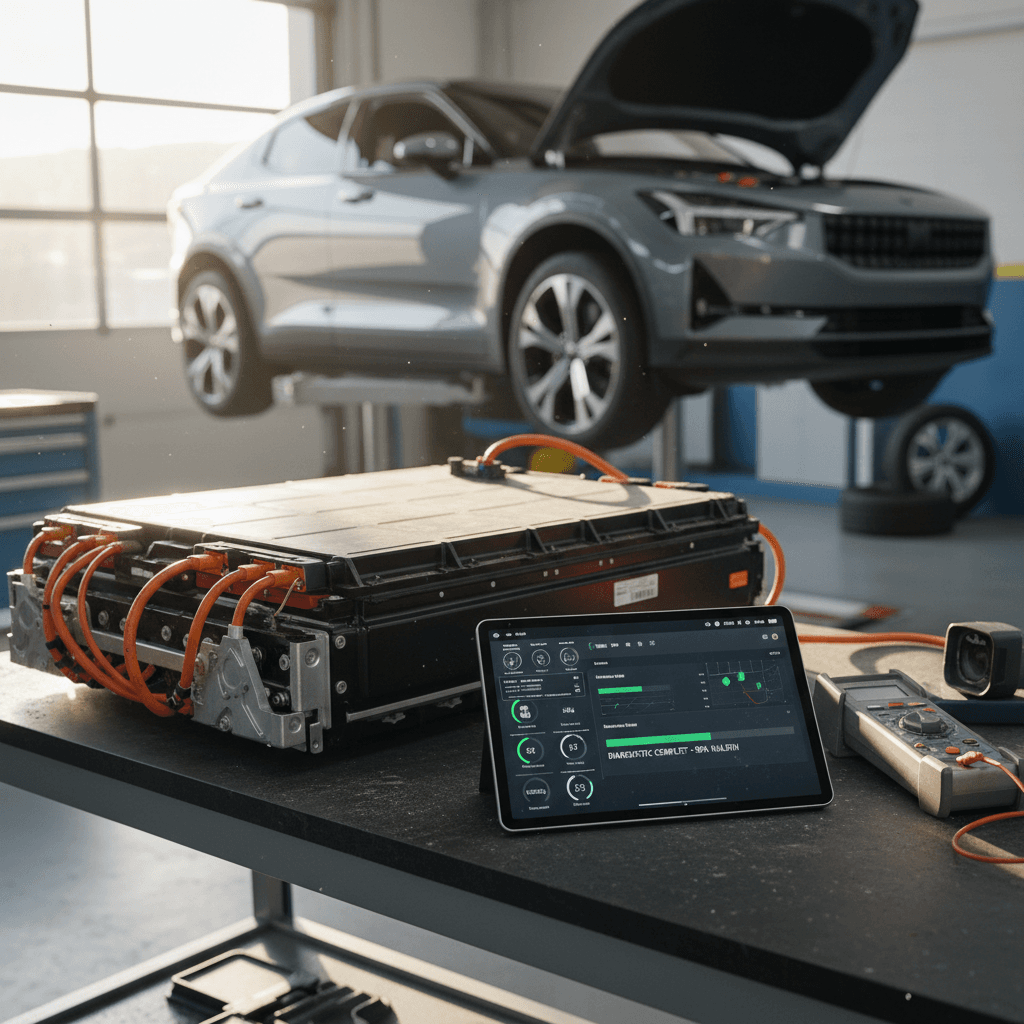
A dealer or specialist can often pull a State of Health (SoH) reading. On Recharged, this data is summarized in the <strong>Recharged Score battery report</strong> so you can see how healthy the pack is relative to age and miles.
6. Verify service history
Consistent, documented service, at least at the recommended intervals, helps if you ever need to make a warranty claim, and it can reveal whether any HV work has already been done.
Real-world Polestar 2 battery degradation vs. the warranty threshold
On paper, the Polestar 2’s battery warranty steps in if capacity drops below roughly 70% of original usable capacity within the term. In reality, most owners are seeing much milder degradation in the first years of ownership, especially on the updated packs.
What the warranty promises
- Protection against early-life battery failures and extreme capacity loss.
- A floor of around 70% usable capacity over 8 years / 100k miles.
- Repair or replacement if diagnostics confirm excessive degradation under normal use.
What owners typically experience
- Single‑digit percentage loss after several years and tens of thousands of miles, assuming reasonable charging habits.
- Gradual range changes that are noticeable but not dramatic for most daily driving.
- Very few documented cases of full pack replacement solely due to degradation within the warranty period.
Warranty threshold is a worst-case line, not a forecast
How the Polestar 2 battery warranty compares to other EVs
From a high level, the Polestar 2’s battery warranty lines up well with other premium EVs on the U.S. market. Here’s how it typically stacks up against some familiar benchmarks:
Polestar 2 vs. typical EV battery warranties
Approximate U.S. high‑voltage battery warranty terms for mainstream EVs. Always check each OEM’s latest documentation.
| Brand / Model | Typical HV battery term | Degradation threshold | Notes |
|---|---|---|---|
| Polestar 2 | 8 years / 100,000 miles | ≈70% capacity | Competitive with other premium EVs; some states extend term. |
| Tesla Model 3 / Model Y | 8 years / 100,000–120,000 miles | 70% capacity | Slightly higher mileage limit on some trims. |
| Hyundai / Kia EVs | 10 years / 100,000 miles | Usually 70% capacity | Longer time term, similar mileage. |
| Volkswagen ID.4 | 8 years / 100,000 miles | 70% capacity | Similar to Polestar baseline. |
| Nissan Ariya / Leaf (newer) | 8 years / 100,000 miles | ~66–70% capacity | One of the earlier EV battery guarantees; now industry standard. |
Comparison is meant as a general guide; exact coverage can vary by model year, trim, and state.
Where Polestar really competes is less about the headline numbers and more about pack design and thermal management. A well‑cooled, modern lithium‑ion pack with an 8‑year/100k‑mile guarantee is a strong combination, especially if your daily driving and charging habits are moderate rather than extreme.
Tips to protect your battery, and keep the warranty hassle-free
You don’t have to baby a Polestar 2 to stay within warranty expectations. The car’s software and thermal management already do a lot behind the scenes. But a few simple habits can protect range, keep degradation slow, and make any future warranty conversation easier.
Smart habits for a long‑lived Polestar 2 battery
1. Use moderate charge limits for daily driving
For everyday commuting, many owners set their charge limit around 70–80%. Save 90–100% charges for road trips where you truly need the extra range.
2. Avoid sitting at 0% or 100% for long periods
Letting the car sit fully empty or fully full for days in extreme temperatures is harder on the pack. If you hit 0%, recharge as soon as you reasonably can.
3. Keep software up to date
Polestar uses software updates to tune battery management and charging behavior. Installing updates as they arrive can help with longevity and performance.
4. Stick roughly to the recommended service schedule
Polestar’s 20,000‑mile / 2‑year service cadence includes checks of the high‑voltage system and thermal management. Skipping them can complicate future claims.
5. Use reputable chargers and adapters
Public DC fast chargers from major networks and UL‑listed home equipment are your friends. Avoid sketchy hardware that isn’t designed for modern EV loads.
6. Document issues early
If you notice sudden, sharp drops in range or repeated charging faults, get them checked while you’re clearly inside the 8‑year/100k‑mile window, and save the paperwork.
Don’t DIY high‑voltage work
FAQ: Polestar 2 battery warranty questions, answered
Common questions about the Polestar 2 battery warranty
Key takeaways for used Polestar 2 buyers
The Polestar 2’s battery warranty is about as strong as anything in its class: 8 years or 100,000 miles of protection against defects and severe capacity loss, with even longer coverage in some emissions states. For a used buyer, that means many early‑build cars still have meaningful battery coverage left, especially if they were first sold in 2022 or later and haven’t hit high mileage yet.
Your job is to verify the in‑service date, mileage, title status, and State of Health before you sign. That’s exactly what Recharged’s Recharged Score Report is built for: it pairs verified battery health data with transparent pricing and expert EV support so you know whether a specific Polestar 2 lines up with your range needs and risk tolerance. With the right homework, and a clear understanding of what the Polestar 2 battery warranty covers, you can shop the used market with a lot more confidence.