You’re not alone if you’re stuck between a plug‑in hybrid (PHEV) and a full battery‑electric vehicle (EV). On paper they can look similar: some electric range, a glossy EPA MPGe number, maybe even the same federal tax credit. But once you factor in purchase price, fuel or electricity, maintenance, and resale, the plug‑in hybrid vs electric total cost story gets more interesting, and more lopsided, than most window stickers let on.
PHEV vs EV in one sentence
How to think about plug‑in hybrid vs electric total cost
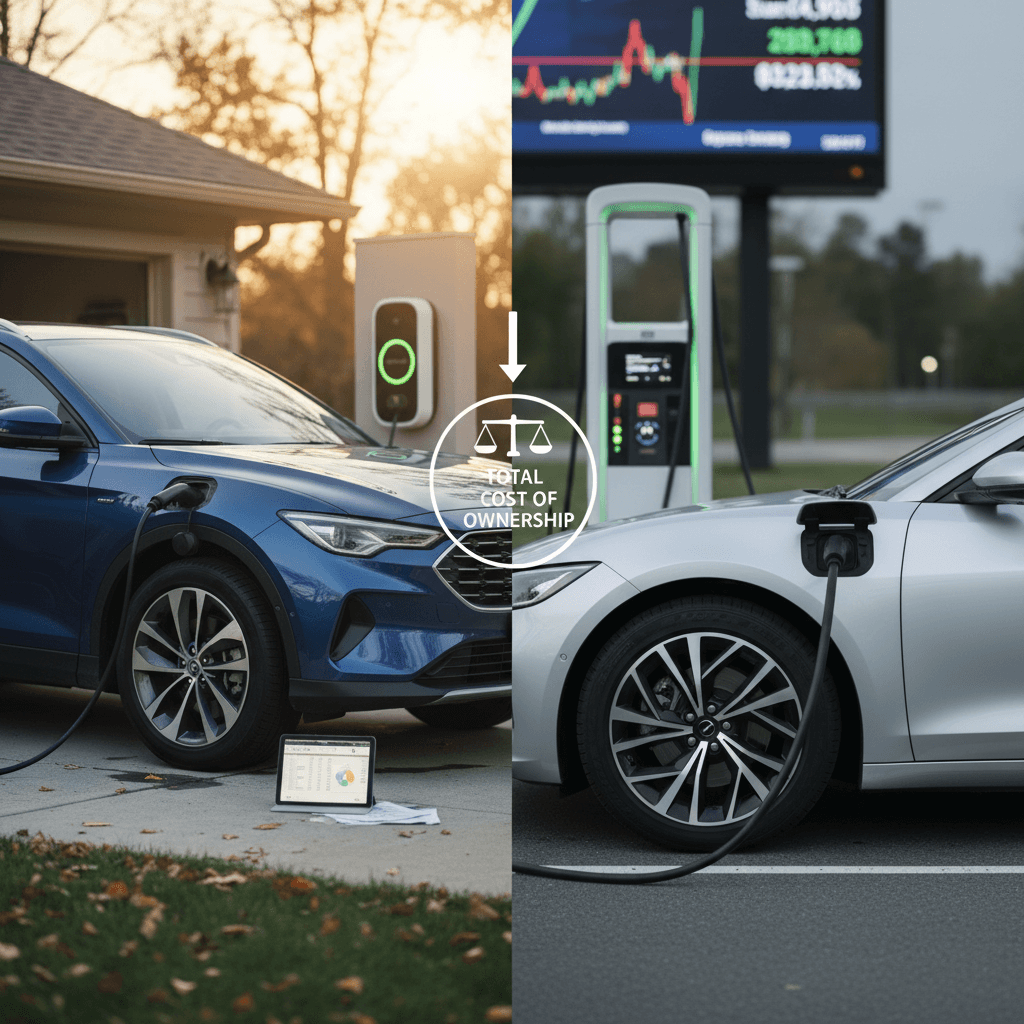
When people ask whether a plug‑in hybrid or an EV is “cheaper,” they usually mean total cost of ownership (TCO): everything you spend and get back over the time you own the vehicle. That means more than just the monthly payment. For a fair plug‑in hybrid vs electric total cost comparison, you have to look at:
- Upfront price, taxes, and finance charges
- Fuel or electricity costs over your miles and years
- Maintenance and repair, including the stuff you don’t see coming
- Insurance, registration, and emissions/inspection fees
- Resale value when you sell, trade, or get an instant offer
Once you lay it out this way, a pattern emerges: plug‑in hybrids tend to win on flexibility and short‑term comfort, while EVs usually win on long‑term cost, especially if you drive a lot or buy used.
What actually goes into total cost of ownership?
The five big levers of total cost
Every dollar you’ll spend (or save) lives in one of these buckets.
1. Purchase & financing
Sticker price, destination, taxes, dealer fees, and interest if you finance. A slightly higher MSRP can be erased by better incentives or lower running costs.
2. Energy costs
Gasoline or diesel for PHEVs, electricity for EVs, or both. Your daily miles and charging habits matter more than any EPA window label.
3. Maintenance & repairs
Oil changes, engine service, brakes, tires, coolant, and surprise repairs. PHEVs carry both an engine and an electric system; EVs skip the engine entirely.
4. Insurance & fees
Premiums, registration, emissions testing (for PHEVs), and any EV road‑use fees your state adds to make up for lost gas tax revenue.
5. Depreciation & resale
How fast the vehicle loses value, and what you can get back when you sell, trade in, or take an instant offer.
Run the math over years, not months
Upfront price and incentives: PHEV vs EV
On showroom day, plug‑in hybrids often look like the bargain. Many sit closer to their gas siblings in price, while EVs still carry a visible battery premium. But federal and state incentives, plus dealer discounts, can flip that script fast.
Typical new pricing and incentives (U.S., 2025–2026)
These are ballpark ranges for mainstream models, not luxury flagships.
| Vehicle type | Typical MSRP range | Common federal credit | Notes |
|---|---|---|---|
| Gas hybrid (HEV, non‑plug‑in) | $28,000–$40,000 | None | Better MPG but no plug, no electric‑only range. |
| Plug‑in hybrid (PHEV) | $35,000–$55,000 | Up to $7,500 if it meets IRA rules | Battery must be at least ~7 kWh and sourcing rules apply; many PHEVs qualify, some don’t. |
| Battery‑electric (EV) | $35,000–$65,000+ | Up to $7,500 new; up to $4,000 used | New and used credits under the Inflation Reduction Act depend on vehicle, price caps, income, and battery sourcing. |
Real numbers depend on brand, trim, and how aggressively a dealer is discounting, especially on EVs.
Don’t assume every plug gets $7,500
How PHEVs benefit
- Shorter battery range means smaller, cheaper packs that sometimes still clear the federal minimum for a credit.
- Because there’s a gas engine, range anxiety disappears, which is a psychological edge, not a math edge.
- For many shoppers who can’t charge at home, a PHEV lets them “test drive” electrification without rearranging their life.
How EVs benefit
- Many EVs under the price caps qualify for full or partial new‑vehicle credits, and more automakers are re‑engineering batteries to comply.
- Used EVs under roughly $25,000 can be eligible for a separate used clean vehicle credit, which does not exist for used PHEVs in the same way.
- Automakers and dealers often stack aggressive discounts and low‑APR offers on EVs to move inventory, less common on niche PHEVs.
Fuel vs electricity costs per mile
Typical energy costs in 2025–2026 (U.S. averages)
If you charge mostly at home, a modern EV that gets about 3–4 miles per kWh and pays around the national average for electricity often lands in the three‑to‑five‑cents‑per‑mile range for “fuel.” That’s roughly half, or even a third, of what a comparable gas SUV spends per mile on gasoline.
A plug‑in hybrid lives in between, and where it lands depends almost entirely on how you use it. If you religiously plug in and your commute fits inside the battery’s 20–40 miles of electric range, you can run a PHEV in EV mode most of the week and spend close to EV money on fuel. The moment you stop plugging in, it reverts to a heavy hybrid dragging a half‑empty battery, and fuel cost per mile heads back toward a regular gas car.
The 80% rule for PHEVs
Maintenance and repair costs
Here’s where the plug‑in hybrid vs electric total cost gap quietly widens. Several large studies and fleet analyses between 2023 and 2025 converge on a simple story: EVs are dramatically cheaper to maintain than gas cars, and plug‑in hybrids sit in the middle because they still have all the gas‑car hardware.
Typical annual maintenance cost ranges
Assumes mainstream models driven a normal 10,000–15,000 miles per year.
| Vehicle type | Typical annual maintenance | Why |
|---|---|---|
| Gasoline vehicle | $900–$1,500 | Oil and filter changes, belts, spark plugs, exhaust, transmission service, more frequent brake work as it ages. |
| Hybrid / Plug‑in hybrid | $700–$1,400 | Still has an engine, oil, and complex emissions gear, plus the hybrid system and battery. Some brake savings from regen. |
| Battery‑electric vehicle | $400–$900 | No engine, no oil, far fewer moving parts. You’re mostly doing tires, cabin filters, brake fluid, and the occasional coolant service. |
These are averages; premium brands or neglected vehicles can cost more regardless of drivetrain.
EV maintenance in one line
Over a long ownership window, those differences add up. Analyses of lifetime costs often put EV maintenance at roughly half what a gas car spends per mile, with plug‑in hybrids saving some money but not nearly as much because they carry both powertrains.
Insurance, registration, and other fees
Insurance is more about vehicle price, repair complexity, and driver profile than whether the car burns gas or electrons. A $50,000 plug‑in hybrid and a $50,000 EV can be shockingly similar on a six‑month premium.
- Some states add extra registration fees for EVs to make up lost gas tax revenue; a plug‑in hybrid that still visits the pump may avoid those.
- PHEVs may need emissions or inspection tests that a full EV skips, adding small recurring costs and hassle.
- In a crash, repair complexity matters: advanced driver‑assist systems and aluminum bodywork can drive up costs on any modern car, regardless of drivetrain.
Ask your insurer before you decide
Resale value and depreciation
EV and plug‑in hybrid resale is moving fast. Early EVs fell off a cliff when new‑car price cuts and tech improvements landed; some plug‑in hybrids have held value surprisingly well because they’re rare and practical. Lately, though, used EV prices have cooled to the point where a three‑to‑five‑year‑old EV can be significantly cheaper to buy than an equivalent‑age PHEV.
From a total‑cost perspective, what matters is not just what the car is worth later, but how much you paid net of incentives versus what you can get back in a trade‑in or instant offer. If you score a heavy discount and a tax credit on an EV today, even steeper depreciation can still leave you ahead of a plug‑in hybrid that started higher and had less support.
Where Recharged fits in
Ready to find your next EV?
Browse Vehicles5‑year plug‑in hybrid vs electric cost comparison
Let’s rough out two realistic mainstream scenarios in today’s U.S. market: a compact or midsize plug‑in hybrid and a comparable battery‑electric. These are simplified example numbers meant to illustrate directionally where the money goes, not precise quotes.
Sample 5‑year cost of ownership (new, mainstream models)
Assumes 12,000 miles per year, mixed driving, and typical U.S. energy prices with mostly home charging for the EV.
| Line item (5 years) | Plug‑in hybrid (PHEV) | Battery‑electric (EV) |
|---|---|---|
| Purchase price (before incentives) | $42,000 | $46,000 |
| Federal / state incentives | −$3,000 (partial credit + small state rebate) | −$7,500 (full federal credit) |
| Net upfront outlay | $39,000 | $38,500 |
| Fuel / electricity | ~$5,000 | ~$2,500 |
| Maintenance & repairs | ~$4,000 | ~$2,500 |
| Insurance & fees | ~$6,000 | ~$6,200 (slightly higher premium, EV fee in some states) |
| Estimated resale / trade‑in value | $18,000 | $17,000 |
| Net 5‑year cost (very rough) | ~$36,000 | ~$32,700 |
Think of this as a template: your numbers will move up or down, but the pattern tends to hold.
Change the inputs and the spread will change, but the shape is consistent with what fleets and owners are seeing: once you account for incentives and operating costs, the EV often undercuts the plug‑in hybrid over a five‑year horizon, even if it started with a higher MSRP.

When a plug‑in hybrid makes more financial sense
None of this means plug‑in hybrids are a bad bet. There are situations where a PHEV is the rational money move, even if its raw cost per mile is higher than an EV’s on paper.
Scenarios where PHEVs shine
These are the edge cases where paying for two powertrains can pencil out.
You can’t install home charging
If you’re in a rental or dense urban condo with no realistic Level 2 installation, living fully on public charging can erode an EV’s savings. A PHEV lets you run electric around town when you can plug in, but never strands you when charging access falls apart.
You do frequent long road trips
If you’re routinely driving hundreds of rural miles where fast chargers are rare, the time and planning overhead of an EV may matter more to you than the extra cents per mile. A PHEV gives you EV commuting with gas‑car road trip convenience.
Harsh winter, no garage
Cold weather shaves range from both PHEVs and EVs, but if you’re constantly parking outside and can’t oversize the battery, a PHEV’s gas backup can be an anxiety reducer, even if it’s not the cheapest solution over 10 years.
Short ownership window
If you tend to swap cars every 2–3 years, you may care more about transaction timing and incentives than about long‑term maintenance gaps. If the right PHEV lease is heavily subsidized, that short‑term deal can be hard to beat.
The risk: paying for flexibility you don’t use
When a full EV is the better money play
For many drivers, especially in the U.S. suburbs, the EV’s value proposition is brutally simple: you do the same commute every day, you have a driveway or garage, and you keep your cars for a while. In that world, the total cost math tips hard toward a full battery‑electric.
You’re a strong EV‑first candidate if…
1. You can reliably charge at home
A basic Level 2 setup turns your driveway into a gas station. Without it, you push more charging to public networks, which are more expensive and less convenient.
2. Your daily miles fit an EV’s comfort zone
If your regular driving is well under an EV’s real‑world range, even after winter and battery aging, you’re paying for capacity you’ll use, not wasting it.
3. You keep cars 5+ years
The longer you own the vehicle, the more years of low maintenance and cheap electricity you bank, and the less you care about the initial MSRP gap.
4. You can use tax credits or a strong used EV deal
Either you qualify for clean vehicle credits on a new EV, or you’re shopping used where depreciation and incentives have already done the hard work for you.
5. You hate service visits
If lost time at the dealer is part of your cost calculation, the EV’s stripped‑down maintenance schedule is a quiet financial win.
Why used EVs are such a sweet spot
Used plug‑in hybrid vs used EV: a different cost picture
Once you shift from new to used, the plug‑in hybrid vs electric total cost story changes shape again. Depreciation and battery aging are already baked into the asking price; now you’re playing a game of future risk vs present discount.
Used plug‑in hybrid realities
- Engine complexity doesn’t go away with age; it gets more expensive. Timing belts, gaskets, carbon buildup, exhaust, and transmission wear are all waiting in the wings.
- The small PHEV battery has fewer miles to save you fuel. If previous owners didn’t plug in, the pack may be more worn than the odometer suggests.
- On the upside, if you rarely charge, a used PHEV behaves and ages more like a nicely optioned hybrid than a science project.
Used EV realities
- There’s no engine risk, but now battery health is everything. Range loss directly affects usability and resale.
- The market has overshot on EV depreciation in some years, so you can sometimes buy a 3–5‑year‑old EV for surprisingly little relative to its original MSRP.
- A good battery diagnostic, like the Recharged Score, lets you separate healthy packs from tired ones and pay accordingly.
How Recharged derisks used EV cost
Checklist: how to choose based on your real costs
6 steps to a smart PHEV vs EV decision
1. Map your actual driving
Look at 3–6 months of trips. How many miles per day? How often do you truly drive more than 150–200 miles in one shot?
2. Be honest about charging access
Can you add a 240V outlet at home or in your building? What will it cost, and who has to approve it? If you can’t, how painful is public charging in your area?
3. Price your energy realistically
Check your electric rate, local gas prices, and how often you’d be at DC fast chargers. A back‑of‑napkin cost per mile beats any marketing claim.
4. Estimate maintenance over your ownership window
Use realistic annual ranges, EVs around the low hundreds per year, PHEVs mid‑hundreds, and multiply by the years you plan to keep the car.
5. Model resale or trade‑in
Look at today’s 5‑year‑old PHEVs and EVs in the same segment. That’s a decent preview of where values might land when you’re done with the car.
6. Compare two or three concrete vehicles
Instead of debating PHEV vs EV in the abstract, pick actual models and trims, then compare monthly payment, incentives, and 5‑year cost side by side.
FAQ: plug‑in hybrid vs electric total cost
Frequently asked questions
Bottom line: which one actually saves you more?
If you strip away the marketing and focus on the math, a pattern emerges. A plug‑in hybrid is a comfort play: it lets you dabble in electric miles without committing your whole life to charging infrastructure, and you pay extra for that flexibility in the form of higher long‑term maintenance and more fuel burned than a true EV.
A well‑chosen EV, especially one you can charge at home and keep for 5–10 years, is a cost play: lower energy cost per mile, fewer moving parts to maintain, strong incentives on the way in, and a simpler story to tell when it’s time to sell or trade. On the used market, where the upfront premium has largely evaporated, those advantages get even sharper.
The right answer for you comes down to where you live, how you drive, and how comfortable you are leaning on the charging network. If you’re ready to run the numbers on a used EV with transparent battery health and clear pricing, dig into our deeper EV vs hybrid cost guide or explore Recharged’s inventory backed by the Recharged Score Report. The more real data you bring to the plug‑in hybrid vs electric total cost question, the easier the decision becomes.