When people talk about the oldest electric car, they usually picture something futuristic that arrived with Tesla. The reality is a lot more interesting. The first true electric cars were buzzing around cities more than a century ago, quiet, clean and, in some ways, surprisingly similar to the EV you might be considering today.
Quick answer
Why the “oldest electric car” still matters today
You’re probably not hunting down a 1909 Baker Electric for your daily commute. So why does the history of the oldest electric car matter if you’re thinking about a used Nissan Leaf, Chevy Bolt, or Tesla Model 3?
- It proves EVs aren’t a fad, drivers liked them long before gas cars took over.
- It shows which ideas worked so well they’ve come back again (like home charging and city-friendly range).
- It explains why infrastructure and policy can make or break a technology.
- It gives you useful context for evaluating today’s EVs, especially battery range, durability, and how you’ll actually use the car.
Where Recharged fits in
Ready to find your next EV?
Browse VehiclesWhat actually counts as the first electric car?
Historians don’t totally agree on the first electric car, because it depends on what you mean by “car.” There are three main contenders you’ll see mentioned:
Three ways to define the “oldest electric car”
Different historians emphasize different milestones
1. Experimental electric carriage
1830s–1840s: Inventors like Robert Anderson in Scotland built crude electric carriages using non‑rechargeable batteries. They proved the concept but weren’t practical, you couldn’t recharge them or buy them as a product.
2. First practical electric car
1880s: By this point, rechargeable lead‑acid batteries and compact electric motors made usable vehicles possible. Gustave Trouvé’s 1881 electric tricycle and Andreas Flocken’s 1888 Flocken Elektrowagen are key examples.
3. First production electric car
1890s–1900s: Brands like Baker Electric, Detroit Electric, and others sold electric cars in small but meaningful numbers. These are the earliest EVs that regular buyers in cities could actually order and drive.
How to think about it
Timeline: key milestones in early electric cars
From experiments to everyday city cars
Timeline of the oldest electric cars and key developments
How the earliest electric vehicles evolved from lab experiments to real transportation
| Year | Vehicle or Milestone | Why It Matters |
|---|---|---|
| 1830s–1840s | Crude electric carriages (e.g., Robert Anderson) | Early proof that batteries and motors could move a carriage, but with non‑rechargeable cells they weren’t practical. |
| 1881 | Gustave Trouvé’s electric tricycle | First documented street‑tested electric vehicle using rechargeable batteries, small, light and city‑friendly. |
| 1883–1888 | Charles Jeantaud’s electric buggies | French carriage maker builds and sells custom electric buggies using improved lead‑acid batteries. |
| 1888 | Flocken Elektrowagen | Widely cited as the first electric car that looks like a true four‑wheeled automobile. |
| 1890–1897 | Early American and British city EVs | Electric cabs and carriages appear in cities like London and New York, proving EVs work well for short urban trips. |
| 1900–1910 | Baker, Detroit Electric, others | Small but real EV industry: hundreds to thousands of cars built, marketed especially to urban drivers and wealthy households. |
Dates are approximate; many early projects were one‑offs or lightly documented.
Meet the early EV pioneers
Gustave Trouvé’s 1881 electric tricycle
French inventor Gustave Trouvé mounted a compact electric motor and rechargeable battery pack to a James Starley tricycle and tested it on a Paris street in 1881. It wasn’t a car in the way we’d define one today, but it proved something crucial: electric drive could be quiet, controllable and practical in crowded cities.
Trouvé quickly pivoted to boats, inventing what we’d now call an electric outboard motor. But his trike is often cited as the first real-world electric vehicle to mix battery, motor and street use.
Andreas Flocken and the 1888 Flocken Elektrowagen
Andreas Flocken, a German engineer, built the Flocken Elektrowagen in 1888. It’s widely regarded as the first true electric car, four wheels, carriage‑like body, a roughly 1 hp electric motor and a rechargeable lead‑acid battery.
It was still a one‑off machine, but if you saw it roll by today, you’d recognize it instantly as ‘a car,’ not a lab experiment.
Baker, Detroit Electric and the era of city EVs
When electric cars were the classy, convenient choice
Baker Electric (1900s)
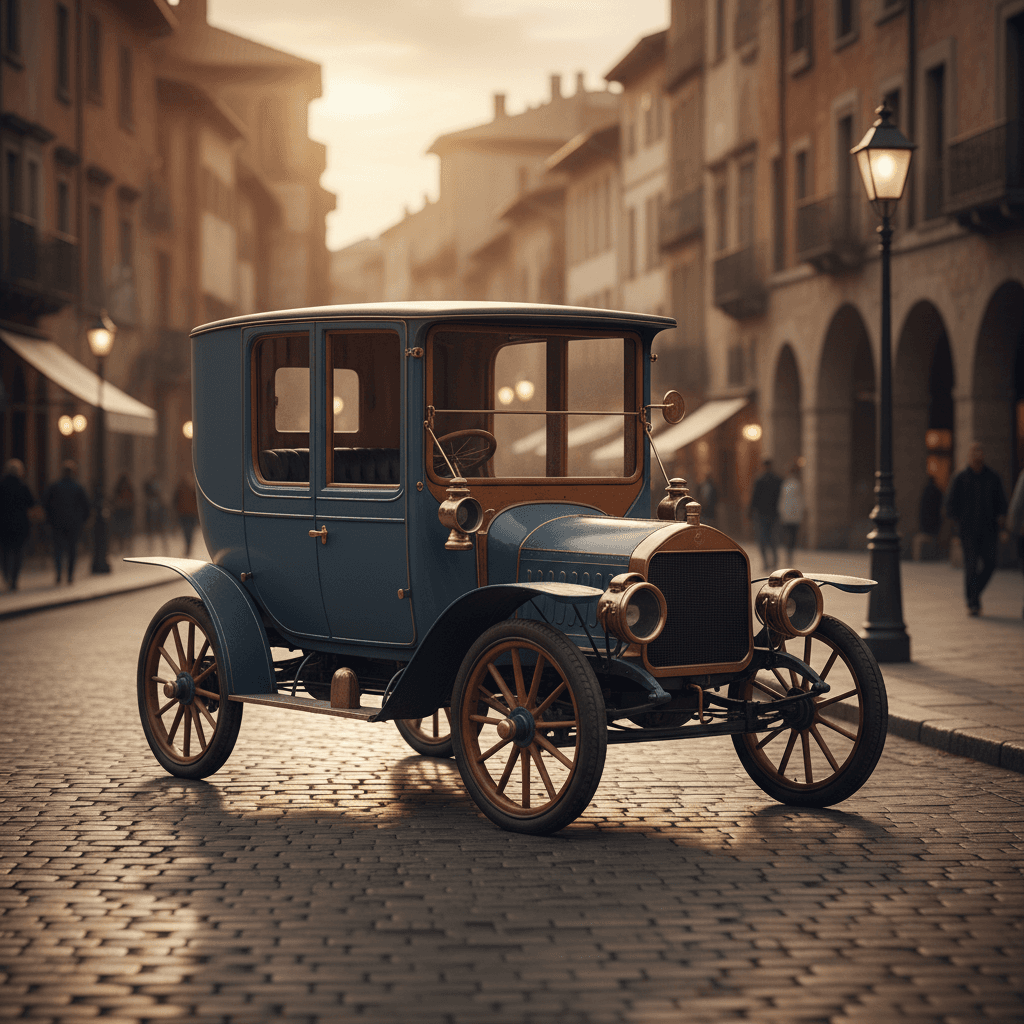
Baker Motor Vehicle Company out of Cleveland built elegant enclosed electric cars with about 20–50 miles of range and top speeds near 20 mph.
They were marketed as clean, reliable city cars, no crank starting, no gears, no fumes. Jay Leno famously owns a 1909 Baker that still runs today.
Detroit Electric (1907 onward)
Detroit Electric focused on comfortable, upright “phone booth” style cars popular with doctors and socialites. Some could cover around 80–100 miles on a charge if driven gently.
For a time, Detroit Electric was one of America’s best‑known automobile brands, powered entirely by batteries.
Electric cabs and commercial EVs
In cities like London and New York, electric taxis and delivery vehicles were common in the early 1900s. They offered easy one‑pedal driving and simple maintenance for stop‑and‑go urban work.
If you’ve ever ridden in a modern electric rideshare in the city, you’ve experienced a very old idea brought back to life.
How early electric cars stacked up against gas cars
By the 1900s, drivers choosing their first car faced three options: steam, gasoline or electric. Steam was powerful but finicky. Gasoline was noisy and dirty, and you had to hand‑crank the engine. Electric cars slotted into an appealing middle ground, especially in cities.
Early electric vs gasoline cars: a side‑by‑side look
Why many city drivers preferred electric cars in the 1900s, until the balance shifted.
| Feature (circa 1905) | Electric car (Baker/Detroit Electric) | Gasoline car (early touring car) |
|---|---|---|
| Starting | Turn a switch or lever; nearly instant | Hand‑crank the engine; can kick back and injure you |
| Noise & smell | Very quiet, no exhaust smell | Loud engine, exhaust fumes, oil and gasoline odors |
| Typical range | 20–80 miles per charge, depending on model | 100+ miles with a tank, if you could find fuel |
| Top speed | 20–25 mph, fine for city streets of the era | 30+ mph as engines and roads improved |
| Maintenance | Simple; mostly batteries, cables and tires | Regular tune‑ups, oil, fuel system issues, more moving parts |
| Refueling/charging | Overnight charging at home or depot | Gasoline from barrels, cans and early gas pumps; infrastructure still emerging |
These comparisons are approximate, but they show why electrics made sense for urban use long before modern EVs arrived.
The catch
Why early electric cars disappeared, for a while
If electric cars were such a hit in early 1900s cities, why did they vanish for nearly a century? It wasn’t because the idea was bad. It was because the world around them changed faster than the technology did.
- Cheap gasoline and the Model T: Mass‑produced gas cars got dramatically cheaper and more capable, especially for families who wanted to drive beyond city limits.
- Better roads, longer trips: As paved roads connected towns, buyers wanted cars that could go farther and be refueled quickly almost anywhere.
- Slow battery progress: Early lead‑acid batteries were heavy and limited in capacity. Energy density didn’t keep up with expectations.
- Policy and infrastructure: Fuel taxes, oil‑industry incentives and the slow spread of electricity in rural areas gave gasoline a huge head start.
“Of the 160 automobiles on display at the first U.S. auto show in 1900, about a third were electric. Two decades later, electric cars had essentially disappeared from the mainstream market.”
What these early EVs already got right
Spend a few minutes with the story of the oldest electric cars and you notice something striking: they nailed many of the same selling points modern EV makers emphasize today.
Early electric car ideas that feel very 2025
The past and present rhyme more than you’d think
Home “refueling”
Early EV owners often charged in private garages or dedicated depots. The promise was simple: start every day with a full ‘tank’ without visiting a fuel station.
Quiet, clean city driving
Even in 1905, marketers stressed that electric cars were clean, quiet and odor‑free, perfect for dense, upscale neighborhoods and medical use.
Ease of use and safety
No cranking, no warm‑up rituals, fewer gears. Electric cars were pitched especially to drivers who wanted simple, dependable transportation, not a mechanical adventure.
A familiar use case
From Baker and Detroit Electric to Tesla, and you
For decades, early Baker and Detroit Electric cars were seen as quirky artifacts, museum pieces and garage trophies. Then lithium‑ion batteries, compact electronics and climate concerns brought electric drive roaring back, first in hybrids, then in full battery EVs.
- Modern EVs still use electric motors and rechargeable batteries, just with vastly better energy density and software.
- They revisit the same promise: easy, quiet, low‑maintenance driving, especially in urban and suburban life.
- They’ve finally solved the range and performance issues that limited early EVs, with many models now comfortably exceeding 250–300 miles of range.
- Charging infrastructure, once a deal‑breaker, is expanding fast, especially DC fast charging along major U.S. corridors.
Thinking about your own EV timeline
Shopping used EVs? Lessons from the oldest electric car
So how does knowing about the oldest electric car actually help you buy a used EV in 2025? By highlighting the same three questions drivers were asking in 1908, range, charging and durability, and showing how much better the answers are now.
Key lessons from early EVs to apply when you shop today
1. Be honest about your daily range needs
Early electric cars lived happily in cities because their owners understood their short‑trip patterns. Track your own driving for a week. If you’re under 40–60 miles a day, a used EV with a realistic range of 140–200 miles may be more than enough.
2. Focus on charging where you live, not just along highways
The oldest EVs worked because owners could charge at home or a depot. That’s still the gold standard. If you can install Level 2 charging or already have a 240V outlet in reach, your EV ownership experience gets dramatically easier.
3. Treat battery health like a major mechanical system
Early EV buyers had to trust the seller’s word about battery condition. You don’t. Look for a <strong>verified battery‑health report</strong>, like the Recharged Score, to understand remaining capacity and expected range before you buy.
4. Consider how long you’ll keep the car
A Baker Electric that still moves today proves electric drivetrains can be incredibly durable. Modern EV motors often outlast the rest of the car. Focus your concerns on <strong>software support, parts availability and battery condition</strong>, not the motor itself.
5. Look beyond headline range numbers
Just as early Detroit Electrics achieved their best range at gentle city speeds, modern EPA range figures assume a mix of driving. If you do a lot of highway, expect somewhat lower real‑world range, and shop accordingly.
6. Use specialists who live and breathe EVs
Early electric car owners relied on specialized garages. Today, a platform like <strong>Recharged</strong> gives you EV‑savvy support, transparent pricing, financing and nationwide delivery so you’re not guessing your way through a big purchase.
Watch out for nostalgia pricing
Oldest electric car: FAQ
Frequently asked questions about the oldest electric cars
Bottom line: the oldest electric car is closer to today than you think
Strip away the brass fittings and carriage bodies, and the oldest electric cars don’t feel so distant. They were built for exactly what many of us still need: reliable, low‑drama transportation for the trips we actually take most, short hops around town, school runs, commutes and errands.
What’s different in 2025 is everything around that simple idea: batteries with far more range, public fast‑charging networks, advanced safety tech and digital tools that tell you precisely what you’re buying. Where early EV buyers took a leap of faith, you can lean on data, diagnostics and expert guidance.
If you’re ready to write your own chapter in this very old story, a modern used EV is one of the smartest ways to do it. With Recharged, you get verified battery health, fair market pricing, EV‑savvy support and nationwide delivery, so the next electric car you bring home is historic for all the right reasons.