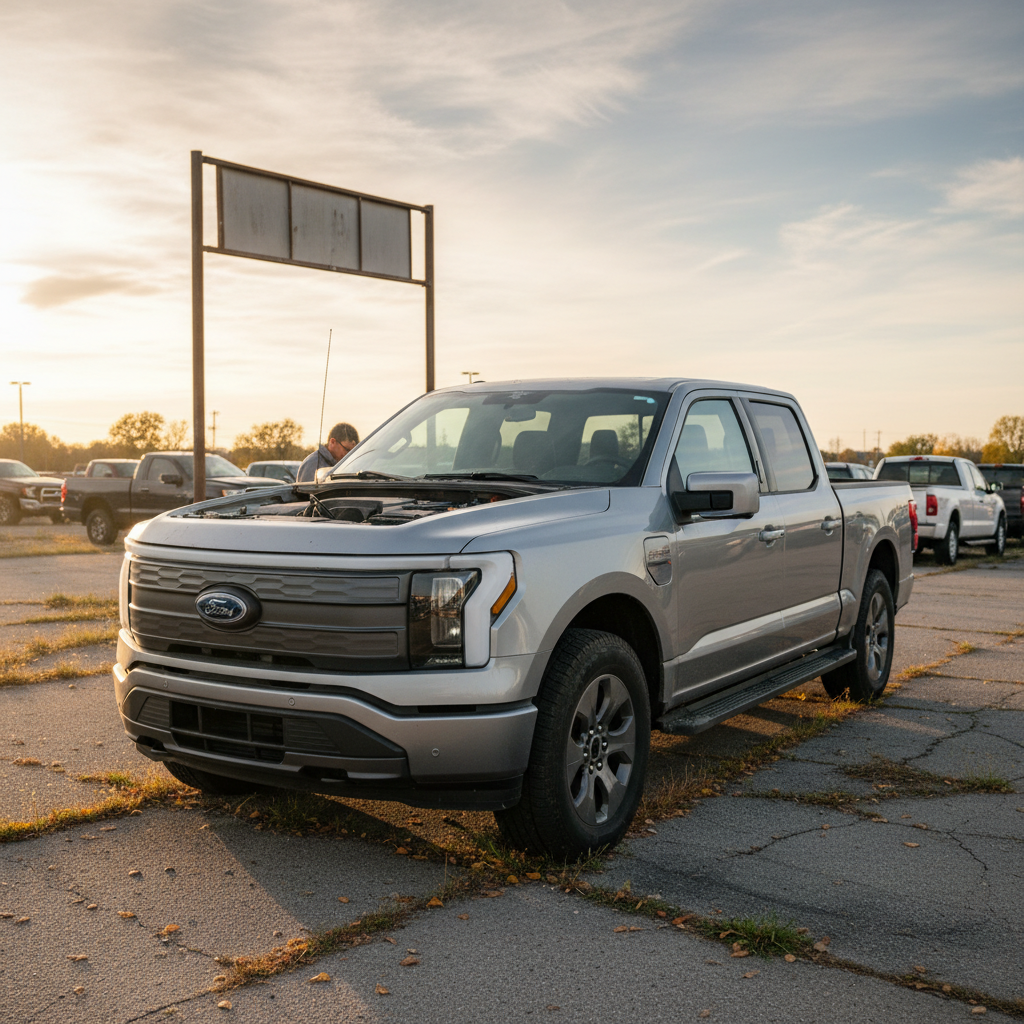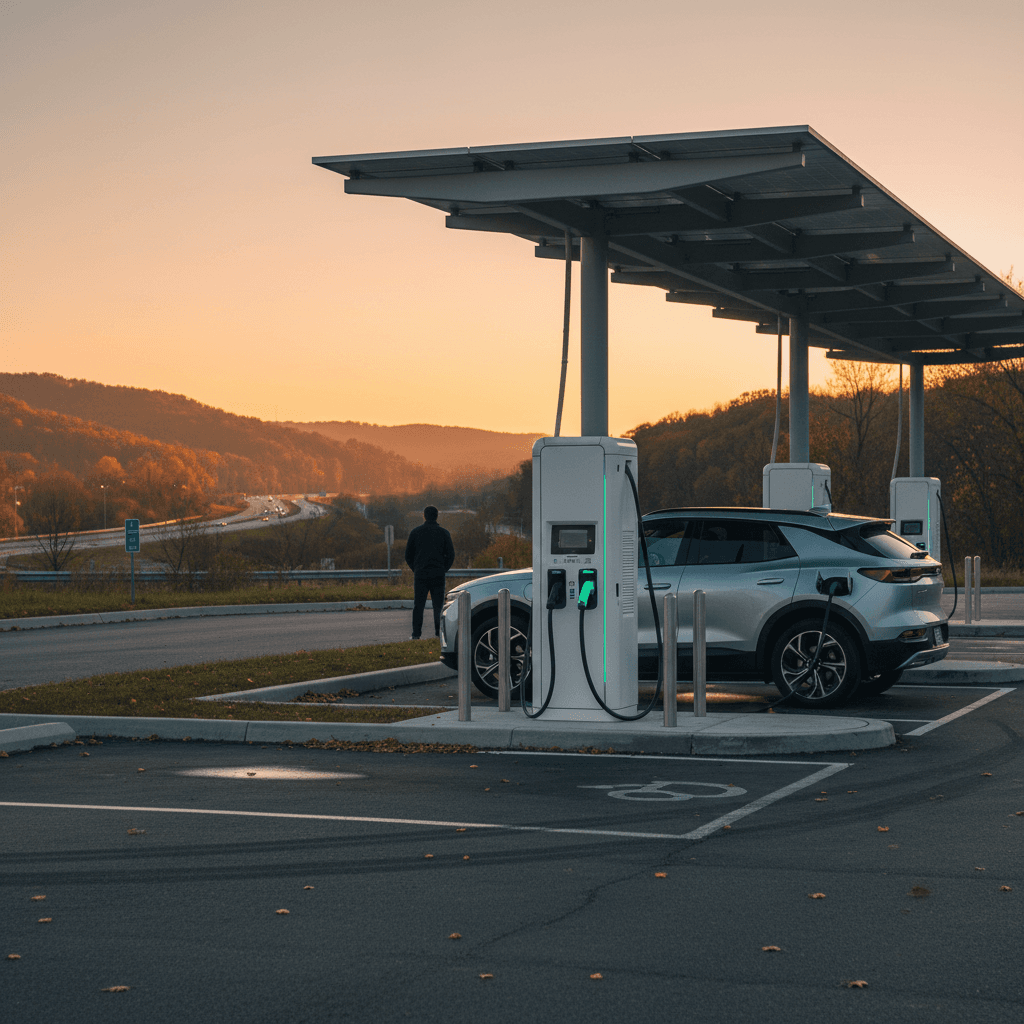
Ohio’s electric car charging network sits in an awkward middle age. It’s not California, but it’s not a charging desert either. You can drive an EV from Cincinnati to Cleveland without white‑knuckling the steering wheel, if you understand where the plugs are, how fast they charge, and how to work around the gaps. This guide breaks down the Ohio electric car charging network in plain language so you can decide whether a new or used EV fits your life in the Buckeye State.
Snapshot: Ohio vs. the rest of the country
Ohio EV and charging network by the numbers
How strong is Ohio’s electric car charging network, really?
If you look only at national league tables, Ohio’s EV scene can seem underwhelming. With about 15.5 public charging stations per 100,000 residents, the state lags far behind Vermont, California and Colorado, and even trails neighbors like Michigan and Pennsylvania. But that statewide average hides a more nuanced story: Ohio’s big metros and interstate corridors are usable today, while some small towns are still living in the pre‑EV era.
Where Ohio’s network works well
- Major metros – Columbus, Cincinnati, Cleveland and Dayton now have dense clusters of Level 2 and DC fast chargers.
- Key interstates – I‑70, I‑71 and I‑75 are increasingly lined with fast chargers at travel plazas, truck stops and big‑box parking lots.
- Urban errands – Grocery stores, malls and garages are quietly adding chargers, turning “park time” into “charge time.”
Where the network still struggles
- Rural counties – One or two stations may serve an entire county, sometimes with older, slower hardware.
- Redundancy – In many smaller towns there’s exactly one fast charger. If it’s down, so are your plans.
- Apartment dwellers – On‑site charging at multifamily buildings is improving but still patchy outside major metros.
Don’t mistake “coverage” for “convenience”
Where the chargers actually are: cities, highways and rural gaps
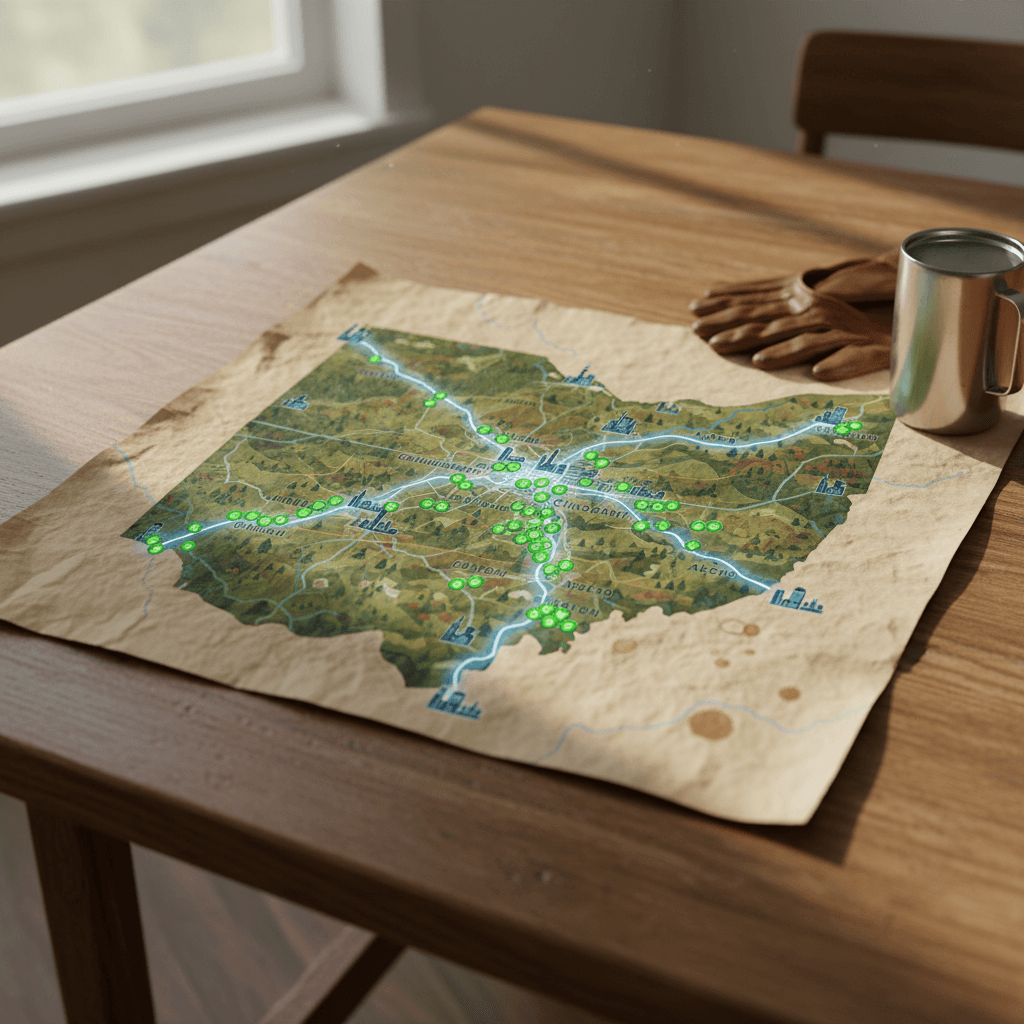
To understand Ohio’s electric car charging network, think in three layers: big cities, highway corridors and everywhere else. PlugShare data shows more than a thousand stations in the Columbus metro alone, over a thousand in Cincinnati, and hundreds around Cleveland‑Elyria and Dayton. Those four hubs anchor the state’s public charging grid.
Best‑served Ohio metros for public EV charging
Where it already feels easy to own an electric car
Columbus
Roughly 1,296 public charging locations, from downtown garages to suburban grocery lots. If you live in Franklin County, range anxiety is more about your schedule than the map.
Cincinnati
With around 1,000+ stations in the broader metro, the I‑71 corridor between Cincinnati and Columbus has become one of Ohio’s most EV‑friendly stretches.
Cleveland–Elyria
Roughly 800+ locations across the metro, with fast chargers clustering near major freeways, hospitals and shopping centers.
Dayton
About 500+ stations, plus strong connections along I‑75 north to Toledo and south toward Cincinnati.
Step outside these hubs and the picture changes. Cities like Toledo, Akron and Youngstown have respectable coverage, but once you’re threading through Appalachia or northwest farm country, you can go 40–60 miles between usable chargers. That’s not a deal‑breaker, but it does mean you plan your route the way your grandparents planned around gas stations in the 1950s, eyes on the next town, and the one after that.
Planning rural drives in Ohio
Fast charging in Ohio: what to expect on the road
For road trips, the backbone of the Ohio electric car charging network is DC fast charging, 50 to 350 kW hardware at highway exits and major commercial centers. Today that network is an eclectic mix: Electrify America parks at Walmarts, GM/EVgo and Pilot Flying J stations along I‑75, Tesla Superchargers (some opening to non‑Tesla EVs), and a scattering of utility‑backed sites.
Common DC fast‑charging options in Ohio
What you’re likely to see when you pull off I‑70, I‑71 or I‑75.
| Network | Typical Location | Max Power (kW) | Plugs | Notes |
|---|---|---|---|---|
| Electrify America | Walmart, Sam’s Club, retail centers | 150–350 | CCS, CHAdeMO | Most common non‑Tesla highway network in Ohio. |
| EVgo | Urban lots, grocery, some highway | 100–350 | CCS, CHAdeMO, NACS at some sites | Often fewer stalls per site, great in cities, thin on redundancy. |
| GM / EVgo / Pilot | Pilot & Flying J truck stops on I‑75, I‑70 | 200–350 | CCS | Designed as long‑haul corridors; powerful but still filling in gaps. |
| Tesla Supercharger | Highway exits, shopping centers | 150–250+ | NACS; some with CCS via Magic Dock | Best reliability; non‑Tesla access expanding but not universal yet. |
| Utility / regional | Co‑ops, cities, local projects | 50–150 | Mostly CCS | One‑off sites; check uptime history in PlugShare. |
Always confirm plug type (CCS, NACS, CHAdeMO) and power rating in your app before you bank on a station.
Watch your connectors
NEVI corridors: federally funded highway chargers in Ohio
Ohio is tapping federal NEVI funds (National Electric Vehicle Infrastructure program) to build a spine of fast‑charging sites along its interstates. The state’s initial plan targeted 27 locations on I‑70, I‑71, I‑75, I‑76, I‑77, I‑80, I‑90 and I‑480, with more to follow on other U.S. highways. Each NEVI site is required to include at least four 150 kW chargers with CCS connectors, spaced roughly every 50 miles along designated corridors.
- On I‑70, expect NEVI‑backed fast chargers near major interchanges from the Indiana line through Dayton and Columbus to West Virginia.
- On I‑75, chargers are being added at key exits between Cincinnati, Dayton, Lima and Toledo, connecting to Michigan and the Great Lakes region.
- I‑71 between Cincinnati, Columbus and Cleveland is steadily filling in, blending NEVI sites with existing private‑network stations.
- Secondary corridors like I‑77 and I‑90 are catching up, with sites near Stark County, Cleveland’s east suburbs and Lake Erie towns.
Politics vs. plugs
Level 2 charging: cities, workplaces and apartments
If DC fast charging is your highway IV drip, Level 2 charging (240‑volt, 6–11 kW) is the daily vitamin. This is what you’ll see at parking garages, hotels, workplaces and many public lots. In Ohio’s big metros, L2 has quietly become the default amenity: park for two hours, come back to 40–60 extra miles of range.
Where Level 2 charging fits into Ohio life
Think in routines, not road trips
Downtown & campus garages
Columbus, Cleveland and Cincinnati garages increasingly reserve a row or two for EVs, often priced like standard parking plus a modest per‑kWh fee.
Workplace charging
Large employers in tech, healthcare and insurance are installing Level 2 banks. For a 30–40‑mile commute, even a few hours of midday charging is plenty.
Apartments & hotels
Multifamily buildings and chains like Marriott, Hilton and newer independents use Level 2 as a marketing bullet point. Always confirm access hours and fees.
Don’t obsess over 100%
Ohio utility and co‑op rebates for home and public chargers
Ohio isn’t generous on statewide EV incentives, there’s no state tax credit and there’s an extra annual registration fee for EVs. But local utilities and electric co‑ops quietly offer some of the best EV charger rebates in the Midwest, especially if you’re willing to install a Level 2 at home or at a business.
Sample Ohio utility and co‑op EV charger rebates
Programs change often; always confirm current terms before you buy hardware.
| Provider | Who it’s for | Charger type | Typical incentive |
|---|---|---|---|
| Butler Rural Electric Cooperative | Homeowners | Level 2 | Up to $1,000 toward purchase and installation. |
| Multiple rural co‑ops (Consolidated, Mid‑Ohio, Darke, Pioneer, Union, Carroll, The Energy Cooperative) | Residential | Level 2 | Around $250 rebate on eligible Level 2 chargers. |
| Hancock‑Wood, North Central, Firelands, Lorain‑Medina co‑ops | Residential & some commercial | Level 2 | Up to $250 per charger; North Central allows multiple per site. |
| Paulding Putnam Electric Cooperative | Residential & commercial | Level 2 | Bill credits around $200 for installing an approved charger. |
| AES Ohio | Businesses, public sites, multi‑family | Level 2 & DCFC | Up to 100% of project cost for public / government L2 and DCFC, with caps per station. |
Many programs require networked chargers and specific installation details, read the fine print and keep receipts.
Stacking savings with a used EV
Ready to find your next EV?
Browse VehiclesHow to take advantage of Ohio charger rebates
1. Identify your utility or co‑op
Look at your electric bill and confirm whether you’re with a big IOU (like AES Ohio) or a rural electric cooperative. Rebate programs are usually tied to your specific provider.
2. Read program rules before buying hardware
Many programs require a networked Level 2 charger or specific brands. Don’t click “buy now” until you’ve checked what qualifies and whether a licensed electrician is required.
3. Get multiple installation quotes
Even with rebates, 240‑volt installation can range from a few hundred dollars to a few thousand depending on your panel and distance. Compare quotes and ask which work is rebate‑eligible.
4. Enroll in off‑peak or managed charging programs
Some utilities offer lower rates if you let them throttle charging or stick to overnight hours. It’s an easy way to cut your fueling cost per mile.
5. Keep documentation tidy
Save invoices, permits and charger serial numbers. Rebate portals often want everything in one upload and can deny incomplete applications.
Best apps and networks for navigating Ohio chargers
Maps built into modern EVs are good, but when you’re depending on the Ohio electric car charging network, you want a second opinion. Different apps see different parts of the elephant, and using two or three together gives you a much clearer picture of what’s actually working today.
Three app “lenses” on Ohio’s charging network
No single app tells the whole story, combine them.
PlugShare
Best for: reality checks. Crowdsourced check‑ins, photos and comments reveal which stations are broken, blocked or painfully slow, even when the network’s own app claims otherwise.
Native car navigation
Best for: turn‑by‑turn sanity. Your EV’s built‑in planner knows your consumption and elevation changes across Ohio’s hills, and can dynamically reroute if a charger is too far at your current state of charge.
Network‑specific apps
Best for: speed & pricing details. Electrify America, EVgo, Tesla, ChargePoint and others show stall availability, pricing and, often, how long current sessions have been running.
Save your personal “greatest hits”
What it’s like to daily‑drive an EV in Ohio
Day to day, living with an EV in Ohio is less about public chargers and more about where you sleep. If you can install a Level 2 at home, or reliably plug into a 120‑volt outlet in a garage, your interaction with the public network shrinks to road trips, the occasional busy errand day and the odd emergency.
Suburban homeowner near Columbus or Cincinnati
With a driveway or garage, you’re the poster child for EV ownership. A 32–40 amp Level 2 charger will refill a typical 60–80 kWh battery overnight, even in winter. Public stations become optional extras.
You’ll lean on fast charging a few times a year, holidays on I‑71, lake weekends up I‑75, where the growing NEVI and private networks make life progressively easier.
Apartment dweller in Dayton or Toledo
Here the story is more complicated. If your building has resident chargers, you’re golden. If not, you’re playing musical chairs at public Level 2s and the occasional DC fast charger. It’s doable, but it demands more planning than a gas car.
Before you buy, scout your neighborhood chargers at the times you’d actually use them, after work, late at night, Sunday afternoons, to see how crowded they get.
Winter is the truth serum
Buying a used EV for Ohio: why battery health matters
The charging network is only half the story; the other half is the battery you bring to it. Two otherwise identical EVs can feel very different in Ohio if one has lost 10% of its capacity and the other has lost 25%. On a cold Cleveland morning, that gap can be the difference between a relaxed commute and an unplanned fast‑charge stop in a strip‑mall parking lot.
That’s where tools like the Recharged Score come in. When you buy a used EV through Recharged, every car gets a battery‑health diagnostic, a transparent score report, and pricing that reflects real‑world range, not just the original window sticker. For an Ohio buyer staring down long winters and emerging charging corridors, that kind of transparency is the difference between theory and lived experience.
Checklist: choosing a used EV that fits Ohio’s network
1. Match range to your worst‑case day
Add up your longest regular drive, commute plus kids’ activities, plus winter buffer, and look for an EV whose <strong>realistic</strong> range (sticker minus 25–30%) still covers it without mid‑day charging.
2. Look for robust fast‑charging support
If you frequently drive I‑70, I‑71 or I‑75, prioritize EVs with solid DC fast‑charging curves (Hyundai/Kia E‑GMP models, newer Teslas, many GM and Ford vehicles). A car that charges from 10–80% in 25–35 minutes transforms road trips.
3. Consider plug standard and adapters
In the next few years, Ohio will shift from CCS to NACS on many new chargers. Make sure your used EV either comes with the right adapter or has a clear path to one, especially if you want to use Tesla Superchargers as they open to more brands.
4. Inspect battery health, not just mileage
A 60,000‑mile EV that spent its life on Level 2 can be healthier than a 25,000‑mile car that fast‑charged daily. Ask for battery‑health reports and charging history when possible; Recharged includes this in its Score report.
5. Test‑drive your charging routine
Before you sign, simulate a week of life with that EV: where you’d charge at home, where you’d charge near work, where your closest reliable fast charger sits on the map.
Ohio EV charging network FAQ
Common questions about charging an EV in Ohio
Ohio’s electric car charging network is a work in progress, messy at the edges, solid where most people actually live and drive. If you pair the current network with a realistic sense of your routes, weather and charging options at home, an EV can fit comfortably into an Ohio life today, especially as a used‑EV value play. The real trick is matching the car, the battery and your daily map to the plugs that already exist, while keeping one eye on the NEVI corridors and utility projects that are filling in the blanks. That’s where thoughtful shopping, and transparent tools like the Recharged Score, turn an experiment into a long‑term, quietly satisfying way to drive.