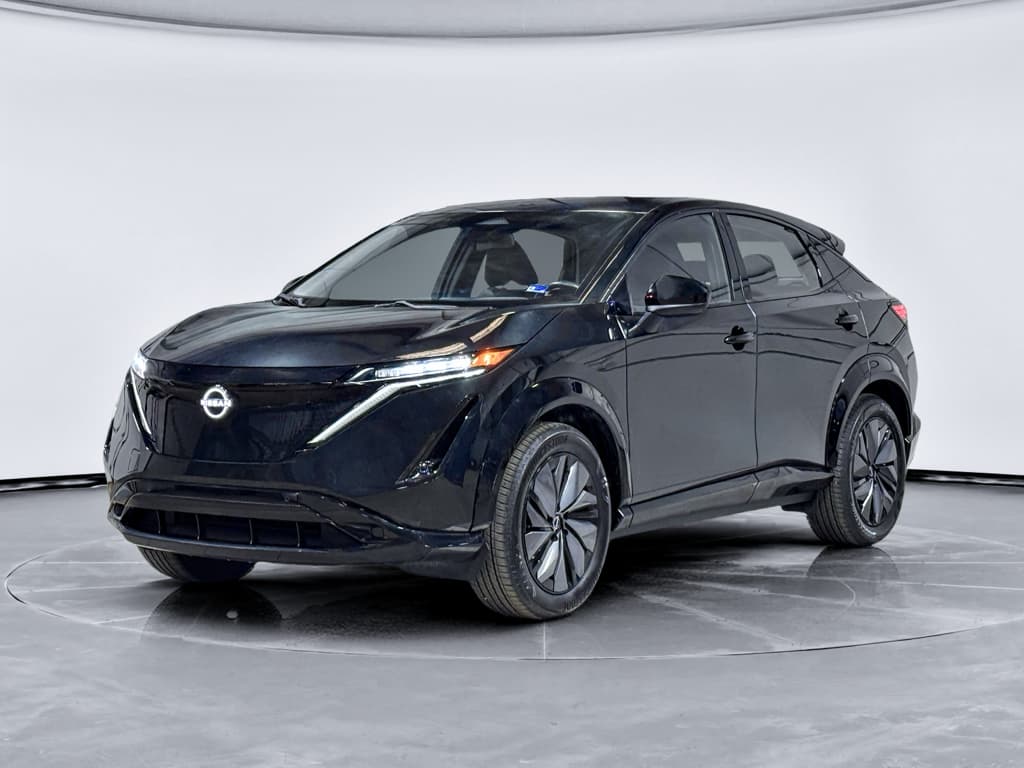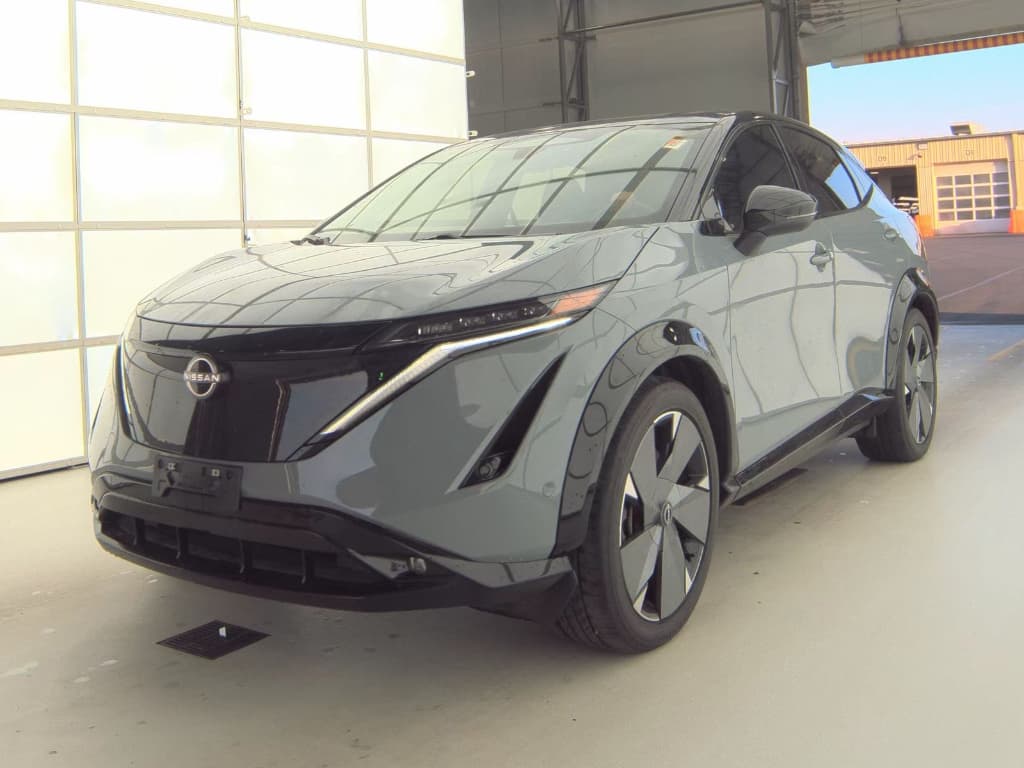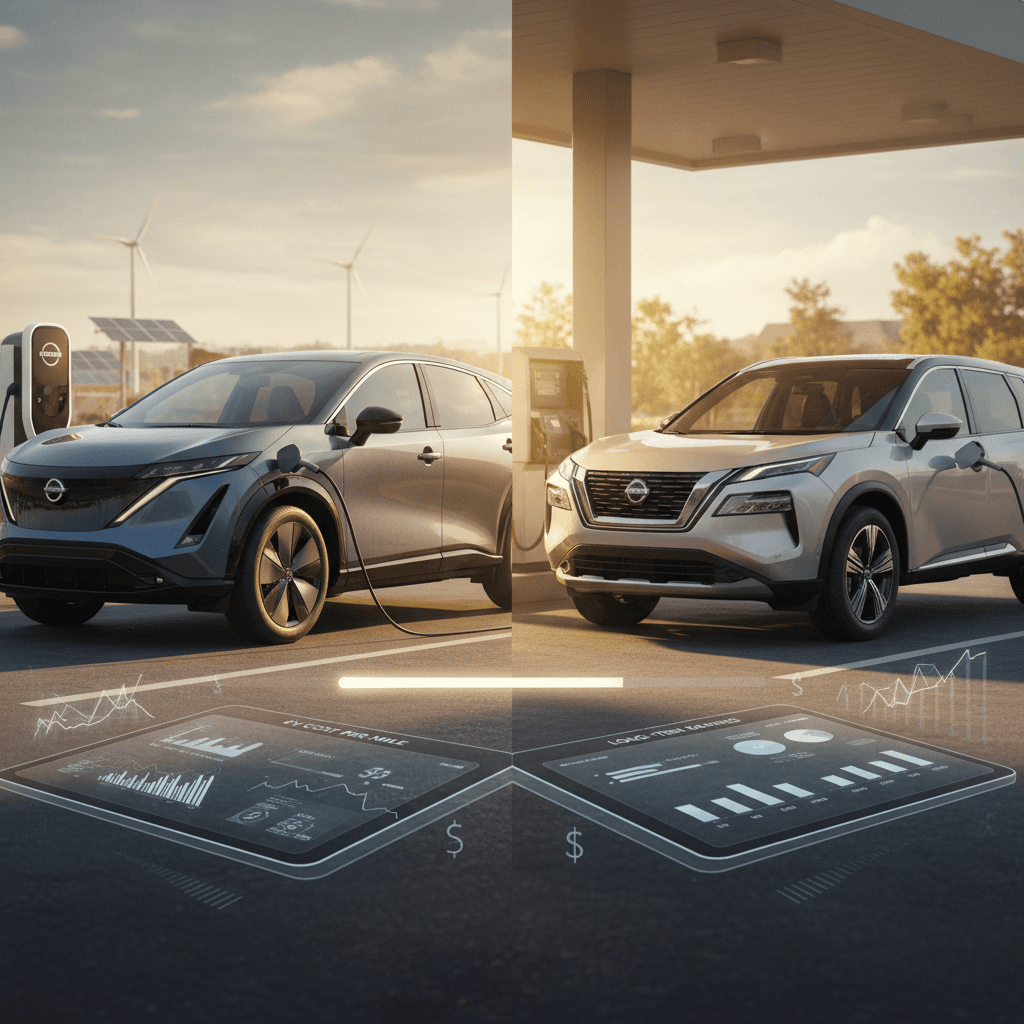
If you’re cross-shopping the **Nissan Ariya electric SUV** against the **Nissan Rogue** in 2026, you’re really asking one question: *will the EV actually cost me less than the gas SUV?* This Nissan Ariya vs. Nissan Rogue cost comparison for 2026 walks through purchase price, incentives, fuel or electricity, maintenance, insurance, and resale so you can see which one fits your real-world budget.
Assumptions used in this comparison
Why compare the Nissan Ariya vs. Rogue in 2026?
The Ariya and Rogue sit in roughly the same **compact-to-midsize crossover** space, but they come from two very different eras. The Rogue is Nissan’s bread-and-butter gas SUV, while the Ariya is a clean-sheet EV built to compete with models like the Tesla Model Y and Hyundai Ioniq 5. In 2026, both are widely available new and increasingly common on the used market, which makes the choice less about technology and more about **total cost of ownership (TCO)**.
- Similar size and family-friendly packaging
- Different powertrains: gasoline vs. fully electric
- Different incentive and tax-credit eligibility
- Very different fuel and maintenance patterns over 5–8 years
Think in terms of “five‑year cost,” not monthly payment
Headline takeaways: which one really costs less?
Ariya vs. Rogue at a glance (typical U.S. scenario)
For a typical U.S. driver, the **Nissan Ariya often ends up similar to, or slightly cheaper than, a Rogue over five years**, especially if you drive more than 12,000 miles a year or can charge mostly at home. The Rogue usually wins on **lower sticker price and simpler refueling**, while the Ariya wins on **energy and maintenance savings**, plus a quieter driving experience.
Purchase price and incentives in 2026
By 2026, you’ll find both the Ariya and Rogue in Nissan showrooms and on used-car lots nationwide. But they don’t start from the same financial baseline.
Typical new pricing snapshots (2026 shopping environment)
Exact MSRPs vary by trim, options, and incentives, but these ranges reflect real-world shopping conversations.
Nissan Rogue (gas)
- MSRP ballpark: Low-to-mid $30,000s for volume trims, more for fully loaded models.
- Discounts/rebates: Traditional dealer discounts, finance offers, and occasional rebates.
- No federal EV credit: As a gasoline SUV, the Rogue isn’t eligible for federal EV tax credits.
Nissan Ariya (EV)
- MSRP ballpark: Typically several thousand dollars above a comparable Rogue trim.
- EV incentives: May qualify for federal or state EV incentives depending on configuration and rules in effect when you buy.
- Dealer pricing: EVs sometimes see more aggressive discounting in markets with strong EV competition.
Incentives change, lock in numbers before you commit
If you’re strictly comparing **new-for-new**, the Rogue usually wins the **purchase-price round**. That said, when you factor in potential **EV incentives and dealer discounts on leftover Ariya inventory**, the price gap can narrow fast, especially if you’re flexible on trim and equipment.
Energy costs: electricity vs. gasoline
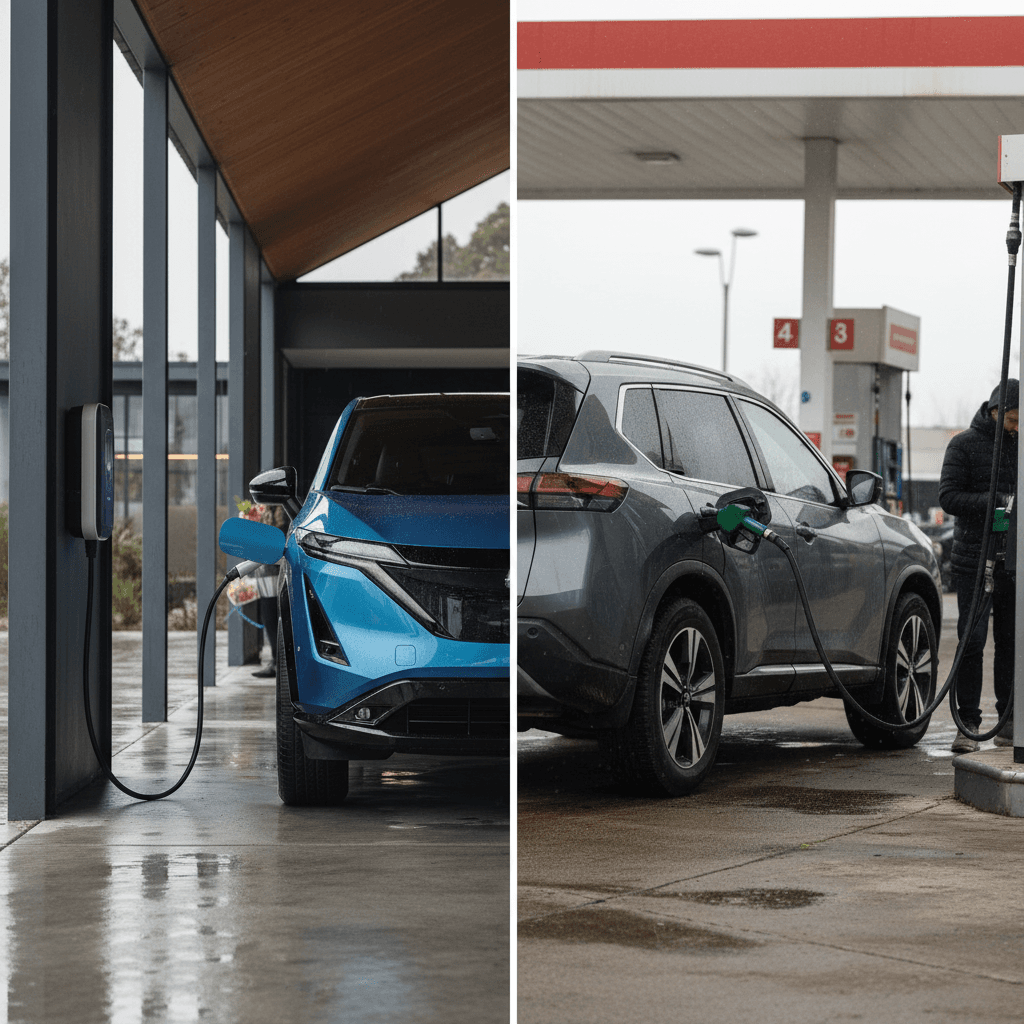
Energy is where the Nissan Ariya makes up ground. Instead of paying for gallons of gasoline, you’re paying for kilowatt-hours of electricity. Over 5–6 years, that adds up, particularly if gas prices stay volatile.
Ariya: kWh, not gallons
- Energy use: Many Ariya trims land in the neighborhood of mid‑30s kWh per 100 miles, depending on wheel size, drivetrain, and driving style.
- Home electricity cost: If you pay around common U.S. residential rates per kWh, that often translates to a noticeably lower cost per mile than gasoline.
- Public DC fast charging: Costs more per kWh than home charging, but most owners still do the majority of charging at home or work.
Rogue: predictable but higher fuel bills
- Fuel economy: The Rogue’s combined mpg means you’re buying dozens of gallons of fuel each month at current gas prices.
- Annual fuel cost: For 12,000 miles a year, it’s not unusual for a gas compact SUV to burn through well over a thousand dollars in fuel annually.
- Upside: Refueling is fast and gas stations are everywhere, helpful if you drive lots of highway miles in rural areas.
Maximize Ariya savings with home charging
Maintenance, repairs, and warranty coverage
Nissan built the Ariya as a ground-up EV with far fewer moving parts than the Rogue’s internal-combustion engine. That changes the **maintenance and repair picture** more than many first-time EV shoppers expect.
Maintenance profiles: Ariya vs. Rogue
Both require routine care, but the EV typically does less of it.
Nissan Rogue (gas)
- Regular oil changes every few thousand miles.
- Transmission service over the life of the vehicle.
- More complex cooling and exhaust systems that can age with mileage.
- Traditional brake service, though modern gas SUVs still benefit from some regenerative-braking assistance if equipped.
Nissan Ariya (EV)
- No engine oil or spark plugs to change.
- Single-speed reduction gearbox with fewer wear items.
- Battery and motor cooling still need periodic checks, but service intervals are generally longer.
- Less brake wear thanks to strong regenerative braking, especially in stop‑and‑go traffic.
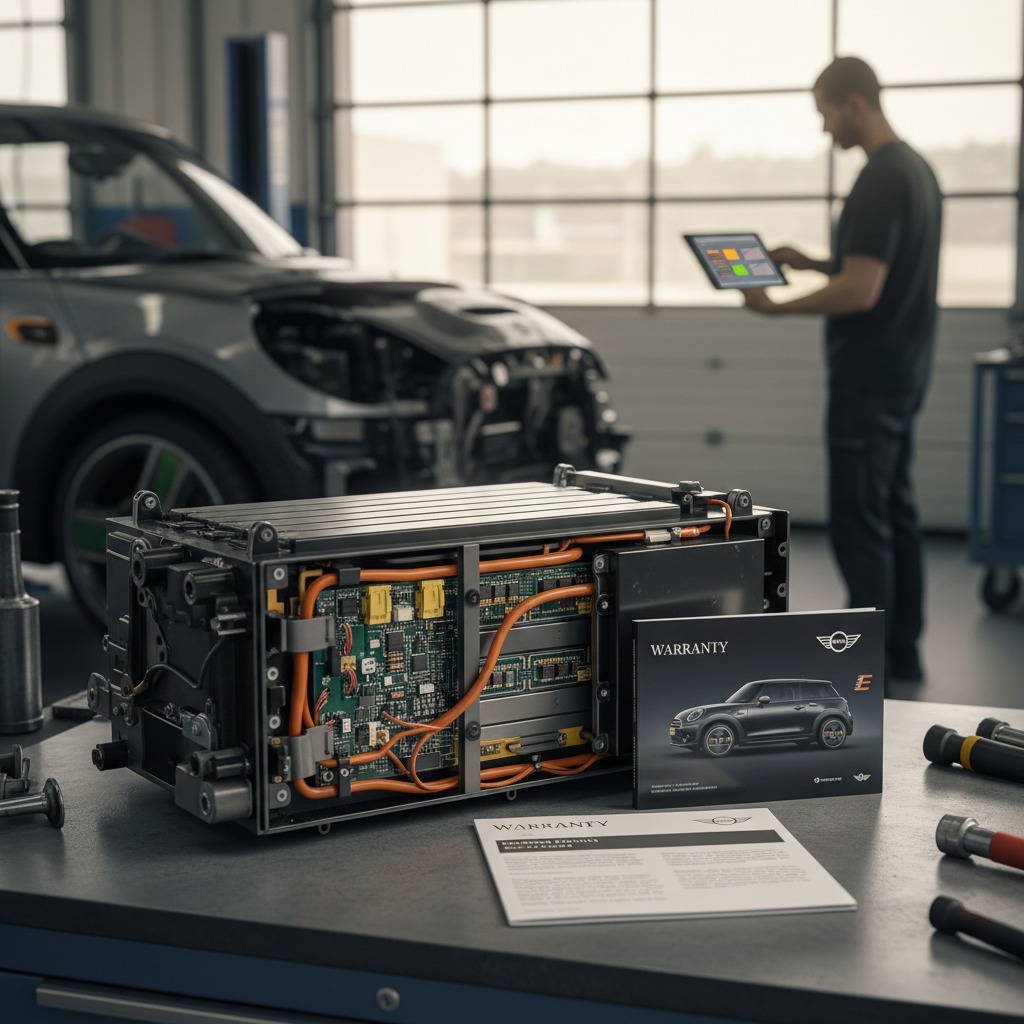
Warranty coverage to keep in mind
Over five to six years, many owners see **routine maintenance costs on an Ariya run meaningfully lower** than on a Rogue, particularly if they drive a lot and keep up with service schedules. Unplanned repairs can still happen on either vehicle, but the EV’s lack of engine components tilts the odds in its favor.
Insurance and taxes
Insurance and taxes don’t get as much attention as fuel and maintenance, but they can nudge the Ariya vs. Rogue equation in either direction, depending on your state and insurer.
- Insurance: EVs like the Ariya can carry higher collision premiums than gas SUVs because their parts and body repairs are often more expensive. On the flip side, advanced driver-assistance tech may help offset some of that through safety discounts.
- Registration fees: Some states now impose additional annual fees on EVs to replace lost gas-tax revenue, while others still offer reduced registration costs or perks like HOV lane access.
- Local incentives: A few jurisdictions offer EV-specific benefits such as reduced tolls or parking discounts, which don’t show up in a traditional TCO spreadsheet but matter to daily life.
Get real quotes, don’t guess on insurance
Depreciation and resale value
Depreciation is where cost-of-ownership math gets messy. The Rogue has more than a decade of used-market history. The Ariya is newer, and EV resale is still evolving as charging networks improve and battery tech advances.
Rogue: steady and predictable
- Established demand: Gas SUVs like the Rogue are staples of the used market, which helps support resale values.
- Wide buyer base: Anyone comfortable with a traditional gas vehicle is a potential Rogue buyer, especially in regions where charging is sparse.
- Less tech risk: There’s no concern about battery degradation or charging standards becoming obsolete.
Ariya: upside and uncertainty
- EV demand growth: In EV-friendly markets, demand for used Ariyas can be strong, especially for trims with healthy range and fast-charging capability.
- Battery health matters: Real-world battery condition and range retention play a big role in what buyers are willing to pay.
- Policy impact: Future incentives, charging buildout, or technology shifts can either boost or soften EV resale values.
How Recharged reduces EV resale guesswork
Ready to find your next EV?
Browse VehiclesFive‑year cost of ownership: side‑by‑side estimates
To tie these pieces together, here’s a simplified five-year cost-of-ownership snapshot for a typical 2026 buyer. This is not a quote, it’s a framework to help you think about where the Ariya and Rogue differ. Numbers will shift based on trim, incentives, local energy prices, and your driving patterns.
Illustrative 5‑year cost comparison (typical U.S. driver, 12,000 miles/year)
These rough figures highlight the structure of costs rather than exact dollar amounts. They assume comparable trims and responsible maintenance.
| Cost category | Nissan Rogue (gas SUV) | Nissan Ariya (electric SUV) |
|---|---|---|
| Initial purchase (after deals/incentives) | Lower | Higher |
| Fuel vs. electricity | Higher ongoing fuel spend | Lower ongoing electricity spend, especially with home charging |
| Routine maintenance | Higher (oil, transmission, more fluids) | Lower (no oil, fewer wear items) |
| Repairs outside warranty | Moderate and well-understood | EV systems generally durable, but advanced tech can be costlier if damaged |
| Insurance | Often moderate | Can be slightly higher, varies by insurer and location |
| Depreciation/resale | Predictable, stable demand | More sensitive to EV market trends and battery confidence |
| Overall 5-year TCO | Competitive, may be lower if you drive few miles | Competitive to lower, especially if you drive more than average and charge at home |
Higher upfront cost for the Ariya is often offset over five years by lower energy and maintenance expenses, especially for drivers with access to home charging.
Don’t rely on generic averages alone
New vs. used: where the Ariya gets interesting
Up to now we’ve mostly discussed a new Ariya versus a new Rogue. But on the used market in 2026, the math can shift, and the Ariya often becomes more compelling.
Used Ariya vs. used Rogue: key angles
By 2026, early Ariya models and plenty of late-model Rogues are in the used pipeline.
Price spread narrows
Battery health is central
Third-party verification helps
Financing used EVs
Charging reality check
Rogue’s used sweet spot
How to choose which Nissan SUV fits your budget
6-step checklist: Ariya vs. Rogue decision
1. Map your real annual mileage
Write down how many miles you actually drive per year. The more you drive, the more the Ariya’s lower **per‑mile energy and maintenance costs** matter. If you barely crack 8,000 miles a year, the Rogue’s lower purchase price may win.
2. Audit your charging options
Can you install or already use a Level 2 charger at home or at work? If yes, the Ariya becomes much more attractive. If you’d be stuck on expensive public fast chargers, its cost advantage shrinks.
3. Get real insurance quotes on both
Use your actual driver details and garaging address to pull quotes on a specific Ariya VIN and Rogue VIN. Avoid guessing, insurance swings can erase a chunk of your EV savings or, conversely, be a non-issue.
4. Check current EV incentives and fees
Confirm federal, state, and local incentives that apply to the Ariya, and factor in any EV registration fees your state charges. These can tilt the five-year cost equation quickly.
5. Compare new vs. used, not just models
Look at a **used Ariya with a strong battery** versus a **new or used Rogue** at a similar monthly payment. The right used EV can deliver new-level tech and lower running costs for about the same monthly outlay.
6. Use transparent used-EV tools
If you’re shopping used, consider a marketplace built for EVs. On Recharged, every vehicle includes a <strong>Recharged Score</strong> with verified battery health and fair-market pricing, plus EV-specialist support to walk through Ariya vs. Rogue trade-offs in plain language.
FAQs: Nissan Ariya vs. Rogue costs in 2026
Frequently asked questions
Bottom line for 2026 shoppers
In 2026, the **Nissan Rogue** remains the safer, more familiar choice for buyers who want a lower upfront price and the convenience of gasoline in every corner of the country. But once you factor in **electricity instead of gasoline, lower routine maintenance, and the right incentives**, the **Nissan Ariya often ends up matching or beating the Rogue on five-year cost of ownership**, particularly if you drive more than average and can charge at home.
If you’re leaning toward an Ariya but worried about long-term costs, the used market is where the numbers can really work in your favor, so long as you know the battery’s real condition. That’s where Recharged comes in: with **Recharged Score battery diagnostics, expert EV guidance, transparent pricing, flexible financing, and nationwide delivery**, you can compare Ariya and Rogue candidates with full cost-of-ownership context, not just a payment number on the windshield.