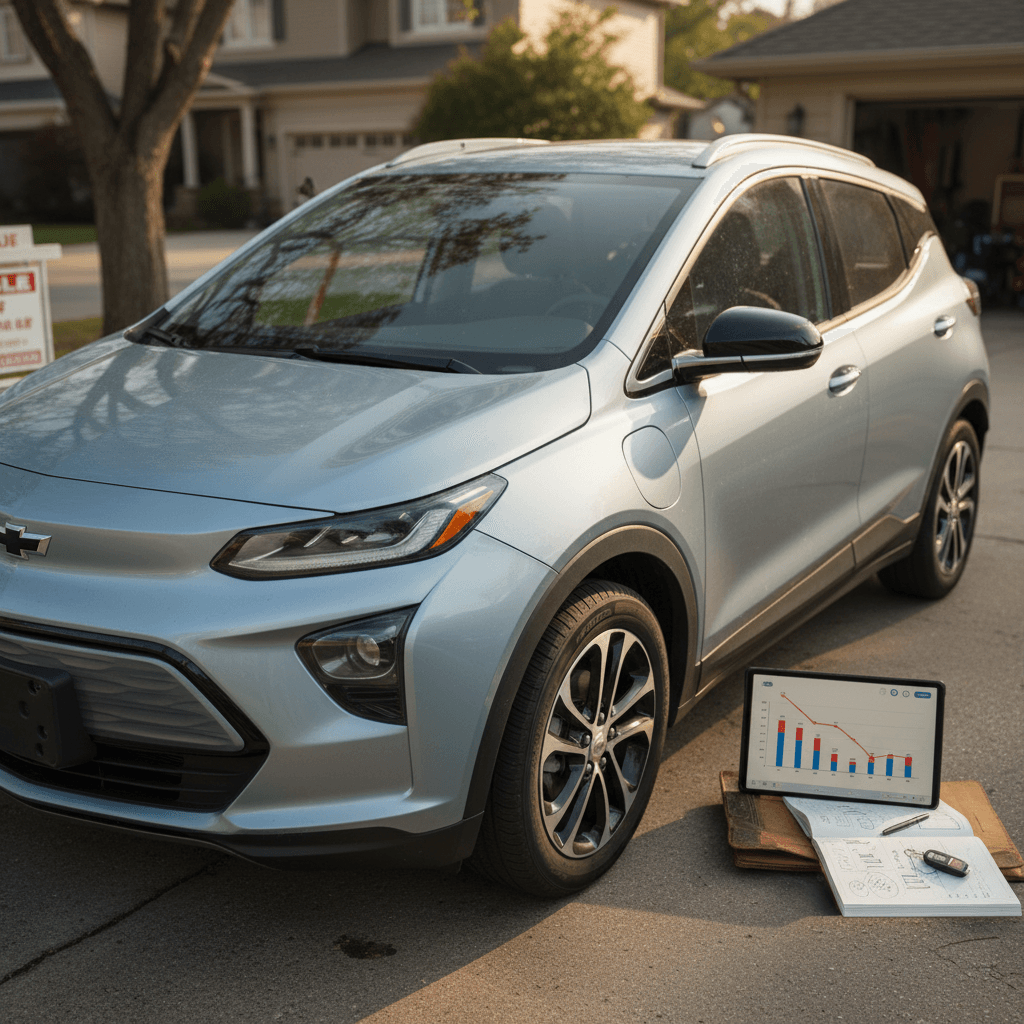
If you own a Nissan Ariya and are thinking about trading it in, you’re in a tricky but manageable moment. The Ariya has seen fast price drops, above-average depreciation, and a planned U.S. discontinuation after the 2025 model year, all of which directly affect your trade-in value, today and over the next few years.
Quick takeaway
Why Nissan Ariya trade-in values are in the spotlight
The Nissan Ariya arrived as Nissan’s follow-up to the Leaf, aiming at the same crowded segment as the Tesla Model Y, Hyundai Ioniq 5, and Ford Mustang Mach-E. Strong competition, price cuts, and changing EV incentives have pushed used Ariya prices down faster than many owners expected. On top of that, Nissan has confirmed the Ariya will leave the U.S. lineup after the 2025 model year, which is already shaping buyer and dealer expectations about long‑term value.
Put simply: the Ariya is a well-reviewed EV, but in today’s market it’s a “value EV” on the used side. That’s good news if you’re buying, but it means you need to be smart and deliberate if you’re trading one in.
What is my Nissan Ariya worth today?
Real-world used Nissan Ariya price ranges (early 2026)
As of early 2026, U.S. listings for 2024–2025 Nissan Ariya models commonly show asking prices in the low $20,000s up to the mid‑$30,000s, depending on trim, mileage, and equipment. Entry trims like Engage and Venture+ tend to cluster in the low‑$20Ks, while better‑equipped Evolve+ and Platinum+ models can still push into the high‑$20Ks and beyond when mileage is low.
A trade-in value is usually lower than what you see on retail sites. Dealers need margin for reconditioning, warranty, and profit, so it’s common to see offers in the mid‑ to high‑teens for higher‑mileage base trims, and into the low‑ to mid‑$20Ks for clean, later‑model, higher‑trim vehicles.
Numbers change fast
How trade-in value is calculated for an Ariya
Every dealer uses a slightly different formula, but most Nissan Ariya trade-in values start with the same three ingredients: auction data, retail comps, and risk.
The three levers behind your Ariya trade-in offer
1. Market data
2. Vehicle specifics
3. Risk & strategy
This is why online pricing tools can feel disconnected from the real offers you receive. They’re modeling averages. Your particular Ariya, its history, its battery health, and the ZIP code where you’re selling, can easily move you several thousand dollars above or below the “book.”
Depreciation: Are Nissan Ariyas good at holding value?
In a word, no. Relative to other compact electric SUVs, the Ariya has shown steeper‑than‑average depreciation so far. Price cuts on new models, competition from Tesla and the Korean brands, and the planned U.S. exit after 2025 have all contributed to faster value loss.
Illustrative depreciation on a recent Nissan Ariya
Approximate values for a well‑equipped Ariya trim, based on typical market patterns. These are directional examples, not individual appraisals.
| Ownership stage | Approx. age | Typical position vs. original MSRP | What that means in trade-in terms |
|---|---|---|---|
| Early ownership | 1–2 years old | Down ~30–40% | Many clean, low‑mile Ariyas still trade in the mid‑ to high‑$20Ks instead of the $40Ks they originally cost. |
| Middle years | 3–4 years old | Down ~45–55% | Trade-in offers often slide into the upper teens or low‑$20Ks for volume trims. |
| Later years | 5+ years old | Down 60%+ | Battery health and warranty status dominate. Strong packs with documentation may still attract decent offers; weak or uncertain packs are heavily discounted. |
Real offers will depend on trim, battery size, mileage, region, and condition.
Discontinuation cuts both ways
Battery health: the silent driver of Ariya value
On any EV, not just the Ariya, the traction battery is the single most expensive component. For buyers and dealers, its condition is the difference between a mature but serviceable EV and a future science project. Two Ariyas that look identical on the outside can deliver very different trade-in values if one pack has aged gracefully and the other has lost a big chunk of usable range.
- Ariya battery warranty coverage is generally 8 years / 100,000 miles against excessive capacity loss, which reassures second and third owners as long as the car is under that window.
- Visible range loss (for example, an Ariya that used to show ~265 miles when new now showing ~210–220 on a full charge) will make detail‑oriented buyers and dealers wary.
- Dealers rarely have deep EV diagnostics in‑house, so if they’re flying blind on pack health, they assume the worst, and bake that into your trade-in number.
Why a battery health report pays for itself
Other factors that move your Ariya trade-in price
6 common levers on Nissan Ariya trade-in value
Mileage & use
Cosmetic condition
Accident & title history
Your ZIP code
Trim & options
Incentives & rates
How to get the most for your Nissan Ariya
You can’t control macro‑level EV pricing, but you have significant influence over your individual Nissan Ariya trade-in value. Think of it as proving two things to the next owner: that the car is healthy and that it’s been cared for.
Practical steps to boost your Ariya trade-in offer
1. Gather your service and charging history
Collect maintenance invoices, tire rotations, brake checks, and any software updates. If you’ve mostly charged at home and avoided chronic fast‑charging, note that too, it’s a positive signal for battery longevity.
2. Get objective battery health documentation
Consider a third‑party battery health report before you shop the car. At Recharged, every vehicle gets a Recharged Score report with verified pack diagnostics, which we use to price the car transparently for both seller and buyer.
3. Fix inexpensive cosmetic issues
Professional detailing, paintless dent repair, and inexpensive wheel touch‑ups can improve first impressions without overspending. Skip big cosmetic projects that won’t fully pay back in added value.
4. Know your numbers before visiting a dealer
Use multiple sources, online price guides, local listings, and at least one written offer, to build a realistic range for your Nissan Ariya trade-in value. Going in blind makes it easier for a low offer to feel inevitable.
5. Get more than one offer
Especially with a niche EV like the Ariya, different buyers will value it differently. Compare a traditional dealer trade‑in, an instant‑offer service, and a used‑EV specialist like Recharged before you decide.
6. Time your move if you can
If you’re close to a mileage break point (say, just under 30,000 miles) or a major service, it may pay to trade slightly earlier so the next owner gets that value instead of the cost.
Leverage your Ariya’s strengths
Trade-in vs. selling your Ariya on consignment
Traditional trade-in
- Fast & simple: You hand the Ariya to a dealer and apply the value to your next vehicle in one transaction.
- Lower price: You’re effectively wholesaling the car, so the dealer keeps the spread between your trade-in and eventual retail price.
- Good for: Owners who prioritize convenience, need to roll equity quickly, or have a more common spec that won’t stand out much in retail listings.
Consignment or marketplace sale
- Higher potential payout: You capture more of the final retail price because you’re not accepting a wholesale number.
- More time & coordination: You (or a marketplace partner) handle marketing, showings, and buyer questions.
- Good for: Well‑optioned trims, low‑mile examples, or Ariyas with documented strong battery health that deserve to be shopped to EV‑savvy buyers.
Where Recharged fits in
How Recharged handles Nissan Ariya trade-ins
Recharged was built around one simple idea: used EVs deserve their own playbook. The Nissan Ariya is a perfect example. It’s a solid product wrapped in complex market dynamics. Our process is designed to surface the real story of your car and reflect that in the offer, not just follow a generic depreciation curve.
What to expect if you bring your Ariya to Recharged
Expert EV intake
Recharged Score battery diagnostics
Transparent pricing & selling paths
Ready to find your next EV?
Browse VehiclesIf you choose to sell through Recharged, we handle marketing, buyer education, paperwork, and even nationwide delivery. That’s especially useful for models like the Ariya, where demand may be limited in your local area but stronger in EV‑dense regions.
FAQ: Nissan Ariya trade-in value
Frequently asked questions about Nissan Ariya trade-in value
Bottom line on your Nissan Ariya trade-in
The Nissan Ariya hasn’t been a resale superstar, and there’s no way around that. But your personal Nissan Ariya trade-in value isn’t locked to the average curve. Battery health, documentation, condition, and where, and with whom, you choose to sell can swing your outcome by thousands of dollars.
If you’re ready to move on, start by understanding realistic price ranges in your area, then put your Ariya’s best attributes on paper: a clean history, healthy battery, and well‑maintained interior and exterior. From there, compare options: a quick dealer trade, an instant offer, or a more strategic sale through an EV‑focused marketplace like Recharged that knows how to tell your car’s story.
In a used EV market this dynamic, information is leverage. The more clearly you can demonstrate the true condition of your Ariya, especially its battery, the closer you’ll get to the value it deserves when it’s time to hand over the keys.