If you’re eyeing a Nissan Ariya, or already driving one, you’ve probably seen the brochure promise: 10–80% in around 35–40 minutes on a DC fast charger. That sounds great on paper, but how does the Nissan Ariya actually perform in real‑world charging speed tests at public stations, on cold mornings, and midway through a long highway slog?
At a glance
Why Nissan Ariya charging speed matters
Charging speed tests aren’t just YouTube fodder. They answer the question you actually care about: How long am I sitting at this charger? The Ariya is a comfortable, quiet SUV, but if you’re stacking 30–40‑minute sessions on a family road trip, those minutes add up. Understanding its real charging performance helps you decide whether the Ariya fits your lifestyle, and if you’re shopping used, whether a specific car is behaving like it should.
Who should care about Ariya charging speed tests?
If any of these sounds like you, read on.
Current Ariya owners
Shoppers & road‑trippers
Used EV buyers
Nissan Ariya battery sizes and charging basics
Before we talk speed tests, it helps to understand what’s under the floor. The Ariya launched with two main battery sizes and supports both home and DC fast charging via CCS in North America.
Nissan Ariya battery & charging specs (overview)
Numbers are rounded; individual trims may vary slightly.
| Battery size | Approx. usable capacity | Peak DC fast charge power | Typical 10–80% DC time (strong charger) | Level 2 0–100% time |
|---|---|---|---|---|
| 63 kWh pack | ~63 kWh | Up to ~130 kW | ~35 minutes | ~10.5 hours |
| 87 kWh pack | ~87 kWh | Up to ~130 kW | ~40 minutes | ~14 hours |
Both Ariya battery sizes support similar peak DC fast‑charging power, but the larger pack naturally takes longer to refill.
Quick translation
Factory claims vs. real‑world charging results
Nissan’s own materials are reasonably honest about Ariya charging. They publish 10–80% in about 35 minutes for the 63 kWh pack and about 40 minutes for the 87 kWh pack on a high‑power DC charger, with peak power listed at up to 130 kW.
Nissan Ariya fast‑charging by the numbers
Independent road tests on 87 kWh Ariya models have seen peak power right around 130 kW, but the more useful figure is the average power over the whole 10–80% or 10–90% window. That average tends to land near 100 kW, which lines up with real‑world 10–80% times in the mid‑30s to around 40 minutes when conditions cooperate.
Don’t chase the peak number
DC fast charging speed test: what we see in the wild
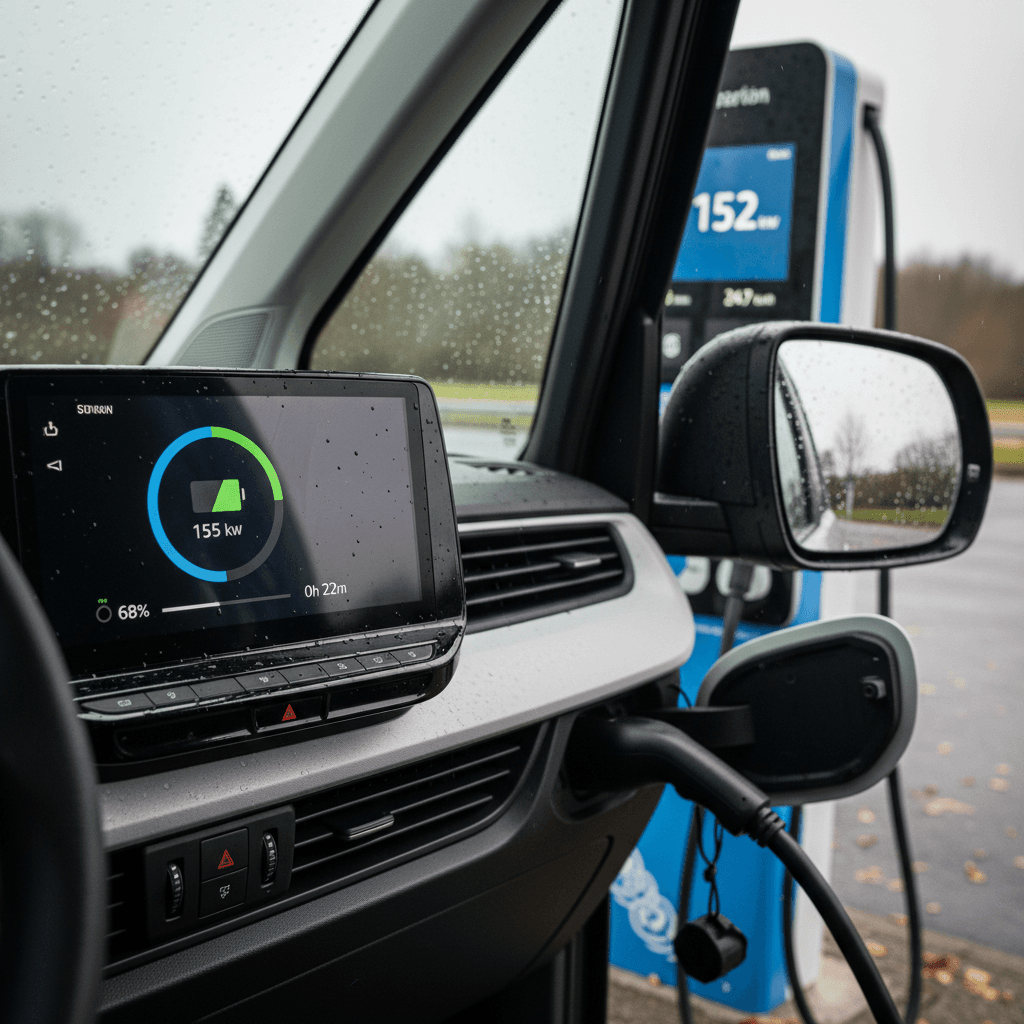
Take a typical scenario: you roll into a 150 kW CCS station on the highway in your 87 kWh Ariya at around 15% state of charge. The battery is warm from driving. Here’s the rough charging curve owners and testers consistently report:
- From 10–30%: power ramps quickly toward ~120–130 kW.
- Around 30–50%: it hangs in the 110–120 kW neighborhood.
- From 50–70%: the taper begins; you’ll often see 80–100 kW.
- From 70–80%: power steps down again, often in the 60–80 kW range.
- Beyond 80%: expect a steep taper, sometimes down into Level‑2‑like speeds as it protects the battery.
Real‑world 10–80% timing
63 kWh Ariya (smaller pack)
- Lighter battery to refill, so 10–80% can be a few minutes quicker on the same charger.
- Often the more efficient trims, so each kWh added translates to a bit more range.
- Best suited for drivers who mostly fast charge occasionally, not nonstop cross‑country road‑trippers.
87 kWh Ariya (larger pack)
- Same ~130 kW peak, but more energy to stuff in, so 10–80% often sits near the 40‑minute mark.
- You gain more absolute miles per stop, which can mean fewer sessions per day on a long trip.
- Better choice if you like to stretch legs between charges rather than stop every couple of hours.
How the Ariya’s charging compares to rivals
Here’s where we need to be blunt: the Nissan Ariya charges respectably, but it’s not at the sharp end of the fast‑charging pack. HyundaI Ioniq 5/6 and Kia EV6 can gulp power at up to 230–350 kW on an 800‑volt architecture, routinely posting 10–80% in about 18–20 minutes. Tesla’s Model Y doesn’t hit those peak numbers but benefits from a highly optimized charging network and similar mid‑20‑minute 10–80% sessions on a strong Supercharger.
Nissan Ariya vs key rivals: fast‑charging snapshot
Approximate figures on strong DC fast chargers; exact numbers vary by trim, conditions, and network.
| Model | Peak DC power | Typical 10–80% time | Charging architecture |
|---|---|---|---|
| Nissan Ariya (63/87 kWh) | Up to ~130 kW | ~35–40 minutes | 400 V |
| Hyundai Ioniq 5 | Up to 230–350 kW | ~18–20 minutes | 800 V |
| Kia EV6 | Up to 230–350 kW | ~18–20 minutes | 800 V |
| Tesla Model Y | Up to ~250 kW | ~25 minutes (Supercharger) | 400 V (Tesla‑optimized) |
The Ariya’s 130 kW peak and ~40‑minute 10–80% times are competitive with some legacy EVs but behind the very fastest new platforms.
Where the Ariya still works well
Level 2 home and public charging speeds
Most Ariya owners will do the bulk of their charging on Level 2, either at home or at destination chargers. Here the Ariya is right in the mainstream of modern EVs.
Level 2 charging: what to expect with an Ariya
Numbers assume a typical 7–7.4 kW residential home charger.
63 kWh battery
- Approx. 10.5 hours from 0–100%.
- Overnight top‑offs from 30–80% are usually just a few hours.
- Perfect for typical daily commuting and errands.
87 kWh battery
- Roughly 14 hours from empty to full.
- Plan on plugging in most nights if you drive a lot.
- Destination Level 2 at 7–11 kW can comfortably refill during a long dinner or hotel stay.
Don’t obsess over 0–100%
5 factors that slow your Ariya’s charging speed
If your own Nissan Ariya charging speed tests are coming up slower than the numbers above, it doesn’t automatically mean something’s wrong with the car. Start by looking at these common culprits:
Top reasons your Ariya charges slower than expected
1. Weak or shared DC fast charger
A 150 kW sticker doesn’t guarantee 150 kW in practice. Stations can be power‑limited, share power between stalls, or throttle output when they’re hot or crowded. If every EV at that site is charging slowly, blame the hardware, not your Ariya.
2. Cold battery or very hot weather
Lithium‑ion packs hate extremes. On a frigid morning, your Ariya may restrict power until the battery warms up. In blazing summer heat, it may also cut power sooner to protect itself. Expect slower ramps and earlier tapering in those conditions.
3. High state of charge on arrival
Fast charging is fastest at low states of charge. If you plug in at 55–60% because the station happened to be convenient, your Ariya may only accept 60–80 kW and then quickly taper. For speed tests, try to arrive closer to 10–20%.
4. Older software or battery conditioning behavior
Some EVs get charging‑curve improvements via software updates; others simply don’t pre‑heat the battery as aggressively as rivals. If your Ariya is older, ask a dealer to confirm it has <strong>current software</strong> and that there are no open service bulletins about charging.
5. Hidden battery or connector issues
If you consistently see glacial charging on multiple networks, in mild temperatures, starting at low state of charge, it’s worth having the car inspected. A weak module, damaged connector, or other fault can all slow charging, and it’s exactly the kind of thing a good battery health report should surface.
Watch for outliers
How to charge your Ariya faster on road trips
You can’t rewrite Nissan’s charging curve, but you can drive, and charge, in a way that plays to the Ariya’s strengths. Think like a long‑distance tester and you’ll shave meaningful minutes off each stop.
Plan around 10–60%, not 10–90%
The Ariya slows down noticeably past about 70–80%. On a big trip, time your stops so you arrive near 10–15% and unplug around 60–70% instead of waiting for a near‑full battery.
- You’ll get more miles per minute of charging.
- Yes, you may add an extra stop, but each one is shorter.
Warm the battery before you plug in
The best Ariya charging speed tests happen when the battery is already warm from driving. Try this:
- Drive at highway speeds for at least 20–30 minutes before a major DC session.
- Avoid long sits right before charging in very cold weather.
- If your navigation supports it, set the charger as a destination so the car can pre‑condition the pack (on compatible trims/software).
Practical tips to keep fast charging…fast
Small habits that add up over a full day behind the wheel.
Use multiple apps
Charge while you rest
Monitor patterns
Used Nissan Ariya: what charging tests to do
If you’re buying a used Nissan Ariya, a charging speed test is one of the simplest ways to check whether the battery and thermal systems are aging gracefully. You’re not just looking for a magic kW number; you’re checking that the car behaves like a healthy Ariya should.
Simple charging tests for a used Ariya
1. Run one solid DC fast‑charge session
On a test drive day, plan a stop at a reputable 150 kW+ CCS charger. Arrive near 15–20% charge, plug in, and note peak power, average power, and time from ~10–80%. You’re aiming to see behavior in that <strong>35–40‑minute</strong> ballpark.
2. Compare Level 2 behavior at home or dealer
If possible, plug into a known good 32–40 A Level 2 charger and confirm the car pulls roughly what you expect (around 7 kW). Wildly low power here may point to onboard‑charger or wiring issues.
3. Ask for a battery health report
Battery diagnostics can reveal deeper issues than a one‑time charging test. A structured report should highlight <strong>usable capacity, degradation, and any fault codes</strong> related to charging or thermal management.
4. Look for consistency, not perfection
A single session that peaks at 120 kW instead of 130 kW isn’t a red flag. What you don’t want to see is <strong>every session crawling along</strong> at 30–40 kW on big hardware with no obvious environmental explanation.
How Recharged helps with used Ariya shopping
FAQ: Nissan Ariya charging speed
Frequently asked questions about Nissan Ariya charging tests
Bottom line: Is the Nissan Ariya fast enough to live with?
If you’re chasing the absolute quickest 10–80% times on the market, the Nissan Ariya isn’t your winner. Its ~130 kW peak and ~40‑minute 10–80% sessions put it a step behind the ultra‑fast 800‑volt crowd. But if you value a calm, comfortable cabin, straightforward driving manners, and you’re willing to bake 20–30‑minute pauses into your day, the Ariya’s charging performance is entirely workable, and predictable, which counts for a lot on the road.
For current owners, use the guidance in this charging speed test to sanity‑check your own results and tweak your road‑trip strategy. For shoppers, especially in the used market, pair a real‑world fast‑charge test with a verified battery health report. At Recharged, every used EV, including the Nissan Ariya, comes with a Recharged Score that pulls those threads together so you can see at a glance how the battery is aging, how it’s likely to charge, and whether the car fits the way you really drive.