If you’re considering a Nissan Ariya, especially a used one, the question on your mind is probably simple: how long will the Ariya’s battery last before range really becomes a problem? The good news is that early data and Nissan’s own design choices point to a battery that should comfortably outlive the typical 8–10 year ownership cycle when treated reasonably well.
Quick answer
Nissan Ariya battery lifespan at a glance
Nissan Ariya battery life: key numbers
Ariya battery packs, range and chemistry basics
To understand Nissan Ariya battery lifespan, it helps to know what’s actually under the floor. Every Ariya sold in the U.S. uses a liquid‑cooled lithium‑ion pack with one of two usable capacities:
- 63 kWh usable pack – standard battery, found on trims like Engage. In U.S. EPA testing it delivers roughly mid‑200s miles of rated range depending on wheel size and drivetrain.
- 87 kWh usable pack – long‑range battery, available with both front‑wheel drive and e‑4ORCE all‑wheel drive. EPA range can reach around 300 miles in the most efficient FWD trims.
- Liquid‑cooled thermal management – unlike the early air‑cooled Leaf, the Ariya circulates coolant through the pack, keeping cell temperatures in a healthier band during fast charging and in hot or cold weather.
- Conservative usable window – Nissan holds back a few kWh at the top and bottom of the pack, so “0%–100%” on the gauge is not the true physical limit. That hidden buffer helps slow down degradation.
Ariya vs. old Leaf
What we know so far about Nissan Ariya battery degradation
The Ariya only started reaching U.S. customers in 2023, so we don’t yet have a decade of hard data. But owner reports, dealer diagnostics and Nissan’s broader EV experience give us a solid early picture of how the Ariya battery is aging so far.
Early Nissan Ariya degradation: the emerging pattern
What owners and data are telling us through 2024–2025
Slow, predictable loss
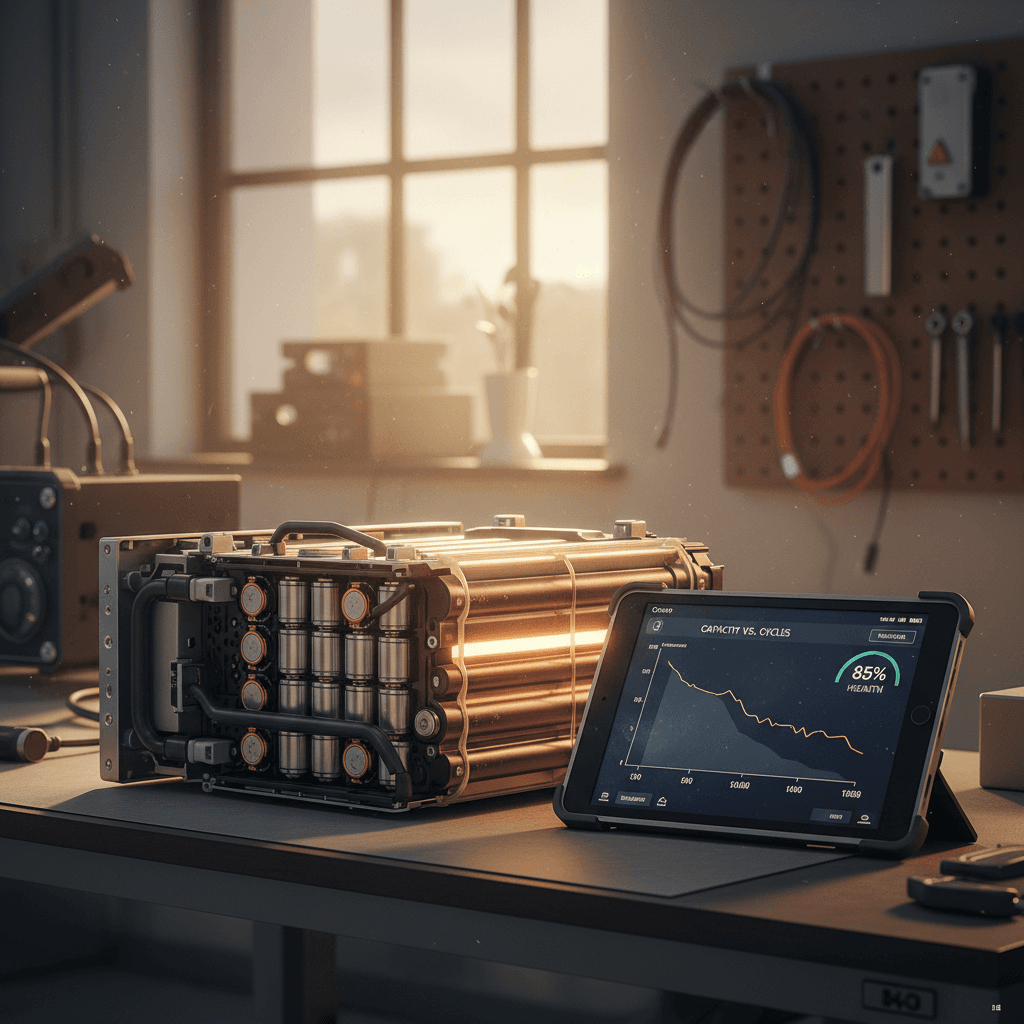
Multiple Ariya owners with roughly 20,000–40,000 miles report battery health readings in the mid‑ to high‑90% range when scanned with dealer tools or OBD apps. That suggests modest, linear‑ish degradation rather than sudden early drops.
Displayed vs. real health
Nissan likely uses a generous buffer and software smoothing, so the state‑of‑health number you see isn’t a perfect window into raw cell chemistry. The upside: you’re less likely to notice small swings, and the pack is protected from drivers living at the extremes.
Range loss vs. degradation
In cold weather, many owners see dramatic temporary range loss at low temperatures. That’s not long‑term degradation; it’s just physics. As the pack warms up in spring, usable range returns close to normal for that age and mileage.
Put simply, there’s no sign of a systemic Ariya battery problem so far. Early builds are seeing the kind of slow, managed capacity loss you’d expect from a modern, liquid‑cooled pack operating within conservative limits.
Interpret early data carefully
Warranty: how long Nissan stands behind the Ariya battery
Beyond chemistry, the most concrete signal you get about how long a Nissan Ariya battery should last is its warranty. Here’s how Nissan frames it in the U.S. market:
Nissan Ariya battery warranty overview (U.S.)
How Nissan’s battery coverage stacks up against common EV standards.
| Coverage element | Nissan Ariya | What it means for you |
|---|---|---|
| Basic battery warranty | 8 years / 100,000 miles | If the high‑voltage battery falls below Nissan’s capacity threshold (around 70%) within this period, it’s eligible for repair or replacement. |
| Capacity guarantee | ≈70% state of health | Nissan explicitly covers excessive capacity loss, not just outright failures, important protection as the pack ages. |
| Transferability | Yes, to subsequent owners | If you buy a used Ariya that’s still within 8 years/100k miles, you inherit the remaining battery coverage. |
| Industry comparison | In line with most major brands | Volkswagen, Hyundai, Kia, Ford and others commonly offer similar 8‑year/100k/70% guarantees. |
Coverage may differ slightly in Canada or other regions, always confirm with local documentation.
Why this warranty matters for used buyers
Ready to find your next EV?
Browse VehiclesWhat really shortens, or extends, an Ariya battery’s life
The question isn’t just “how long does a Nissan Ariya battery last?” It’s really “under what conditions?” The same pack can live a very different life in Minnesota than in coastal California, or in the hands of a road‑trip warrior vs. a gentle commuter.
Habits that shorten battery life
- Living at 100% all the time – Regularly parking for days on end at a true full charge increases cell stress, especially in hot climates.
- Frequent DC fast charging from low states of charge – Using 130 kW fast chargers occasionally is fine, but hammering the pack from under 10% to near 100% several times a week will age it faster.
- Extended heat exposure – Parking in full sun for years in very hot regions is tough on any lithium‑ion pack, even with cooling.
- Hard driving right after fast charging – Piling on aggressive acceleration when the pack is already warm keeps cell temperatures elevated.
Habits that extend battery life
- Daily charging to a moderate level – Living between roughly 20–80% for day‑to‑day use is easier on the pack than constantly topping off to full.
- Mix of Level 2 and fast charging – Using home or workplace Level 2 for most charging and saving DC fast charging for trips keeps thermal stress in check.
- Reasonable storage SOC – If you leave the Ariya parked for weeks, storing it around 40–60% and in the shade is ideal, though not mandatory.
- Letting the car manage temperature – The Ariya’s liquid‑cooling system and software are designed to keep the battery in a healthy temperature window. Trust that system rather than micro‑managing.
Don’t obsess over perfection
How long can a Nissan Ariya battery last in the real world?
When people ask “Nissan Ariya battery lifespan: how long?” they’re usually trying to map years and miles to a simple answer. The honest answer is a range, not a single number, but we can set realistic expectations based on current EV norms and the Ariya’s design.
Realistic Nissan Ariya battery lifespan scenarios
Approximate outcomes assuming you start with an 87 kWh FWD Ariya rated around 300 miles of EPA range. Numbers are illustrative, not guarantees.
| Use case & climate | Annual mileage | 10‑year outcome | 15‑year outcome |
|---|---|---|---|
| Gentle commuter, mild climate | 8,000–10,000 mi/yr | Battery still likely above ~80% capacity; effective range maybe 230–250 miles. | Battery may dip closer to 70–75% capacity but still perfectly usable for daily driving. |
| Mixed driving, average U.S. climate | 12,000–15,000 mi/yr | Battery in the ~75–85% band is a reasonable expectation; range more like 200–240 miles. | If kept, pack may hover near the warranty threshold, but many owners won’t keep the car this long. |
| Heavy fast‑charging, hot climate | 18,000–20,000+ mi/yr | Higher degradation risk; could approach 70% by year 8–10 if heavily abused. | Beyond 10 years, range might be significantly reduced, making a pack repair or replacement an economic question. |
Range estimates assume similar driving conditions and climate over time.
Zooming out, for most owners the Ariya’s high‑voltage battery is likely to be a 15‑year component or longer. Other wear items, suspension, interior, infotainment hardware, are more likely to limit the practical life of the vehicle before the pack truly “wears out.”
Shopping used? Ariya battery health checklist
If you’re eyeing a used Ariya, battery lifespan isn’t theoretical, it’s a line item in your buying decision. Here’s a practical checklist to make sure the pack fits your expectations before you commit.
Used Nissan Ariya battery health checklist
1. Verify build year and in‑service date
The 8‑year/100,000‑mile battery warranty starts from the original in‑service date, not model year. Ask for paperwork or use a VIN report so you know exactly how much coverage remains.
2. Confirm odometer and DC fast‑charging history
Higher mileage isn’t bad by itself, but heavy DC fast‑charging use can accelerate aging. Some service records or telematics reports note fast‑charge frequency; if not, at least align the seller’s story with past usage (e.g., lots of road trips vs. short‑hop commuting).
3. Get a real battery health reading
Ask the seller for a recent dealer battery report or have a shop pull the pack’s state of health with diagnostic tools. A one‑time range guess from the dash isn’t enough to judge long‑term <strong>Nissan Ariya battery health</strong>.
4. Compare range to original EPA ratings
Look up the specific trim’s original EPA range and compare it to what the seller sees at 100% on a warm day. Some drop is normal; a huge gap might indicate harder use, cold weather, or simply a trip computer that’s been trained by short drives.
5. Check for software updates and recalls
Battery management system (BMS) updates can improve how the car estimates and protects the pack. Confirm any relevant campaigns or recalls are complete; a Nissan dealer or EV‑savvy shop can help.
6. Use independent diagnostics when possible
Every EV listed on <strong>Recharged</strong> comes with a Recharged Score Report, which includes a third‑party battery health assessment, fair‑market pricing, and expert notes. That takes much of the guesswork out of buying a used Ariya.
Simple habits to preserve your Ariya’s battery day to day
You don’t need to obsess over spreadsheets to get good Nissan Ariya battery lifespan. A handful of easy practices will capture most of the benefit modern battery management can offer.
- Use home or workplace Level 2 for most charging. It’s convenient and gentler on the pack than relying constantly on DC fast charging.
- Don’t panic about 100%, but avoid parking at full for days. Charging to 100% for a trip is fine; just try not to leave the car sitting at true full charge, especially in summer heat.
- Plan fast‑charge sessions around the middle of the pack. Fast‑charging from about 15–70% is less stressful than squeezing the last few percent at the top.
- Precondition in extreme weather. When available, letting the car warm or cool the cabin (and pack) while plugged in reduces strain compared with heating or cooling purely from the battery on the road.
- Watch for sudden, unexplained drops. If range falls off a cliff compared with last season under similar conditions, that’s worth a diagnostic check, especially while under warranty.
Don’t ignore the 12‑volt battery
FAQ: Nissan Ariya battery lifespan & degradation
Frequently asked questions about Nissan Ariya battery life
Bottom line: is the Nissan Ariya battery built to last?
If you strip away the marketing and look at the engineering, warranty and early owner data, the picture is reassuring: the Nissan Ariya battery appears to be built for the long haul. With liquid cooling, conservative usable capacity and an 8‑year/100,000‑mile, ~70% capacity warranty, Nissan is signaling that the pack should outlast the way most people actually own cars.
That doesn’t mean you can abuse it without consequence. Heavy fast‑charging in brutal heat and parking at full charge forever will eventually show up as lost range. But for drivers who mostly charge at home or work, use DC fast charging when they need to, and avoid chronic extremes, the Ariya’s battery is on track to be a 10‑ to 15‑year component.
If you’re shopping used, pairing Nissan’s warranty with an independent assessment, like the Recharged Score battery health diagnostics included with every EV sold on Recharged, gives you a clear, data‑driven picture of how a particular Ariya has aged. And that’s ultimately what matters: not just how long the average pack might last in theory, but how well this specific car will fit your life for years to come.