If you’ve looked at EV listings lately, you’ve probably seen terms like NACS, CCS, “Tesla plug,” and “adapter included.” With most automakers switching to Tesla’s NACS connector but thousands of existing CCS-equipped cars and chargers still on the road, it’s fair to ask: what does NACS vs CCS actually mean for how you charge today, and for the EV you buy next?
The short version
Why NACS vs CCS matters more than ever in 2026
The great connector transition, by the numbers
This is the first time in modern car history that the *plug* on the car you buy can significantly change which fast-charging networks you can use, and how simple those sessions are. The good news is that the industry has largely converged on NACS in North America. The challenge is that we’re living through a multi‑year transition where millions of CCS vehicles and thousands of CCS-only stations will coexist with a rapidly growing NACS ecosystem.
Don’t panic if your car has CCS
NACS and CCS in plain English
What is NACS?
NACS stands for North American Charging Standard. It began life as Tesla’s proprietary connector in the U.S. and Canada and was later opened and standardized under SAE J3400. Key points:
- Uses a compact, lightweight plug for both AC and DC charging.
- Is the native connector on most Tesla vehicles in North America.
- Is being adopted by major automakers (Ford, GM, Hyundai–Kia, Mercedes, VW Group, and more) starting with 2025 model years and beyond.
- Is standard on Tesla Superchargers and increasingly common on new high-power sites from joint ventures like Ionna.
What is CCS?
CCS stands for Combined Charging System. In North America you’ll see it labeled as CCS1. It was developed by a consortium of automakers and suppliers as an open standard.
- Uses a larger connector: J1772 AC pins plus two DC power pins below.
- Is native on most non-Tesla EVs sold in North America up through the early–mid 2020s.
- Is standard at virtually all non‑Tesla DC fast-charging networks (Electrify America, EVgo, ChargePoint DC, etc.).
- Will continue to be supported on new stations, often alongside NACS.
From your point of view as a driver, NACS and CCS are simply two different-shaped plugs that both support slow AC and fast DC charging. The deeper differences, communication protocols, pin layout, and standardization processes, matter mostly to charger manufacturers and automakers. What you care about is: **Where can I plug in, how fast will it charge, and how many adapters do I have to juggle?**
Connector design: size, shape, and ease of use
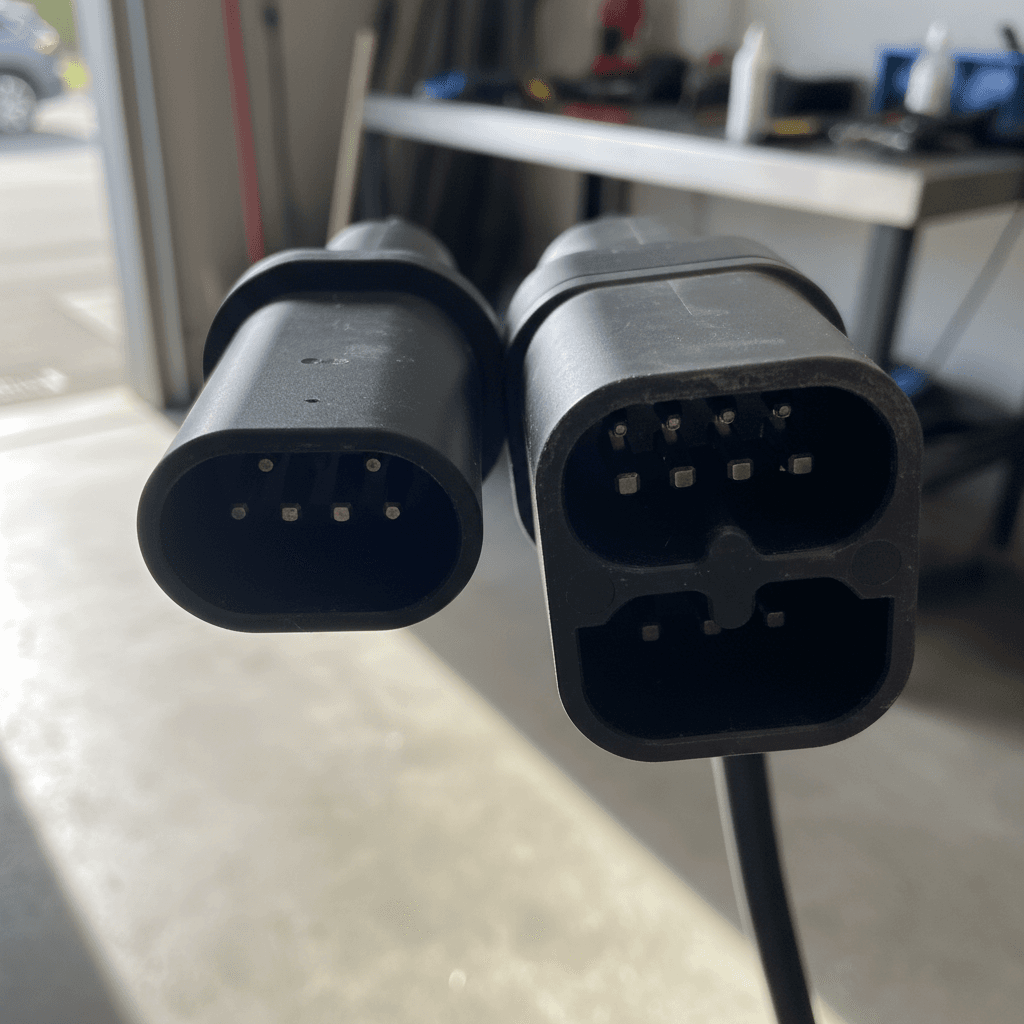
How NACS and CCS connectors compare in everyday use
Form factor matters when it’s freezing, dark, or you’re stretching to reach a port.
NACS: compact and lightweight
- Smaller plug that’s easy to handle with one hand.
- Cable is usually thinner for a given power level, thanks to efficient design and cooling.
- Same connector handles AC (home and Level 2) and DC fast charging.
- Feels familiar if you’ve used a gasoline pump, grab, plug, done.
CCS1: functional but bulky
- Larger connector with more plastic housing and bigger pins.
- Cables can be thick and heavy on high‑power units.
- Separate J1772 inlet for AC on the car plus the DC pins below.
- Not a deal‑breaker, but more awkward for people with limited strength or when ports are in odd locations.
Real‑world usability tip
Charging speed: does NACS actually charge faster?
There’s a persistent myth that one standard is “faster” than the other. In practice, **charging speed is limited more by your car and the charger hardware than by the connector shape**.
Technical headroom: NACS vs CCS1
Both standards can support far more power than today’s passenger EVs typically sustain, especially at 400 V battery voltages.
| Feature | NACS (SAE J3400) | CCS1 |
|---|---|---|
| Max DC voltage (typical passenger EVs) | Up to ~1,000 V | Up to ~1,000 V |
| Current rating (connector standard) | No fixed hard cap; designs commonly target 500–600 A+ with cooling | Typical high‑power hardware around 500 A with liquid cooling |
| Peak power possible (theoretical) | 400 kW+ with high‑amp designs | 400 kW+ with latest CCS hardware |
| Real‑world car limits (2024–2026 EVs) | Often 150–270 kW peak depending on model | Often 100–270 kW peak depending on model |
Connector ratings are not usually the limiting factor, battery architecture, thermal management, and charger capability matter more.
In other words, a 2025 Hyundai Ioniq 5 or Kia EV6 will charge at roughly the same speed on a 350 kW CCS charger as it will on a high‑power NACS charger, assuming similar site quality and conditions. The plug doesn’t make a slow‑charging car fast or vice versa.
What actually controls your charging speed
Network access: Superchargers, CCS sites, and new hubs
Where the standards debate does matter is **which networks you can use easily**. Until recently, the picture looked like this: Tesla owners had NACS and near‑frictionless access to Superchargers, while non‑Tesla drivers relied on CCS networks with more fragmented reliability. That’s changing quickly.
Fast-charging landscape in North America (2026 snapshot)
Different connector standards are converging on similar stations.
Tesla Superchargers
- Historically NACS‑only, Tesla‑only.
- Now increasingly support non‑Tesla CCS cars via built‑in adapters (Magic Dock) or driver‑supplied adapters.
- Newer stalls often include NACS hardware that can serve both Tesla and non‑Tesla EVs.
Legacy CCS networks
- Electrify America, EVgo, ChargePoint DC, FLO and others primarily offer CCS plus CHAdeMO.
- Many new stations add NACS plugs alongside CCS1 to serve both types natively.
- CCS will remain essential for older EVs (and for some fleets) well into the 2030s.
New joint‑venture hubs
- Networks like Ionna (BMW, GM, Hyundai–Kia, Mercedes, Stellantis, Honda, Toyota) are building high‑amenity sites.
- Most new hubs open with both CCS1 and NACS connectors from day one.
- Designed to support 400 kW‑class charging and 400–800 V architectures.
How this feels as a driver
Adapters and compatibility: who needs what?
Adapters are the bridge technology that lets CCS cars use NACS sites (especially Superchargers) and, in some cases, NACS‑equipped cars use CCS sites. As of 2026, most major automakers that announced NACS adoption also provide or sell factory‑approved adapters for their existing CCS fleets.
Common charging scenarios and the adapter you’ll need
This table focuses on North American passenger EVs in 2024–2026. Always confirm details with your vehicle maker before purchasing third‑party hardware.
| Your car port | Charger plug | What you typically need | Notes |
|---|---|---|---|
| CCS1 (most 2019–2024 non‑Tesla EVs) | CCS1 at public fast charger | No adapter | Standard use case today. |
| CCS1 | NACS at Tesla Supercharger | Automaker‑supplied CCS→NACS adapter or Tesla‑approved adapter | Often provided free or discounted for a period; required for most Supercharger sites without Magic Dock. |
| CCS1 | NACS at non‑Tesla site (e.g., Ionna, updated EA) | Usually no adapter (station offers CCS plug too) | Most new sites include both CCS and NACS cables. |
| NACS native (many 2025+ EVs and Teslas) | NACS at Tesla Supercharger or new hubs | No adapter | Plug and charge, assuming your automaker has a Supercharger access agreement. |
| NACS native | CCS1 at legacy DC fast charger | NACS→CCS1 adapter (less common, sometimes third‑party) | Check that your automaker supports this for DC; many early adapters are CCS→NACS only. |
| Any EV with J1772 AC port | J1772 Level 2 public or home station | J1772 plug or simple J1772↔NACS adapter | Low‑power AC adapters are simpler and cheaper than DC fast‑charge adapters. |
Factory‑approved adapters are strongly recommended over generic third‑party units, especially for DC fast charging.
Safety first with adapters
Checklist: using NACS/CCS adapters without headaches
1. Confirm your automaker’s official stance
Before buying anything, check your manufacturer’s website or owner portal to see which adapters they support, whether they’re offering free or discounted units, and which networks your car is actually authorized to use.
2. Distinguish AC vs DC charging
Many inexpensive adapters are <strong>AC‑only</strong> (for Level 2/J1772 use). They do not work for DC fast charging. Make sure any adapter you consider explicitly states DC fast‑charge compatibility and current limits.
3. Double‑check power ratings
Look for current and voltage specs that match or exceed your car’s maximum DC charge rate. Using an underrated adapter can cause slow charging or automatic derating as the hardware heats up.
4. Inspect before each use
Check adapter pins and housing for discoloration, melting, or cracks, especially if you frequently fast charge. Stop using an adapter that shows any signs of damage.
5. Mind cable strain
High‑power cables are heavy. Support both the adapter and connector so the weight isn’t hanging entirely from your car’s inlet. This is especially important on older CCS inlets and early third‑party adapters.
Buying a used EV: does NACS vs CCS really matter?
If you’re shopping the used market, which is where Recharged focuses, the connector question feels especially tricky. Many of the best‑value EVs in 2026 (Chevy Bolt EUV, Hyundai Kona Electric, VW ID.4, Kia Niro EV, early Ford Mustang Mach‑E and F‑150 Lightning, and of course used Teslas) span both standards and multiple adapter strategies.
When connector type is a big deal
- You rely heavily on DC fast charging for road trips or apartment‑dwelling daily use. In this case, make sure your car has reliable, convenient access to both CCS and NACS corridors you’ll actually drive.
- You live far from robust CCS infrastructure but near dense Supercharger coverage. For a non‑Tesla, an automaker‑approved CCS→NACS adapter and confirmed Supercharger access matter a lot.
- You plan to keep the car 7–10 years. Choosing a model with a clear adapter roadmap or native NACS port can reduce long‑term friction.
When it matters less than you think
- You mostly charge at home on Level 2. For many owners, public fast charging is an occasional backup, not a daily lifeline.
- You live in a region with dense multi‑standard hubs (NACS and CCS at the same sites). In these areas, either connector works fine.
- You’re buying a value‑priced used EV primarily for commuting. Battery health, range, and price usually matter more than connector politics.
How Recharged helps de‑risk used EV charging
Key charging questions to ask when buying a used EV
Use these as a quick decision framework, not just a spec sheet exercise.
Where will I charge most?
If you can install or already have Level 2 at home, connector differences mostly affect road trips. If you’ll rely on public fast charging weekly, prioritize convenient NACS and CCS access along your regular routes.
What trips do I actually take?
Map your 3–4 most common long‑distance routes in apps like A Better Routeplanner or your automaker’s planner. Check how many CCS and NACS‑capable sites exist today and what’s planned in the next 2–3 years.
How healthy is the battery?
A car with slightly less‑than‑ideal connector support but a strong battery is often a better long‑term buy than the reverse. Degraded packs can make even the best charging network feel inadequate.
Where charging standards are headed next
The political fight is largely over: in North America, NACS is becoming the default DC fast‑charging connector on new EVs and new public sites, while CCS will remain an important compatibility layer for the existing fleet. For drivers, the next few years are about making this transition as painless as possible.
What the NACS–CCS transition looks like over time
If you own a CCS‑only EV today (2019–2024 era)
Confirm whether your automaker offers or plans to offer an official CCS→NACS adapter and what it costs.
Prioritize routes with strong CCS coverage and, where available, Superchargers that support your car via adapter or Magic Dock.
Expect CCS support at major highway sites for the life of your vehicle, but understand that the newest, nicest hubs may lean NACS‑heavy over time.
If you later upgrade, don’t over‑penalize a great used EV just because it’s CCS, focus on total ownership costs and charging where *you* live.
If you buy a NACS‑native EV (2025 and later)
Enjoy plug‑and‑play access to Tesla Superchargers and most new highway hubs from day one, assuming your automaker has signed an access agreement.
Keep an eye on whether your brand offers NACS→CCS adapters for older CCS‑only stations you might still encounter, especially off the beaten path.
Understand that home charging will likely use the same NACS inlet, your wallbox or mobile connector just speaks NACS instead of J1772.
As networks evolve, you’ll be on the standard most new U.S. infrastructure is targeting, which should reduce adapter juggling over time.
The big picture isn’t NACS versus CCS as a tribal fight. It’s about making sure a used Kona driver in Kansas and a new NACS‑equipped Hyundai driver in California can both find fast, reliable charging with minimal friction.
NACS vs CCS charging FAQ
Frequently asked NACS vs CCS questions
Key takeaways for today’s and future EV owners
- In North America, NACS is becoming the default connector on new EVs and public fast‑charging sites, but CCS will remain important for the existing fleet well into the 2030s.
- Charging speed is determined more by your EV’s battery and the charger hardware than by whether the plug is NACS or CCS.
- Adapters are a bridge technology, not a permanent annoyance, use factory‑approved hardware for DC fast charging and be wary of generic devices.
- If you mostly charge at home, connector politics matter less; if you live on the road or lack home charging, focus on real‑world network coverage for your routes.
- On the used market, don’t overreact to connector type. Prioritize battery health, realistic range, and verified charging options where you live and drive.
- Recharged’s combination of Recharged Score battery diagnostics, fair‑market pricing, and EV‑specialist guidance is designed to help you navigate this transition with confidence, whether your next EV has a CCS port, a NACS port, or both via adapters.
We’re in the messy middle of a historic connector transition, but it’s trending in drivers’ favor: more stations, more plug types per site, and better cross‑compatibility. Understand the basics of NACS vs CCS, choose a car that matches how you really charge and travel, and the details of plug shapes and acronyms fade into the background. When you’re ready to explore used EV options, Recharged is here to translate all of this into a simple, transparent buying experience.