If you’re looking at a Mini Cooper Electric, safety is probably high on your checklist. The good news: the latest Mini Cooper Electric doesn’t just rely on its charm. It’s a **5‑star Euro NCAP car** and has even been named **Best in Class for safety** among city and supermini EVs. In this guide, we’ll break down the Mini Cooper Electric safety rating, crash test results, how the U.S. data fits in, and what you should look for if you’re considering a used Mini EV.
Which Mini are we talking about?
Mini Cooper Electric safety overview
Small cars used to mean big compromises on safety. The newest **Mini Cooper Electric (J01)** is one of the clearest counter‑examples. In 2025, Euro NCAP awarded it a **5‑star overall rating**, with strong scores for adults, children, pedestrians, and driver‑assist tech. The car was also named **Best in Class for “City Car & Supermini” safety for 2025**, putting it at the top of a segment that includes several larger EVs.
Mini Cooper Electric (J01) Euro NCAP scores
Those numbers don’t just clear the bar; they’re competitive with much larger and more expensive EVs. For a city‑sized hatchback, the Mini Cooper Electric is at the sharp end of crash protection and active safety performance.
Crash test ratings at a glance
Mini EV crash test ratings snapshot
Key safety ratings for current Mini EVs and the outgoing Mini Cooper SE where data is available.
| Model / generation | Program | Overall rating | Adult protection | Child protection | Pedestrian / VRU | Safety assist |
|---|---|---|---|---|---|---|
| Mini Cooper Electric (J01, 2025–) | Euro NCAP | 5 stars | 89% | 85% | 77% | 79% |
| Mini Cooper Electric (J01, 2025–) | Euro NCAP “Best in Class” | Best in Class 2025 | , | , | , | , |
| Mini Cooper 3‑Door (F66, gasoline, 2025–) | Euro NCAP | 5 stars | 83% | 82% | 81% | 77% |
| Mini Aceman (J05, 2025–, electric) | Euro NCAP | 5 stars | 83% | 87% | 77% | 79% |
| Mini Countryman (U25, incl. Electric) | Euro NCAP | 5 stars | 83% | 87% | 81% | 79% |
| Mini Cooper 2‑door (previous gen, U.S.) | IIHS | Good (crashworthiness)* | G | G | , | , |
Euro NCAP results are for European‑market models; U.S. IIHS data currently covers the outgoing gasoline Cooper, which shares key structure with the previous‑gen Cooper SE.
Mind the generation gap
Euro NCAP crash test: Mini Cooper Electric
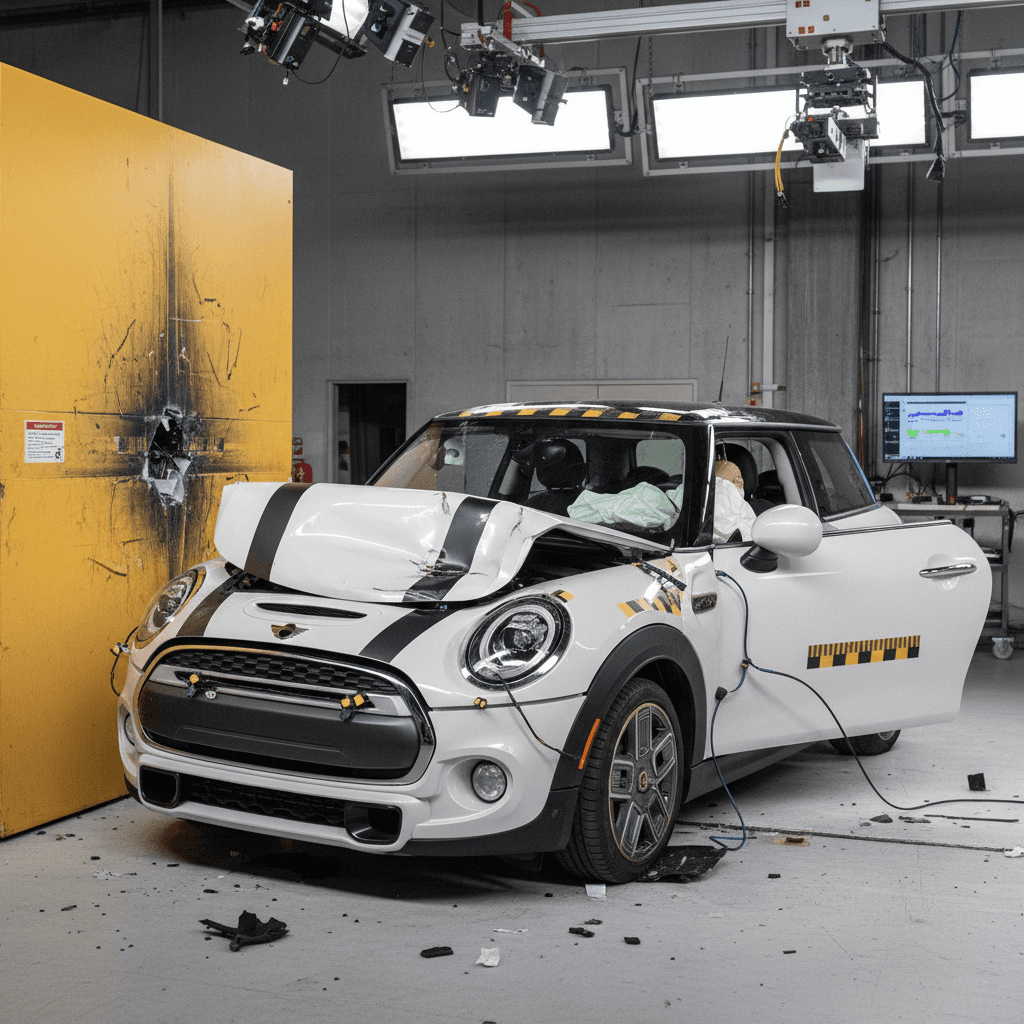
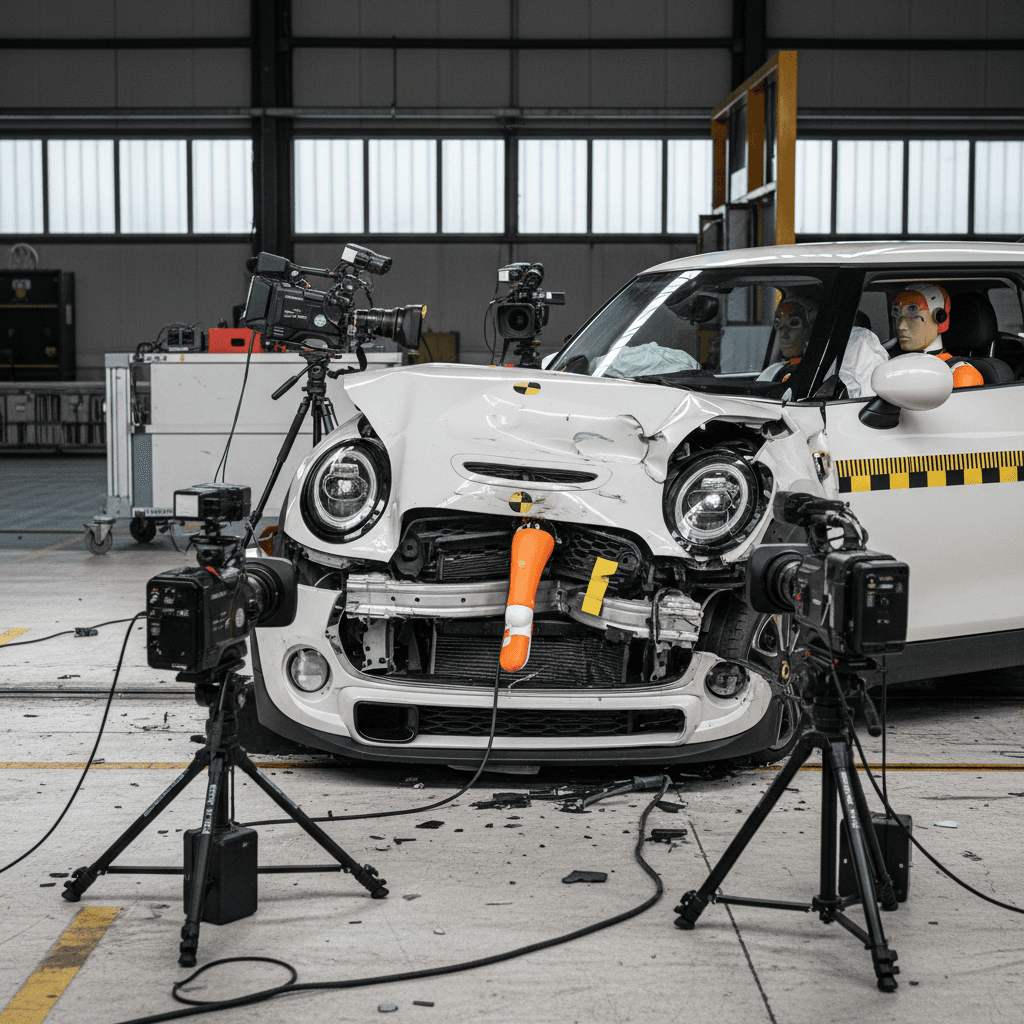
Euro NCAP’s 2025 test of the **Mini Cooper Electric (Cooper E/SE)** is the most complete crash‑safety snapshot we have so far. The testing covers full‑width and offset frontal crashes, side impacts, whiplash performance, and a wide range of active safety scenarios involving cars, pedestrians, and cyclists.
- **Adult occupant (89%)** – Strong passenger cell integrity in both frontal and side impacts, with good chest and leg protection for most dummy positions. Side‑impact results were especially strong, which matters in urban crashes where Minis spend most of their time.
- **Child occupant (85%)** – High scores for 6‑ and 10‑year‑old child dummies in both front and side impacts, plus clear Isofix/LATCH markings and good compatibility with commonly used child seats.
- **Pedestrian / vulnerable road user (77%)** – The front bumper and hood offer generally good leg and head protection, and the car’s automatic emergency braking can spot and brake for pedestrians and cyclists in many scenarios.
- **Safety assist (79%)** – A well‑rounded active safety suite: automatic emergency braking, lane keep assist, blind‑spot monitoring, speed assistance, and cyclist‑aware exit warnings all contribute to the score.
Best in Class for 2025
IIHS and U.S. safety ratings for the Mini Cooper
In the U.S., safety ratings are typically published by **IIHS** and **NHTSA**. As of early 2026, detailed U.S. crash tests for the **new J01 Mini Cooper Electric** haven’t been released yet. However, we can look at how the outgoing Mini performed to understand the brand’s baseline.
- **IIHS (previous‑generation Mini Cooper 2‑door hatchback)** – Rated **Good** in key crashworthiness categories like moderate-overlap front and small‑overlap front (driver side), with **Acceptable** headlights and **Marginal** LATCH ease of use. This structure underpinned the prior‑generation Mini Cooper SE electric sold in the U.S.
- **Countryman benchmark** – The new Mini Countryman (including the Countryman Electric) has earned 5 stars from Euro NCAP and an **IIHS Top Safety Pick** in the U.S., suggesting that BMW/Mini’s latest platforms are engineered to meet demanding U.S. and European crash standards.
- **NHTSA** – Historically, Mini models haven’t always been tested by NHTSA, and when they are, data can lag new product launches. For the latest generation of Mini EVs, Euro NCAP remains the most complete, up‑to‑date reference.
How to cross‑check a specific car
Mini Aceman and Countryman Electric safety
Mini is rolling out a full bench of EVs, and the safety story extends beyond the Cooper hatchback. If you want a Mini EV but need more space or a slightly higher driving position, the **Mini Aceman** and **Mini Countryman Electric** are worth a close look.
How the Mini Aceman and Countryman Electric stack up
Both models are 5‑star Euro NCAP cars with strong family‑friendly scores.
Mini Aceman (J05) – compact EV crossover
- 5‑star Euro NCAP rating (2025) with 83% adult and an excellent 87% child‑protection score.
- All variants (Aceman E, SE, John Cooper Works) share the same strong passive structure and driver‑assist suite.
- Good choice if you like Mini’s character but want easier rear‑seat access and more cargo flexibility than the Cooper hatch.
Mini Countryman Electric (U25) – larger family EV
- 5‑star Euro NCAP rating with 83% adult, 87% child, 81% pedestrian, 79% safety assist.
- Also recognized as an IIHS Top Safety Pick in the U.S. in recent testing.
- Shares technology and philosophy with BMW’s X1/iX1, giving it big‑car safety in a compact‑SUV footprint.
If safety is priority #1
Key safety and driver-assist features on Mini EVs
Raw crash performance matters, but the best outcome is avoiding a crash in the first place. The latest Mini EVs come loaded with **active safety** and **airbag** technology that goes well beyond what small cars offered even five years ago.
- **Airbags and restraints** – Front, side, curtain, and often a central airbag between the front seats to reduce head‑to‑head contact in side impacts. Knee airbags for driver and front passenger are commonly included, along with seatbelt pretensioners and load limiters.
- **Automatic emergency braking (AEB)** – Detects vehicles, pedestrians, and cyclists; can apply brakes automatically if the driver doesn’t react in time. This is a big contributor to the Cooper Electric’s Safety Assist score.
- **Lane‑keeping and lane‑departure warnings** – Gently nudge or warn you if you drift out of your lane without signaling, helping prevent side‑swipes and run‑off‑road crashes.
- **Blind‑spot monitoring and rear cross‑traffic alert** – Optional or standard depending on trim, they watch the lanes you can’t easily see and warn you backing out of parking spaces.
- **Speed assistance** – Camera‑based recognition of posted limits plus manual or automatic speed‑limiter functions to help you stay within the law.
- **Cyclist‑aware door opening alerts** – Sensors can warn if you’re about to open a door into the path of a passing cyclist, small feature, big impact in city driving.
Don’t assume every Mini has every feature
How safe is a small EV like the Mini in real life?
The uncomfortable truth in crash physics is that, all else equal, **heavier vehicles tend to protect their occupants better** in multi‑car collisions, simply because they push around lighter vehicles. That’s why people often assume small cars like the Mini are at a disadvantage.
Where the Mini’s size works against it
- In a head‑on crash with a much larger SUV or pickup, the laws of physics still favor the heavier vehicle.
- You sit closer to the impact in a small car, so structural engineering and airbags have to work harder.
- Ride height differences can create “mismatch” in bumper and frame engagement during impacts.
Where modern engineering levels the field
- A stiff passenger cell and well‑designed crumple zones can keep intrusion low even in severe crashes.
- EV packaging lets designers put more structure and battery protection low in the car, improving stability.
- High‑performance AEB, lane‑keeping and blind‑spot systems help avoid the kinds of crashes where size matters most.
So while a Mini Cooper Electric will never rewrite basic physics, its **5‑star crash performance and Best‑in‑Class Euro NCAP award** show that you don’t have to choose between a city‑friendly footprint and serious passive and active safety engineering.
What to check when buying a used Mini Cooper Electric
If you’re looking at a used **Mini Cooper SE** (previous generation) or planning ahead for used **Mini Cooper Electric (J01)** inventory, safety should be part of your inspection checklist, right alongside battery health, price, and maintenance history.
Safety checklist for a used Mini EV
1. Confirm the exact model and generation
Use the VIN to determine whether you’re looking at an older **Mini Cooper SE** or the newer **Mini Cooper Electric (J01)**. Crash ratings and standard safety equipment differ between them.
2. Verify crash and damage history
Pull a vehicle history report to check for prior accidents or structural repairs. A car that was once crashed hard may not perform like a fresh example in a future impact.
3. Inspect airbag and safety system status
On a test drive, check for any persistent airbag or driver‑assist warning lights. Scan the car with a diagnostic tool if possible to confirm there are no stored safety‑system faults.
4. Check driver-assist feature coverage
Confirm the car has **automatic emergency braking, lane keeping, and blind‑spot monitoring** if those matter to you. Some features are part of optional packages on earlier cars.
5. Evaluate headlights and visibility
Headlight performance varies by trim and generation. Test night visibility and check for **cloudy lenses** or misalignment, which can undermine safety even on a 5‑star car.
6. Review tire and brake condition
Grippy, properly sized tires and healthy brakes are your first line of defense. Uneven wear or bargain‑basement replacement tires can lengthen stopping distances, particularly in wet weather.
How Recharged helps on safety
Mini Cooper Electric safety FAQ
Frequently asked questions about Mini Cooper Electric safety
Bottom line: Is the Mini Cooper Electric a safe EV?
For a car that built its identity on style and go‑kart handling, the **Mini Cooper Electric’s safety story is unusually strong**. A 5‑star Euro NCAP rating, Best‑in‑Class recognition, and a family of related Minis (Aceman and Countryman Electric) that also score five stars point to consistent, deep engineering rather than a marketing line.
If you want a **small EV that doesn’t make you compromise on crash protection or modern driver‑assist tech**, the Mini Cooper Electric should be on your shortlist. And if you’re shopping used, pairing those crash‑test credentials with a **verified battery‑health report and clean history**, the kind of information you get through a Recharged Score Report, can help you land a Mini that’s as safe to live with as it is fun to drive.