Your tires play a bigger role in how an electric vehicle feels than most drivers realize. With more weight, instant torque and near‑silent powertrains, EVs punish the wrong tires and reward the right ones. That’s why Michelin EV tires, from Pilot Sport EV to e·Primacy and “EV Ready” Defender and Primacy lines, are showing up on everything from Lucid Airs to everyday crossovers.
Quick take
Why electric vehicles need different tires
If you’re coming from a gas car, it’s tempting to think a tire is just a tire. But an EV asks far more from its rubber. The battery pack adds hundreds of pounds, so the tire has to carry more load without overheating or wearing out prematurely. At the same time, an electric motor can deliver 100% of its torque the instant you touch the pedal, which puts huge shear forces through the contact patch, especially on performance EVs.
- Higher curb weight from the battery requires stronger carcasses and higher load ratings.
- Instant torque and regenerative braking increase wear on the tread, especially on drive wheels.
- Quiet drivetrains make tire noise much more noticeable inside the cabin.
- Range depends heavily on rolling resistance; every watt saved at the tire extends how far you can go per charge.
Michelin’s own EV education material emphasizes these points: stronger internal construction to handle mass, compounds that balance grip and wear, and tread designs that lower rolling resistance so you don’t give up range every time the tire flexes against the road.
EVs can chew through the wrong tires
What makes Michelin EV tires different from regular tires?
Michelin approaches EVs on two tracks: dedicated EV tires like Pilot Sport EV, and a broad range of “EV Ready” tires that are engineered to work equally well on electric and combustion vehicles. Under the branding, the technologies are all about structure, rubber compounds and noise control.
Core technologies in Michelin EV tires
What’s happening inside the tire that you never see
Stronger construction
Low rolling resistance
Noise reduction
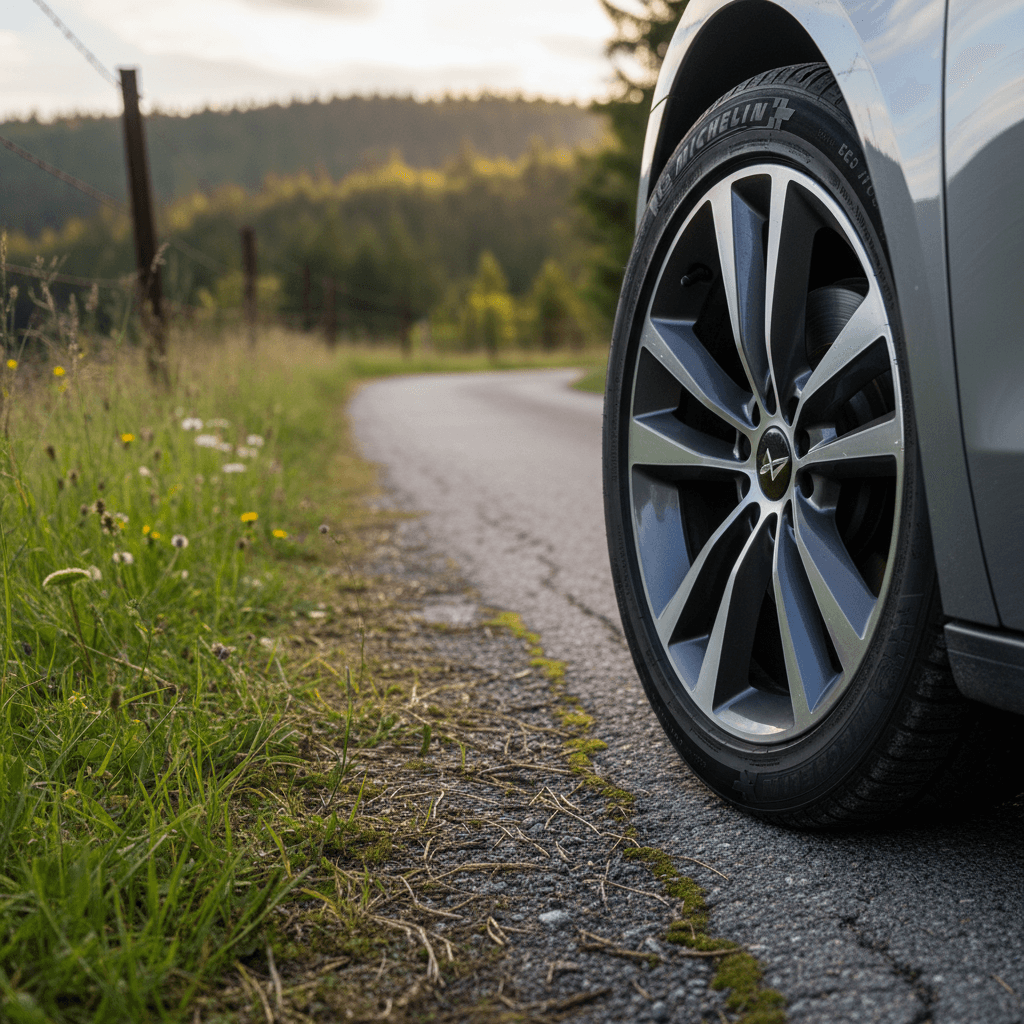
Look for EV cues on the sidewall
Key Michelin EV and “EV Ready” tire families
Michelin’s lineup can be confusing because several tire families come in EV‑specific or EV‑ready flavors. Here’s how the most relevant ones break down if you own, or are buying, a used EV.
Popular Michelin EV and EV Ready tire lines
High‑level view of how each line fits common EV use cases.
| Tire line | Category | Season | EV focus | Best for |
|---|---|---|---|---|
| Pilot Sport EV | Performance | Summer | EV‑specific | High‑performance EVs and sporty driving |
| Primacy MXM4 / e·Primacy | Touring | All‑season or summer | EV Ready / EV‑optimized | Premium sedans and crossovers focused on comfort and range |
| Defender 2 / Defender LTX | Durability | All‑season | EV Ready | Long‑life tires for heavier EV crossovers, SUVs and trucks |
| Pilot Sport All‑Season 4 | Performance | All‑season | EV Ready | Drivers who want year‑round grip with EV compatibility |
| CrossClimate 2 | All‑weather | All‑season (3PMSF) | EV Ready | Mixed climates with light snow where you still want one set year‑round |
Always check your owner’s manual and the tire placard for the correct size and load rating before buying.
Two lines matter most if you’re specifically searching for Michelin EV tires: Pilot Sport EV, a dedicated performance EV summer tire that appears as original equipment on models like the Lucid Air, and e·Primacy/Primacy MXM4 T1, which focus on quiet, efficient touring for EVs and plug‑in hybrids.
Pilot Sport EV vs. e·Primacy: which is right for you?
Same manufacturer, different priorities.
Pilot Sport EV
- High‑performance summer tire tuned for EVs.
- ElectricGrip compounds derived from Formula E development for strong dry and wet grip under instant torque.
- Lower rolling resistance than non‑EV Pilot Sport siblings to help preserve range.
- Best fit: performance EV sedans, coupes and crossovers where you prioritize steering feel and grip.
e·Primacy / Primacy MXM4 T1
- Touring tire family with strong EV adoption as OE on premium EVs.
- Focus on low rolling resistance and quiet operation, with some tests showing meaningful range gains vs. rival EV‑branded all‑season tires.
- Best fit: daily‑driven sedans and crossovers where comfort and efficiency matter more than ultimate cornering.
Don’t overlook EV Ready all‑season options
How Michelin EV tires affect range, noise, and handling
Why tire choice matters so much on an EV
Range and efficiency
Rolling resistance, energy lost as the tire deforms and recovers, plays a bigger role in EV efficiency than in gas cars, because the rest of the drivetrain is so efficient. Michelin’s EV‑oriented compounds and tread designs aim to keep that resistance low. On the road, that translates into a few to several extra miles of range per charge, especially at highway speeds.
Noise and comfort
In an EV, you don’t have an engine masking road noise. Michelin uses Acoustic Technology, a foam ring bonded inside the tire, and PIANO‑style tread tuning to cut cabin noise. The result is a ride where your music and conversations aren’t fighting a constant tire drone.
Handling is the third pillar. Everyday drivers mostly notice it as stability in crosswinds, consistent steering response and predictable braking. Performance EV drivers feel it as the ability to put down torque exiting a corner without triggering traction control constantly. Michelin’s EV tires emphasize casing stiffness and tread block support so the tire doesn’t feel mushy under a heavy car.
Beware of chasing only one metric
Choosing the right Michelin EV tire for your use case
Instead of asking, “What’s the best Michelin EV tire?”, start from how and where you actually drive. A highway commuter in Arizona and a performance‑minded driver in the Northeast have very different needs, even if they both own the same EV model.
Step‑by‑step: pick the right Michelin EV tire
1. Confirm size, load and speed rating
Check the tire placard on your driver’s door jamb and your owner’s manual. Your replacement tires must meet or exceed the specified size and <strong>load index</strong>, especially on heavier EVs and SUVs.
2. Decide your priority: range, comfort or performance
If maximum range and a quiet ride matter most, look at e·Primacy/Primacy MXM4 T1 and other touring EV‑ready tires. If you care about sharp steering and grip, Pilot Sport EV or Pilot Sport All‑Season 4 may be a better fit.
3. Match to your climate
In milder climates, summer plus all‑season setups can work. In snow‑belt states, consider Michelin’s CrossClimate 2 (all‑weather with snow rating) or a dedicated winter set in addition to your EV‑oriented summer or touring tires.
4. Consider how hard you drive
Frequent launches, high‑speed highway running and heavy loads (road trips with the family, gear or trailers) all justify more robust options like Defender LTX EV‑ready variants or Pilot Sport EV in the appropriate size.
5. Set a realistic budget
EV‑specific and EV‑ready Michelins often cost more than generic options, but can pay back through longer life, better efficiency and quieter operation. Compare total cost of ownership, not just up‑front price.
Think in total cost per mile, not price per tire
Michelin EV tires and used EVs: what to look for
When you’re shopping the used EV market, whether through a private seller, a dealer, or a digital retailer like Recharged, tires are one of the best early clues to how the car’s been treated and what it will cost to run.
Reading the current tires
- Brand and model: Seeing Michelin Pilot Sport EV, Primacy, Defender or other EV‑ready tires in the correct spec is a good sign that the previous owner cared about range and safety.
- Uneven wear: Feathering or inner‑edge wear may indicate alignment issues or chronic over‑ or under‑inflation.
- Mismatched sets: Different brands front and rear, or wildly different tread depths, can hint at piecemeal, cost‑cut maintenance.
How Recharged approaches tires
Every vehicle sold through Recharged comes with a Recharged Score Report, which includes verified battery health and a detailed condition overview. When a vehicle needs tires to meet our standards, we prioritize fitting high‑quality, EV‑appropriate options so you’re not buying a range‑optimized used EV on worn‑out rubber.
Because we specialize only in EVs, we also see real‑world wear patterns across many models, which helps us recommend the right type of Michelin EV or EV‑ready tire for your specific vehicle and driving profile.
Tire questions to ask about any used EV
- When were the tires last replaced?
- Are they Michelin EV or EV Ready, or another EV‑rated tire?
- Have they been rotated on schedule?
- Is there a record of alignment checks?
Care and maintenance tips for Michelin EV tires
You paid for premium tires; the way you maintain them determines how much value you actually get. The basics haven’t changed, but they matter more when each millimeter of tread is dealing with added EV weight and torque.
- Check pressures at least once a month and before long trips. EVs are sensitive to low pressure, just a few PSI down can hurt both range and tire life.
- Rotate tires on schedule, often every 6,000–8,000 miles, or as your manual recommends. Regenerative braking and heavy rear‑motor setups can wear back tires faster.
- Have alignment checked if you notice the steering wheel off‑center, pulling, or abnormal wear patterns.
- Avoid repeated full‑throttle launches and hard braking if you want to maximize tread life, even on robust EV‑oriented designs like Pilot Sport EV or Defender LTX.
- Inspect for damage after pothole hits or curb impacts, EV weight makes sidewall and belt injuries more serious.
Tie tire checks to charging routines
Frequently asked questions about Michelin EV tires
Michelin EV tires: common questions
Bottom line: Are Michelin EV tires worth it?
If you drive an EV, your tires are doing more than just keeping you on the road. They’re a major lever for range, noise, comfort and safety. Michelin’s EV and EV Ready lines, Pilot Sport EV, e·Primacy/Primacy, Defender, CrossClimate and others, are among the most thoughtfully engineered options for balancing those trade‑offs.
For performance‑minded drivers, Pilot Sport EV delivers the kind of steering feel and grip enthusiasts expect, but with EV‑appropriate rolling resistance and noise tuning. For commuters and families, Primacy, Defender and CrossClimate EV‑ready lines quietly stack the odds in your favor with efficiency and durability.
If you’re in the market for a used EV, pairing a healthy battery, backed by something like Recharged’s Score Report, with the right set of Michelin EV tires is one of the simplest ways to make your ownership experience smoother and less expensive. The right rubber won’t fix everything, but it will make every mile you drive a little calmer, safer and more efficient.