If you’re cross-shopping a **Mercedes-Benz GLE** against the all-electric **Mercedes EQS SUV**, you’re not just picking a powertrain. You’re choosing between two completely different five‑year cost stories. On paper they’re both plush, three‑row Mercedes SUVs; in your bank account, the **total cost of ownership** can diverge dramatically depending on how you buy, how you drive and whether you look at new or used examples.
What this guide covers
Why compare Mercedes GLE vs Mercedes EQS SUV for total cost of ownership?
On a test drive, the GLE 450 and EQS 450 4MATIC SUV feel like cousins: similar footprint, similar seating, similarly serene cabins. But once you bring finance apps and utility bills into the room, they’re very different animals. The **GLE burns premium gasoline**; the **EQS SUV burns electrons**. The GLE has mature residuals; the EQS SUV has seen **steep early depreciation**, which is painful if you bought new, and a gift if you’re buying used.
For a U.S. household deciding where to park $60,000–$90,000 worth of metal (or slightly-used metal), understanding **total cost of ownership (TCO)** is more important than arguing over 0–60 times. This is especially true if you’re looking at a used EQS SUV on Recharged that’s already absorbed its initial value drop versus a late‑model GLE.
How we’re comparing GLE and EQS SUV ownership costs
To keep things apples-to-apples, we’ll loosely benchmark a **2024–2025 GLE 450 4MATIC** against a **2024–2025 EQS 450 4MATIC SUV**. Both are mid/upper trims that most buyers actually pick, with all‑wheel drive and plenty of options. We’ll focus on **five‑year costs** for a typical U.S. owner driving about **12,000 miles per year**.
- Location: U.S. national averages for fuel and electricity, with a nod to how local rates can swing results.
- Driving: Mixed city/highway use, not hypermiling and not Autobahn abuse.
- Ownership horizon: 5 years / 60,000 miles, starting from roughly new.
- Data sources: EPA-style fuel and energy use estimates, cost‑to‑own models, and current market behavior for GLE and EQS SUV depreciation.
Important disclaimer
Sticker price, incentives and the used-market plot twist
On MSRP alone, the EQS SUV is the pricier sibling. A new EQS 450 4MATIC SUV typically stickers five figures higher than a comparably-equipped GLE 450. But that’s only half the opener; the other half is **incentives and resale.**
New vs used: how GLE and EQS SUV enter your life
The price tag you see is not the price you actually pay over time
New Mercedes GLE 450
- Generally lower MSRP than EQS SUV.
- Occasional dealer discounts or lease offers, but no federal EV tax credit.
- Conservative depreciation: luxury SUV norms, but not a cliff.
New Mercedes EQS 450 SUV
- Higher MSRP, but often more aggressive dealer discounts and lease cash.
- Depending on structure, may effectively benefit from federal EV incentives through leasing.
- Historically **faster early depreciation**, especially on 2022–2024 models.
The used EQS SUV curve
By contrast, used GLE pricing is more predictable. You don’t get the same fire‑sale bargains you’ll sometimes see on EQS SUVs, but you also don’t see the same dramatic initial drop. If you’re shopping **used** rather than new, the gap between a GLE and an EQS SUV can shrink, or even flip, in the EQS SUV’s favor, especially on a well‑priced example with documented service and battery health.
Fuel vs electricity: what it really costs per mile
Here’s where the two SUVs truly diverge. The **GLE buys fuel 15 gallons at a time**; the **EQS SUV sips kilowatt‑hours**, often at home while you sleep. Let’s put rough numbers around that.
Realistic efficiency snapshots
GLE: Cost per mile on gasoline
Assume 20 mpg combined and premium gas at $4.25/gal (a middle‑of‑the‑road U.S. scenario):
- Fuel cost per mile ≈ $4.25 ÷ 20 = $0.21/mile.
- At 12,000 miles/year, that’s about $2,520/year in fuel.
- Five years: roughly $12,500 in gasoline alone.
If your gas is cheaper and your commute is gentle, you can come in lower. If you live in a high‑cost region or tow regularly, expect more.
EQS SUV: Cost per mile on electricity
Assume 32 kWh/100 miles (~3.1 mi/kWh) and home electricity at $0.20/kWh:
- Energy use per mile ≈ 0.32 kWh.
- Electricity cost per mile ≈ 0.32 × $0.20 = ~$0.06/mile.
- At 12,000 miles/year, that’s about $720/year in electricity.
- Five years: roughly $3,600 in home charging.
Fast‑charging regularly on public networks can push that closer to $0.15–$0.20/mile, but most EQS owners do the bulk of their charging at home.
Time‑of‑use rates can tilt the math further
Maintenance and repairs: is the EV really cheaper?
Mercedes vehicles are not cheap dates, no matter what’s under the hood. But the EQS SUV eliminates a long list of **engine‑related consumables and services** that the GLE still carries: oil changes, spark plugs, exhaust components, transmission fluid services and so on.
Typical 5‑year maintenance patterns
Conceptual comparison for a well‑maintained GLE 450 vs EQS 450 SUV over five years, excluding collision repairs.
| Category | GLE 450 (Gas) | EQS 450 SUV (EV) | What it means for you |
|---|---|---|---|
| Routine service | Higher: multiple oil services, engine filters, transmission fluid | Lower: cabin filters, brake fluid, tire rotations | The GLE sees the dealer more often and for more complex work. |
| Brakes | Moderate pad/rotor wear | Often lower wear thanks to regen braking | EQS SUVs tend to stretch brake life if mostly driven in town. |
| Wear items | Similar: tires, wipers, suspension components | Similar, sometimes higher tire spend | The EQS SUV is heavy and torquey; budget for quality tires. |
| Out‑of‑warranty repairs | Engine, turbo, emissions components can be pricey | High‑voltage components are durable but specialized | Both can deliver big bills if something major fails; warranties and service history matter. |
Actual numbers will vary by dealer, independent vs dealer service, and how many miles you drive each year.
Rule of thumb
Where things get nuanced is **long‑term reliability and parts pricing**. Traditional Mercedes powertrains are well‑understood by independent shops. High‑voltage EV components are robust but more specialized; if you need a battery‑related repair after warranty, you’ll want a very good service advisor and, ideally, a strong warranty or extended coverage.
Insurance, taxes and fees: the often-overlooked line items
Insurance algorithms love nothing more than an expensive SUV packed with sensors, glass and LED light signatures. Both GLE and EQS SUV qualify. In practice, premiums tend to be **similar or slightly higher on the EQS SUV**, simply because its MSRP and repair complexity started higher when new.
- If you buy **used**, the gap can narrow, since insurers also look at current market value.
- Some states offer **EV registration discounts** or reduced inspection costs, lightly favoring the EQS SUV.
- Other states impose **EV-specific road‑use fees** in lieu of gas taxes, adding back $100–$200/year for the EQS SUV.
- Property tax on vehicles (where applicable) is generally higher for higher‑value vehicles in early years, again, often the EQS SUV when new, but not always when buying used.
Don’t forget local EV fees
Depreciation and resale: the big wild card
Depreciation is where the EQS SUV’s story becomes dramatic. Many early buyers watched their six‑figure SUVs shed value with the enthusiasm of a tech stock in a bad quarter. That’s unnerving if you bought new, yet incredibly attractive if you’re coming in as the second owner.
How value typically falls over five years
Very rough directional patterns, assuming typical use and no crashes
Mercedes GLE
- More traditional luxury‑SUV curve.
- Expect something like 45–55% total depreciation over 5 years in many cases.
- Residuals supported by broad demand for gas Mercedes SUVs.
Mercedes EQS SUV
- Early U.S. data has shown sharper initial drops, especially in years 1–3.
- EQS SUVs have appeared on the “biggest two‑year depreciation” lists more than once.
- After the first big hit, curves start to normalize and can make **used EQS SUVs outstanding value**.
The sweet spot: used EQS SUV, verified battery
The GLE, in contrast, is more boring in the best sense: value drops are predictable, resale demand is broad, and you’re unlikely to see 60‑plus‑percent drops in the first couple of years unless the market itself turns.
5‑year cost snapshot: GLE vs EQS SUV side by side
Let’s bring this together into a simplified five‑year snapshot. These are not quotes, just **directional comparisons** to show how different categories stack up if you buy near‑new and drive 12,000 miles per year.
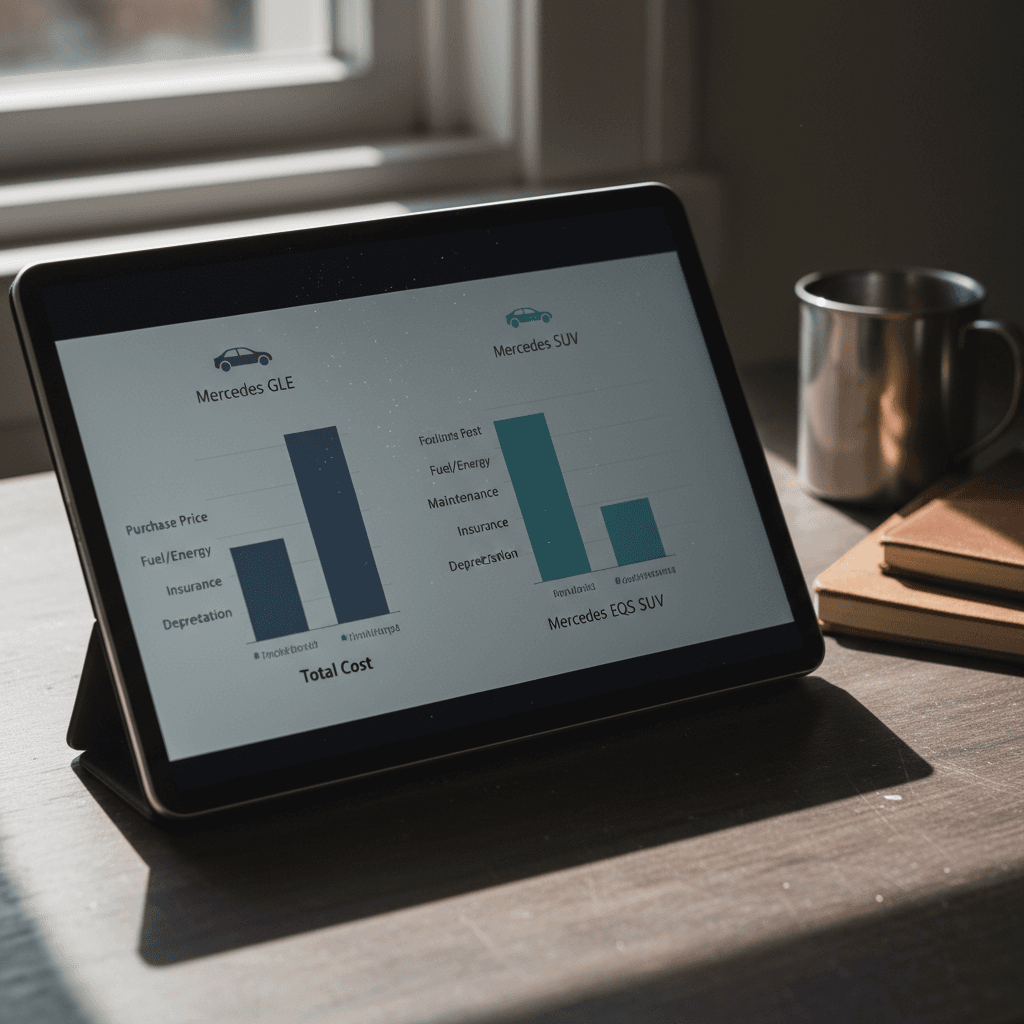
Illustrative 5‑year ownership cost comparison
Conceptual ranges for a near‑new GLE 450 vs EQS 450 SUV over five years, assuming 60,000 miles. All amounts are rough, pre‑tax and will vary widely by buyer and location.
| Cost category (5 yrs) | GLE 450 (gas) | EQS 450 SUV (EV) | Why it differs |
|---|---|---|---|
| Fuel / electricity | ≈ $11,000–$14,000 in premium gasoline | ≈ $3,000–$6,000 in electricity (home + some DC fast charging) | EV efficiency and cheaper energy heavily favor the EQS SUV. |
| Routine maintenance | ≈ $4,000–$7,000 | ≈ $2,500–$5,000 | No oil changes or engine services for the EQS SUV, but similar tires and brakes. |
| Repairs out of warranty | Highly variable; budget several thousand as a cushion | Also variable; major HV issues are rare but costly | Good warranty coverage and service history are key for both. |
| Insurance, taxes, fees | Similar band; often a bit lower total for the GLE if values stay lower | Similar band; may be higher earlier on due to higher initial value and EV fees | Local EV fees and valuation rules can swing this either way. |
| Depreciation (if bought new) | Moderate, typical luxury SUV curve | Historically higher percentage drop, especially in first 3 years | Tech‑heavy EVs and price cuts have weighed on EQS SUV resale from new. |
| Depreciation (if bought used) | Still present but milder | Often significantly softened, someone else took the big hit | This is where a used EQS SUV can be a standout value. |
Think of this as a map, not a contract. Your local fuel, power and deal will move these up or down.
New vs used flips the script
Who should choose GLE vs EQS SUV?
When the GLE makes more sense
- You road‑trip far off the fast‑charging map. In rural corridors with sparse DC fast chargers, gasoline is still easier.
- You have unpredictable access to home charging. Apartment‑dweller with no guaranteed parking? The GLE saves you public charging gymnastics.
- You prefer mature depreciation curves. The GLE behaves more like a classic luxury SUV on resale, which some buyers find comforting.
- You tow frequently. While both can tow, fueling a gas SUV on long towing trips is still simpler today.
When the EQS SUV shines
- You can charge at home. Plugging in overnight is the single biggest unlock for low running costs.
- Your commute lives in stop‑and‑go traffic. EVs use far less energy in city driving than gas SUVs do, and regen braking shines here.
- You’re buying used and value comfort. A lightly‑used EQS SUV can deliver S‑Class‑level plushness with Camry‑like energy costs.
- You care about local emissions. The EQS SUV’s tailpipe emissions are zero; for many families, that matters as much as the math.
Leaning toward used? How Recharged changes the math
If this comparison has you eyeing the **used EQS SUV listings** instead of a brand‑new GLE, you’re not alone. The trick is separating bargain luxury from future‑expense trap. That’s precisely where Recharged’s model is built to help.
Why a used EQS SUV (or any used EV) is different with Recharged
Cut through the guesswork on battery health and fair pricing
Verified battery health
Fair market pricing
Financing, trade‑in & delivery
Ready to find your next EV?
Browse VehiclesIf you’re on the fence between a newer‑model GLE and a slightly‑used EQS SUV, running the numbers on Recharged, payment, expected fuel or electricity costs, and projected resale, can often clarify which one genuinely costs less to live with over the next five years.
FAQ: Mercedes GLE vs Mercedes EQS SUV ownership costs
Frequently asked questions
Bottom line: luxury SUV comfort, very different running costs
The **Mercedes GLE** and **Mercedes EQS SUV** both deliver that familiar, quietly opulent Mercedes SUV experience. The difference is how they treat your wallet between now and year five. The GLE asks you to keep feeding it premium fuel and traditional maintenance in exchange for familiar depreciation and straightforward road‑trip logistics. The EQS SUV front‑loads more of the pain into MSRP and early‑year depreciation but rewards you with **low energy costs, fewer routine services and a calmer conscience about local emissions**.
If you’re buying **new** and dread resale uncertainty, a well‑equipped GLE can still be the conservative play. If you’re shopping **used**, especially with tools like Recharged’s **battery‑health‑verified EQS SUV listings**, the smart money often flows toward the EV. Either way, taking an hour to map out your own mileage, local fuel and power rates, and likely ownership horizon will tell you more than any brochure, and can easily swing the decision thousands of dollars in your favor.