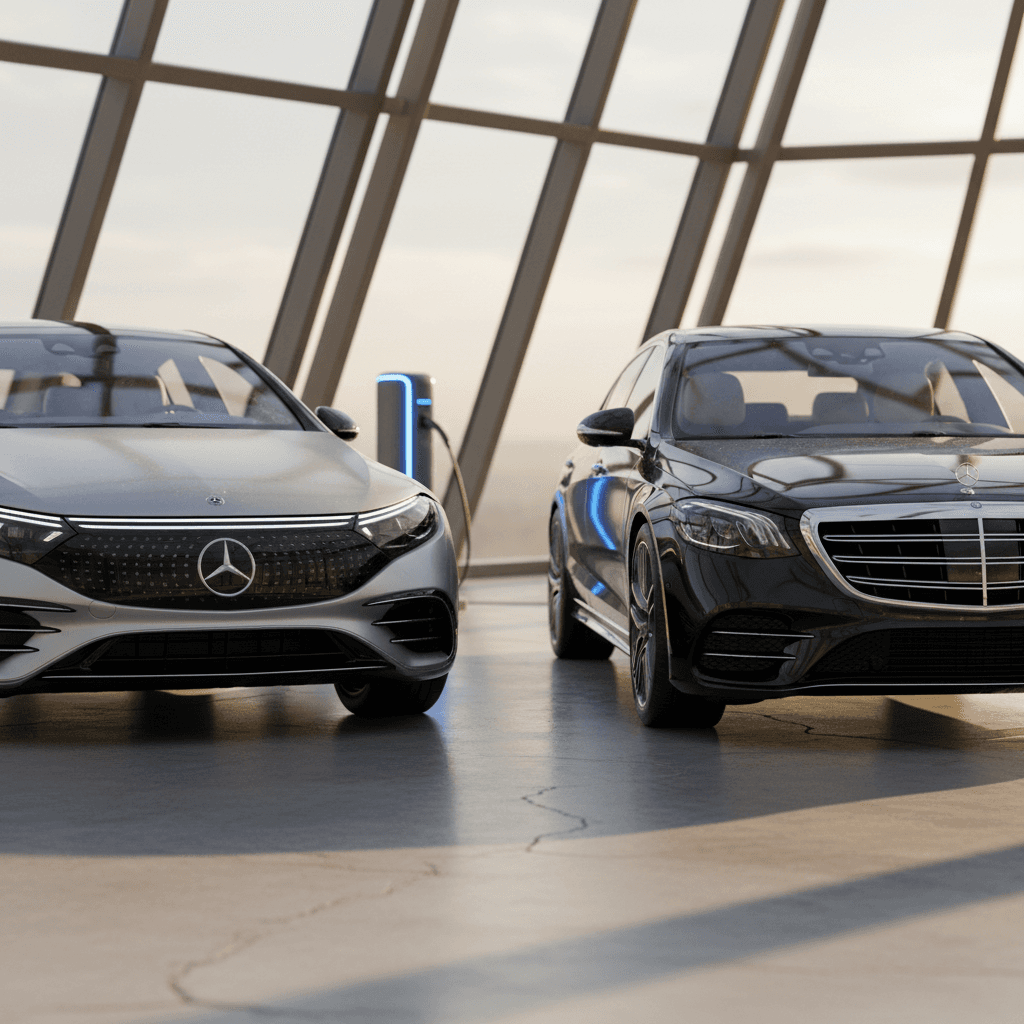
You’re shopping for the flagship Mercedes experience and torn between the all‑electric Mercedes EQS and the traditional Mercedes S‑Class. Both sit at the top of the brand’s luxury ladder, but they deliver that experience in very different ways, one with batteries and instant torque, the other with a silky gasoline engine and decades of refinement. This guide compares Mercedes EQS vs Mercedes S‑Class so you can decide which you should buy, especially if you’re considering a used example.
Two flagships, two philosophies
EQS vs. S-Class: what this comparison covers
For fairness, we’ll focus on the EQS sedan (not the EQS SUV) and the long‑wheelbase S‑Class sedan, which is the norm in the U.S. We’ll walk through driving feel, comfort, tech, performance, range and refueling, ownership costs, depreciation, and what to watch for if you’re shopping the growing used‑EV market. Along the way, we’ll highlight how Recharged approaches used EQS models with battery‑health diagnostics and transparent pricing.
EQS vs. S-Class: flagship snapshot
Quick answer: EQS vs. S-Class, who should buy which?
At a glance: which Mercedes is right for you?
Use this as a starting point before diving into the details.
You’ll likely prefer the EQS if…
- You have home charging or reliable access to overnight charging.
- You mainly drive in the city or on predictable commuter routes.
- You want ultra‑quiet, near‑silent operation and cutting‑edge tech like the available Hyperscreen.
- You care about lower running costs and are comfortable with EV charging stops on road trips.
- You’re open to taking advantage of steep used‑EQS depreciation to get a lot of car for the money.
You’ll likely prefer the S‑Class if…
- You often drive long distances where gas refueling is simpler than fast charging.
- You value classic Mercedes styling, a stately presence, and a more conventional driving experience.
- You don’t have convenient home charging or live in an apartment with limited charging access.
- You prefer proven gasoline tech and want to avoid early‑adopter EV concerns.
- You plan to use the car as a chauffeur or executive vehicle, where back‑seat comfort is everything.
Start with where you park and how you drive
Driving feel: silent EV glide vs classic Mercedes waft
EQS: near‑silent and effortless
The EQS rides on a dedicated EV platform with air suspension and rear‑axle steering. Even in its earlier 450+ form, you get brisk acceleration (roughly mid‑5‑second 0–60 mph in many trims) and quiet, turbine‑like thrust. Higher‑spec dual‑motor models like the EQS 580 or AMG EQS deliver serious straight‑line pace with instant torque.
The EQS feels heavy but planted. Rear‑axle steering can make it surprisingly maneuverable in tight city streets or parking garages, shrinking what is otherwise a very long car.
S‑Class: smooth and familiar
The S‑Class leans into what Mercedes has done well for decades: effortless, almost floaty comfort with a gasoline engine humming quietly in the background. Turbocharged six‑ and eight‑cylinder options deliver strong power with a traditional multi‑gear automatic.
The car isolates you from poor pavement, and the steering and throttle feel more conventional than the EQS. If you’re coming from other luxury sedans, the S‑Class driving experience will feel intuitively familiar right away.
Noise & refinement
Comfort, space, and interior experience
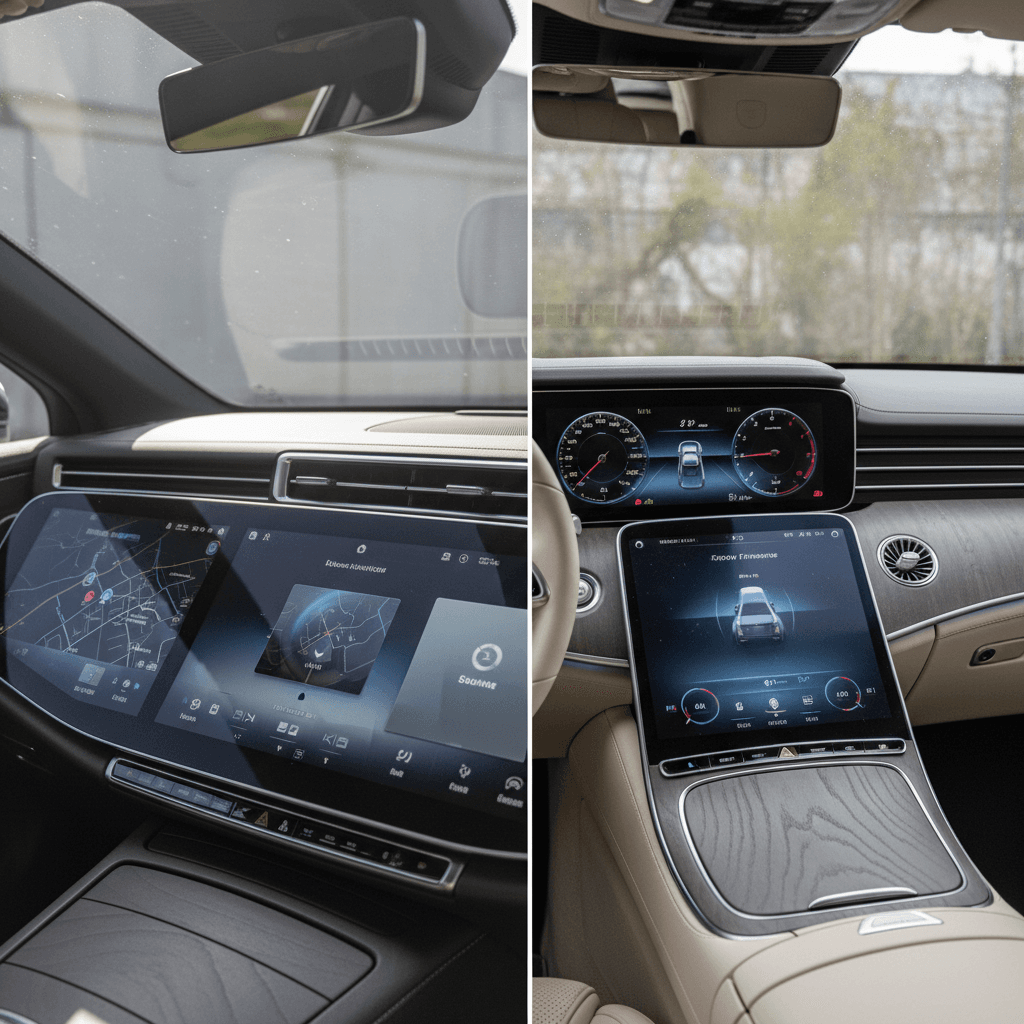
Both cars are exceptionally comfortable, but they approach luxury differently. The EQS interior feels like a high‑end tech lounge; the S‑Class feels like a private jet.
Interior comparison: EQS vs. S‑Class highlights
Where the cabins feel similar, and where they don’t.
| Feature | Mercedes EQS | Mercedes S-Class |
|---|---|---|
| Front seats | Thickly padded, often with heating, ventilation, and massage; more futuristic shapes | Equally plush, with classic Mercedes seat design and available hot‑stone style massage |
| Rear seats | Comfortable, but traditional sedan EQS focuses a bit more on front occupants unless optioned with Executive packages | Rear cabin is a core focus; long‑wheelbase cars often have exceptional legroom and reclining, massaging seats |
| Cabin vibe | Minimalist, screen‑driven, ambient‑light‑heavy, especially with Hyperscreen | Blends modern screens with wood, leather, and traditional luxury cues |
| Storage and practicality | Hatchback‑style rear opening on EQS sedan gives generous cargo access; flat floor helps space | Traditional trunk but typically wide and long; plenty for luggage and business travel |
| Noise & isolation | Extremely quiet at low speeds; EV drivetrain eliminates engine noise | Superb isolation from wind and road; some muted engine sound remains under hard acceleration |
Exact equipment varies by model year and trim; always confirm options on the specific car you’re considering.
Rear passengers still win in the S‑Class
Tech, safety, and autonomy
On paper, the EQS and S‑Class offer similar menus of safety and driver‑assistance tech: adaptive cruise, lane‑keeping, active steering assist, automatic emergency braking, augmented‑reality navigation, and more. In practice, the EQS often feels a bit more like a rolling smartphone, while the S‑Class balances new tech with more traditional controls.
Technology strengths: EQS vs. S‑Class
Both are loaded, just tuned for different buyers.
EQS tech advantages
- Available MBUX Hyperscreen spanning nearly the entire dash.
- EV‑specific interfaces: charging status, route planning with charger stops, energy flow displays.
- Over‑the‑air updates for certain features and improvements.
- Futuristic ambient lighting and soundscapes tied to drive modes.
S‑Class tech advantages
- More physical controls for some functions; fewer actions buried in menus.
- Highly polished driver‑assistance tuning focused on comfort.
- Advanced comfort tech like active suspension that can scan the road (on certain trims).
- Rear‑seat entertainment and tablet options optimized for chauffeur duty.
Shared safety focus
- Multiple radar and camera systems for collision avoidance.
- Automatic emergency braking and pedestrian detection.
- Blind‑spot monitoring with exit warning.
- Advanced airbag systems and strong crash‑test performance expectations for both flagships.
Tech complexity cuts both ways
Performance, range, and refueling vs charging
From a performance standpoint, there’s no clear winner: both lineups include quick and very quick variants. The bigger story is how you replenish that performance, gas vs. electricity, and what that means for your lifestyle.
Typical range and energy experience
Approximate, real‑world‑oriented comparisons. Exact numbers vary by trim, wheel size, climate and driving style.
| Metric | Mercedes EQS (sedan) | Mercedes S-Class |
|---|---|---|
| 0–60 mph (mainstream trims) | Around 5–5.5 seconds for EQS 450 variants; quicker for EQS 580 and AMG models | Roughly 4.5–5.5 seconds for S 500/S 580, depending on engine and year |
| Usable range (typical) | Many EQS sedans deliver roughly 300–350 miles of real‑world range when driven sensibly | 400–450 miles of highway range per tank is common in S‑Class sedans |
| Refuel/charge time | Fast charging: ~30 minutes to go from low to ~80% at a high‑power DC station, plus time to find and queue | Gas fill‑up: usually 5–10 minutes including payment |
| Best use case | Daily commuting, urban/suburban errands, trips planned around charging stops | Long‑distance, unplanned routing where gas stations are ubiquitous |
Always verify EPA ratings for your specific EQS trim and consider your local charging or fueling infrastructure.
Think in door‑to‑door time, not just specs
Running costs, maintenance, and depreciation
This is where the Mercedes EQS vs Mercedes S‑Class decision can swing hard in favor of the EV, especially on the used market. The EQS eliminates fuel, oil changes and many traditional service items, but adds battery and high‑voltage complexity. The S‑Class burns more fuel but lives on a mature, well‑understood platform.
Ownership cost realities to keep in mind
1. Energy costs: electricity vs premium gas
If you can charge at home on reasonable electricity rates, your per‑mile energy cost in an EQS is often far below an S‑Class running premium gas. Public DC fast charging can narrow that gap, but most owners rely on overnight Level 2 at home.
2. Maintenance: fewer fluids vs more moving parts
EQS: no engine oil or spark plugs, and fewer wear items tied to engine vibration. You still have brake fluid, coolant loops, and EV‑specific service. S‑Class: traditional engine services plus complex suspension and electronics. Both can be expensive out of warranty, but the S‑Class stacks more routine visits.
3. Depreciation: EQS drops faster (for now)
Early EQS models have seen <strong>steep depreciation</strong> as EV incentives, rapid tech changes, and limited demand for large luxury EVs have pressured prices. The S‑Class also depreciates quickly but historically holds a bit more value in the luxury‑sedan space.
4. Insurance and tires
Flagship Benzes aren’t cheap to insure, and both ride on big, often low‑profile tires. Expect higher‑than‑average tire and insurance costs either way, and price them into your ownership budget.
Battery health matters more than odometer on an EQS
Buying used: EQS vs. S-Class
If you’re shopping used, the calculus changes again. The EQS can be a used‑EV bargain if you understand charging, range needs, and battery health. The S‑Class can be a safer emotional bet for traditional buyers, but also carries higher fuel and service bills over time.
Used EQS: opportunity and homework
Rapid depreciation means you can often find lightly used EQS sedans for a fraction of their original MSRP. That opens the door to an ultra‑luxury EV at a price similar to a mid‑range new crossover.
But you need to look deeper than the window sticker:
- Verify battery health and remaining warranty.
- Review charging history when possible (frequent DC fast charging can age packs faster).
- Test all tech features: Hyperscreen, driver‑assist, air suspension, rear‑axle steering.
- Confirm that any software campaigns or recalls have been performed.
At Recharged, every EQS we list comes with a Recharged Score Report that includes third‑party‑verified battery diagnostics and fair‑market pricing, so you’re not guessing about pack health or overpaying for a trendy spec.
Used S‑Class: known quantity, old‑school costs
The S‑Class has decades of history in the used‑car market. Buyers and independent shops know their quirks: air‑suspension components, complex electronics, and high‑end interior modules can all get pricey with age, especially once factory warranty ends.
Key checks include:
- Comprehensive service records and evidence of regular maintenance.
- Inspection of suspension, steering, and brake systems for wear.
- Electronics scan to catch lurking module or sensor issues.
- Verification of options you care about (night vision, Executive Rear Seat, Burmester audio, etc.).
If you’re buying privately, it’s worth pairing a pre‑purchase inspection with a reputable extended warranty provider. If you’re trading into an EQS instead, Recharged can provide an instant offer or consignment option for your current S‑Class to simplify the switch.
How Recharged de‑risks used EQS shopping
Ready to find your next EV?
Browse VehiclesMatch the car to your lifestyle
Which flagship fits your life better?
Primarily city & suburban driving
You drive 30–70 miles a day and usually sleep at the same address each night.
You have (or can install) a Level 2 charger at home or a dedicated spot at work.
You value the quiet, instant response of an EV over engine sound.
You rarely take cross‑country trips by car, or you’re comfortable planning charging stops.
→ <strong>EQS is usually the better fit</strong>, especially as a value play on the used market.
Frequent long‑distance travel
You regularly do 300+ mile days, sometimes on unfamiliar routes.
Charging infrastructure along your routes is spotty or heavily congested.
You don’t have reliable home charging (street parking, shared lots, etc.).
You’d rather stop at any gas station than hunt for high‑power chargers.
→ <strong>S‑Class is usually the smarter bet</strong> for stress‑free long‑distance work.
Status, chauffeuring, and back‑seat comfort
You’ll be using the car for clients, VIPs, or as a chauffeured vehicle.
Rear‑seat legroom, recline, and amenities outrank frunk size or EV novelty.
You prefer a timeless, conservative exterior that reads immediately as a high‑end sedan.
→ A long‑wheelbase <strong>S‑Class</strong>, possibly with Executive Rear Seat or Maybach‑level options, remains the gold standard.
Early adopters and tech enthusiasts
You enjoy being on the cutting edge and don’t mind some software updates or learning curves.
You want the most futuristic Mercedes cockpit you can get today.
You like the idea of silent acceleration, rear‑axle steering, and EV‑specific features.
→ A well‑vetted <strong>EQS</strong>, especially from a trusted EV retailer, will likely make you happier than even a loaded S‑Class.
Mercedes EQS vs. S-Class: FAQ
Bottom line: should you buy a Mercedes EQS or S-Class?
If you have stable home charging, mostly predictable routes, and want the most modern expression of the Mercedes flagship, the EQS is the smarter buy, especially pre‑owned, where rapid depreciation puts top‑shelf luxury EVs within reach. It’s quieter in daily use, cheaper to power in many markets, and packed with forward‑looking tech. If you regularly cover long distances, lack reliable charging, or need a vehicle that signals classic executive luxury from every angle, the S‑Class still wears the crown. In that case, fuel and maintenance costs are the price of a known quantity that fits almost anywhere gas is sold.
Whichever direction you lean, take the time to run the numbers: energy, insurance, maintenance, and depreciation over the years you’ll own the car. And if the EQS ends up on your shortlist, consider shopping with a platform like Recharged, where every used EV comes with verified battery health, transparent pricing, and specialist guidance to make your flagship‑Mercedes decision as informed, and stress‑free, as possible.