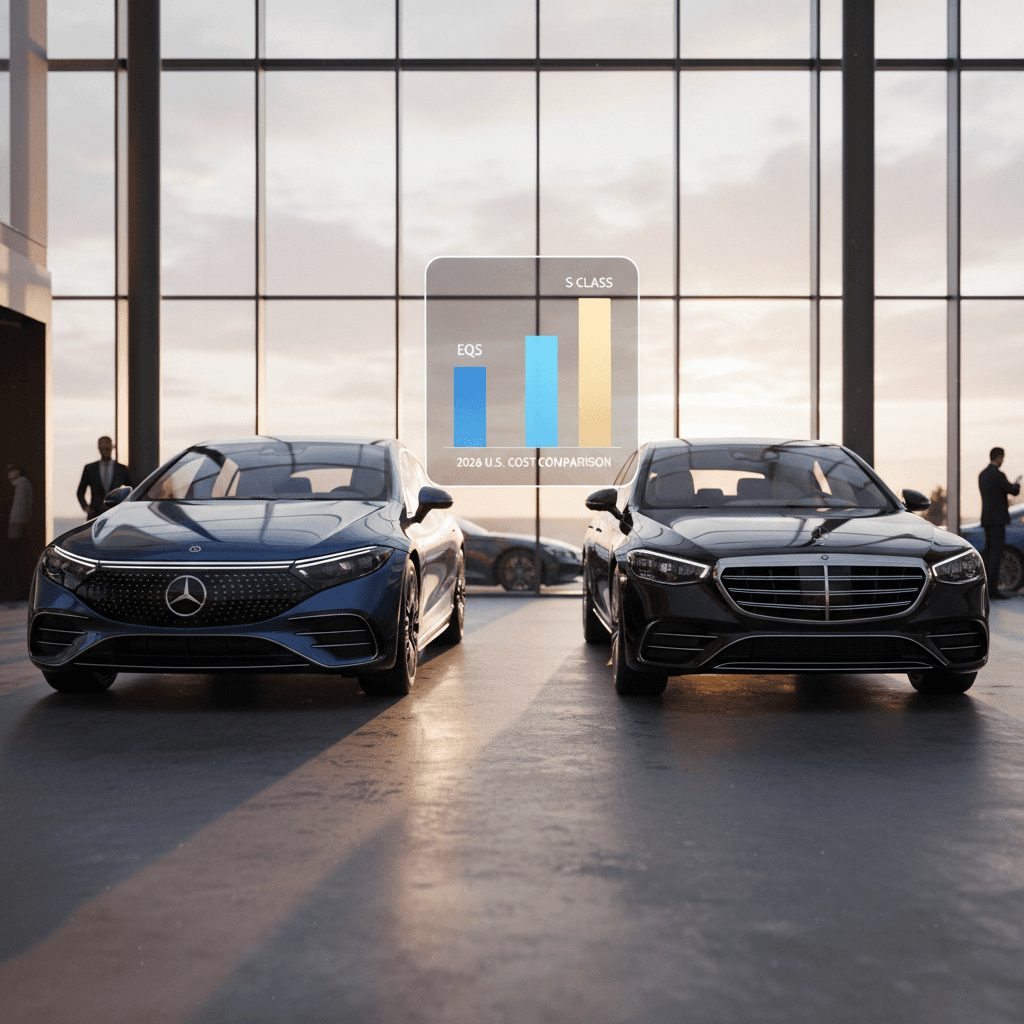
You don’t cross-shop a Mercedes EQS and a Mercedes S-Class unless you’re serious about comfort and you’re thinking hard about long‑term costs. In 2026, the equation is trickier than ever: Mercedes has slashed EQS pricing, the S-Class remains the benchmark gas luxury sedan, and the used market is full of surprisingly affordable EQS sedans. This 2026-focused Mercedes EQS vs Mercedes S-Class cost comparison walks you through sticker price, payments, fuel vs. electricity, maintenance, depreciation, and where the smart money goes, especially if you’re open to a used EV.
2026 snapshot
Why compare the EQS vs. S-Class in 2026?
Historically, the S-Class has been the no‑brainer for buyers who want the quietest, most cosseting gas sedan on the market. The EQS arrived as the electric counterpart: all the tech and isolation, with a giant battery pack where the gas tank used to be. By 2026, though, the money story has changed.
- New EQS models have seen substantial MSRP cuts compared with early years, plus frequent dealer incentives.
- The S-Class still commands strong prices and holds value better, but it burns premium fuel and has traditional maintenance needs.
- Used EQS sedans have dropped sharply in price, creating an unusual situation where an electric flagship can be cheaper to buy than a used S-Class of the same age.
If you’re shopping in this segment today, you’re really asking two questions: “What will this cost me every month?” and “What will this cost me over five to seven years?” Let’s break those pieces apart.
Sticker price: 2026 EQS vs. S-Class MSRP and real-world discounts
Approximate 2026 U.S. pricing snapshot
Mercedes has responded to slower‑than‑expected EQS demand by cutting prices on its top EVs. For 2026, that means the gap between a well‑equipped EQS sedan and a comparably trimmed S-Class is often smaller than you’d expect, or even reversed once you factor in dealer discounts on EQ models.
2026 Mercedes EQS vs. S-Class: typical U.S. starting points
Approximate starting MSRPs for core trims, before destination, options, or incentives. Real transaction prices can be several thousand lower, especially on EQS.
| Model (2026 MY) | Approx. starting MSRP | Powertrain | Notes |
|---|---|---|---|
| EQS 450+ sedan | ≈$104,000–$108,000 | Single-motor electric | Large battery, RWD emphasis on range and comfort. |
| EQS 580 4MATIC sedan | ≈$120,000–$125,000 | Dual-motor electric AWD | More power and traction, similar comfort kit. |
| S 500 4MATIC | ≈$118,900+ | 3.0L inline‑6 turbo, mild hybrid | Traditional choice; most common S-Class lease spec. |
| S 580 4MATIC | ≈$129,000+ | 4.0L twin‑turbo V8, mild hybrid | Big power, bigger fuel and insurance bills. |
Actual dealer pricing in your area will vary. Use this as a directional guide, not a quote.
Where incentives tilt the math
On paper, a base EQS 450+ and an S 500 4MATIC live in the same neighborhood. Add real‑world discounting and it’s common to see an EQS lease advertised for similar or even lower money than an S-Class lease with comparable equipment.
Monthly payments: financing and leasing math
EQS: lower effective price, higher incentives
If you’re financing, EQS price cuts plus frequent dealer incentives can chip thousands off the cap cost. Captive finance arms sometimes sweeten the deal with subvented APRs or aggressive lease money factors to move EV inventory.
- More likely to see big discount plus low APR on EQS.
- Leases often structured with higher residuals than real‑world resale to keep payments appealing.
S-Class: stronger residuals, fewer discounts
The S-Class doesn’t usually need fire‑sale pricing. Residual values are stronger, so leases look decent, but up‑front discounts tend to be smaller than EQS, especially on fresh model years.
- Better long‑term value retention, especially on S 500.
- Higher money factors or fewer APR specials than the EVs.
Don’t shop by payment alone
If the monthly number is your hard guardrail, you may find EQS and S-Class sitting closer together than you’d think. The real divergence shows up once you start paying for energy and maintenance every month.
Energy costs: EQS electricity vs. S-Class premium gas
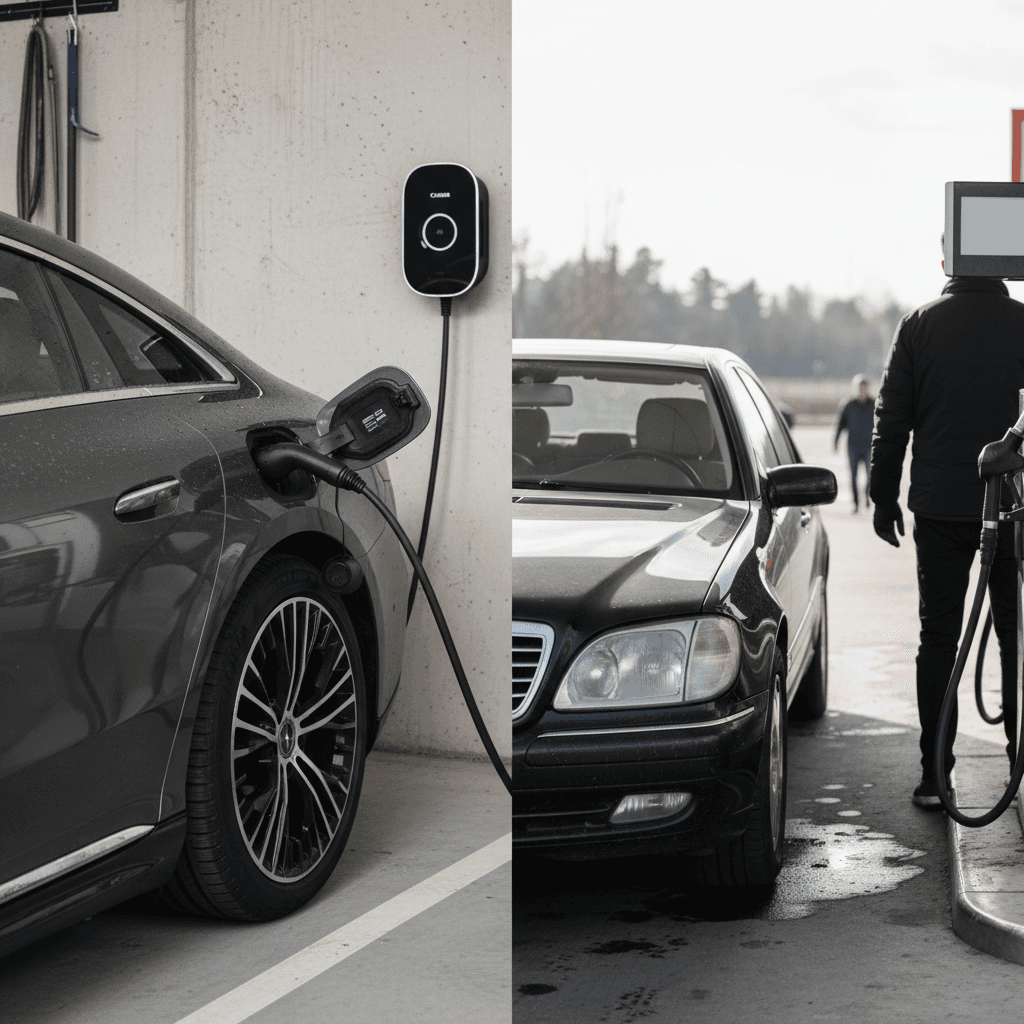
At this price point, owners often drive 10,000–15,000 miles a year. That’s where the EQS quietly starts clawing back money. Premium fuel plus big‑car weight make the S-Class thirsty, while the EQS’s electricity bill, especially if you charge at home off‑peak, looks pretty tame by comparison.
Typical annual energy costs (U.S., 15,000 miles)
Assumes mixed city/highway driving, realistic efficiency, and mid‑2025 U.S. energy prices.
EQS 450+ / 580
Electricity: roughly $600–$900/year with mostly home charging at ~$0.13–$0.18 per kWh.
Frequent DC fast charging or very high local rates can push this higher, but it’s still tough to spend more than ~$1,200/year unless you road-trip constantly.
S 500 4MATIC
Premium gas: often $2,400–$3,000/year at 15–20 mpg and $4.00–$4.50/gal premium.
Steady highway miles help, but in stop‑and‑go city use you’ll feel every pound of that luxury sedan.
S 580 4MATIC
Premium gas: $2,700–$3,300/year isn’t unusual with the V8.
If fuel prices spike again, the S 580 is the first to make you wince at the pump.
EV energy savings add up
On energy alone, the EQS can easily save $1,500–$2,000 per year versus an S-Class if you drive 15,000 miles and charge mostly at home. Over five years, that’s a serious chunk of change, roughly equivalent to a full year of payments on a used EQS in today’s market.
Maintenance and repairs: who’s cheaper to keep?
Both of these cars live in the “don’t cheap out on maintenance” neighborhood. But the way they spend your money is different. The S-Class brings everything you’d expect from a complex gasoline flagship; the EQS eliminates some jobs entirely and adds a few EV‑specific wrinkles.
Typical maintenance differences: EQS vs. S-Class (first 5 years)
Big-ticket routine items most owners will encounter during the first 5 years or 60,000–75,000 miles.
| Item | EQS (electric) | S-Class (gas) | Cost impact |
|---|---|---|---|
| Oil changes | None | Every ~10k miles or annually | S-Class racks up hundreds per year in oil and filters. |
| Transmission service | None | Periodic fluid/service | Additional several hundred dollars over 5 years. |
| Brakes | Pads/rotors last a long time thanks to regen braking | Heavier reliance on friction brakes | EQS often goes much longer between pad/rotor jobs. |
| Cooling system | Battery and inverter coolant service on long intervals | Engine cooling system service | Comparable, but complexity differs. |
| Tires | Similar wear; weight favors higher tire spend on both | Similar | Budget generously; these cars are heavy. |
| Dealer service packages | EV‑specific checks; no combustion‑engine complexity | Comprehensive engine, fuel, and emissions checks | S-Class typically more labor per visit. |
Exact intervals and pricing vary by dealer and region. Always follow the maintenance schedule in your owner’s manual.
Warranty and service plans
Bottom line: the EQS typically wins on routine maintenance and wear items, though both are pricey if something truly exotic fails out of warranty. If you expect to keep the car past its basic warranty period, the S-Class’s engine and transmission add uncertainty the EQS simply doesn’t have.
Depreciation and resale: EQS hit vs. S-Class stability
This is the piece most shoppers underestimate. Early EQS sedans have already taken steep depreciation. Used‑market data through 2025 shows 2023 EQS sedans trading in the low‑$50,000s, massive drops from original MSRPs. The S-Class, by contrast, continues to behave like a traditional luxury flagship: expensive, but with more predictable resale curves.
How depreciation hits different buyers
Same brand, very different curves.
New EQS buyer
If you’re first owner on a new EQS, expect heavy first‑3‑year depreciation, especially if Mercedes keeps cutting MSRPs. You’ll save on energy and maintenance, but resale value is the wild card.
Great if you plan to lease or don’t mind being the one who eats the curve.
New S-Class buyer
The S-Class follows a more conventional Mercedes luxury pattern. You’ll still lose money, this is not a Corolla, but auction and retail values are more predictable, and long‑term demand for a traditional flagship remains stronger worldwide.
Better if you plan to own 7–10 years and maintain it meticulously.
The EQS used-car gift
This is where Recharged leans in: every used EQS we list comes with a Recharged Score that includes verified battery health and fair‑market pricing, so you’re not guessing how much range you’re really buying or whether the discount is justified by condition.
Insurance, taxes, and fees
Insurance on either of these isn’t going to make you smile. The S-Class and EQS are expensive, loaded with sensors and aluminum bodywork, and beloved by collision‑repair shops. In many ZIP codes, premiums for EQS and S-Class are in the same ballpark, with minor swings based on local repair data and theft trends.
- Registration and property taxes in many states are tied to vehicle value. A heavily discounted or used EQS can be cheaper to register than a fresh S 580.
- Some states add modest EV fees to replace gas‑tax revenue; factor those in, but they rarely erase the fuel‑cost advantage.
- Advanced safety and driver‑assist systems can raise repair bills across both models, nudging insurance up, not down.
Quote both cars with your insurer
5-year total cost of ownership: simple scenarios
Let’s pull this together with some high‑level 5‑year scenarios. These aren’t quotes; they’re sanity checks to help you see how the money tends to move if you drive 15,000 miles a year and either buy new or go used.
Illustrative 5-year cost snapshots (15,000 mi/year)
These scenarios assume typical 2025–2026 U.S. pricing patterns, average insurance, and routine dealer service. Dollar figures are rounded to keep things readable.
| Scenario | Vehicle | 5-year energy | 5-year maintenance | 5-year depreciation* | Very rough 5-year total |
|---|---|---|---|---|---|
| A: New EQS owner | New EQS 450+ | $3,000–$4,500 | $5,000–$7,000 | $45,000–$55,000 | Mid–high $60Ks+ |
| B: New S-Class owner | New S 500 4MATIC | $12,000–$15,000 | $8,000–$10,000 | $40,000–$50,000 | Low–mid $70Ks+ |
| C: Used EQS bargain | 3‑year‑old EQS bought around $55K | $3,000–$4,500 | $5,000–$7,000 | $20,000–$30,000 | Low–mid $40Ks+ |
| D: Used S-Class | 3‑year‑old S 500 bought around $70K | $12,000–$15,000 | $8,000–$10,000 | $25,000–$35,000 | Mid–high $50Ks+ |
Use this as a framework, then plug in your own local numbers and actual quotes.
Why the used EQS looks so good
New vs. used: why a used EQS is a wild-card bargain
By 2026, the EQS is one of the clearest examples of how EV economics shift when you stop staring at MSRP and look at the second owner’s deal. A three‑year‑old EQS with a healthy battery is often priced closer to a new E-Class than to a new S-Class, yet it still feels like a spaceship inside.
Pros and cons of going used EQS vs. used S-Class
Both can be smart, if you buy with your eyes open.
Used EQS: pros
- Huge first‑owner depreciation means significantly lower purchase price.
- Low energy and routine maintenance costs if you charge mostly at home.
- Whisper‑quiet ride, cutting‑edge tech, and no visits for oil changes.
Used EQS: watch‑outs
- Battery health and DC fast‑charge history matter, a lot.
- Out‑of‑warranty repairs on rare EV parts can be costly.
- Model‑line uncertainty as Mercedes reshapes its EQ strategy.
This is exactly where Recharged’s Recharged Score helps you separate great used EQS candidates from “priced low for a reason” cars. We test and verify battery health, analyze fast‑charging behavior, and benchmark pricing against the wider market before a car ever hits our site. If you’re comparing an EQS and S-Class in the real world, that kind of data is the difference between a clever buy and an expensive science project.
Which one makes sense for you?
The mileage monster
If you drive 15,000–20,000 miles a year and mostly charge at home, the EQS is the clear financial favorite. You’ll spend far less on energy and routine maintenance, and the comfort level is on par with (or better than) S-Class.
The long‑term traditionalist
If you plan to keep the car 8–10+ years and you’re more comfortable with familiar gas hardware, a carefully maintained S 500 still makes sense. You’ll pay more at the pump but benefit from established resale and a global repair ecosystem.
The value hunter
If you’re willing to buy used, a 2–4‑year‑old EQS with a clean battery health report is one of the most compelling deals in the luxury world right now. Your 5‑year cost to own can undercut a used S-Class while delivering a more modern driving experience.
How Recharged fits in
Ready to find your next EV?
Browse VehiclesChecklist: How to run your own EQS vs. S-Class numbers
Build a personalized 5-year comparison
1. Get real local prices, not just MSRPs
Collect actual dealer quotes or online listings for the specific EQS and S-Class trims you’re interested in. For used EQS candidates, look for listings that include battery health information or third‑party inspection reports, Recharged provides this automatically on its vehicles.
2. Estimate your annual mileage and mix
Write down how many miles you drive per year and what portion is city vs. highway. High city miles favor the EQS even more thanks to regen braking and stop‑and‑go efficiency.
3. Plug in your own energy costs
Check your home electricity rate (and any EV off‑peak plan) plus local premium gas prices. Then estimate kWh per 100 miles for the EQS and mpg for the S-Class. Multiply by your annual mileage to see your personal energy spread.
4. Ask dealers or shops for service menu pricing
Request 5‑year maintenance estimates for each car. Include oil changes, major services, brakes, and tire expectations. You don’t need a perfect forecast, just a sense of the relative gap.
5. Look up projected resale values
Use valuation tools or EV‑focused resources to see what 3–5‑year‑old examples of each car are actually selling for. That real‑world number matters more than whatever residual figure appears in a lease ad.
6. Include insurance, taxes, and EV fees
Get actual insurance quotes on both VINs, and check your state’s EV fees and property or excise taxes. Roll those into your 5‑year spreadsheet instead of hand‑waving them.
7. Decide how much uncertainty you’re comfortable with
If you’re risk‑averse, a lightly‑used S-Class or an EQS with strong third‑party battery diagnostics (like a Recharged Score report) will feel safer than guessing. Be honest about whether you want to be an early adopter or a proven‑platform owner.
FAQ: EQS vs. S-Class cost questions
Frequently asked EQS vs. S-Class questions
When you stack the Mercedes EQS and S-Class side by side in 2026, the decision isn’t just about how they drive. It’s about how they spend your money over thousands of miles and several years of ownership. The EQS leans hard on low energy and maintenance costs, plus surprisingly attractive used pricing; the S-Class leans on tradition, predictable resale, and familiar hardware. If you’re willing to think beyond the monthly payment and run the full 5‑year numbers, especially with real battery data on a used EQS, you may find the electric flagship quietly wins the cost game, even in the rarefied air of Mercedes’ top tier.