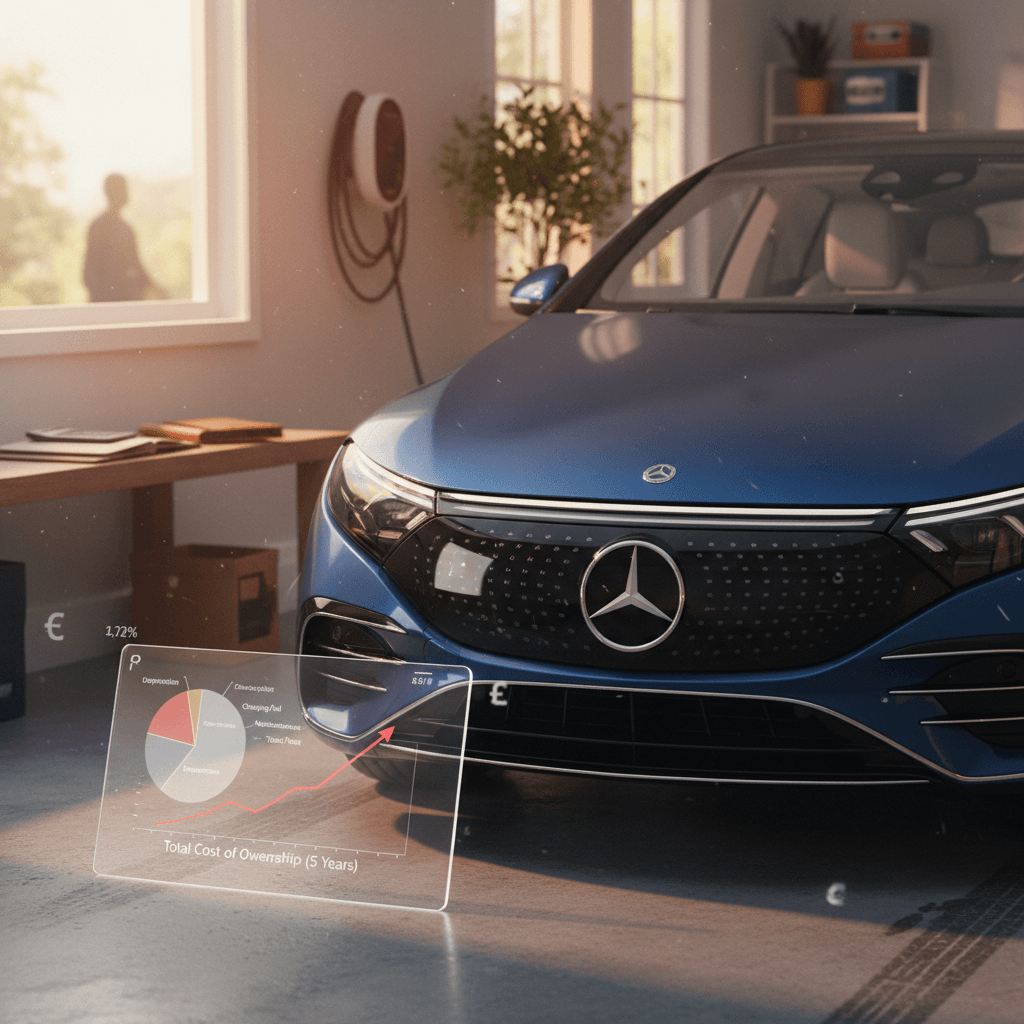
The Mercedes EQS is a flagship luxury EV with a flagship price, and a reputation for brutal early depreciation. If you’re trying to understand the Mercedes EQS true cost of ownership over 5 years, sticker price tells only a fraction of the story. The rest is hiding in resale value, electricity, insurance, and the surprisingly modest maintenance that comes with a big battery and no V8 under the hood.
What this guide covers
Why Mercedes EQS ownership costs are tricky to judge
On paper, the EQS looks like an accountant’s dream: no gasoline, long service intervals, brake pads that last ages thanks to regen. In practice, ultra-luxury EVs are dominated by depreciation and insurance. Those two line items can easily outweigh whatever you save at the plug, especially if you buy new and sell within five years.
What pushes EQS costs up
- Six‑figure MSRP on many trims
- Heavy early‑year depreciation as new tech arrives
- High insurance premiums for a large, complex luxury EV
- Costly bodywork and glass if you’re unlucky in traffic
What keeps EQS costs down
- No engine oil, plugs, belts, or transmission service
- Lower “fuel” cost per mile than a comparable gas S‑Class
- Fewer wear items thanks to regen braking
- Potential incentives and HOV access depending on your state
Luxury EV rule of thumb
Key assumptions and EQS specs for this 5-year analysis
To make the numbers comparable, we’ll focus on a typical rear‑drive EQS 450+ or similar trim bought near new and driven like a real car, not a garage sculpture.
5‑year Mercedes EQS cost of ownership assumptions
These baseline assumptions keep the math realistic and comparable to common cost‑of‑ownership studies.
| Category | Assumption |
|---|---|
| Purchase price (new) | $110,000 out‑the‑door (including taxes/fees) |
| Annual mileage | 12,000 miles/year (60,000 miles over 5 years) |
| Energy efficiency | 3.0 miles/kWh (mixed city/highway) |
| Home electricity rate | $0.15 per kWh (U.S. average-ish) |
| Public DC fast charging | Used for 20% of miles at $0.40 per kWh |
| Insurance | $2,700/year (good record, urban/suburban) |
| Maintenance & repairs | $900/year average outside of warranty add‑ons |
| Residual value (year 5) | ~35% of original MSRP |
You can adjust these numbers up or down based on your own driving, electricity rates, and insurance quotes.
Model years covered
Mercedes EQS 5‑year cost of ownership at a glance
Depreciation: the elephant in the S‑Class–sized room
Depreciation is where the EQS shows its most Germanic flair for excess. Luxury EVs are evolving quickly, and early buyers are effectively paying for the rapid obsolescence curve. Big MSRP, new tech every year, lots of supply coming off lease, perfect recipe for used‑market bargains and painful first‑owner spreadsheets.
- Estimated new purchase (out‑the‑door): $110,000
- Estimated value after 5 years / 60,000 miles: ~$38,000 (about 35% of original)
- Estimated depreciation: $72,000
- Depreciation per year: ~$14,400
- Depreciation per mile: about $1.20
Why EQS depreciation is so steep
This is also why the EQS can be an excellent used buy. Someone else eats the first $40,000–$50,000 in value loss, and you step into a car that still feels absolutely contemporary. We’ll come back to that when we look at used 3‑year‑old examples.
Electricity costs: home vs public charging
Compared with an S‑Class or BMW 7 Series, the EQS’s energy bill is almost genteel. Your real‑world efficiency will depend on temperature, wheel choice, and your right foot, but 3.0 miles per kWh is a reasonable middle ground for a big luxury EV.
5‑year electricity cost estimate for Mercedes EQS
Assuming 12,000 miles/year, 3.0 mi/kWh efficiency, 80% home charging and 20% DC fast charging.
| Category | Math | 5‑year estimate |
|---|---|---|
| Total miles driven | 12,000 miles/year × 5 | 60,000 miles |
| Total kWh used | 60,000 ÷ 3.0 mi/kWh | 20,000 kWh |
| Home charging share | 80% of 20,000 kWh | 16,000 kWh at $0.15 |
| Home charging cost | ≈ $2,400 over 5 years | |
| DC fast charging share | 20% of 20,000 kWh | 4,000 kWh at $0.40 |
| DC fast charging cost | ≈ $1,600 over 5 years | |
| Total electricity cost | ≈ $4,000 over 5 years |
If your home rate is cheaper, many off‑peak EV plans are, you can shave these numbers down further.
Realistic cushion
Even at the higher end of that range, you’re typically saving several thousand dollars in “fuel” versus a comparable gas flagship sedan over five years. It doesn’t cancel out depreciation, but it softens the blow.
Insurance, taxes and fees for a Mercedes EQS
Insuring an EQS is not a Civic‑money exercise. You’re driving a six‑figure, heavy, technology‑dense luxury EV with plenty of expensive glass and sensors. Insurers price accordingly, especially in urban ZIP codes.
What to expect beyond the purchase price
These non‑energy running costs are easy to overlook when you’re dazzled by the Hyperscreen.
Insurance
Budget around $2,500–$3,000 per year for full coverage, assuming a clean record. That’s roughly $12,500–$15,000 over 5 years.
Taxes & registration
Sales tax will likely be baked into your initial out‑the‑door price, but don’t forget annual registration: often $300–$600/year in many states, more in high‑fee jurisdictions.
EV fees & credits
Some states add EV road‑use fees while others still offer rebates or HOV access. Over 5 years, these can nudge overall ownership cost a few hundred dollars in either direction.
Bodywork & glass are expensive
Maintenance and repairs: where EVs quietly win
The good news: once you’ve written the check to buy it, an EQS is fundamentally cheaper to keep alive than an S‑Class with a twin‑turbo engine. You still have air suspension, steering, HVAC, and all the other trimmings of a complex luxury car, but the powertrain itself is remarkably low‑drama.
- No oil changes, spark plugs, fuel filters, or multi‑thousand‑dollar transmission services.
- Brake pads often last 80,000+ miles thanks to strong regenerative braking.
- Tire wear can be significant on a heavy, torquey EV, budget for at least one full set over 5 years.
- Software updates can add features or fix quirks without a trip to the dealer.
5‑year maintenance estimate
Putting it together: 5‑year Mercedes EQS cost summary
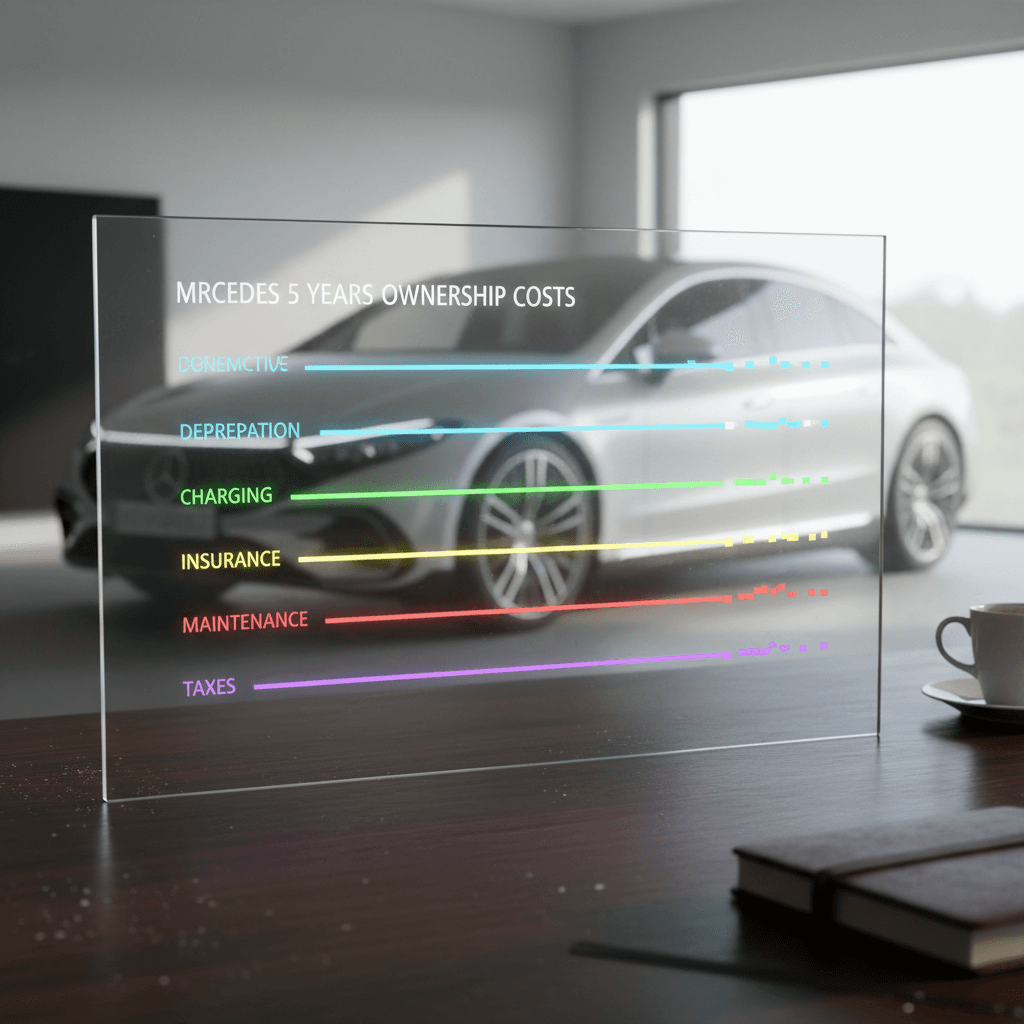
Add it all up and the true cost of owning a new EQS for five years is less about electricity and more about what accountants call capital expense, the chunk of value that evaporates during your tenure behind the wheel.
Estimated 5‑year true cost of ownership – new Mercedes EQS
All numbers rounded; actual costs will vary by state, trim, and how you drive.
| Cost category | 5‑year estimate | Notes |
|---|---|---|
| Depreciation | $72,000 | From $110,000 purchase to ~$38,000 resale |
| Electricity (home + DCFC) | $7,000 | Assumes mixed home/public charging, moderate efficiency |
| Insurance | $13,500 | $2,700/year average |
| Maintenance & repairs | $4,500 | Routine service, one set of tires, minor fixes |
| Registration & misc. fees | $2,500 | State‑dependent, some EV fees possible |
| Total 5‑year cost | ≈ $99,500 | Excludes financing costs |
| Cost per mile (60,000 miles) | ≈ $1.66/mile | All‑in ownership cost |
Depreciation is the star of this particular horror film; energy and maintenance play supporting roles.
For context
New vs used EQS: how the curve flips in year three
If you’re reading this and thinking “Nice car, shame about the depreciation,” you’ve already stumbled onto the hack: don’t be the first owner. The EQS is one of those vehicles that makes far more financial sense as a 2–3‑year‑old used purchase than as a showroom‑fresh indulgence.
Scenario A: New EQS, 5 years
- Buy at ~$110,000 out‑the‑door
- Sell after 5 years/60,000 miles at ~$38,000
- Depreciation: ~$72,000
- 5‑year total cost: just under six figures
Scenario B: 3‑year‑old EQS, next 5 years
- Buy a well‑kept 3‑year‑old car for, say, $55,000–$60,000
- Sell after 5 more years (age 8, higher miles) for perhaps $20,000–$25,000
- Depreciation: closer to $35,000–$40,000
- Same electricity, similar insurance, slightly higher maintenance
Where used EQS buyers win big
This is exactly the slice of the market where Recharged operates: used EVs with verified battery health and transparent pricing. A Recharged Score Report surfaces key EQS data, battery condition, prior use patterns, market‑correct pricing, so you’re not guessing about the single most expensive component in the car.
How the EQS compares to gas luxury sedans
Luxury shoppers rarely cross‑shop spreadsheets, but they probably should. Stack an EQS against a Mercedes S‑Class, BMW 7 Series, or Audi A8, and the pattern is consistent: the EQS tends to lose value faster early on, but it’s cheaper to energize and maintain.
EQS vs gas flagship: cost themes
Exact numbers vary, but the high‑level dynamics are stable.
Gas luxury sedan
- Higher fuel cost: often $12k–$15k+ over 5 years
- More frequent and complex maintenance
- Depreciation is still heavy, but market is more mature
- Resale demand broader in some regions
Mercedes EQS
- Lower energy cost: around $7k–$8k over 5 years
- Fewer moving parts, less routine service
- Steep early‑year depreciation as EV tech evolves
- Appeals strongly to second‑owner EV adopters
Total-cost reality check
Practical ways to lower your EQS cost of ownership
6 smart moves to tame EQS ownership costs
1. Buy used after 2–3 years
Let someone else finance the privilege of first ownership. Target EQS models with complete service history and strong battery health metrics; this is where a verified diagnostic like the Recharged Score can save you from guesswork.
2. Favor home charging over DC fast charging
Home charging at off‑peak rates is usually the cheapest way to feed an EQS. It also tends to be gentler on the battery than constant DC fast charging, which can support long‑term range retention.
3. Shop insurance aggressively
Rates vary wildly. Get quotes from multiple insurers, ask about telematics or mileage‑based programs, and revisit your policy annually. A few hundred dollars per year saved becomes a few thousand over 5 years.
4. Protect the wheels and tires
The EQS’s big, low‑profile tires are not cheap. Keep them properly inflated, avoid pothole roulette, and consider a dedicated winter set if you live in a snow belt to minimize curb‑rash and blowouts.
5. Keep software and services in check
Some connected services and subscription options are nice-to-haves rather than must-haves. Periodically audit what you’re paying for; over five years, "only" $25 here and $30 there adds up.
6. Think in total cost per mile
When you evaluate upgrade or sale timing, look at your <strong>all‑in cost per mile</strong>, purchase, depreciation, energy, and insurance, not just your payment. It’s the best way to decide whether to hold or move on.
How to find a used EQS with strong battery health
With any used EV, battery health is the whole ballgame. The EQS starts with a large pack, so modest degradation isn’t the end of the world, but you still want to know what you’re buying. Range that quietly shrinks by 20–30% over time changes your daily routine.
Key checks before you sign for a used EQS
These are exactly the items Recharged bakes into its Recharged Score Report for used EVs.
State of health (SoH)
Ask for a quantified battery state of health from a reputable diagnostic, not just “range feels fine.” A detailed report shows how the pack has aged over time.
Use & charging history
Moderate daily driving and mostly home charging is the ideal pattern. Heavy DC fast‑charging use or large swings from 0–100% charge every day can stress the pack.
Service and warranty
Confirm open recalls, service campaigns, and remaining battery warranty coverage. On a complex luxury EV like the EQS, paperwork is your friend.
Every vehicle sold through Recharged includes a Recharged Score Report that surfaces these battery and usage details in one place, along with fair‑market pricing and nationwide delivery options. You focus on whether you actually like the car; we focus on whether it’s a smart long‑term buy.
FAQ: Mercedes EQS true cost of ownership
Frequently asked questions about 5‑year EQS costs
Bottom line: who the EQS makes financial sense for
If you’re the sort of buyer who likes to be first in line, spec the rare color, and trade out of cars every 3–4 years, the Mercedes EQS is going to be an indulgence, not a spreadsheet win. The true cost of ownership over 5 years is dominated by depreciation, well into five‑figure territory even before you add electricity, insurance, and maintenance.
But for the right second owner, the EQS is a compelling play: a deeply comfortable, eerily quiet luxury flagship whose worst financial sins have already been committed by someone else. Buy thoughtfully, ideally with verified battery health and transparent pricing, charge mostly at home, and keep the car long enough, and the EQS begins to look less like a financial folly and more like what it feels like on the road: a very modern kind of luxury car.
If you’re ready to explore that second‑owner sweet spot, Recharged can help you find a used EQS (or other luxury EV) with a clear, data‑backed picture of long‑term costs. That way, the only surprise you get from your car is how quiet 80 mph can feel.