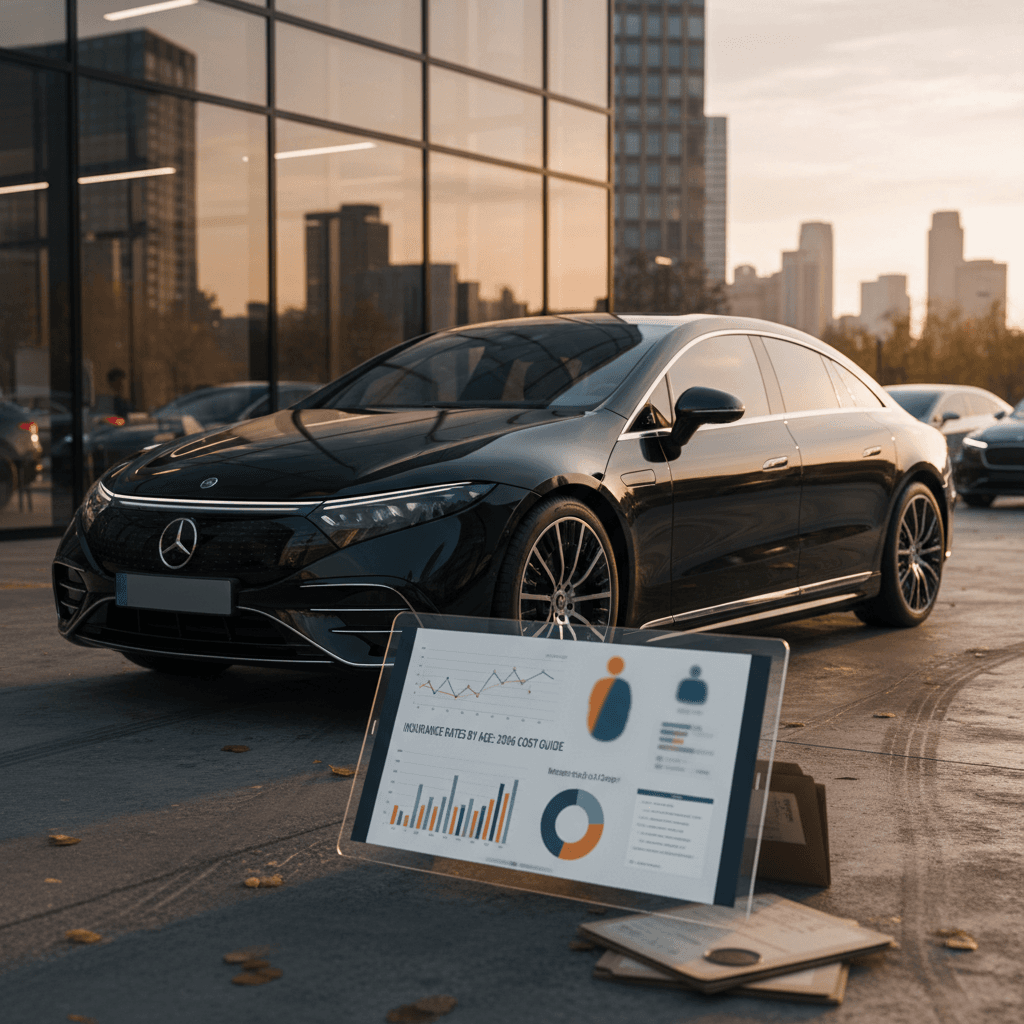
If you’re shopping for a Mercedes EQS, or trying to budget for a used one, the insurance bill can be more shocking than the acceleration. Luxury EVs already cost more to insure than comparable gas sedans, and Mercedes EQS insurance rates by age can swing thousands of dollars a year between a 22‑year‑old and a 50‑year‑old with the exact same car.
Key takeaway on EQS insurance
Overview: What to Expect From Mercedes EQS Insurance by Age
Mercedes EQS Insurance at a Glance (2026)
Those are broad averages. What you’ll actually pay depends on the EQS sedan vs SUV, trim, where you live, how you drive, and all the usual underwriting suspects. But age is one of the big levers insurers pull when they price risk, and with a six‑figure EV like the EQS, those age‑based differences really show up in the quote.
How Much Does It Cost to Insure a Mercedes EQS?
Let’s start with the big picture, then zoom into Mercedes EQS insurance rates by age.
- Recent nationwide analyses of EV insurance put the average full‑coverage premium for a Mercedes‑Benz EQS sedan around $4,700–$4,900 per year (roughly $400 per month) for a mid‑30s driver with a clean record.
- Some studies that blend trims, locations, and insurers find typical EQS premiums clustering in the low‑to‑mid‑$4,000s annually, again, for a standard “good driver, good credit” profile.
- Luxury‑focused carriers and high‑cost metro areas can easily push an EQS quote above $6,000–$7,000 per year, especially for performance AMG variants or younger drivers.
- A bare‑bones liability‑only policy on an older EQS, rare and not recommended for a car this valuable, would be far lower, but leaves you dangerously exposed on a $60,000–$100,000 asset.
Sticker shock alert
Mercedes EQS Insurance Rates by Age: Example Breakdown
Every insurer uses its own formula, and your ZIP code, credit tier, driving history, and mileage matter just as much as your birthday. Still, it’s useful to look at how average U.S. car insurance prices change by age, then layer in what we know about EQS pricing.
Illustrative Mercedes EQS Insurance Rates by Age
These ballpark figures show how insurance costs for a Mercedes EQS might scale by age for a full‑coverage policy in the U.S. They’re not quotes, just realistic ranges to help with budgeting.
| Driver age | How insurers see you | Illustrative annual EQS premium | What that means monthly |
|---|---|---|---|
| 18–20 | Highest‑risk, little experience | $8,000–$13,000 | $665–$1,085 |
| 21–24 | Still very high risk | $6,500–$10,000 | $540–$835 |
| 25–29 | Risk dropping, still pricier | $5,000–$8,000 | $415–$665 |
| 30–39 | Prime, lower‑risk years | $4,200–$6,000 | $350–$500 |
| 40–54 | Typically the sweet spot | $3,800–$5,500 | $315–$460 |
| 55–64 | Still low risk, some discounts | $3,700–$5,300 | $310–$440 |
| 65–74 | Slight uptick for aging risk | $4,000–$5,800 | $335–$485 |
| 75+ | Elevated claims risk again | $4,500–$7,000 | $375–$585 |
Assumes a relatively safe ZIP code, clean driving record, average annual mileage, and full‑coverage limits that match or exceed lender requirements.
These are guideposts, not quotes
Why Mercedes EQS Insurance Is So High (At Any Age)
4 Reasons EQS Insurance Starts High, Then Age Adjusts It
Understanding the baseline makes the age differences easier to swallow.
1. Vehicle value and segment
2. Complex EV hardware
3. EV‑specific repair patterns
4. Luxury‑brand loss history
How Age Interacts With Other Insurance Rating Factors
Age doesn’t operate in a vacuum. A 22‑year‑old with a spotless driving record might still pay less to insure an EQS than a 40‑year‑old with two recent at‑fault crashes. Here’s how age plays with the rest of the risk puzzle.
1. Age and experience
Insurers know that crash frequency is highest for new drivers, eases off rapidly in the late 20s and 30s, then starts to tick back up in the 70s. They bake that into their base rate tables. With a car as powerful and heavy as the EQS, any lack of experience is magnified in their models.
2. Age plus driving record
Tickets and at‑fault crashes can raise EQS premiums by thousands of dollars a year. A minor speeding ticket might move the needle a bit; a DUI can make coverage brutally expensive at any age. For younger drivers, violations stack on top of already‑high age‑based rates.
3. Credit, telematics, and usage
In most states, credit‑based insurance scores still matter. So does how and when you drive. Some insurers offer telematics programs that reward low‑risk behavior and limited mileage, helpful for older EQS drivers who don’t commute daily.
4. Location and garaging
Your ZIP code can swing EQS insurance more than age once you’re out of your teens. Dense urban areas with high theft and accident rates, or coastal regions with more severe weather, tend to be pricier. A garage‑kept EQS in a low‑crime suburb looks far better on an underwriter’s screen than the same car street‑parked downtown.
Buying used? Insurance still tracks replacement cost
Saving on EQS Insurance for Young Drivers (18–29)
If you’re under 30 and eyeing an EQS, insurers will assume you’re more likely to bend metal, even if you’re the cautious one in your friend group. There are ways to fight back, but you’ll need to be deliberate.
Smart Moves for Young EQS Drivers
1. Choose the right trim and body style
Performance AMG variants and some SUV configurations can be significantly more expensive to insure than a lower‑power EQS 450+ sedan. If your goal is to keep premiums somewhat sane, start with the least aggressive powertrain and wheel/tire package that still makes you happy.
2. Start with higher deductibles (if you can afford them)
Bumping collision and comprehensive deductibles from, say, $500 to $1,000 can trim hundreds off an annual EQS premium. Just be sure you have that amount in an emergency fund, otherwise you’re trading a lower bill today for an ugly surprise after a claim.
3. Stay on a family policy when possible
A 20‑something added to a parent’s multi‑vehicle policy often pays less than they would on their own. The EQS will still be rated as a high‑value vehicle, but multi‑car and loyalty discounts help soften the blow.
4. Prove it with telematics
Usage‑based programs that monitor braking, cornering, and nighttime driving can be a lifeline for young EQS drivers. If the app shows you’re smooth and predictable behind the wheel, some insurers will discount your rate faster than age alone would.
5. Keep mileage realistic
Insure the EQS for how you’ll actually use it. If you have a beater commute car and the EQS is mainly for weekends and trips, make sure the policy reflects lower annual mileage and pleasure use.
Think twice about liability‑only on an EQS
Saving on EQS Insurance in Your 30s, 40s, and 50s
These are typically the golden years for car insurance. If you’re 30–59 with a clean record, you’re exactly the customer insurers want to keep. With a Mercedes EQS, that means you have leverage.
How to Use Your Best Insurance Years Wisely
You’ve earned lower rates, now make sure you capture them.
Shop at renewal
Tune coverage, not safety nets
Stack multi‑policy discounts
Leverage your clean record
Mercedes EQS Insurance for Seniors: What Changes After 65
Once you cross into your late 60s and 70s, age quietly moves back onto the underwriter’s worry list. Claim frequency and injury severity start to climb again, and that shows up in EQS quotes even if you’ve never so much as scraped a curb.
- Many insurers nudge premiums up gradually from the mid‑60s onward, especially for heavier, more powerful vehicles like the EQS.
- Annual mileage usually falls in retirement, which can help offset some of that age‑based increase, so keep your odometer estimates up to date.
- Completing approved mature‑driver or defensive‑driving courses can unlock small but meaningful discounts in many states.
- If reaction times or comfort behind the wheel change, using the EQS primarily for daytime, local driving and reducing night or bad‑weather miles can both lower risk and support better rates via telematics.
Consider downsizing coverage, not safety

10 Ways to Lower Mercedes EQS Insurance at Any Age
Universal EQS Insurance Savings Checklist
1. Compare at least three quotes
Prices for a Mercedes EQS swing wildly between carriers. A company that’s competitive on compact crossovers may be sky‑high on a flagship EV. Always price‑check before you renew.
2. Right‑size your deductibles
Higher deductibles lower your premium, but only raise them to a level you could comfortably cover on short notice. Many EQS owners land in the $1,000–$2,000 range for collision and comprehensive.
3. Ask about EV‑specific discounts
Some insurers now offer small discounts for electric vehicles, advanced driver assistance suites, or participation in EV‑friendly telematics programs. They won’t always volunteer these, ask directly.
4. Keep your record clean
On a car as expensive as the EQS, major violations and at‑fault crashes can add thousands of dollars a year. Drive the way you want your rate to look.
5. Update mileage annually
If your EQS turns into a weekend car or a road‑trip toy instead of a daily commuter, updating your mileage can nudge your premium down. Don’t let the insurer assume 15,000 miles a year if you’re driving 6,000.
6. Improve security and garaging
Off‑street or garage parking can help, especially in high‑theft areas. So can factory security and tracking features, make sure your insurer knows what your car has.
7. Bundle with home or renters insurance
Multi‑policy discounts stack nicely with multi‑car discounts. If you’re insuring a second vehicle or a home, bundling is low‑effort money saved.
8. Review coverage as your EQS ages
As the EQS depreciates, the gap between what it’s worth and what you’re paying to protect it can widen. Periodically revisit whether extras like gap or new‑car replacement coverage still make sense.
9. Consider a used EQS
Buying a high‑quality used EQS can soften insurance costs because the car’s replacement value has already taken the steepest depreciation hit. Platforms like <strong>Recharged</strong> pair used EVs with transparent battery‑health data, which can give you confidence to shop older model years.
10. Pay attention at claim time
How an insurer handles EQS claims, parts sourcing, repair decisions, communication, matters as much as the premium. Sometimes paying a bit more for a carrier that understands EVs is worth it in stress saved.
Insurance and the Total Cost of EQS Ownership
Insurance is just one piece of the EQS ownership puzzle, but it’s a big one, often second only to depreciation in your annual cost to own. EVs can win back ground with lower “fuel” and maintenance costs, yet the insurance line item still stings if you’re coming from something modest.
Where insurance fits in
- Depreciation: The EQS drops most in the first 3–4 years, which is exactly when insurance is busiest protecting your investment.
- Charging: Home charging is usually cheaper per mile than gas, which can free up some budget to allocate toward insurance.
- Maintenance: EVs don’t need oil changes, and brake wear is often lower, but Mercedes parts and labor are still premium‑priced when something does need attention.
Why used EQS buyers care even more
If you’re looking at a used EQS, your monthly payment might be much lower than a new‑car buyer’s, but your insurance costs could be surprisingly close. That’s why Recharged includes a Recharged Score battery‑health and value report with every EV, so you can weigh the whole ownership picture, depreciation, range, and likely insurance needs, before you commit.
FAQs: Mercedes EQS Insurance Rates by Age
Frequently Asked Questions
Is a Mercedes EQS Worth It Despite Insurance Costs?
On paper, Mercedes EQS insurance rates by age can look intimidating, especially if you’re under 30 or live in a pricier part of the country. But insurance is just one line in a much bigger story. The EQS delivers S‑Class‑level comfort, all‑electric torque, and a quiet, low‑maintenance ownership experience that a lot of drivers are happy to pay extra to enjoy.
The key is to go in with clear eyes. Get quotes for your real age, address, and driving record before you fall in love with a specific VIN. Compare trims, play with deductibles, and see whether a well‑chosen used EQS from a transparent marketplace like Recharged can get you the car you want without blowing up your budget.
If you treat insurance as part of the car, not an afterthought, you’ll be in a much better position to decide whether the EQS fits your life today and how your costs are likely to change as you move from your 20s into your 30s, 40s, and beyond.