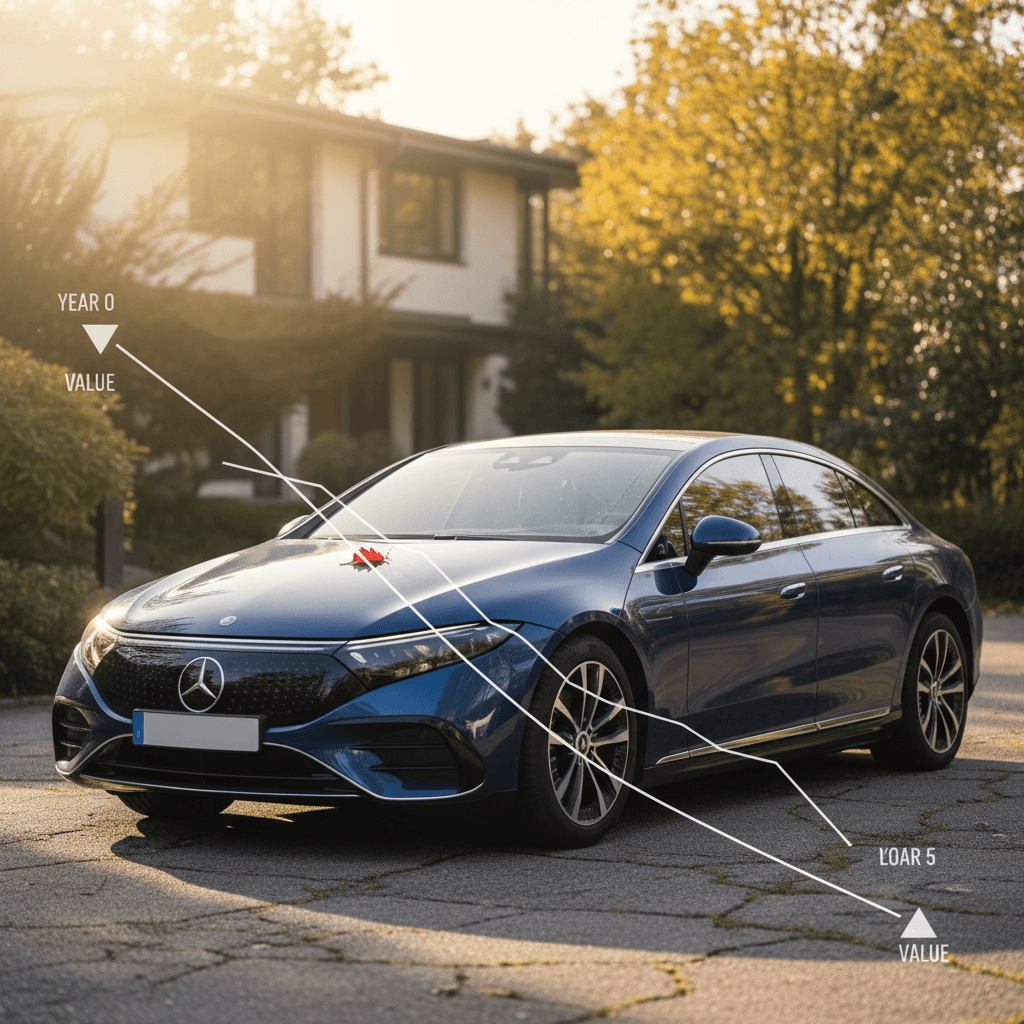
If you’re eyeing a Mercedes EQS, the five-year depreciation curve isn’t just a chart, it’s the difference between a painful loss and a smart long-term play. Luxury EVs like the EQS tend to drop faster in value than gas sedans, but that curve can work in your favor if you understand what’s happening and time your purchase right.
Key takeaway
Why Mercedes EQS depreciation matters over 5 years
The EQS launched as Mercedes-Benz’s electric flagship, with pricing that easily pushes into six figures once you add options. At that level, depreciation is the single largest ownership cost, often dwarfing electricity, insurance, and maintenance combined over five years. For shoppers comparing an EQS to a Tesla Model S, Lucid Air, or an S-Class, understanding the five-year curve is essential to making a rational decision rather than an emotional one.
- If you buy new, you’re absorbing the steepest drop in the first 24–36 months.
- If you buy at 2–4 years old, you’re often letting the first owner pay for most of that drop.
- If you plan to sell within five years, timing your exit can preserve thousands of dollars in value.
- If you buy used without checking battery health, you may overpay relative to how long the car will realistically serve you.
Tip for shoppers
How much does a Mercedes EQS depreciate in 5 years?
The Mercedes EQS hasn’t been on sale long enough for full cradle‑to‑grave data, but between early auction results, wholesale values, and how similar luxury EVs behave, a picture is emerging. The EQS appears to depreciate faster than an S‑Class and broadly in line with or slightly quicker than a Tesla Model S, especially in the first three years.
Estimated 5-year Mercedes EQS depreciation snapshot
Important caveat
What drives the Mercedes EQS depreciation curve?
Main forces shaping EQS depreciation
Luxury EVs respond to different pressures than comparable gas sedans.
Battery & tech pace
Brand & segment
Pricing & incentives
Interest rates & payment sensitivity
EV vs ICE perception
Regional demand
EQS vs S‑Class
Year-by-year Mercedes EQS depreciation curve
To make the five‑year curve more concrete, let’s use a simple example. Imagine a well‑equipped EQS with an original MSRP of $120,000. Real‑world transaction prices may be lower due to discounts and incentives, but sticker price is a clean starting point.
Illustrative 5-year Mercedes EQS depreciation curve
Approximate retained value for a $120,000 Mercedes EQS, assuming typical mileage and condition. These are directional, not guaranteed.
| Age | Approx. value | % of original MSRP | What’s happening in the market |
|---|---|---|---|
| Year 1 | $85,000–$95,000 | 70–80% | Still nearly new, but incentives and discounts on remaining new inventory cap used pricing. |
| Year 2 | $72,000–$82,000 | 60–68% | More off‑lease and demo units hit the market; newer software or trim updates put gentle pressure on early builds. |
| Year 3 | $60,000–$72,000 | 50–60% | Steepest part of the curve largely behind you. Many examples now in mainstream used‑car channels rather than just Mercedes dealers. |
| Year 4 | $54,000–$66,000 | 45–55% | Depreciation slows; miles, accident history, and battery health start to matter more than model‑year bragging rights. |
| Year 5 | $48,000–$60,000 | 40–50% | Vehicle is firmly in used‑luxury territory. Clean history and strong range performance command a premium over neglected or high‑mile cars. |
Actual market values will vary by trim, options, and region.
How to read this curve
Mercedes EQS vs other luxury EVs: depreciation comparison
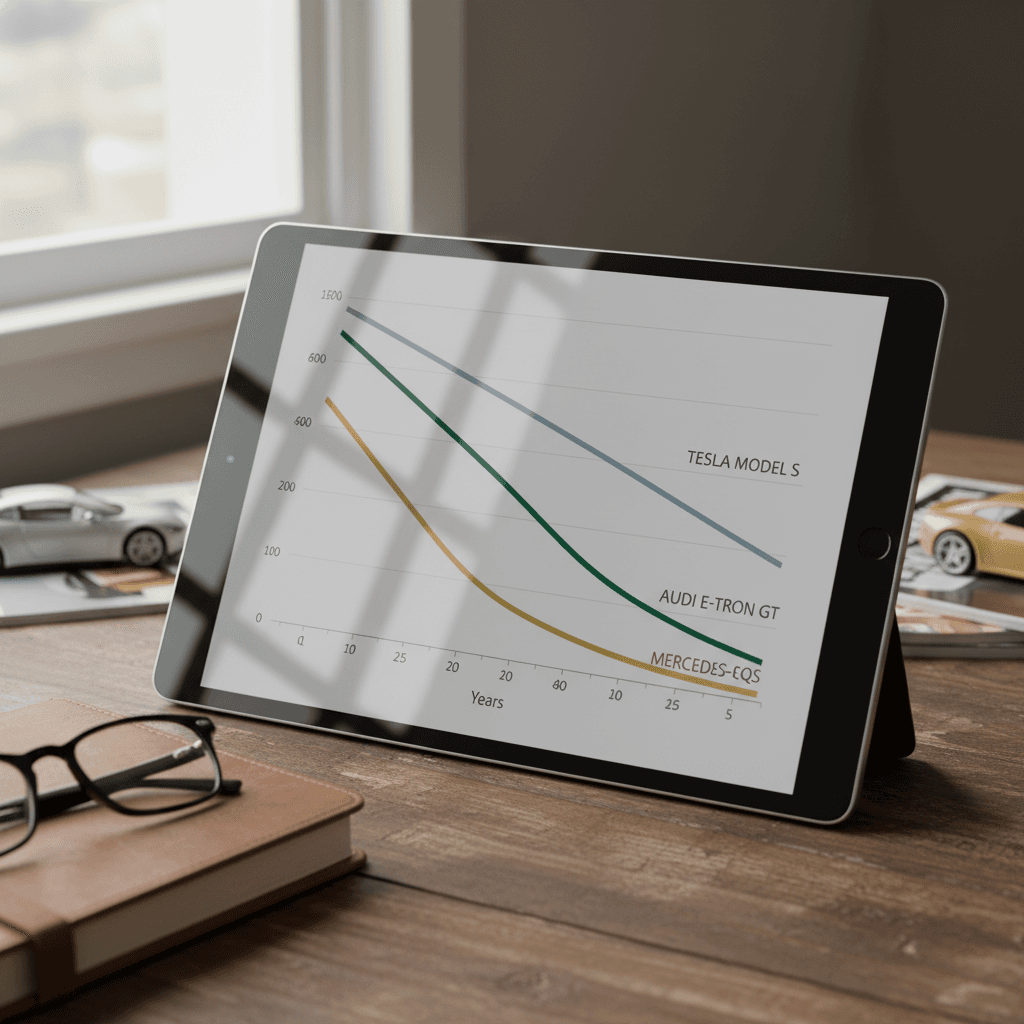
Tesla Model S
The Model S benefits from a massive charging network and strong brand recognition, but it’s also one of the oldest EV nameplates on the road. That combination has created a wide spread in values: newer, high‑range examples hold up reasonably well, while older cars and high‑mile performance trims can be relative bargains.
- Depreciation pace: Historically steep in the first 3–5 years, then stabilizes.
- Vs EQS: In many markets, late‑model Model S examples retain a slightly higher percentage of MSRP than similar‑age EQS, but the gap narrows as both age.
Audi e-tron GT / Porsche Taycan
The e‑tron GT and Taycan target similar buyers: design‑focused luxury shoppers who care about performance. These models also face brisk early depreciation as leasing and incentives push down effective new prices.
- Depreciation pace: Comparable or even steeper than EQS in some trims, especially high‑spec cars with big options lists.
- Vs EQS: The EQS often sits in the same ballpark by year five, around half of original MSRP, though local brand loyalty can sway results either way.
Where EQS can shine
Battery health vs depreciation on the EQS
For any EV, battery health is the backbone of resale value. A Mercedes EQS with a strong pack that still delivers close to its original range is worth materially more than an identical car that’s lost a chunk of usable range, even if both look perfect on the outside.
How battery health shapes EQS resale value
Two EQS sedans can look identical on paper and be worlds apart in real value.
Real-world range
Fast-charging behavior
Warranty cushion
Why you shouldn’t skip diagnostics
That’s why every used EV on Recharged comes with a Recharged Score Report, including verified battery health, range assessment, and pricing benchmarks. Instead of trusting an odometer and a seller’s word, you see how the EQS you’re considering stacks up against similar cars and what that means for long‑term value.
Leasing vs buying new vs buying used EQS
Three common EQS ownership paths, and how depreciation hits each one
1. Lease new (3 years)
Leasing a new EQS pushes most residual‑value risk onto the captive finance arm. You’re effectively pre‑paying depreciation via your monthly payment, then handing the car back right as the steepest drop ends. It’s appealing if you want the latest tech and don’t plan to own long term.
2. Buy new and keep 7–10+ years
If you want to be the first owner, long‑term ownership is the best way to amortize the high initial hit. You’ll ride out the early years where values fall fastest and enjoy the EQS deep into its battery warranty and beyond.
3. Buy used at 3–5 years
From a pure depreciation standpoint, this is often the sweet spot. You’re buying after the bulk of the curve has already played out and, if you choose carefully, you can still have years of battery warranty remaining and modern features.
Smart play for value‑seekers
How to buy a used Mercedes EQS without overpaying
Used EQS prices can look all over the map, especially between private sellers, franchises, and independent dealers. To keep from overpaying or getting stuck with a problem car, focus on a few non‑negotiables.
Used Mercedes EQS buying checklist
Verify original MSRP and options
Pull the build sheet or window sticker. A heavily optioned EQS may have cost $20,000+ more than a base car when new, which matters when you compare asking prices and depreciation.
Get an independent battery health report
Don’t rely only on dashboard range estimates. Use a third‑party diagnostic or a platform like <strong>Recharged</strong>, where every car comes with a <strong>Recharged Score</strong> that quantifies pack health and expected range.
Check warranty balance and in‑service date
Confirm when the battery warranty clock started and whether any major components have been replaced. A car with several years of high‑voltage coverage left deserves a pricing premium.
Study mileage and use pattern
High highway miles with consistent charging can be less stressful on a pack than short‑hop city duty with constant fast‑charging. Ask for charging habits and typical use, not just total miles.
Pull a full history report
Look for accident history, structural repairs, flood damage, and repeated electrical issues. Luxury EVs are complex, and those stories often show up in the data long before they show up in a quick test drive.
Benchmark price against the market
Use multiple sources to see where the asking price sits versus similar EQS listings. On Recharged, we bake fair‑market pricing into the listing using current auction and retail data.
How Recharged fits in
Tips to protect your EQS resale value
If you already own an EQS, or you’re about to, there’s a lot you can do to stay on the right side of the depreciation curve. You can’t beat the math of time and miles, but you can position your car to be one of the more desirable examples when it’s time to sell or trade.
- Keep charging habits battery‑friendly: avoid frequent 100% fast‑charges and long periods at very high or very low state of charge when possible.
- Stay on top of software updates and recall campaigns through your Mercedes dealer or over‑the‑air updates.
- Document all service and repair work and keep a folder or digital record you can hand to the next owner.
- Protect the interior and exterior, luxury‑grade materials show wear quickly if neglected, and cosmetic issues hit resale hard on six‑figure cars.
- Time your sale or trade before major redesigns or range upgrades in the EQS lineup that could reset used‑car expectations.
Don’t ignore cosmetic condition
FAQs about Mercedes EQS depreciation
Mercedes EQS depreciation: common questions answered
Bottom line: is a used Mercedes EQS a smart buy?
If you’re willing to let someone else take the first‑owner hit, the Mercedes EQS depreciation curve over five years can actually work in your favor. The steep early drop turns a six‑figure flagship into a far more attainable used EV, provided you’re disciplined about battery health, history, and pricing.
For value‑focused buyers, the sweet spot is often a 3–5‑year‑old EQS with documented service, clean history, and a strong battery report. That’s where you capture most of the luxury experience at a fraction of the original price while avoiding the worst of the curve. And if you’d rather not decode that market on your own, Recharged can help you compare cars apples‑to‑apples with a Recharged Score Report, EV‑savvy financing options, trade‑in support, and even delivery to your driveway.