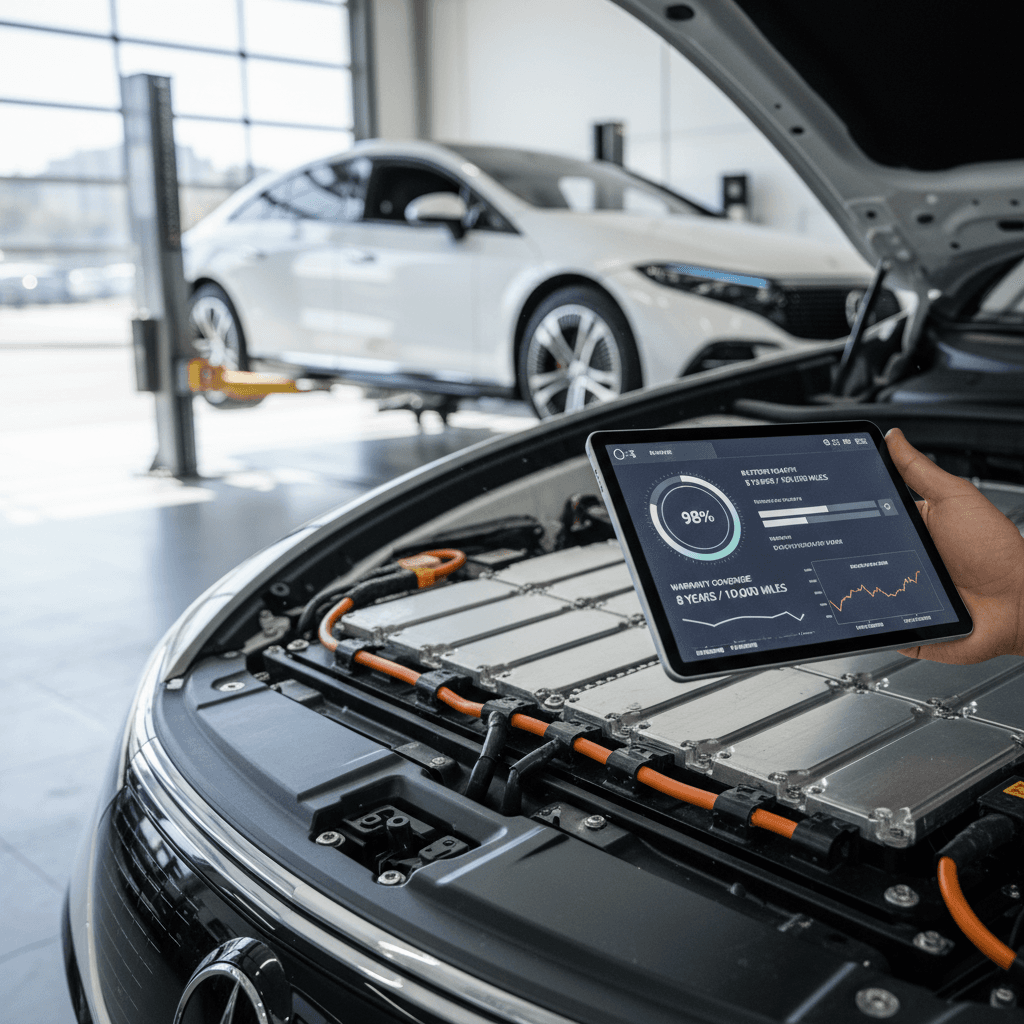
If you’re looking at a Mercedes EQS, new or used, the single biggest line item in the fine print is the battery warranty. The high‑voltage pack is the most expensive component in the car, so understanding what the Mercedes EQS battery warranty covers, and where it stops, can easily be the difference between a confident long‑term purchase and a five‑figure surprise.
Quick answer
Overview: Mercedes EQS battery warranty at a glance
Core Mercedes EQS battery warranty numbers
Think of the EQS battery warranty as a long, narrow safety net. It’s designed to protect you from premature battery failure or abnormal degradation, not to make every range drop or charging quirk a warranty event. The key is knowing what counts as “abnormal” in Mercedes’ eyes, and how those rules play out in the real world, especially if you’re shopping used.
How long the Mercedes EQS battery warranty lasts
For U.S.‑spec EQS sedan and EQS SUV models, Mercedes publishes a dedicated EQ warranty booklet that separates the high‑voltage battery from the regular new‑vehicle coverage. Here’s how the timelines usually break down for recent model years:
Typical Mercedes EQS warranty terms (recent U.S. models)
Approximate coverage for EQS sedan and EQS SUV. Always verify against the original warranty and service booklet for your VIN and state.
| Component | Standard coverage | What starts the clock? | Notes |
|---|---|---|---|
| New‑vehicle (bumper‑to‑bumper) warranty | 4 years / 50,000 miles | Original in‑service date | Covers most non‑wear components: electronics, interior hardware, many mechanical parts. |
| High‑voltage battery (EQS / EQS SUV) | Up to 10 years / 155,000 miles | Same in‑service date as vehicle | Dedicated Battery Limited Warranty against defects and excessive capacity loss. |
| High‑voltage battery (some early documentation / non‑U.S. markets) | ≈8–10 years / 100,000+ miles | Original in‑service date | Details vary by region; U.S. EQ warranty books show 10y/155k for EQS/EQE. |
| Emissions / CARB states | Up to ~10 years / 150,000 miles | In‑service date, in a CARB state | In some stricter states, emissions rules effectively require longer EV battery coverage. |
Model‑year quirks and CARB‑state rules can tweak these numbers slightly; use this as a framework, not a substitute for the actual booklet.
Two details matter if you’re looking at a used EQS. First, everything starts from the original in‑service date, the day the car was first sold or put into demo service, not the model year printed on the trunk. Second, mileage limits matter just as much as time. A 2022 EQS that racked up 130,000 highway miles as an Uber might be much closer to the 155,000‑mile cap than a 2021 that lived an easy suburban life.
Pro tip: check in‑service date, not just model year
What the EQS battery warranty actually covers
Mercedes uses legalese like “defects in material or workmanship” and “failure to maintain certified status,” but in plain English the EQS battery warranty is there to protect you in a handful of concrete scenarios.
Covered scenarios under a typical EQS battery warranty
Real‑world examples of when Mercedes is more likely to pick up the tab.
1. Pack or module failures
If individual battery modules, contactors, or the pack casing itself fail due to a defect, Mercedes will typically repair or replace the affected components under the Battery Limited Warranty, as long as you’re within the time and mileage limits.
Examples include cells that won’t balance, internal short circuits, or pack cooling plate defects that aren’t caused by outside damage.
2. Thermal management faults
The EQS relies on active liquid cooling to keep the pack in its comfort zone. If a factory‑defective coolant valve, pump, or sensor causes the battery to overheat or throw persistent high‑voltage warnings, that’s usually a warranty issue, not your problem.
3. DC fast‑charging issues caused by the battery
If the car refuses DC fast charging or charges dramatically below expected power levels because of a pack defect, rather than a bad charging station, the warranty can apply. The dealer will typically run diagnostics and, if they confirm an internal battery fault, proceed under the battery warranty.
4. Abnormal capacity loss (below a set threshold)
Most modern EQ battery warranties define a minimum usable capacity floor (often around 70% of original usable capacity). If your EQS drops below the stated threshold under normal use, Mercedes may repair or replace the pack or modules to restore it above that floor.
You’ll need dealer‑run diagnostics documenting the capacity loss.
5. High‑voltage safety systems
Components that are part of the battery safety system, like high‑voltage contactors, isolation monitoring, or pack‑mounted sensors, are generally included in battery coverage if they fail due to a defect. The goal is to ensure the pack remains sealed, fire‑resistant, and electrically isolated from the cabin.
6. Software/calibration when tied to a defect
On modern EVs, a lot of “battery problems” are actually software and calibration issues. If Mercedes issues an update or reprogramming that’s required to resolve a warranty‑covered battery concern, that work typically falls under the same claim.
The pattern here is consistent: the warranty is aimed at unexpected failures and defects, not gradual aging or damage from use. If something in the pack or its safety systems fails earlier than Mercedes thinks it should under normal operation, the warranty is your backstop.
What the Mercedes EQS battery warranty does NOT cover
The exclusions matter as much as the coverage. A lot of disappointed warranty claims come down to the fact that the owner assumed “battery warranty” meant “anything related to range or charging.” Mercedes, and every other OEM, disagrees.
- Normal, gradual capacity loss that still keeps the pack above the stated minimum (often ~70% usable capacity).
- Range swings caused by weather, driving style, speed, or accessory use (heat, A/C, big wheels, roof boxes).
- Damage from accidents, road debris, floods, or improper lifting/jacking of the car.
- Damage from unauthorized modifications or tampering with the pack, BMS (battery management system), or high‑voltage wiring.
- Issues caused by ignoring warning messages or continuing to drive with known high‑voltage faults.
- Wear‑and‑tear on related components like tires, brakes, suspension, or charging cables not supplied with the vehicle.
Warranty ≠ performance guarantee
Capacity loss & degradation: how much before Mercedes steps in?
Battery degradation is where the rubber really meets the road. The EQS uses a large pack, over 100 kWh in most trims, which means you can lose quite a bit of capacity before it truly impacts daily usability. Mercedes knows this, and structures its warranty accordingly.
Typical capacity threshold
While Mercedes doesn’t shout it from the rooftops, many EV battery warranties, including those referenced in EQ docs, use a floor of around 70% of original usable capacity. Drop below that under normal use, and you’re in potential warranty territory.
The exact number and test procedure are defined in the warranty booklet and internal service guidance. Dealers will typically run a formal capacity test rather than just reading the dash‑estimated range.
Real‑world expectations
Early owner data on EQS models suggests that, with mixed driving and reasonable charging habits, you should expect modest capacity loss in the first few years, then a slower decline. High DC fast‑charging usage, extreme heat, and constant 100% charges can accelerate aging, but that still doesn’t automatically equal a warranty claim unless you trip the formal threshold.
Think in kWh, not miles
Maintenance rules to keep your EQS battery warranty valid
Unlike a gas car, there’s no oil to change in an EQS battery, but Mercedes still expects you to follow a maintenance schedule. Skipping that schedule doesn’t automatically void your battery warranty, but it can give the manufacturer an argument if something goes wrong.
Key habits to protect your EQS battery warranty
Follow the official maintenance schedule
Mercedes typically calls for regular service visits (often around every 1–2 years) that include high‑voltage checks. Keep invoices and digital records; they’re your proof that you didn’t ignore required inspections.
Let the dealer perform battery‑related work
Repairs, diagnostics, or software updates on the high‑voltage system should be done at an authorized Mercedes‑Benz dealer. Independent tinkering with the pack or BMS can give Mercedes grounds to deny coverage.
Watch for and address warning lights quickly
If the EQS throws a persistent high‑voltage, cooling, or charging error, don’t ignore it. Document it, schedule service, and get the concern on record while you’re still in the warranty window.
Use charging equipment that meets specs
Using reputable, properly grounded home EVSE and avoiding sketchy adapters or non‑compliant hardware reduces the chance Mercedes can claim damage from “improper external equipment.”
Avoid obvious abuse scenarios
Intentionally running the pack to 0% for long storage, overheating the car off‑road, or submerging it in floodwater are all situations where Mercedes can credibly lean on abuse exclusions.
Skipping service can cost you leverage
New vs used: how EQS battery warranty transfers
The good news is that Mercedes structures the EQS battery warranty to follow the car, not the first owner. That matters a lot if you’re shopping the used market today, when most EQS models are only a few years old.
How EQS battery coverage works over the car’s life
What you get as the first, second, or third owner.
First owner (new EQS)
- 4 yr / 50k mi new‑vehicle coverage.
- Up to 10 yr / 155k mi high‑voltage battery warranty.
- Eligible for paid extended service contracts on top.
Second owner (used, still in warranty)
- Inherits remaining time and miles on both new‑vehicle and battery warranties.
- CPO EQS can add an extra year of bumper‑to‑bumper coverage, often with unlimited miles.
Later owners (high miles / older car)
- If the car has passed 10 years or 155,000 miles from in‑service date, battery coverage is typically over.
- At that point you’re relying on the inherent durability of the pack and your due‑diligence on battery health.
There’s no special paperwork required to transfer the EQS battery warranty in most U.S. cases, it goes with the VIN. But you’ll want documentation of in‑service date, mileage, and service history so you know exactly how much runway is left.
How the EQS battery warranty compares to other EVs
From 30,000 feet, the EQS sits near the top of the pack on battery warranty length. Many mainstream EVs cluster around 8 years / 100,000 miles; Mercedes stretches the EQS and EQE battery coverage toward 10 years / 155,000 miles, which is genuinely generous on paper.
EV battery warranty comparison snapshot
How Mercedes EQS stacks up against common competitors on high‑voltage battery coverage in North America.
| Brand / Model | Typical battery warranty | Capacity guarantee notes |
|---|---|---|
| Mercedes‑Benz EQS / EQS SUV | Up to 10 years / 155,000 miles | Often tied to ~70% usable capacity floor; defined in EQ warranty booklet. |
| Mercedes‑Benz EQB | 8 years / 100,000 miles | Shorter than EQS/EQE but in line with mainstream EV norms. |
| Tesla (Model S/3/X/Y) | 8 years / 100,000–150,000 miles (model‑dependent) | Most packs warranted to ~70% capacity over the term. |
| Hyundai / Kia EVs | 10 years / 100,000 miles | Strong headline term; some markets quote lifetime coverage on certain chemistries. |
| GM Ultium models | 8 years / 100,000 miles | Standard modern‑EV baseline; capacity thresholds usually around 60–70%. |
Exact terms change by model year and region; always check the warranty booklet for the specific car you’re cross‑shopping.
Quietly one of the stronger warranties
Buying a used EQS: how to check remaining battery coverage
On a six‑figure luxury EV, battery warranty is effectively a line item on the balance sheet. Two otherwise similar EQS sedans, same options, similar miles, can have very different risk profiles depending on how much factory battery coverage remains and what the battery’s actual health looks like.
Used EQS battery‑warranty checklist
1. Pull the in‑service date and warranty summary
Ask a Mercedes dealer or seller for the factory warranty summary for that VIN, which lists the in‑service date and current expiration for the new‑vehicle and high‑voltage battery warranties.
2. Confirm current mileage and usage history
High highway mileage isn’t automatically bad for EVs, but an EQS that’s already close to 155,000 miles has little to no battery warranty left. Look for documentation of how the car was driven and charged.
3. Get a true battery health report
Dash‑estimated range is not a battery test. At Recharged, every EQS comes with a <strong>Recharged Score</strong> that includes independently verified battery health, so you know how much usable capacity is actually left, not just what the guess‑o‑meter says.
4. Review DC fast‑charging behavior
On a test drive, watch how the car behaves at a reputable DC fast charger. If it charges unusually slowly compared with other EQS owner reports, that’s a flag to investigate with diagnostics before you buy.
5. Scan for high‑voltage or cooling system repairs
Service records mentioning repeated high‑voltage warnings, coolant leaks, or pack‑related work deserve extra scrutiny. A clean history with regular inspections is what you want to see.
6. Consider extended coverage for everything else
The battery may be covered for close to a decade, but air suspension, steering, infotainment, and driver‑assist hardware are not. Some buyers pair the long battery warranty with a shorter extended service contract for peace of mind on the rest of the car.
How Recharged helps de‑risk a used EQS
FAQ: Mercedes EQS battery warranty
Frequently asked questions about the EQS battery warranty
Bottom line: is the Mercedes EQS battery warranty good enough?
Zoom out, and the Mercedes EQS battery warranty is quietly one of the stronger offerings in the market: up to 10 years and 155,000 miles of high‑voltage coverage aimed squarely at the scariest failure scenario most shoppers worry about. It won’t keep your range from ever dropping or pay for every charging quirk, but it does put meaningful guardrails around catastrophic pack failure and abnormal degradation.
If you’re buying new, that long battery runway pairs with the standard 4‑year / 50,000‑mile new‑vehicle warranty and any extended coverage you choose for the rest of the car. If you’re buying used, especially a 2‑ to 5‑year‑old EQS, the combination of remaining battery warranty and a solid, third‑party battery health report can turn a high‑depreciation luxury EV into a smart value play.
That’s exactly where Recharged comes in. Every EQS we list comes with a Recharged Score Report that makes the invisible visible: verified battery health, clear warranty timelines, and fair‑market pricing, backed by EV‑specialist support, financing options, trade‑in offers, and nationwide delivery. If you love the idea of an EQS but don’t love rolling the dice on a six‑figure battery pack, there’s a way to have the car and keep your risk in check.