If you’re eyeing a new or used Mercedes EQS, the question behind all the glossy marketing is simple: **how much does the EQS battery degrade per year**, and what does that mean for real‑world range and resale value? With a six‑figure luxury EV built around a massive pack, understanding degradation isn’t just nerdy curiosity, it’s financial risk management.
Quick answer
Why Mercedes EQS battery degradation per year matters
On a big‑battery luxury EV like the EQS, degradation is about more than just range. The high‑voltage pack is the single most expensive component in the car, and long‑term capacity loss affects **driving range, fast‑charging speed, and resale value**. If you’re buying used, the difference between a healthy pack and a tired one can easily mean thousands of dollars over the life of the car.
- Helps you estimate **real‑world range** 5–10 years down the road, not just when the car is new.
- Clarifies what’s covered by the **10‑year / 155,000‑mile EQS battery warranty** and what isn’t.
- Lets you compare a used EQS to other luxury EVs on more than just mileage and trim.
- Informs how cautiously you need to drive and charge if you want to **minimize long‑term degradation**.
Used‑buyer tip
EQS battery basics: size, chemistry, and warranty
Before you can talk about Mercedes EQS battery degradation per year, you need to know what you’re degrading. The EQS doesn’t use a tiny skateboard pack, it’s one of the largest batteries you can buy in a production passenger car today.
Core Mercedes EQS battery specs
Key battery details for the main EQS variants sold in the U.S.
| Model | Battery type | Usable capacity (approx.) | EPA range when new |
|---|---|---|---|
| EQS 450+ sedan | NCM lithium‑ion | ≈108 kWh | ~350–360 miles |
| EQS 450 4MATIC sedan | NCM lithium‑ion | ≈108 kWh | ~345 miles |
| EQS 580 4MATIC sedan | NCM lithium‑ion | ≈108 kWh | ~340–345 miles |
| EQS SUV 450+/450 4MATIC | NCM lithium‑ion | ≈108–118 kWh | ~300–330 miles |
| EQS SUV 580 4MATIC | NCM lithium‑ion | ≈118 kWh | ~285–305 miles |
Exact values vary slightly by model year and region, but these figures are representative for 2022–2025 EQS sedans and SUVs.
Battery warranty headline
What the EQS pack and warranty look like in numbers
How much do Mercedes EQS batteries degrade per year?
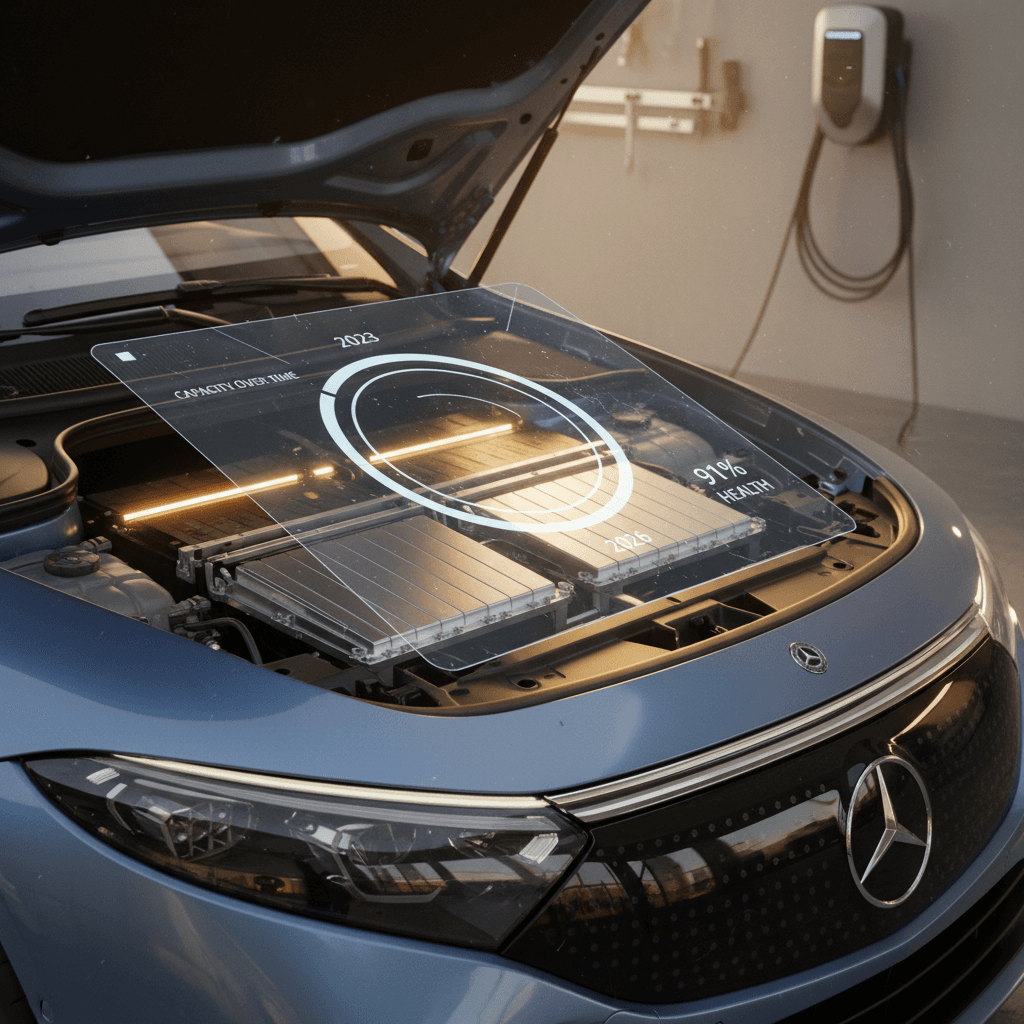
Mercedes doesn’t publish a neat "X% per year" number, and the on‑board State of Health (SoH) readouts that do exist on modern EVs are notoriously inconsistent. But if you triangulate independent EV‑wide degradation studies with real‑world EQS owner reports, a reasonable picture emerges.
Estimated Mercedes EQS battery degradation per year
What you can realistically expect under different usage patterns
Typical mixed use
Estimate: ~1.5–2.5% capacity loss per year.
Normal commuting, occasional fast charging, garage parking, and moderate climates tend to land here. After 8 years, many EQS packs should still retain roughly 80–88% of original capacity.
Hard use & harsh climates
Estimate: ~2.5–4% per year.
Lots of DC fast charging, frequent 100% charges, hot parking (no shade/garage) and high annual mileage can push degradation toward the upper end, but the 70% warranty floor still applies.
Gentle use
Estimate: ~1–1.5% per year.
Lower annual mileage, mostly AC Level 2 charging, avoiding long‑term 100% storage, and temperate climates can keep an EQS pack in excellent shape even at 10 years.
Important caveat
The good news is that even if your EQS loses, say, **15% of capacity over 6–7 years**, you’re still working with an enormous pack. A 2023 EQS 450+ sedan that started around 350–360 miles of EPA range would still realistically deliver something in the **290–310‑mile range** with that level of degradation, which is more than many brand‑new EVs today.
What the 10‑year / 155,000‑mile EQS battery warranty really means
Mercedes’ EQS battery warranty is one of the more generous in the industry on paper, but you need to understand what it actually covers, and what it doesn’t, before you draw conclusions about degradation.
- Coverage is usually **10 years or 155,000 miles**, whichever comes first, from the original in‑service date.
- There’s a **minimum capacity guarantee** (typically around 70% of original usable capacity). If the battery falls below that threshold inside the term, Mercedes may repair or replace it.
- The warranty **doesn’t cover normal gradual degradation** above that threshold, even if you wish the car still had its brand‑new range.
- Coverage can be affected by misuse or neglect, like ignoring required software updates or documented abuse.
What "70% capacity" really looks like
In practice, for most owners
Most EQS owners will sell or trade out of the car long before they hit 70% capacity. That capacity floor is there to catch outliers, packs that degrade unusually quickly or have underlying defects, not to describe a typical outcome.
As a used buyer, the takeaway is that a normal 6‑ or 7‑year‑old EQS with reasonable mileage should still have **comfortably more than 70% capacity remaining**, assuming it has a clean history and hasn’t been abused.
For high‑mileage or fleet use
If you’re racking up miles, think 20–30k per year with frequent DC fast charging, the warranty becomes more relevant. You’re more likely to cross the **155k‑mile cap** within 6–8 years, and your pack will see more thermal cycles.
That doesn’t mean automatic failure, but it does mean you should pay close attention to charging habits, cooling performance, and software updates over the life of the car.
Real‑world signs of EQS battery degradation
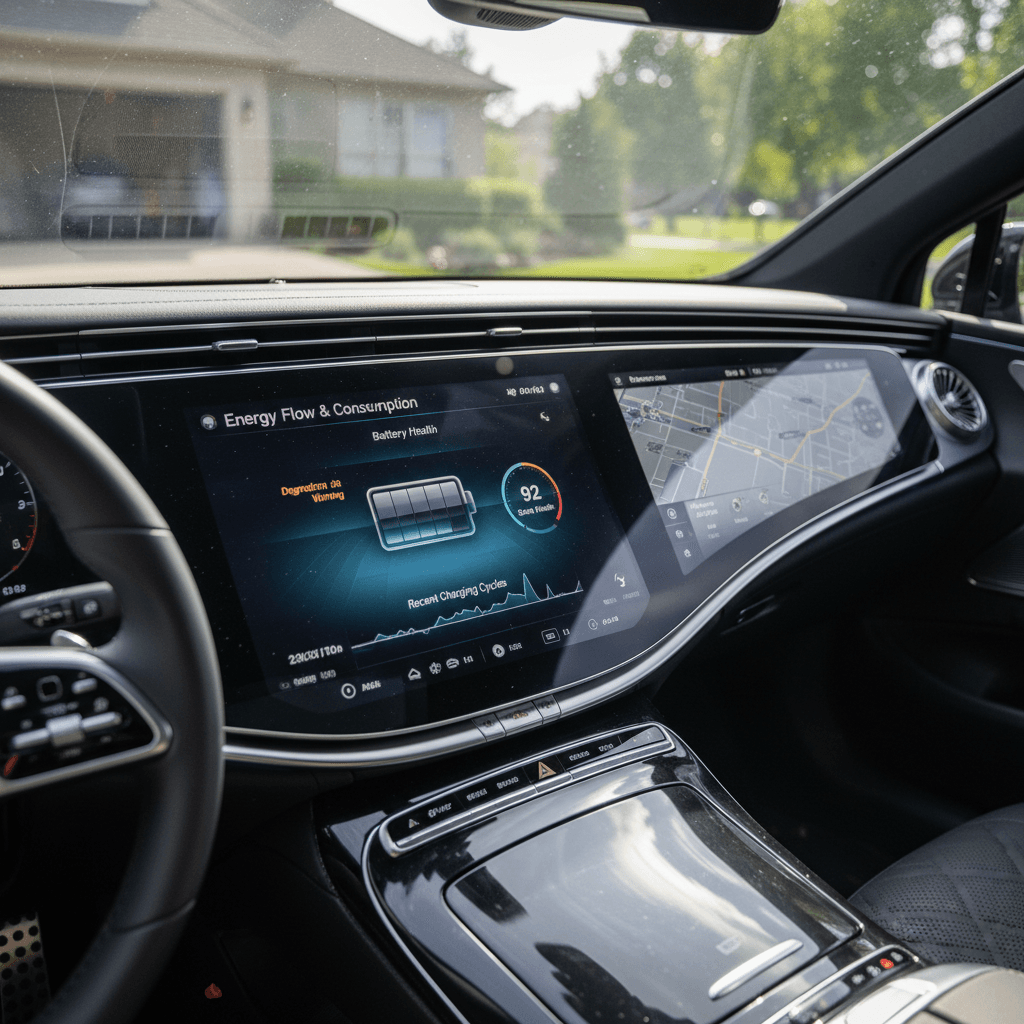
Because Mercedes doesn’t provide an obvious battery health percentage readout the way your phone might, you’ll be inferring EQS battery degradation per year from behavior rather than a single number. Here’s what to watch for.
Practical signs your EQS battery has lost capacity
Noticeably lower range at 100%
If your EQS once predicted ~350 miles at 100% and now consistently shows ~300 in similar conditions, that’s a hint you’ve lost some usable capacity, though software and weather can also move that number around.
Shorter legs between fast‑charge stops
On routes you drive frequently, pay attention to how far you can go between DC fast‑charging stops at the same starting state of charge. Consistently needing to stop earlier can indicate degradation.
Reduced peak fast‑charge power
A heavily degraded or heat‑stressed pack may struggle to hit its original DC fast‑charging peak rates, even at low state of charge and warm temperatures.
Big gap between displayed range and real‑world miles
All EVs can be optimistic or conservative, but an EQS whose real‑world highway range is dramatically below its own estimates, after checking tire pressures and driving style, may have meaningful degradation or a calibration issue.
Range drop ≠ guaranteed degradation
Factors that speed up or slow down EQS battery degradation
The chemistry in an EQS pack isn’t wildly different from other NCM‑based EV batteries, so the same basic rules apply. How you charge, where you park, and how hard you drive all influence how many percent of capacity you lose each year.
What actually affects Mercedes EQS battery degradation per year?
Habits and conditions that matter more than brand marketing
Charging behavior
- Frequent 100% charges and letting the car sit at 100% for days at a time accelerate degradation.
- Living between ~20–80% for daily use is gentler on the cells.
- Lots of DC fast charging heats the pack and adds stress, especially in hot weather.
Climate & parking
- High heat is the enemy. Parking in the sun in hot climates day after day is tough on the pack.
- Very cold temperatures temporarily reduce range but don’t necessarily cause permanent degradation if the pack is properly managed.
- Garage parking helps keep temperatures in a healthier band.
Driving patterns
- High, sustained highway speeds with lots of full‑throttle launches increase pack temperatures and cycling.
- Moderate driving with regenerative braking engaged is easier on the battery.
- Higher annual mileage means more cycles per year, which naturally raises annual degradation.
Software & maintenance
- Mercedes uses software to manage charging limits, cooling, and displayed range; updates can change how range is estimated.
- Following recommended service bulletins and software campaigns can protect the pack and maintain warranty coverage.
Simple rule of thumb
How to check battery health on a used Mercedes EQS
If you’re buying a used EQS in 2026 or beyond, you’re not just buying a luxury interior and a big touchscreen, you’re buying the remaining life of a six‑figure battery pack. Because the car won’t volunteer a simple "battery health 91%" readout, you need a structured approach.
Used EQS battery health checklist
1. Start with model year, mileage, and in‑service date
Confirm when the car first went into service and how many miles it has. A 2022 EQS with 60,000 miles should still be safely within the 10‑year/155k‑mile battery warranty window, but degradation will be higher than a 20,000‑mile example.
2. Ask for DC fast‑charging history
Frequent use of 150+ kW DC fast charging isn’t a deal‑breaker, but a car that’s lived on road‑trip duty and fast chargers will typically have higher degradation than one mostly charged at home.
3. Look at 100% range estimates in realistic conditions
With the car fully charged and tires correctly inflated, note the projected range in the default (often Comfort) drive mode. Compare that to the EPA figure for that trim. Be sure to factor in temperature and recent driving style before assuming it’s all degradation.
4. Test a known route at highway speeds
If possible, drive a familiar highway loop starting from a known state of charge and measure real miles vs. % battery used. This gives a back‑of‑the‑envelope kWh‑per‑mile figure that can be compared to what a healthy car would deliver.
5. Pull a professional battery health report
Third‑party diagnostic tools and platforms like the <strong>Recharged Score</strong> can estimate usable battery capacity and flag anomalies. This is especially valuable on high‑mileage EQS examples where degradation risk has had time to compound.
6. Verify warranty status in writing
Have a dealer or qualified EV retailer confirm remaining battery warranty coverage in writing, including the 10‑year/155k‑mile term and capacity guarantee language relevant to that VIN and model year.
How Recharged helps here
Ready to find your next EV?
Browse VehiclesManaging EQS range loss over time
Even if you buy an EQS that’s effectively "like new" today, you’ll be living with the consequences of your charging and driving choices for years. The goal isn’t to baby the car, it’s to avoid the small but compounding habits that push you toward the high end of the degradation range.
- Use **scheduled charging** at home so the car finishes charging near your departure time instead of sitting at 100% for hours.
- For daily use, **target 70–80%** instead of 100% unless you need the full range for a trip.
- On road trips, use DC fast charging when necessary, but try not to fast‑charge from 0–100%, **20–80% swings** are easier on the pack and usually faster overall.
- Whenever possible, **park in a garage or shade**, especially in very hot climates.
- Keep software updated so you benefit from improvements in **thermal management and range estimation**.
- Check tire pressures regularly; under‑inflated tires waste energy and make it look like you’ve lost more range than you actually have.
What not to do
Where a used EQS fits in the EV battery degradation landscape
Broad independent studies of thousands of EVs suggest an average battery capacity loss of roughly **2–3% per year across the industry**, with a slowdown after the initial couple of years as the chemistry settles. The EQ family doesn’t appear to be an outlier: owner reports from EQC, EQE, and EQS models generally show **modest degradation** over tens of thousands of miles, with outliers often explainable by climate, usage, or software quirks rather than inherently weak chemistry.
Strengths
- Very large pack means **usable range stays strong** even with notable degradation.
- Battery warranty **extends to 10 years / 155k miles**, with a clear capacity floor.
- Thermal management and conservative charge buffers help avoid early rapid decline.
Weaknesses
- Weight and complexity mean that **efficiency losses** (tires, alignment, etc.) can mimic degradation.
- Software‑estimated range can be jumpy after updates, making it harder to read true capacity changes.
- High sticker price makes any major pack issue feel more painful, even if statistically rare.
What this means for you
- A well‑cared‑for EQS is likely to have **competitive or better long‑term usable range** versus rival luxury EVs.
- The big pack and long warranty give used‑car buyers more cushion, even at 8–9 years old.
- Objective battery health data becomes key to **separating great used EQS examples from the rest**.
FAQ: Mercedes EQS battery degradation per year
Frequently asked questions about EQS battery degradation
Bottom line: should you worry about EQS battery degradation?
If you’re trying to decide whether a Mercedes EQS belongs in your garage, or whether a used EQS is a smart buy in 2026, the right way to think about battery degradation is **risk band, not horror story**. Under normal use, you’re likely looking at something in the **1.5–2.5% per‑year range**, cushioned by one of the larger packs and more generous warranties in the segment. That still leaves you with substantial real‑world range deep into the car’s second decade.
Where things get dicey is when you combine hard use, extreme climates, and a lack of data. That’s exactly the gap Recharged is trying to close: every EQS we sell includes a **Recharged Score battery health report, fair‑market pricing, and EV‑specialist support** so you’re not buying six‑figure guesswork. If you treat degradation as a quantifiable variable rather than an EV boogeyman, a well‑chosen EQS can be one of the least stressful ways to live with a luxury EV long‑term.